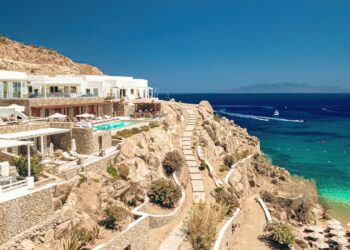
Folegandros sits between Milos and Santorini, a 32-square-kilometre sliver of rock with 200-metre cliffs dropping into the Aegean. The island has roughly 720 permanent residents, one main road, no airport, and three villages that together hold every taverna, shop, and bar you will need. Its capital, Chora, balances on a cliff edge like a sentence that refuses to end — whitewashed houses, medieval walls, and four interconnected squares where dinner lasts until the candles burn down to nothing.
This is not a destination for travellers who want busy resort beaches, water parks, or all-night clubs. Folegandros rewards a different kind of visitor: the kind willing to hike 45 minutes down a rocky trail for a swim, eat handmade pasta at a table under a plane tree, and watch the sunset from a hilltop church while the wind does its best to rearrange their hair. If that sounds like your sort of holiday, keep reading.
| Location | Western Cyclades, between Milos and Santorini |
| Area | 32 km² |
| Population | Approximately 720 year-round residents |
| Highest point | 455 metres (Agios Eleftherios) |
| Airport | None — ferry access only |
| Ferry from Piraeus | From approximately 3 hours 45 minutes (high-speed) to 7+ hours (conventional) |
| Best for | Couples, hikers, repeat Greece visitors, slow travellers |
| Best time | Late May – June and September – early October |
Who Will Love Folegandros — and Who Should Skip It
Folegandros works exceptionally well for couples looking for somewhere more intimate than Santorini, hikers who want coastal trails without crowds, repeat Greece visitors who have already done the Cycladic circuit, and anyone whose idea of a great holiday involves doing very little with real intention. The island also suits photographers and solo travellers comfortable with their own company.
It is less suitable for families with young children, since most beaches require either a boat ride or a steep hike to reach, and there are few facilities once you arrive. Travellers who want organised nightlife, extensive shopping, or large resort pools will find Folegandros too quiet. The island also demands a degree of physical fitness — flat ground is rare here, and the heat between July and August makes the required walking more demanding.
If your priority is a beach holiday with easy access to sunbeds and waterside bars, Paros or Milos will serve you better. If you want the drama of a cliff-top Cycladic village without the crowds that come with it, Folegandros is one of the strongest options in Greece.
Chora and the Kastro
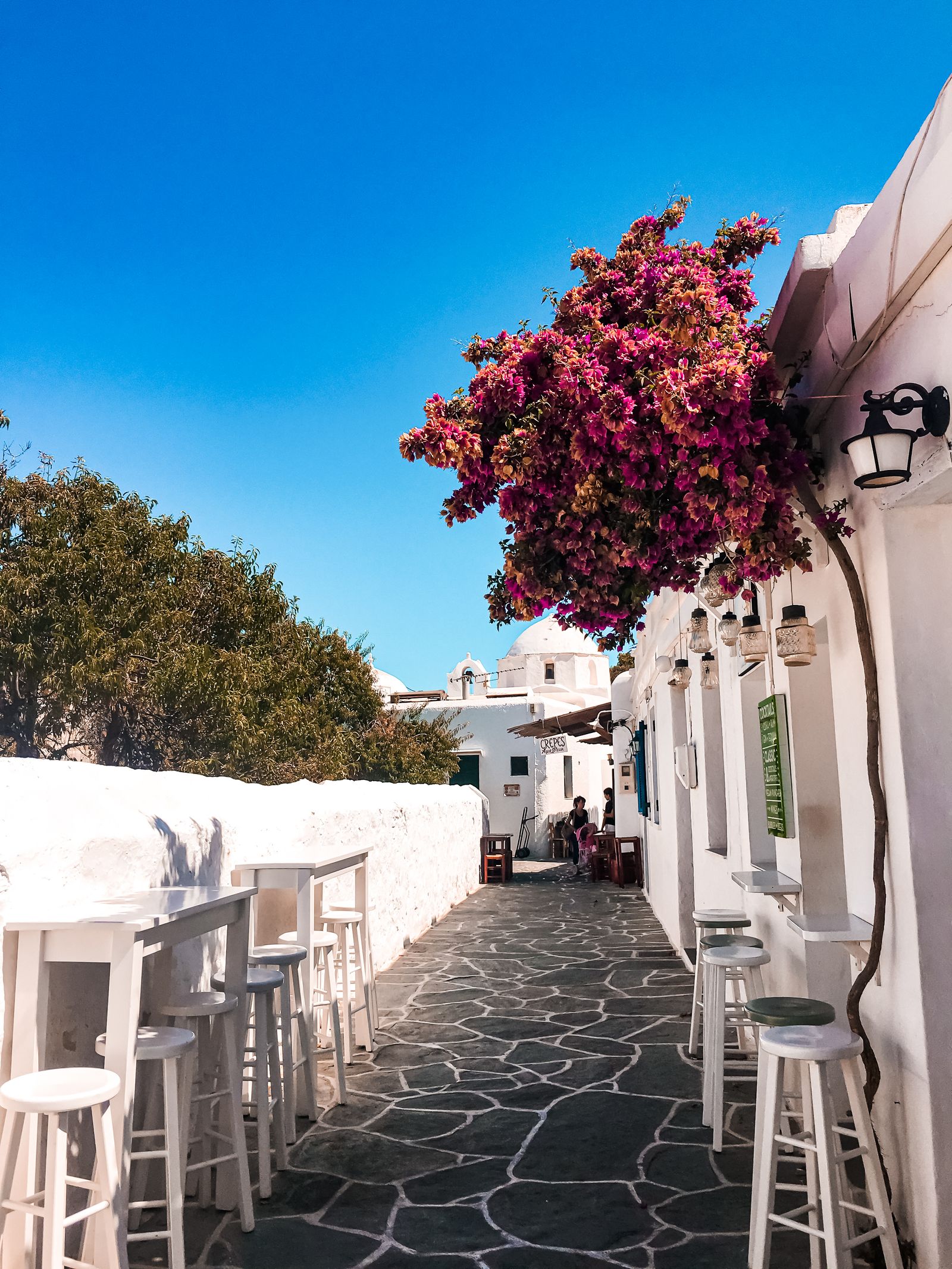
Folegandros has three settlements, but Chora is the one that stays with you. The village sits on a natural plateau roughly 200 metres above sea level, its northern edge built directly on the cliff face. From certain angles, the houses appear to grow out of the rock itself, their outer walls doubling as the cliff’s final defence against gravity.
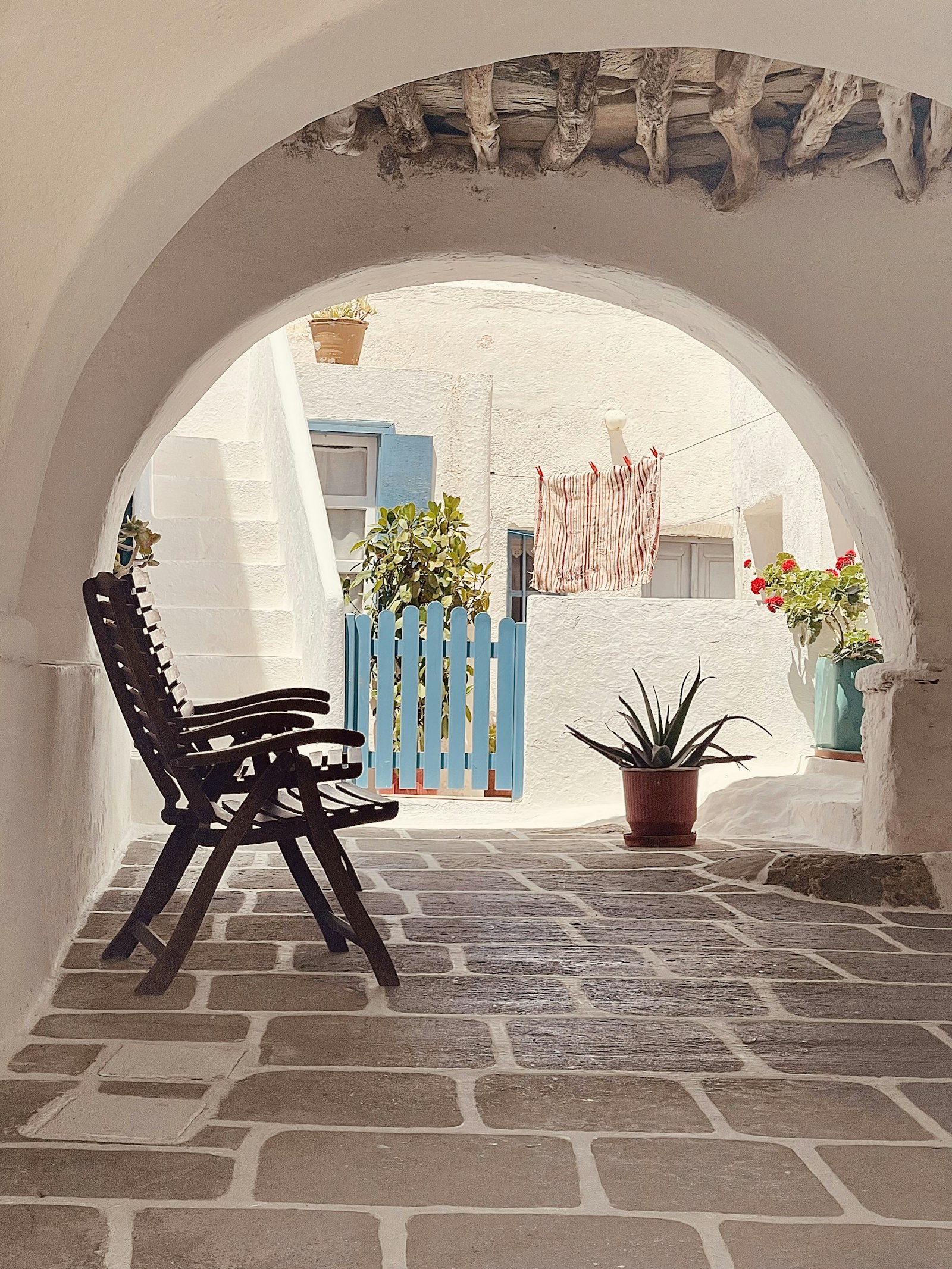
The village organises itself around four linked squares, each with a slightly different character — one shaded by a large plane tree, another opening toward the sea, a third bordered by the walls of a church. In the evenings, tables and chairs fill these squares, and the line between indoor and outdoor dining disappears entirely. The absence of cars through the village centre (traffic is routed around) keeps the atmosphere genuinely peaceful.
The Kastro is the oldest section of Chora, a medieval defensive settlement established after the Fourth Crusade when Marco Sanudo, the Venetian Duke of the Archipelago, built fortifications across the Cyclades in the years following 1204. Rather than a conventional fortress with walls and towers, the Kastro uses the houses themselves as fortification — their outer walls form a continuous barrier, with the cliff serving as a natural defence on the north side. Some of the houses within the Kastro are believed to be over a thousand years old, and the settlement has been continuously inhabited since its construction. It is designated as a protected traditional settlement by the Greek Ministry of Culture.
Walking through the Kastro’s narrow lanes feels like entering a smaller, older village inside the village. The scale contracts — doorways are low, alleys just wide enough for one person, and the light changes from the open brightness of the squares to something cooler and more contained. It is genuinely one of the best-preserved medieval settlements in the Cyclades, comparable to the Kastro on Sifnos but more compact and less visited.
The Church of Panagia
Above Chora, on the island’s highest accessible point, sits the Church of Panagia (the Virgin Mary), the largest and most important church on Folegandros. The current building dates to 1821, though it stands on the foundations of an earlier ancient temple, and a place of worship has likely occupied this site for far longer than written records can confirm.
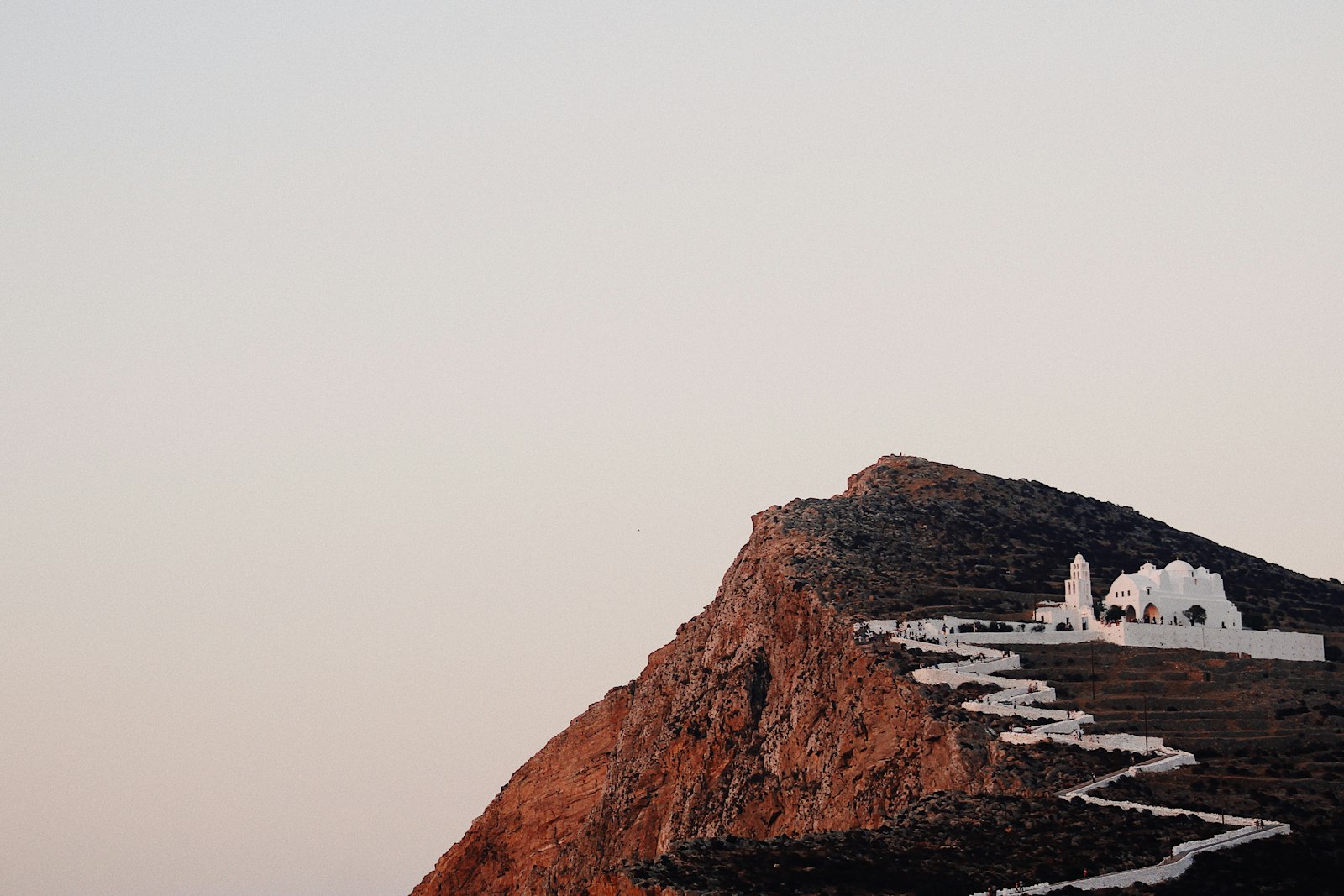
The walk up takes about 20 minutes from the main square of Chora, following a zigzag cobblestone path that grows steeper as it climbs. There is no shade along the route, so afternoon ascents in July and August require a hat, water, and a tolerance for heat. The effort is repaid in full: from the church courtyard, the view extends across Chora’s rooftops, down the cliffs, and out to the neighbouring islands of Sikinos, Ios, and on clear days, Santorini.
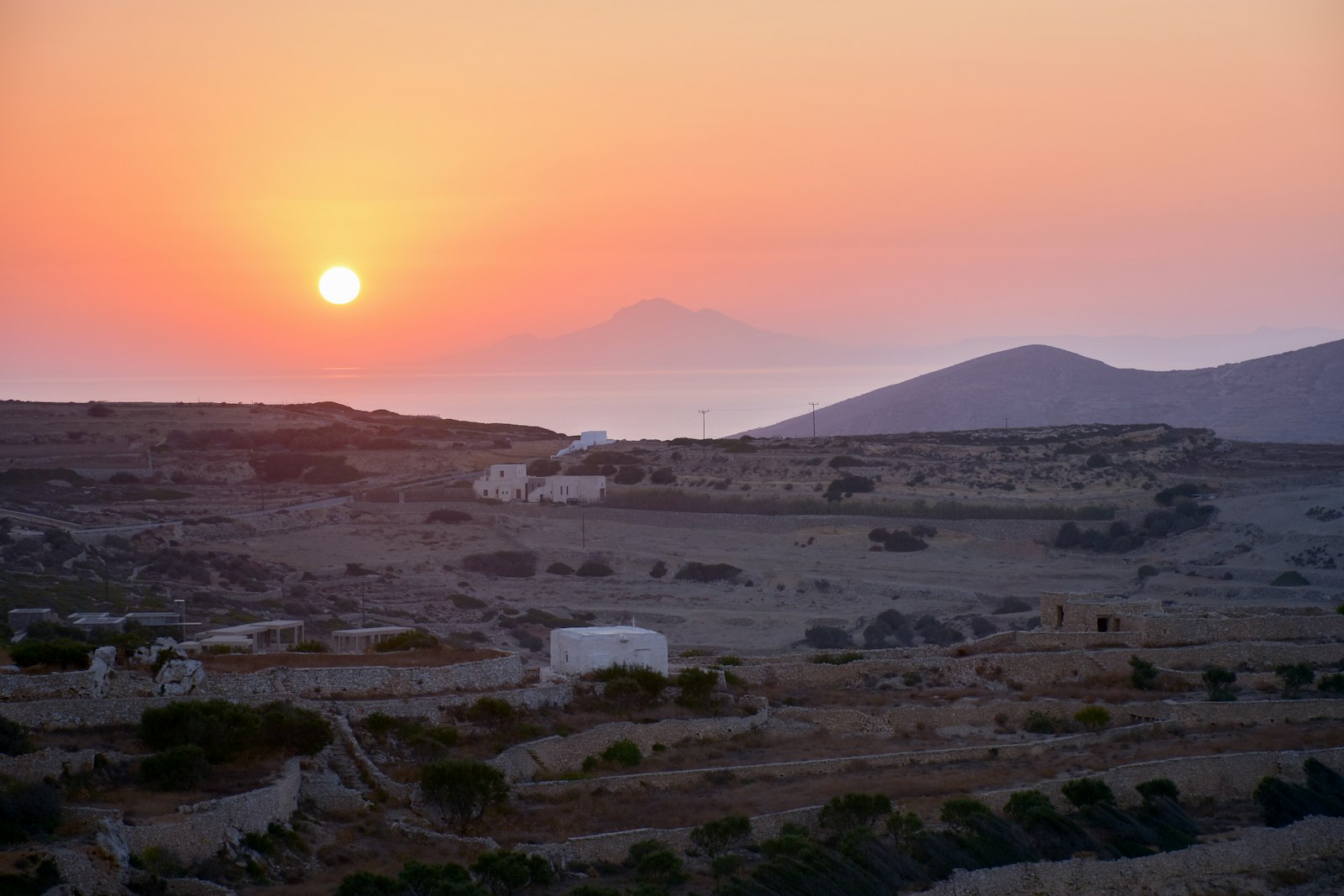
Most visitors time their walk for the hour before sunset, and for good reason — the light across the cliff face and the sea below shifts through a sequence of golds and pinks that earns its reputation without exaggeration. The church courtyard fills with people but rarely feels overcrowded, partly because the walk filters out anyone not genuinely interested. Arrive early enough to claim a comfortable rock or wall to sit on, and give yourself enough daylight for the descent — the path is unlit.
The church itself holds local significance beyond its views. The Virgin Mary icon housed here is considered the protector of the island, and during the week after Easter it is carried from house to house across Folegandros in a procession unique to the island, with families hosting the icon overnight in turn. If you happen to visit during Easter, this is one of the most distinctive local celebrations in the Cyclades.
Beaches
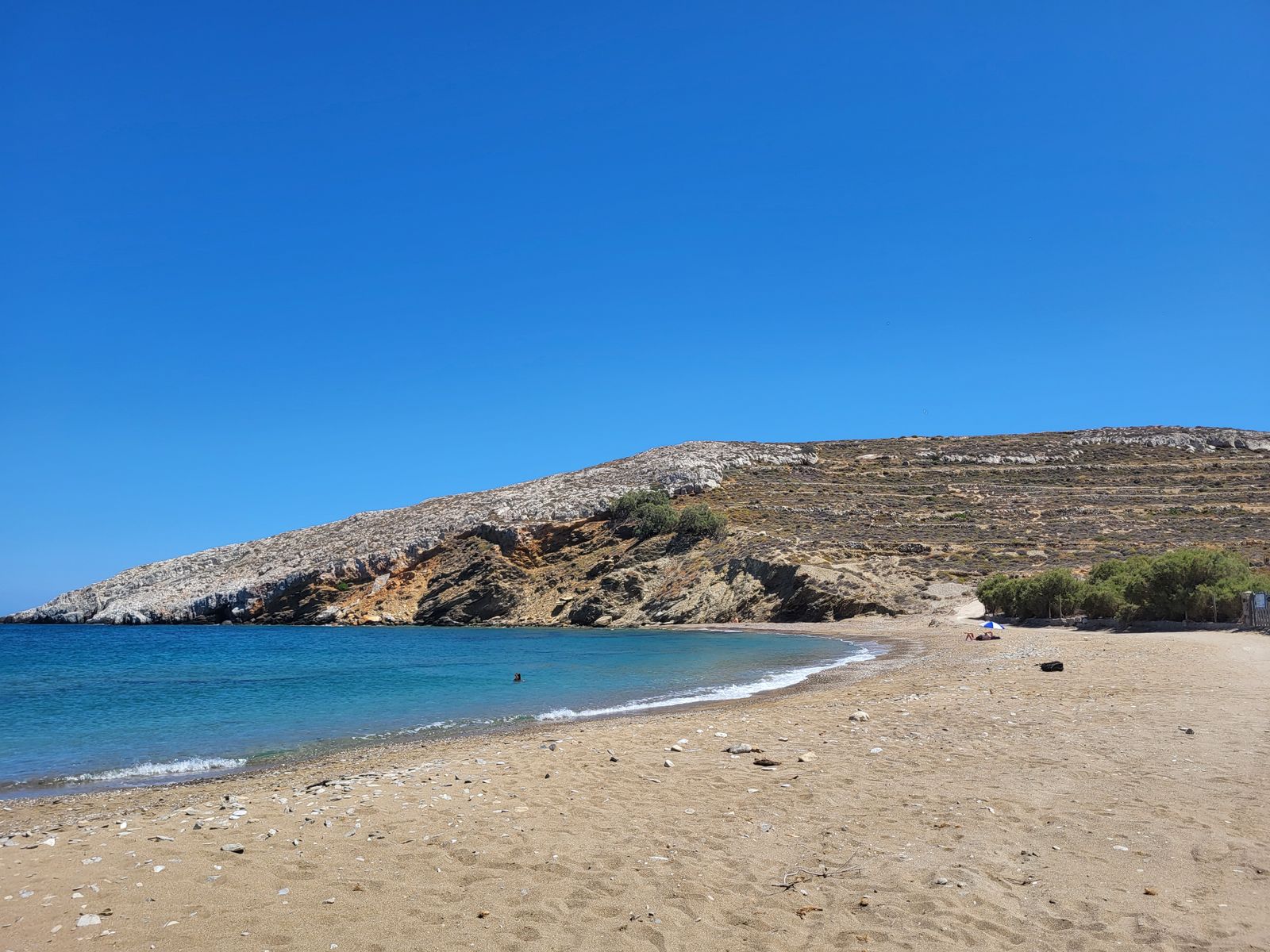
Folegandros does not do easy beach access. Almost every worthwhile swimming spot on the island requires either a boat taxi, a hike of 15 to 45 minutes, or an ATV ride down an unpaved road. This is both the island’s defining limitation and one of its greatest strengths — the effort filters out the majority of day-trippers, leaving you with water clarity and relative solitude that more accessible islands rarely deliver.
The south and southwest-facing beaches are sheltered from the meltemi, the strong northerly wind that blows across the Cyclades from roughly mid-June through September. When the meltemi is up — and in July and August it frequently is — these southern beaches remain calm while the north coast becomes rough and uncomfortable. This is worth planning around: check the forecast before choosing your beach for the day.
| Beach | Surface | Access | Facilities | Best for |
|---|---|---|---|---|
| Katergo | Fine pebbles | 30-min hike or 10-min boat from port | None — bring everything | Swimmers, solitude seekers |
| Agali | Sand | Bus from Chora or short drive | Tavernas, sunbeds available | Easiest beach day, families |
| Agios Nikolaos | Sand and small pebbles | 20-min walk from Agali or water taxi | Two small tavernas | Quieter swimming, lunch spot |
| Livadaki | White pebbles | 45-min steep hike or boat from Agali | None | Snorkelling, experienced hikers |
| Livadi | Sand | 1 km walk from port | Nearby tavernas and rooms | Families, easy access |
| Agios Georgios | Sand and pebbles | ATV via unpaved road from Ano Meria | None | Remote beauty, total quiet |
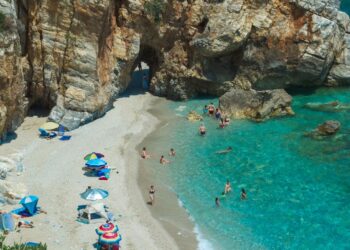
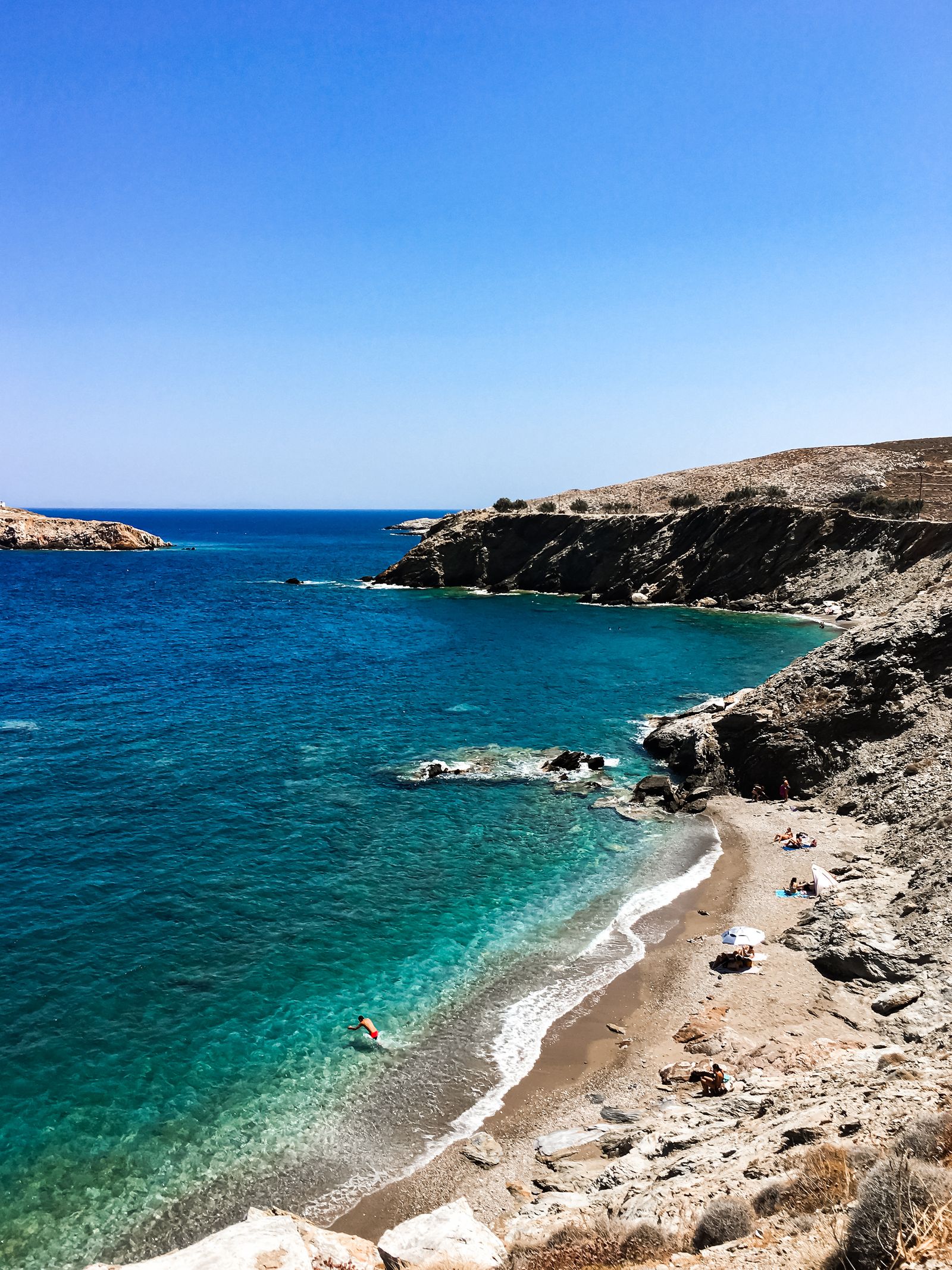
Katergo is the beach most visitors consider the finest on the island — a crescent of pale pebbles backed by vertical grey cliffs, with water so clear the seabed is visible from metres away. It faces southwest, which keeps it sheltered from the meltemi during summer. Access is either by a 30-minute hike from the Livadi area or a 10-minute boat taxi from Karavostasis port. There is no shade, no food, and no fresh water, so preparation is essential. Strong currents can develop on windy days, so exercise caution even in apparently calm conditions.
Agali (also written Angali or Agkali) is the most accessible and popular beach, served directly by the local bus from Chora. It has a sandy shoreline, a few tavernas directly on the sand, and sunbed hire available during summer. It fills up by late morning in July and August, so early arrivals have a meaningfully better experience. From Agali, a coastal path leads to Agios Nikolaos beach in about 20 minutes — a walk worth taking for the quieter water and a good seafood taverna at the far end.
Livadaki is the most rewarding beach for those willing to earn it. White pebbles, turquoise-green water, and mineral rock formations make it one of the best snorkelling spots in the western Cyclades. The 45-minute hike down from Ano Meria is steep and shadeless, so it should be attempted in the morning or late afternoon. A boat taxi also runs from Agali during summer. Near Livadaki, the Aspropounta lighthouse sits above the coast and adds a worthwhile extension for hikers returning to Ano Meria.
Hiking Trails
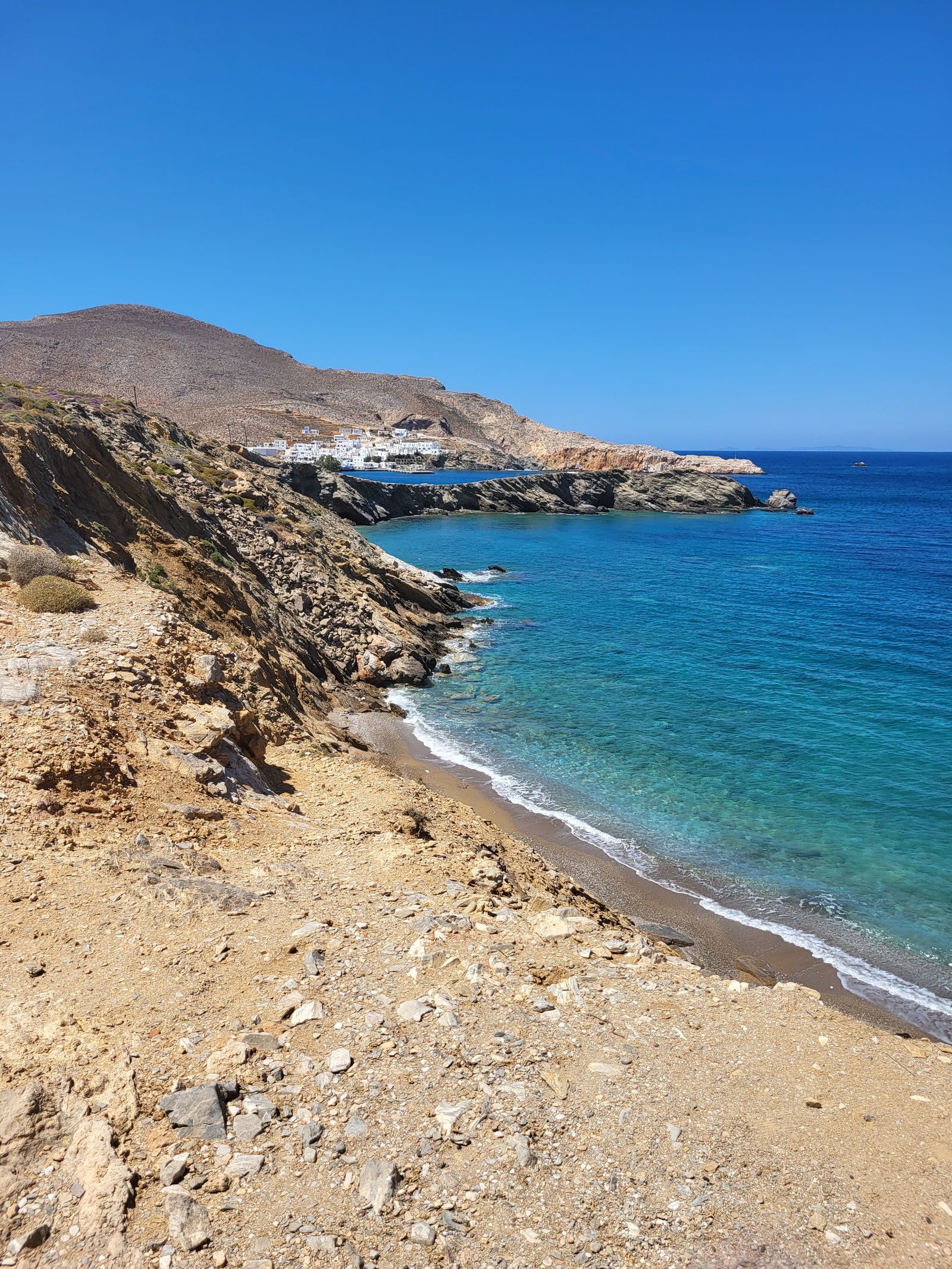
Folegandros has approximately 20 kilometres of marked footpaths, most of them old stone-paved routes that once connected the island’s villages, farms, and churches before the single paved road was built. The trails are well-maintained and signposted, making the island one of the better hiking destinations in the Cyclades — less dramatic than Amorgos in terms of elevation gain, but with a network of shorter, interconnected routes that can be combined over several days.
The most popular route runs from Chora through the countryside to Agali beach, passing the small churches of Stavros and Christos along the way — roughly 3.5 kilometres, taking about an hour at a comfortable pace. The path descends gradually through terraced hillsides bordered by dry-stone walls, with views opening up toward the coast as you approach the bay. This trail works well as a one-way walk, taking the bus back up to Chora from Agali.
For a more demanding outing, the circular trail from Ano Meria through Livadaki beach and the Aspropounta lighthouse covers about 5.5 kilometres and takes around two hours. The lighthouse itself, standing white against the blue at the island’s southwestern tip, is worth the walk even without the beach detour. The descent to Livadaki is steep and requires careful footing, but the trail surface is good.
Several shorter paths lead from Ano Meria down to remote northern beaches — Agios Georgios, Ambeli, and Ligaria — each taking 30 to 50 minutes. These trails are less trafficked and lead to some of the most isolated swimming spots on the island. Bring more water than you think necessary, wear closed-toed shoes, and avoid starting any hike in the midday heat between June and September.
Ano Meria and the Ecomuseum
The road from Chora continues north for about five kilometres to Ano Meria, the island’s agricultural village. Calling it a village gives a slightly misleading impression — Ano Meria is not a compact settlement but a scattered collection of farmsteads, called themonies, spread across the hillside with dry-stone walls, terraced fields, and small whitewashed churches between them. About 350 people live here, and the pace of life is noticeably slower than in Chora.
The Ecological and Folklore Museum (Ecomuseum), which opened in 1988, occupies an old family compound — a themonia — and preserves the layout of a traditional rural household as it would have functioned from the 17th century onward. Inside, you will find terracotta storage jars, farm tools, an old loom, a wine press, and the threshing floor that now serves as an open-air performance space. It was the first ecomuseum in Greece to be restored using only original materials and methods, and the guided tours are thoughtful and informative. The museum typically operates during summer afternoons — confirm local hours before making the trip, as schedules can vary.
Ano Meria is also where the island’s best traditional food is served. A handful of family-run tavernas along the main road specialise in local dishes that are difficult to find elsewhere, and eating here is one of the genuine highlights of a Folegandros visit. The bus from Chora runs to Ano Meria regularly in summer, making a late-afternoon trip for the museum and an early dinner a practical and rewarding combination.
What to Eat
Folegandros has a local food identity that goes beyond the standard Cycladic menu, and eating well here is one of the best reasons to visit. The signature dish is matsata — thick, irregular handmade pasta strips, rolled by hand and typically served with a slow-cooked rooster or rabbit stew in a tomato and wine sauce. Every decent taverna on the island serves its own version, and the differences between them are a matter of family tradition rather than recipe variation. Order it on your first evening. The lobster version, with local Aegean spiny lobster, appears at higher-end establishments and is worth trying if you enjoy shellfish.
Souroto is the island’s local cheese — a soft white cheese made from goat’s or sheep’s milk (or a mix), stored in brine. It is used in salads, eaten with bread and honey, or baked into cheese pies. Another local specialty is karpouzenia — pies made with watermelon and souroto cheese, fried until crisp. They are sweet, salty, and unlike anything you will have tasted before. Kalasouna, a cheese and onion pie, is another traditional recipe specific to Folegandros.
The tavernas in Ano Meria are the strongest options for traditional cooking, using ingredients grown on or around the farms that surround them. In Chora, the restaurants around the main squares offer a wider range but tend to lean slightly more contemporary. The port village of Karavostasis has a handful of fish tavernas that work well for a first-night or last-night meal while waiting for the ferry.
One practical note: Folegandros has no wine-making tradition of its own, so the wines served are typically imported from Crete or other Greek wine regions. The local spirit is rakomelo — honey-sweetened raki — and it appears at the end of most meals whether you ordered it or not.
Best Time to Visit
The ideal windows for Folegandros are late May through June and September through early October. During these months, temperatures are comfortable for hiking (mid-20s to low 30s Celsius), the sea is warm enough for swimming, ferry services run frequently, and the island has enough visitors to keep its tavernas and services open without feeling strained.
July and August bring peak temperatures (regularly above 35°C), stronger meltemi winds, higher accommodation prices, and noticeably more visitors — particularly in Chora, where the squares can feel crowded by evening. The beaches remain manageable because the effort required to reach them filters out the less committed, but securing accommodation without advance booking becomes difficult. If July or August is your only option, book well ahead and plan your hiking and beach visits for early morning.
The shoulder months of April and late October are possible but limited. Some accommodation and tavernas may be closed, ferry services are less frequent, and the weather becomes unpredictable. The upside is near-empty trails and a Chora that feels genuinely local.
How to Get There
Folegandros has no airport. Access is exclusively by ferry, with services operating from Piraeus (Athens) and from neighbouring Cycladic islands. During summer, connections are frequent and reliable; outside the peak season, schedules thin out and weather-related cancellations become more common.
| Route | Duration | Frequency (summer) | Approx. price from |
|---|---|---|---|
| Piraeus – Folegandros | 3 h 45 min – 7+ hours | 4–7 sailings per week | €39.50 |
| Santorini – Folegandros | 20 min – 2 h 45 min | 6–7 sailings per week | €7 |
| Milos – Folegandros | 55 min – 2 hours | 2–7 sailings per week | €7 |
| Sifnos – Folegandros | 45 min – 1 h 30 min | 2–5 sailings per week | €8 |
The most practical arrival strategy for international visitors is to fly into Santorini, which receives direct flights from many European cities, and then take the short ferry crossing to Folegandros. The journey from Santorini can be as quick as 20 minutes by high-speed vessel, making this one of the easiest connections in the Cyclades. Alternatively, take a high-speed ferry directly from Piraeus — the fastest crossings take under four hours, though conventional ferries are considerably slower.
Folegandros fits naturally into a Cycladic island-hopping itinerary — common combinations include Milos–Folegandros–Santorini, or a western Cyclades loop adding Sifnos and Serifos. Check ferry schedules in advance, as some routes operate only a few days per week even in summer. Operators serving Folegandros include Seajets (high-speed), Fast Ferries, Blue Star Ferries (conventional), and the local Maistros Santorini service.
All ferries arrive at Karavostasis, a small port settlement on the southeast coast. It has a handful of tavernas, an ATM, a car and scooter rental office, and some accommodation. The bus to Chora meets arriving ferries and takes about five minutes.
Getting Around
Folegandros has one main paved road running from Karavostasis through Chora to Ano Meria — a total distance of about 10 kilometres. A secondary road branches off to Agali beach. Beyond these, the roads to remote beaches and trailheads are unpaved and in some cases steep enough that a standard scooter is inadequate.
The local bus operates three routes in summer: Karavostasis to Chora, Chora to Agali, and Chora to Ano Meria. Services run roughly every 90 minutes during the day, with the last return from Ano Meria around 20:00. The bus is reliable, cheap, and sufficient for visitors who plan to use boat taxis for beach access. Timetables are posted at stops and generally accurate.
For more flexibility, an ATV or quad bike is the preferred option among most visitors. ATVs handle the unpaved roads to beaches like Agios Georgios and Livadaki that scooters cannot safely manage. Several rental outfits operate in both Karavostasis and Chora, with prices starting from around €25–40 per day depending on the vehicle. A car is also an option and provides welcome shelter from the meltemi, though parking in Chora is limited to the outskirts. Note that you cannot drive through Chora itself — the village is pedestrianised.
For beaches not reachable by road, boat taxis operate during summer from both Karavostasis and Agali. Round-trip tickets to Katergo from the port cost approximately €14, while water taxis between Agali and Agios Nikolaos beach run for about €5 return. Schedules are seasonal, so confirm times once on the island.
Where to Stay
Folegandros has limited accommodation compared to larger Cycladic islands, and in peak season it books up quickly. The three main areas each offer a different experience.
Chora is the strongest base for most visitors. It puts you within walking distance of the island’s best dining, the Panagia walk, and the bus stops for beaches and Ano Meria. Accommodation here ranges from simple rooms above shops to design-led boutique properties. The main trade-off is that Chora sits at the top of a steep hill — if you stay elsewhere, you will need transport to reach the evening atmosphere that makes the village special.
Karavostasis suits travellers who prioritise proximity to the sea and the ferry. The port area has a small beach, a few tavernas, and a calmer atmosphere than Chora. It works well for a first or last night, and for those who want to walk to Katergo beach or Livadi beach without needing a vehicle. The bus to Chora runs frequently in summer.
Agali and Ano Meria have a smaller number of properties, generally simpler in style. Staying at Agali puts you right on the island’s most accessible beach but separates you from the evening life of Chora. Ano Meria appeals to those who want rural quiet and proximity to hiking trails, though getting to Chora for dinner requires the bus or a rental vehicle.
Regardless of where you stay, book well in advance for July and August. Folegandros has a finite number of beds, and its growing reputation means late availability is increasingly rare during peak weeks.
How Many Nights
Three nights is the minimum for a satisfying visit — enough time to walk the Chora and Kastro, hike to or take a boat to two beaches, eat matsata at least twice, and watch the sunset from the Church of Panagia. Four nights allows for a full day of hiking, a trip to Ano Meria, and a more relaxed pace that suits the island’s character.
Five nights or more is ideal for travellers who want to walk the complete trail network, try multiple remote beaches by boat and foot, or simply enjoy the rare luxury of having nowhere particular to be. Folegandros does not reward rushing — its pleasures are slow ones, and adding a day or two beyond the standard visit often produces the moments that stay with you longest.
A Three-Day Outline
Day 1: Arrive at Karavostasis, take the bus to Chora. Explore the Kastro and main squares in the afternoon. Walk up to the Church of Panagia for sunset. Dinner in one of Chora’s squares — order matsata with rooster or rabbit.
Day 2: Take the bus or drive to Agali beach for the morning. Walk the coastal path to Agios Nikolaos for lunch at the seaside taverna. Return to Agali by water taxi and catch the bus back to Chora. Evening stroll through the quieter western squares.
Day 3: Take the bus to Ano Meria. Visit the Ecomuseum in the afternoon, eat at one of the traditional tavernas nearby. Alternatively, hike from Ano Meria to Livadaki beach (allow time and water for the steep return) or take the boat taxi to Katergo from the port for a final morning swim.
Limitations Worth Knowing
Folegandros is a superb island, but it asks certain things of its visitors that are worth acknowledging before you book.
The ferry is your only way on and off the island, and sailings can be cancelled or significantly delayed when the meltemi blows hard. Build flexibility into your itinerary if you have an onward flight to catch — booking a critical connection for the same day as your last Folegandros ferry is a gamble. The island’s medical facilities are limited to a regional medical centre (not a full hospital), so travellers with serious medical conditions should factor this into their planning.
Most beaches have no facilities whatsoever — no shade, no food, no lifeguard. This means carrying water, sun protection, and supplies for every beach visit. The hikes to reach them are exposed to sun and wind, and the trails, while well-marked, can be loose and steep. Comfortable footwear is essential; sandals and flip-flops are inadequate for anything beyond Chora’s cobblestones.
The island is not well suited to mobility-impaired travellers. Steps, cobblestones, steep trails, and limited road access to most beaches create significant barriers. Visitors with mobility concerns should consider whether the island’s terrain is manageable before committing.
Wi-Fi and mobile signal are generally reliable in Chora and Karavostasis but can be weak or absent at remote beaches and hiking trails. If digital disconnection is part of the appeal, Folegandros delivers it whether you planned for it or not.
Folegandros and the Western Cyclades
Folegandros sits at the heart of what is sometimes called the quiet Cyclades — a chain of smaller islands stretching from Serifos and Sifnos in the north through Folegandros and neighbouring Sikinos to Milos in the west. Together, they offer a Cycladic experience closer to what these islands felt like decades ago, before mass tourism reshaped the more famous names. A two-week itinerary combining three or four of these islands with a stop on Santorini is one of the best ways to experience both versions of the Cyclades — the postcard and the reality behind it.
Folegandros is also a strong partner for Syros, whose neoclassical capital, Ermoupoli, provides a complete change of character from the rural Cycladic landscape. The contrast between the two islands — one built on rock and simplicity, the other on maritime commerce and architecture — is one of the most satisfying pairings in the Aegean.
This article was researched and verified as of July 2026. Ferry schedules, prices, museum hours, and boat-taxi services may vary by season and year. We recommend confirming time-sensitive details directly with operators before travelling. Vivid Greece is an independent publication and is not affiliated with any accommodation, tour, or transport provider mentioned in this guide.