Andros: The Cultured Soul of the Cyclades — An Emerging Destination for 2026
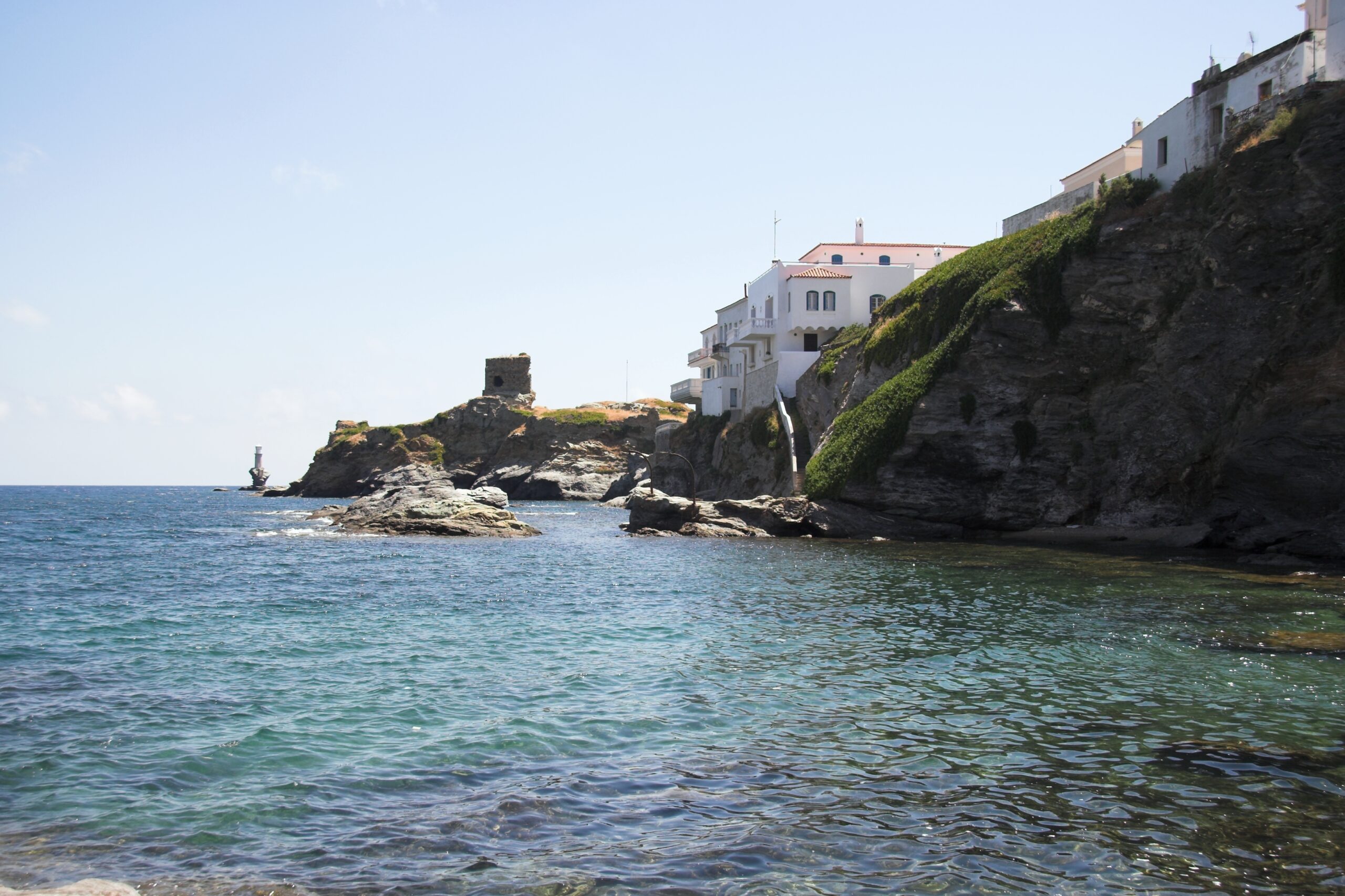
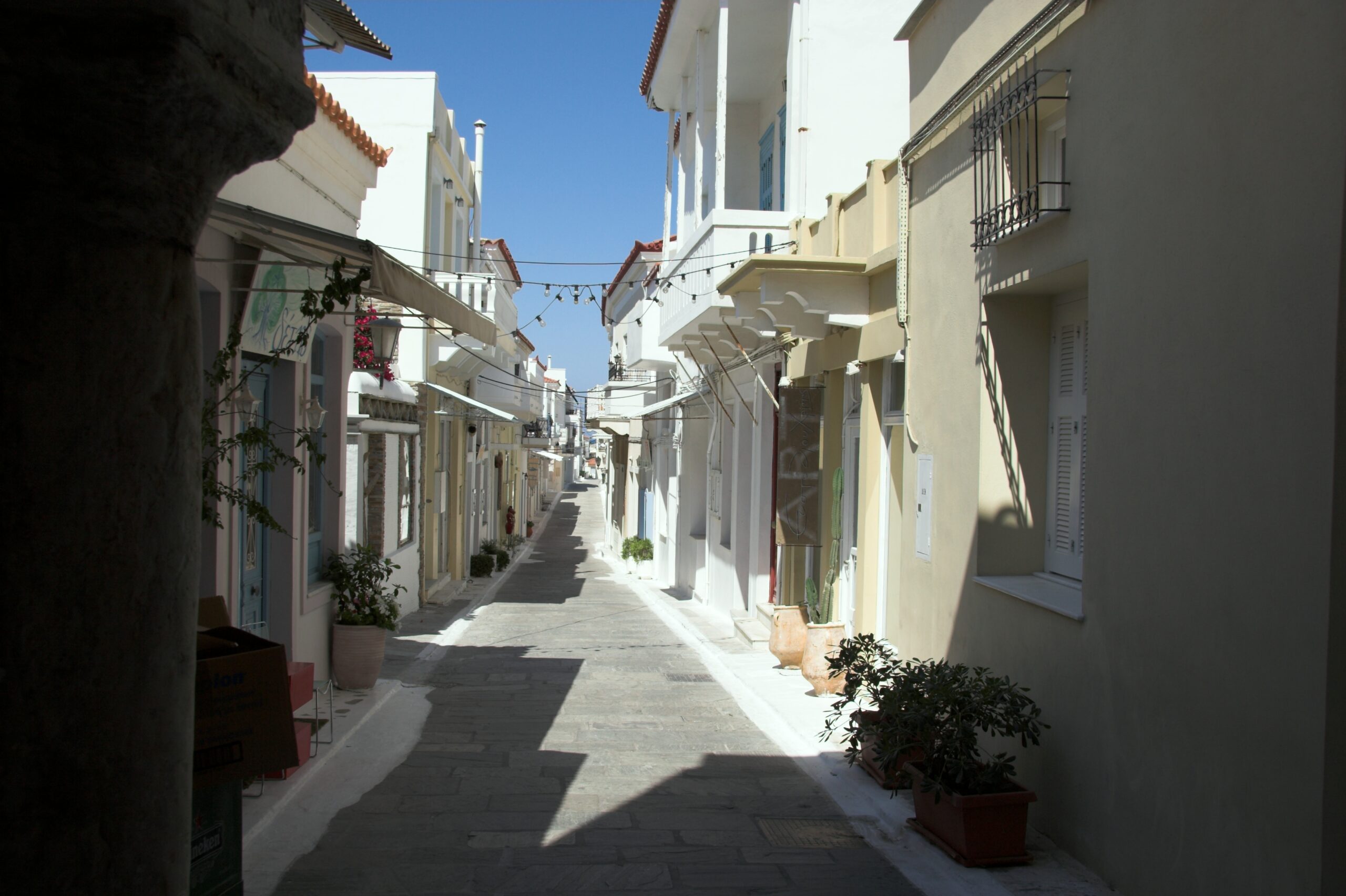
There’s a moment, somewhere along the marble-paved streets of Andros Chora, when you stop and realise this island is different. The light is the same fierce Aegean gold, the sea still blazes that impossible blue — but the architecture tells a different story. Neoclassical mansions built by wealthy sea captains rise four storeys above narrow alleys. Museum façades anchor the main pedestrian street. A stone bridge leads to a Venetian castle perched on its own sea-rock, the ruined tower standing like a sentinel over two churning bays.
This is Andros. And if you haven’t been paying attention, it’s time to start.
The northernmost island of the Cyclades is having a quiet renaissance. It never needed the noise of Mykonos or the volcanic drama of Santorini — it had something rarer all along: genuine culture, extraordinary hiking infrastructure, lush green valleys fed by freshwater springs, and a maritime heritage written in every stone. In 2026, as the Greek islands grow ever more crowded, Andros stands out as the destination for travellers who want more than a sunlounger and a sunset selfie.
Why Andros Is Not Like the Other Cyclades
Most Cycladic islands follow a familiar script: whitewashed cubes, windmills, dusty hillsides, blue-domed churches. Andros breaks every rule in that script.
Locals have long called it the “Little England of the Cyclades” — not because of the weather (the sun is still relentless), but because of its prosperity, its education, its quiet refinement. Centuries of seafaring wealth left behind an island that reads like a small northern European city dropped into the Aegean: marble streets, neoclassical architecture spanning two hundred years, world-class museums, and a civic pride that expresses itself in beautifully maintained squares and spotless village lanes.
But Andros is also surprisingly green. Where most Cyclades islands are dry and rocky, Andros has freshwater springs, rivers, waterfalls, walnut groves, and lush valleys. The landscape changes as you drive inland — the bleached coastal rock softens into terraced orchards and shaded mountain paths. It’s a completely different sensory experience from what you might expect on a Cycladic island.
And then there’s the hiking. Over 500 kilometres of historic footpaths thread across the island, of which 240 kilometres have been restored and waymarked to European standards — earning the island the prestigious “Leading Quality Trails — Best of Europe” designation. That’s not a footnote; it’s the backbone of an entire travel identity.
For travellers who’ve already ticked off Folegandros or Amorgos and want the next layer of depth, Andros is the island that rewards curiosity. It attracts hikers, artists, museum-goers, and those who travel not to escape themselves, but to find something worth thinking about.
I remember standing at the tip of the Chora peninsula, wind in both directions, the old Venetian tower above me and the open Aegean below on either side — feeling that specific feeling Greece sometimes gives you, when a place is so perfectly itself that it makes everywhere else feel slightly improvised.
A History Written in Stone: Maritime Legacy and Neoclassical Grandeur
Andros has been inhabited since the 4th millennium BC. That’s a long story — and you can read most of it in the architecture.
The island’s golden age came during the 18th and 19th centuries, when its sea captains built some of the most successful merchant fleets in the Aegean. These weren’t ordinary sailors; they were entrepreneurs who traded across the Mediterranean and came home with fortunes. They invested those fortunes in stone — in the neoclassical mansions, the elegant public fountains, the marble-paved squares that still define the character of Chora and the surrounding villages today.
The result is an island where architecture is genuinely worth looking at. Walk through the old town and you see the language of prosperity: pilasters, pediments, shuttered windows with wrought-iron balconies, carved marble details. The style spans roughly two hundred years, from early neoclassicism through to the late 19th-century eclectic — and it’s remarkably well preserved.
The Naval Museum in Chora tells this story directly, with exhibits on Androsian seafaring traditions, model ships, navigational instruments, and portraits of the captains who shaped the island’s identity. It’s small, but beautifully curated, and the location — overlooking the sea — feels earned.
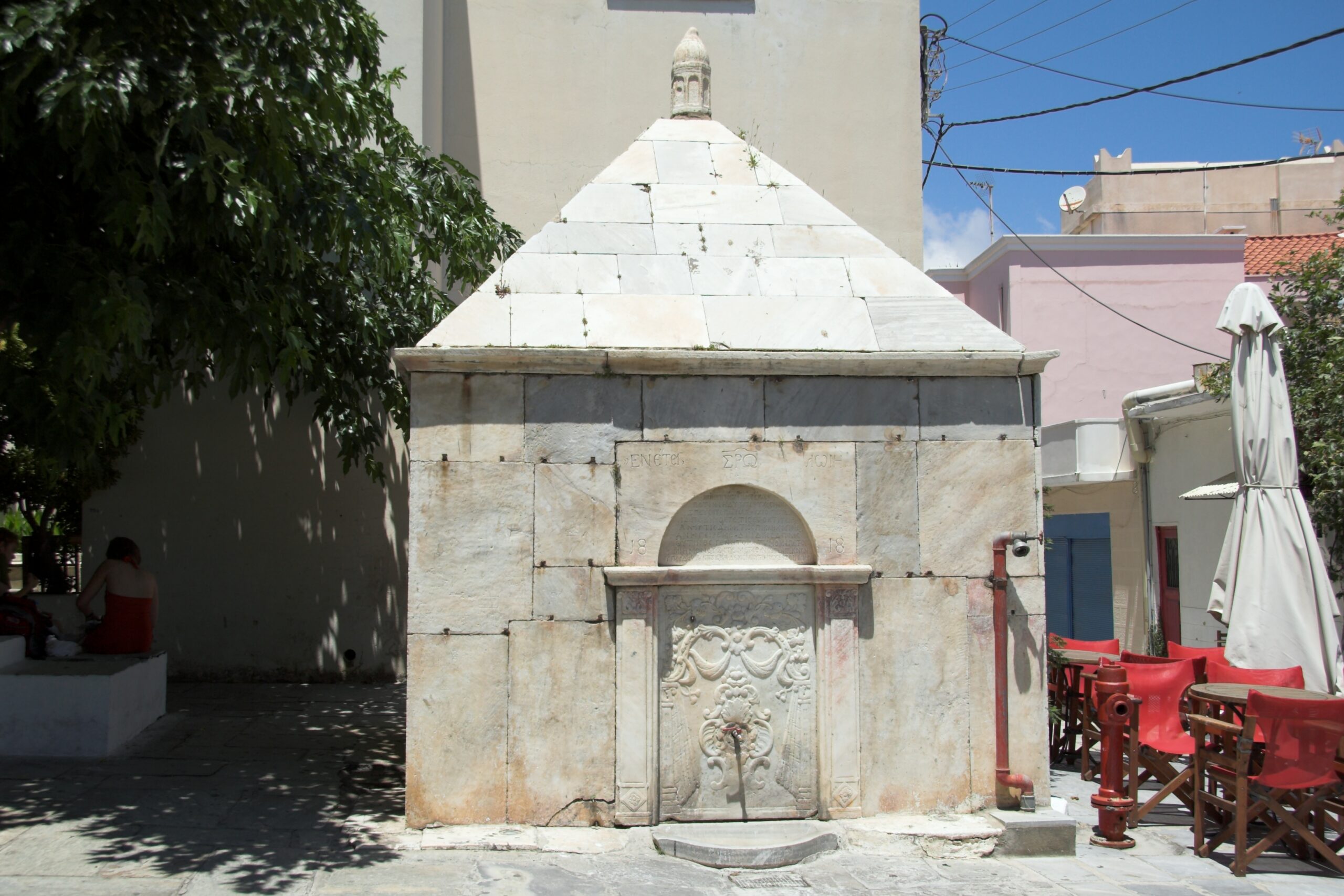
Equally worth finding is the historic marble fountain in Andros town, inscribed with the date 1818. It’s the kind of detail that easily gets walked past but shouldn’t be — it’s a physical reminder of when this island was building civic infrastructure at a moment when most of Greece was still under Ottoman rule.
The Venetian presence is everywhere too. The island passed through Venetian hands for centuries, and its most famous landmark — the medieval castle at the tip of the Chora peninsula — dates to that era. Even in ruins, it carries a commanding authority.
For travellers interested in the deeper layers of Greek history, Andros pairs beautifully with a visit to Tinos, its neighbour island, which has its own extraordinary artistic and religious heritage.
Chora: A Capital Unlike Any Other in the Cyclades
Most Cycladic capitals charm you. Andros Chora astonishes you.
Built on a long, narrow peninsula that juts into the sea between two bays, the old town is all marble underfoot and neoclassical facades on either side. There are no cars in the pedestrian heart of it, just the sound of your footsteps on stone, the distant crash of surf, and the occasional laughter from a café table in one of the small squares.
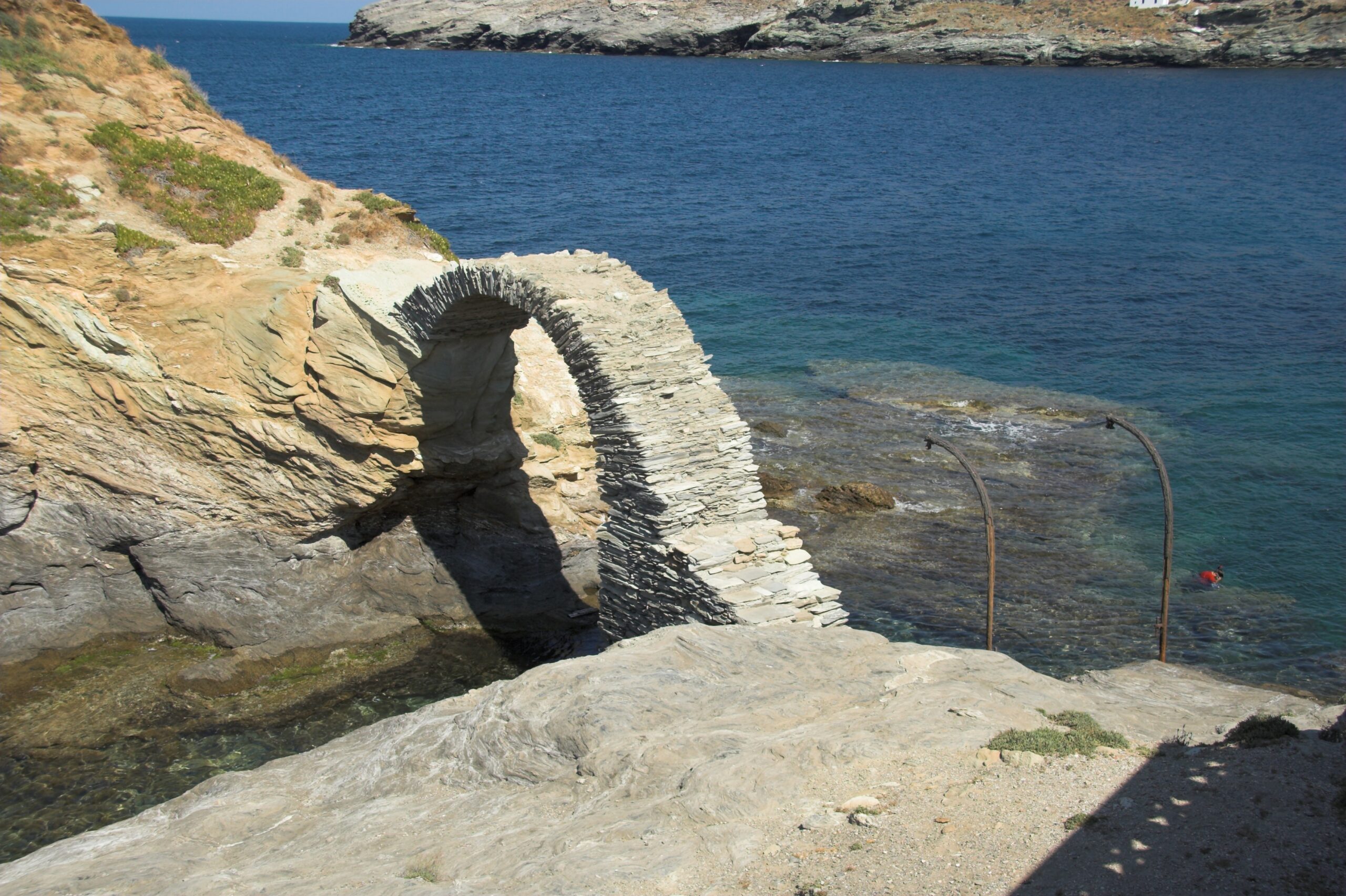
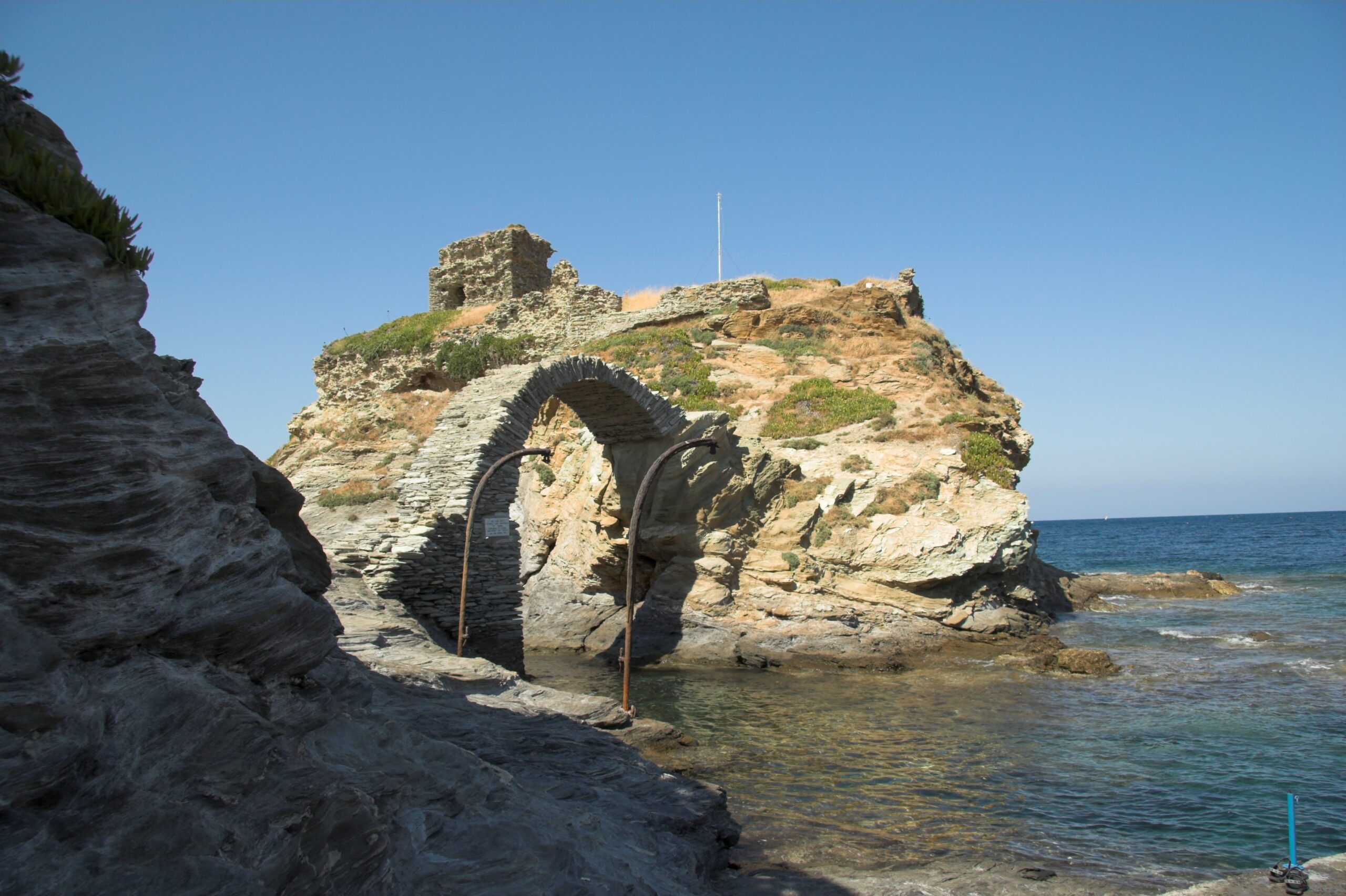
At one end of the peninsula stands the Venetian castle — or what remains of it after a catastrophic earthquake in the 17th century reduced it to a dramatic fragment. A stone arch bridge, known locally as the Bridge of Love, connects the castle rock to the mainland. Cross it on a windy day and you’ll feel the Aegean in both ears.
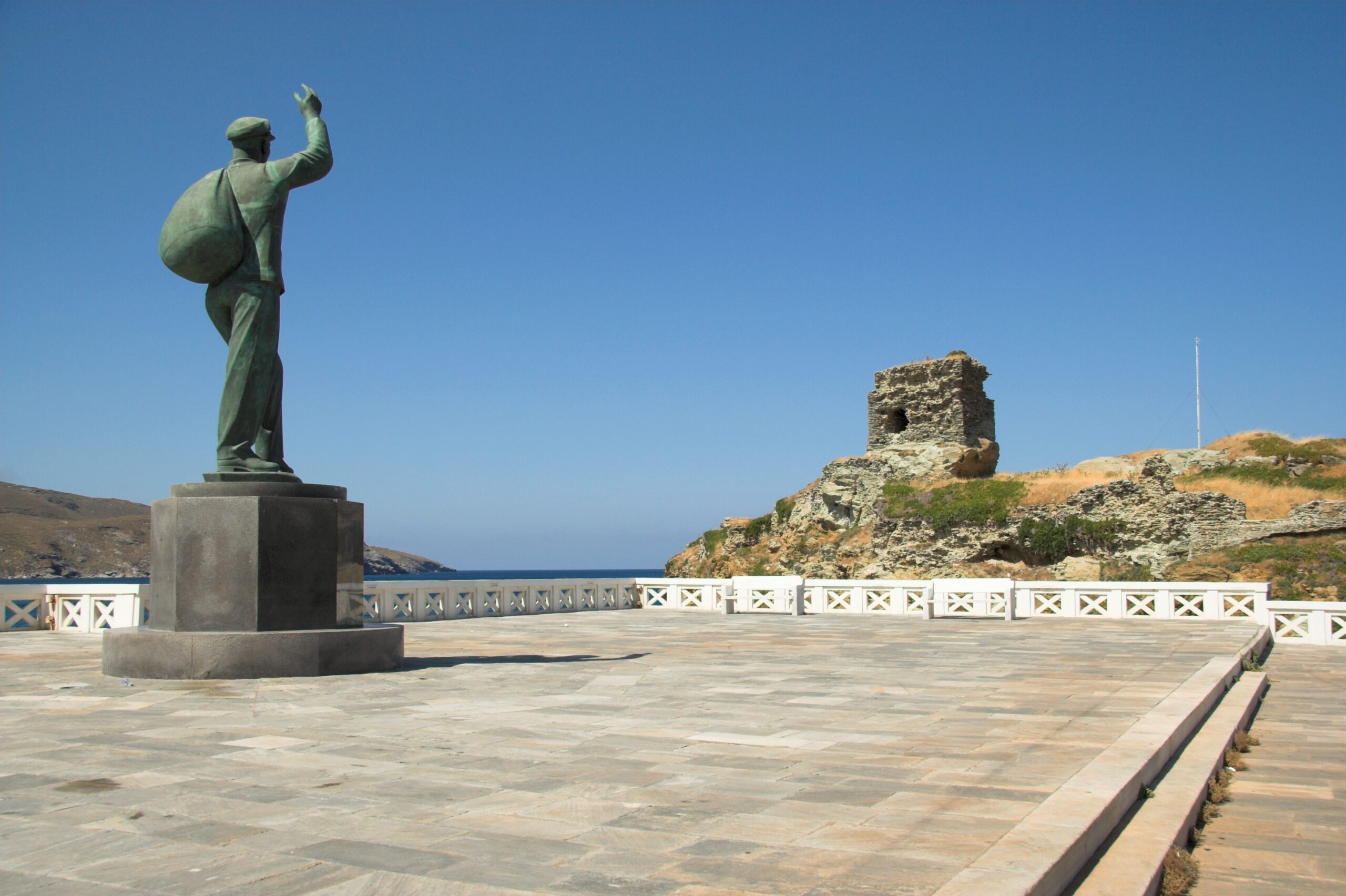
At the other end of the peninsula, on a small promontory overlooking the sea, stands the statue of the Unknown Sailor — a brooding bronze figure who seems to be searching the horizon. It’s become something of an emblem for the island, and rightly so.
Between these two poles, the Chora’s main street hosts two of the most important cultural institutions in the Cyclades. The Goulandris Foundation Museum of Contemporary Art (established 1979) holds an astonishing collection for an island of this size — works by Cézanne, van Gogh, Picasso, Kandinsky, Miró, Rodin, Degas, Monet, and Gauguin, alongside rotating contemporary exhibitions. The Goulandris Foundation also funded the island’s Archaeological Museum (1981), which displays findings from the island’s geometric settlement period alongside a permanent projection room and rotating modern art shows.
For a village of perhaps 1,800 people, having two museums of this calibre is extraordinary — and it shapes the whole atmosphere of the place. Chora feels serious about culture in a way that most Greek island capitals simply don’t.
The Alleys and the Light
Beyond the flagship institutions, the joy of Chora is in its texture. Wander off the main street and you quickly find yourself in a network of narrow alleys where the marble is worn to a shine, the walls are draped with bougainvillea, and the views between buildings suddenly open to the sea.
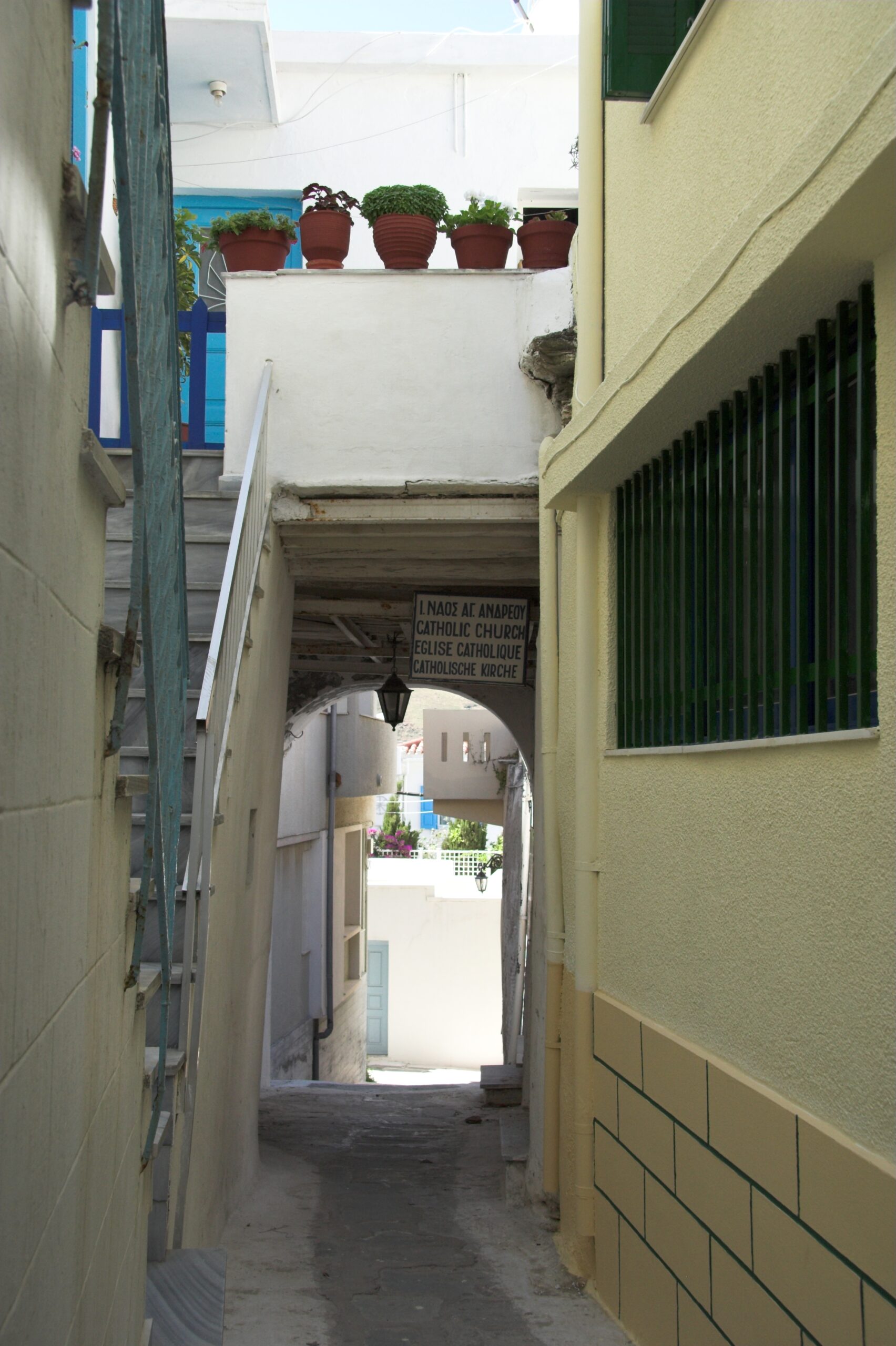
The old town repays slow walking. Give it a full morning. Have a coffee in the main square, visit at least one museum, cross the Bridge of Love, and then get deliberately lost in the alleys before lunch. You won’t regret it.
Andros Routes: Hiking the Best-Kept Secret in the Cyclades
If you came to Andros purely for hiking, you would not be disappointed. You would, in fact, be overwhelmed.
The Andros Routes network encompasses over 500 kilometres of historic footpaths — the original transport infrastructure of the island before motorised vehicles arrived. Of these, 240 kilometres have been restored and waymarked to European standards, certified by the European Ramblers Association as a Leading Quality Trail — Best of Europe. There are 18 marked trails totalling over 60 miles, ranging from easy half-day coastal walks to challenging mountain routes, all the way up to a 100-kilometre long-distance trail that crosses the entire island.
The landscape these trails traverse is unlike anything else in the Cyclades. Because Andros has freshwater springs, rivers, and underground water courses, the interior is lush and green. Trails wind through olive orchards, walnut groves, and terraced fields. You pass through valley floors where the sound of running water follows you for hours — genuinely rare on a Greek island. Higher up, the paths open onto sweeping views of the Aegean and the neighbouring islands, the kind of panorama that makes the climb entirely worth it.
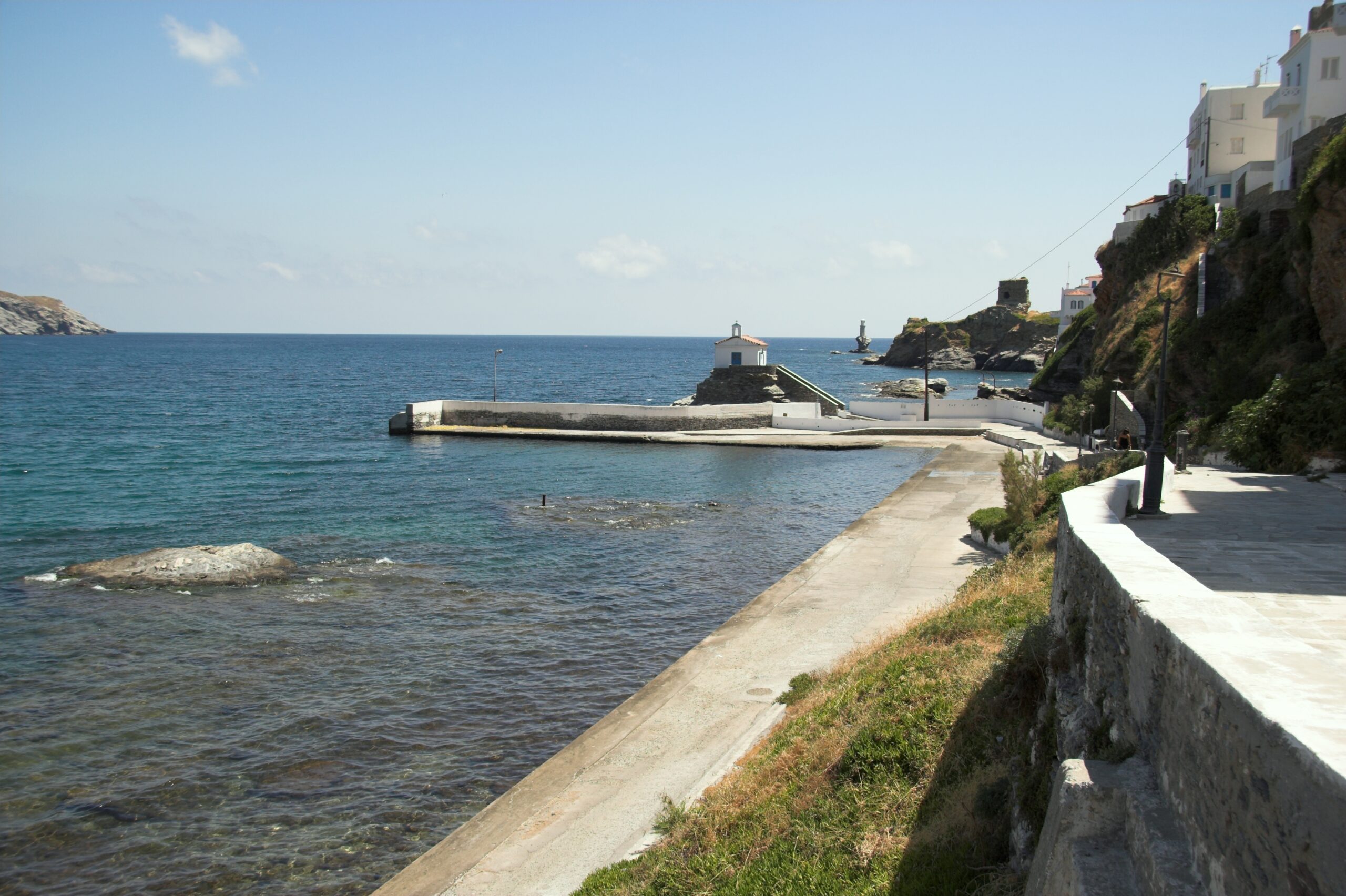
The best season for hiking on Andros is spring — from late March through to mid-June — when the wildflowers are in bloom, the temperatures are comfortable, and the trails are at their greenest. Autumn (September–October) is an equally rewarding alternative, with cooler temperatures, golden light, and far fewer other people on the paths. For serious hikers comparing Greek destinations, the trails here are on a different level from anything available on Santorini or Mykonos — arguably comparable only to the extraordinary network at Zagori and the Vikos Gorge in mainland Epirus.
There’s something almost meditative about walking an ancient footpath on a Cycladic island — following a route that shepherds and sailors and merchants walked for centuries before you, the Aegean always somewhere in the distance, the air smelling of thyme and salt and something you can’t quite name.
The Villages: Stenies, Menites, Apikia & the Hidden Interior
Andros is not just its Chora. The island’s interior is scattered with villages that each have their own distinct personality — and collectively they offer a window into a way of life that the tourist trade hasn’t yet managed to simplify.
Stenies
Just a few kilometres north of Chora, Stenies is the village of the sea captains. The archontika — the grand neoclassical captain’s houses — line its lanes in a state of dignified grandeur, their walled gardens concealing fountains and courtyards. The Church of Agios Nikolaos here has an unusual architecture that surprises first-time visitors, and the views down into the valley and out to sea are exceptional. Stenies is also a gateway for several of the Andros Routes hiking trails.
Menites
Further into the interior, Menites sits between walnut trees and plane trees in a mountain landscape threaded with running water. The springs here feed the island’s freshwater network, and the village has a perpetually cool, shaded quality that feels like relief after a morning in the sun. It’s one of those places that feels completely off the tourist circuit — and completely itself.
Apikia
Nearby Apikia is home to the famous Sariza Springs, where natural mineral water flows from carved marble lion-head fountains. The springs are one of Andros’ most beloved local institutions — Androsians have been drinking this water for generations, and the bottled water from Sariza is sold across Greece. Drinking from the lion heads yourself is the obvious thing to do, and the obvious thing is sometimes the right thing.
Beyond these three, the island has other villages worth a detour: Mesaria, with its Byzantine church; Gavrio, the main port town with its own easy-going atmosphere; and the quieter northern villages of Lamyra and Ano Pitrofos, where the roads narrow to a single lane and the houses seem to grow directly from the hillside.
Beaches: Where the Sea Is Always a Surprise
Andros doesn’t advertise its beaches as loudly as Milos or Koufonisia — and that restraint is entirely justified, because the beaches here are genuinely outstanding and still relatively uncrowded.
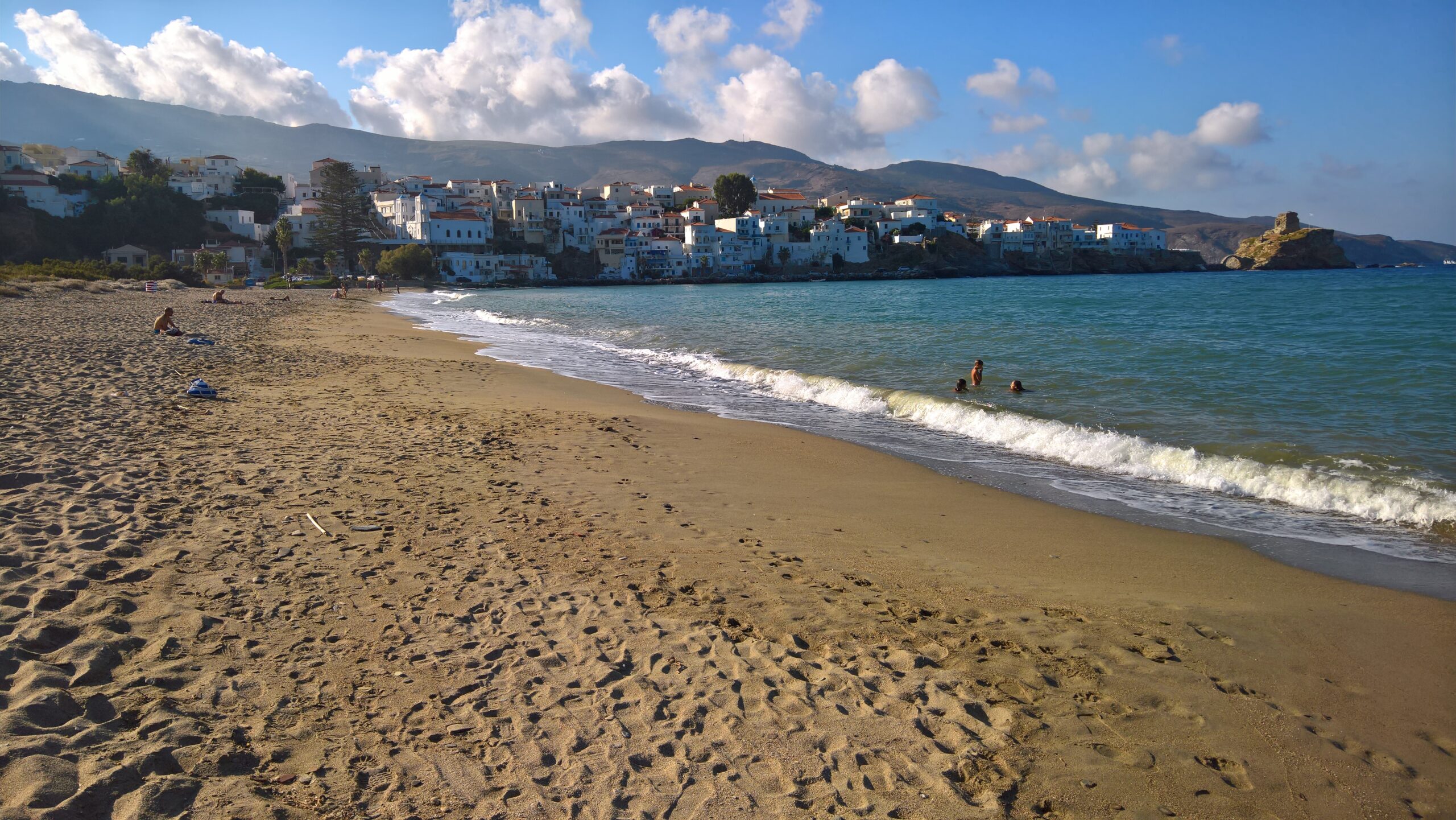
The Best Beaches on Andros
Achla is widely considered the finest beach on the island — some say one of the finest in the Cyclades. Reached by 4×4 or by boat from the north, its remoteness is exactly the point. Golden sand, turquoise water, and very few people, even in summer. It takes effort to reach, and rewards that effort entirely.
Vitali is a hidden gem on the northeast coast, tucked between cliffs, reachable down a gravel road. The water here is exceptionally clear — ideal for snorkelling — and a summer taverna makes an afternoon here feel like a complete decision rather than just a stop on the way somewhere else.
Tis Grias to Pidima (literally, “the old woman’s leap”) is the most iconic beach on Andros and one of the most photographed in the Cyclades — a bay dominated by a single dramatic rock formation that rises vertically from the water. It’s instantly recognisable, genuinely dramatic, and well worth the detour.
Kypri is the beach for the active traveller: a watersports hub with windsurfing, SUP, waterski, and wakeboarding available throughout summer, reachable by bus from Batsi.
Agios Petros and Chrysi Akti (Golden Sand) offer easier, more accessible alternatives — the first right beside the main road between Gavrio and Batsi, the second a wide sandy bay ideal for families.
For those comparing beach quality across the Cyclades, Andros holds up extremely well — and unlike Milos or Koufonisia, you’re unlikely to have to fight for a patch of sand.
Food & Gastronomy: The Androsian Table
Andros has one of the most distinctive and least-known food cultures in the Cyclades. It’s not flashy. It doesn’t have Michelin stars. But it has a genuine local culinary tradition that’s worth going out of your way to experience.
The signature dish is Foutalia (or Froutalia) — a thick, slow-cooked omelette that resembles a Spanish tortilla but is entirely its own thing. The traditional version uses Andros’ famous local pork sausages (loukanika), potatoes sautéed in pork fat, and optionally zucchini, artichokes, or broad beans depending on the season. It’s served as a mezze appetiser or as a summer lunch, and it’s the kind of dish that makes you understand why people don’t just cook it at home — there’s a technique and a quality of ingredients that makes the taverna version always better.
The Androsian loukanika (pork sausages) are celebrated across Greece for their quality and distinct seasoning. You’ll find them grilled, in stews, in the Foutalia, and sold to take home at local shops in Chora and Batsi.
Manoura cheese is another local treasure: an aged cheese matured in the island’s volcanic caves, which gives it a deep, earthy quality unlike any other Greek cheese. It appears in local pies and is worth seeking out at a proper taverna or a village produce shop.
For a sweet finish, look for Karioka (a local chocolate-almond sweet) and Kaltsouni, a traditional pastry that varies slightly from village to village. Bougatsa — the filo pastry custard pie — is also very well made on Andros, and worth having for breakfast.
For travellers with a serious interest in Greek island food culture, Andros pairs naturally with a visit to Sifnos, the Cyclades’ dedicated food island, or with the extraordinary culinary landscape of Crete.
Greek island food at its best is never about the menu — it’s about the ingredients and the season. On Andros, when you eat Foutalia made with local sausages and new-season potatoes in a courtyard taverna in Stenies, with cats threading between the chairs and the hills going golden in the afternoon light, you understand exactly what that means.
Practical Guide: Getting There, Getting Around & When to Go
Getting to Andros
Andros is one of the most accessible Cycladic islands from Athens, which is part of what makes it so appealing as a destination. Ferries depart from Rafina port — roughly 30 kilometres east of central Athens, reachable in 40 minutes by taxi or direct bus from Athens airport.
The fastest crossing takes just 50 minutes (high-speed services), with regular services averaging around 1 hour 55 minutes. There are approximately 7 daily sailings from Rafina, with the first departure around 07:05 and the last around 19:15. The foot passenger fare is approximately €25 per person (2026 pricing). Operators include Cyclades Fast Ferries, SeaJets, and Golden Star Ferries — check Ferryhopper for live schedules and bookings.
Andros can also be reached from Mykonos (approximately 2 hours 25 minutes), making it an easy addition to an island-hopping route through the northern Cyclades.
Getting Around
A rental car is strongly recommended for exploring Andros beyond Batsi and Chora. The beaches — particularly Achla and Vitali — require a vehicle to reach, and the inland villages are scattered across a large area.
There is a bus service connecting Gavrio port to Batsi and Chora, which is useful for foot passengers without cars. A water taxi operates between Chora and Achla beach during the warmer months.
When to Go
The best time to visit Andros is late April through mid-June — the sweet spot after Orthodox Easter when the island is at its lushest and most beautiful, temperatures are warm but not punishing, and tourist numbers are well below peak summer. The wildflowers are in bloom, the hiking trails are in perfect condition, and the atmosphere in Chora and the villages is relaxed and authentic.
September and October offer a superb alternative for those who prefer to avoid summer crowds entirely — cooler temperatures make hiking genuinely comfortable, the sea is still warm from months of summer sun, and the island has a reflective golden-afternoon quality that photographers love.
July and August are busy by Andros standards (though never Mykonos-busy), hotter, and more expensive — but the beaches are at their best and the cultural programme at the Goulandris Museum is usually at its most active.
For more on timing your Greek islands trip, the guide to September in Greece covers the shoulder season in depth.
Where to Stay
Batsi, on the western coast, is the main resort town and the most practical base for travellers without a car — it has the best concentration of hotels, restaurants, and facilities. The Iliades Luxury Boutique Suites consistently receives outstanding reviews (9.6 rating), and the Aneroussa Beach Hotel is another well-regarded option.
Chora offers a more atmospheric stay, closer to the cultural heart of the island. Accommodation here tends towards boutique options and traditional guesthouses.
For the most immersive experience, the villages — Stenies, Menites, and the quieter inland settlements — offer rental houses and small guesthouses where the pace of life is entirely different from any resort.
Is Andros Right for You?
Andros is not for everyone — and that’s meant as a compliment.
It’s an island that asks something of its visitors. It asks you to slow down, to walk, to look at architecture, to eat in a courtyard taverna rather than a beachfront tourist trap. It rewards curiosity, cultural interest, and a willingness to explore beyond the obvious. It has no interest in competing with Mykonos or Santorini, because it’s playing a completely different game.
If you want world-class contemporary art in a neoclassical capital. If you want 240 kilometres of certified hiking trails through landscapes you won’t find on any other Cycladic island. If you want beaches that are genuinely beautiful without being Instagram-saturated. If you want to eat local food that has a specific identity and a specific story. If you want to feel, even for a few days, like a traveller rather than a tourist.
Then Andros is your island. And 2026 might be exactly the right year to discover it — before everyone else does.
For a broader look at how Andros compares to the wider Cyclades family, the Ionian Islands Showdown guide offers a useful framework for thinking about island personalities and how to choose the right one for your trip.
Ferry schedules and prices correct as of July 2026. Always verify current timetables directly with operators before travelling.