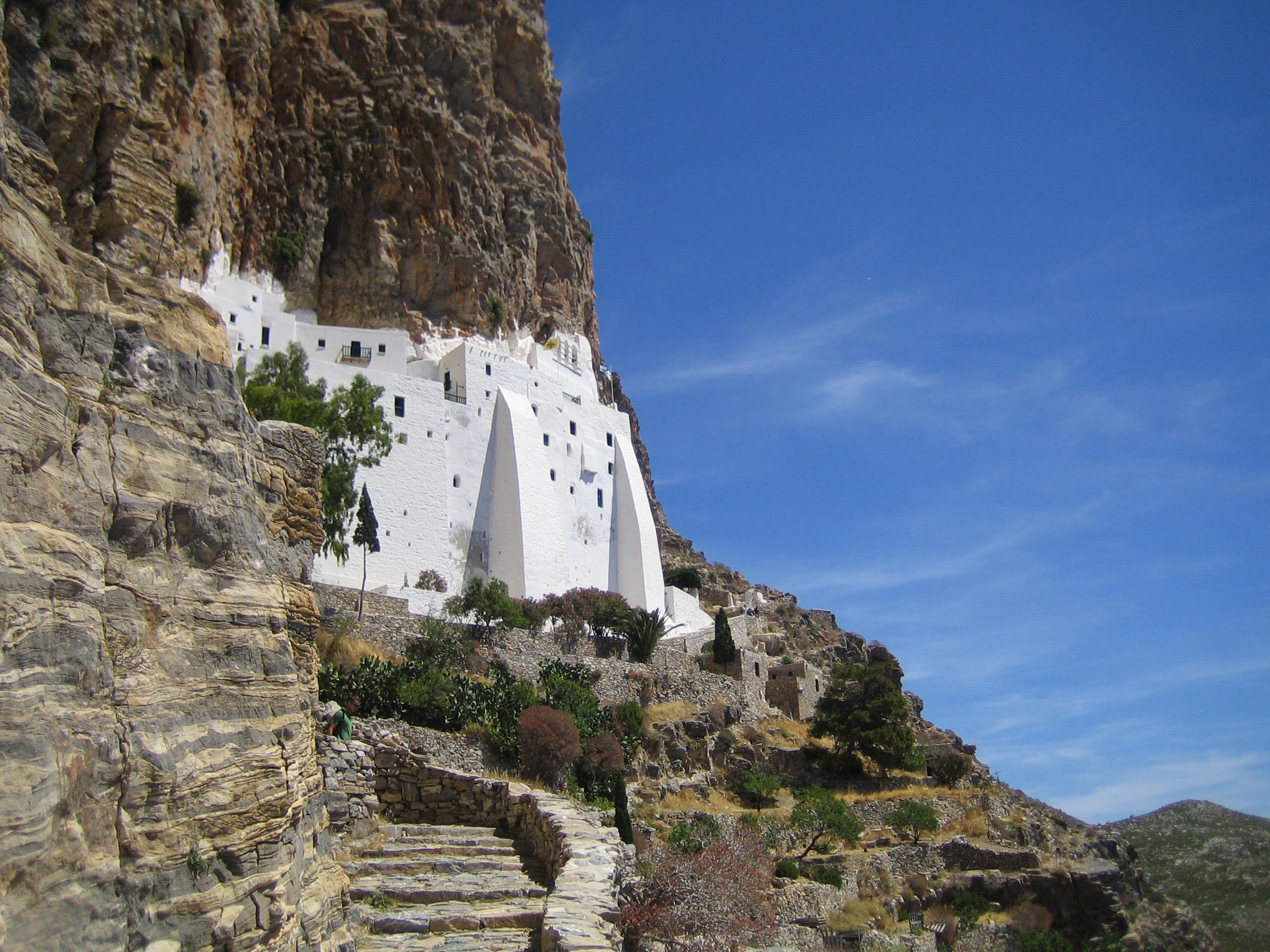
There is a photograph that stops people mid-scroll. A sliver of whitewashed monastery — barely wider than a few windows — pressed impossibly against a sheer orange cliff that plunges three hundred meters into a thrashing cobalt sea. It looks like it was painted there by a dreaming monk, something between architecture and miracle. That is Amorgos in a single image: theatrical, austere, and completely, startlingly real.
The easternmost island of the Cyclades sits at a place where the Aegean feels less like a postcard sea and more like something ancient and untamed. There is no airport here. No international cruise ships. No beachside DJ sets bleeding into the night. What Amorgos offers instead is something that Greece’s most celebrated islands have gradually traded away — the sense that you have arrived somewhere that has not bent itself to your expectations.
Hikers come for the old stone paths that thread through wild thyme and silence. Film lovers make the pilgrimage to the beach where Luc Besson filmed The Big Blue in 1988. Foodies discover that a small island with goat-dotted hillsides and homemade raki can produce a table that rivals anything in the Cyclades. And everyone, sooner or later, stands before that monastery on its cliff and feels something shift.
This is the Amorgos travel guide for people who want the real thing.
Why Amorgos? The Real Greece Experience
The Easternmost Cycladic Island
Amorgos lies at the eastern edge of the Cyclades, separated from Naxos and the central island cluster by open sea. Its elongated, narrow shape — about 33 kilometers long but never more than 6 kilometers wide — means that the Aegean is almost always visible from wherever you stand. The island’s backbone is a rocky spine of mountains running its full length, dropping dramatically to the sea on both sides. Villages cling to ridgelines. Paths descend through terraced hillsides carved over thousands of years.
Geographically, Amorgos belongs to the Little Cyclades cluster — geologically and culturally closer to the untamed eastern Aegean than to the polished terraces of Santorini. That distinction matters. The light here is sharper. The stone older. The silences longer.
No Airport, No Mass Tourism — Authenticity Preserved
The absence of an airport is not a flaw in Amorgos’ design. It is its most important feature. Every visitor arrives by ferry, which means everyone has made a deliberate choice to come here — no accidental daytrippers, no cruise crowds spilling off gangplanks at noon. The island’s tourism remains at a human scale, shaped by people who want to walk its trails, drink its raki, and sit long enough at a clifftop taverna to actually notice the sunset.
Like Folegandros, Amorgos has resisted the gravitational pull of mass tourism that has transformed so many Cycladic islands. Both share a dramatic topography, a fierce pride in local culture, and a quiet insistence that the traveler slow down and pay attention. If Folegandros feels like a secret whispered between islands, Amorgos feels like the secret’s older, wilder sibling.
The Legacy of The Big Blue (1988)
In 1988, French director Luc Besson chose Amorgos as the setting for The Big Blue, his mythic, visually intoxicating film about competitive free-diving, friendship, and obsession. The film’s underwater sequences — shot off the island’s coast — and the iconic scenes at Agia Anna beach brought Amorgos into the consciousness of European travelers in a way that no tourism campaign ever could.
Decades later, the film retains a cult following. Travelers arrive clutching mental images of those opening scenes, searching for the exact shade of blue they saw on screen. They usually find it. The Aegean around Amorgos has a clarity and depth of colour that is genuinely cinematic — no filters required.
Getting to Amorgos: Ferry Routes & Logistics
Ferry from Piraeus (Athens)
The main gateway to Amorgos is Piraeus, Athens’ port. Ferries operate to Katapola (the island’s main port) and sometimes also to Aegiali, the quieter northern harbour. Journey times vary significantly depending on the ferry type:
- Conventional ferry (Blue Star Ferries): approximately 8–9 hours, overnight options available
- High-speed ferry (SeaJets): approximately 5–6 hours
Ferry prices for 2026 range from approximately €50 to €97 one-way depending on the operator, season, and class. Booking early is strongly recommended for July and August. Use Ferryhopper to compare routes and prices in real time — it is one of the most reliable tools for Greek island ferry planning.
Connections from Other Cycladic Islands
Amorgos fits naturally into an island-hopping itinerary through the Cyclades. Regular connections run from:
- Naxos: 2–3 hours, frequent services in summer
- Santorini: 3–4 hours by high-speed ferry
- Syros, Paros, and Ios: various routes with seasonal frequency
For those building a multi-island route that includes dramatic coastal scenery and geological drama with fewer crowds, combining Milos and Amorgos in the same trip makes for a compelling contrast — volcanic colour at one end of the Cyclades, cliff monasteries and wild hiking at the other.
Two Ports: Katapola vs. Aegiali
Amorgos has two functioning ports, which effectively give you two different entry points into island life:
- Katapola is the main port — livelier, better connected to Chora (the capital), and the arrival point for most ferries. The port village is charming in its own right, with seafront tavernas and easy access to the island’s interior.
- Aegiali sits at the northern end of the island, smaller and significantly more relaxed. Its sandy beach and sleepy atmosphere attract travellers who want to disconnect entirely.
Deciding which port to use first depends on your priorities. Most visitors start at Katapola and work their way northward.
Monastery of Panagia Hozoviotissa: The Icon
History & Significance (11th Century)
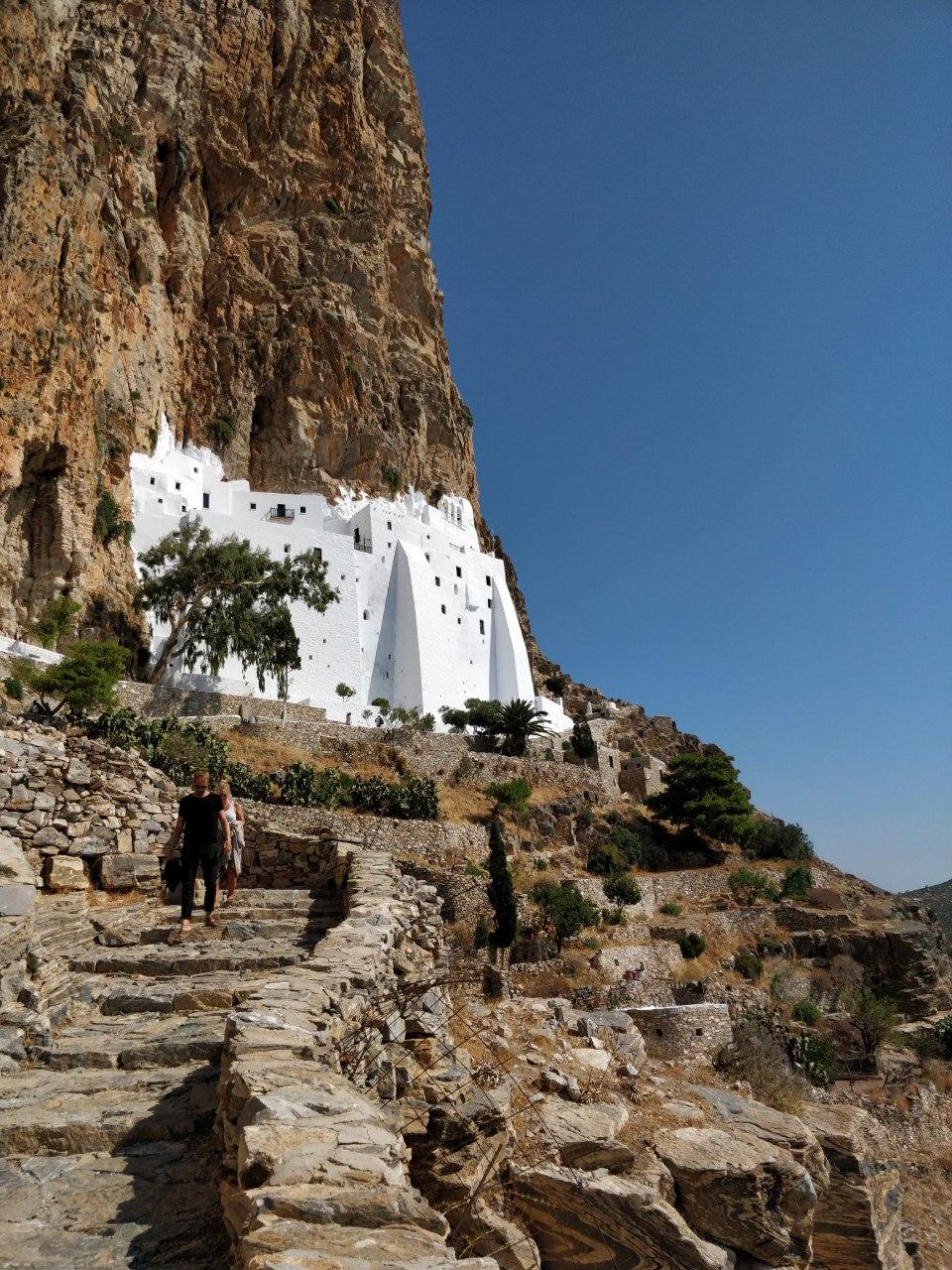
Nothing on Amorgos — nothing in the Cyclades, arguably — prepares you for the Monastery of Panagia Hozoviotissa. Founded in 1088 CE by Emperor Alexios I Komnenos of Byzantium, this is one of the oldest and most venerated monasteries in Greece. It was built to house a miraculous icon of the Virgin Mary — said to have floated to the island from Palestine — in a natural cave in the cliff face.
The monastery does not sit beside the cliff. It grows out of it. Its eight storeys are embedded directly into the rock at a near-vertical angle, with walls barely eight meters wide in places, stacked improbably upward like a whitewashed dream defying gravity. From certain angles it is almost invisible against the pale limestone. From others, it blazes white against the ochre stone, catching the late afternoon sun.
For nearly a thousand years, monks have lived here, kept watch over the icon, and looked out across the same sea.
The 350 Stone Steps & the Physical Challenge
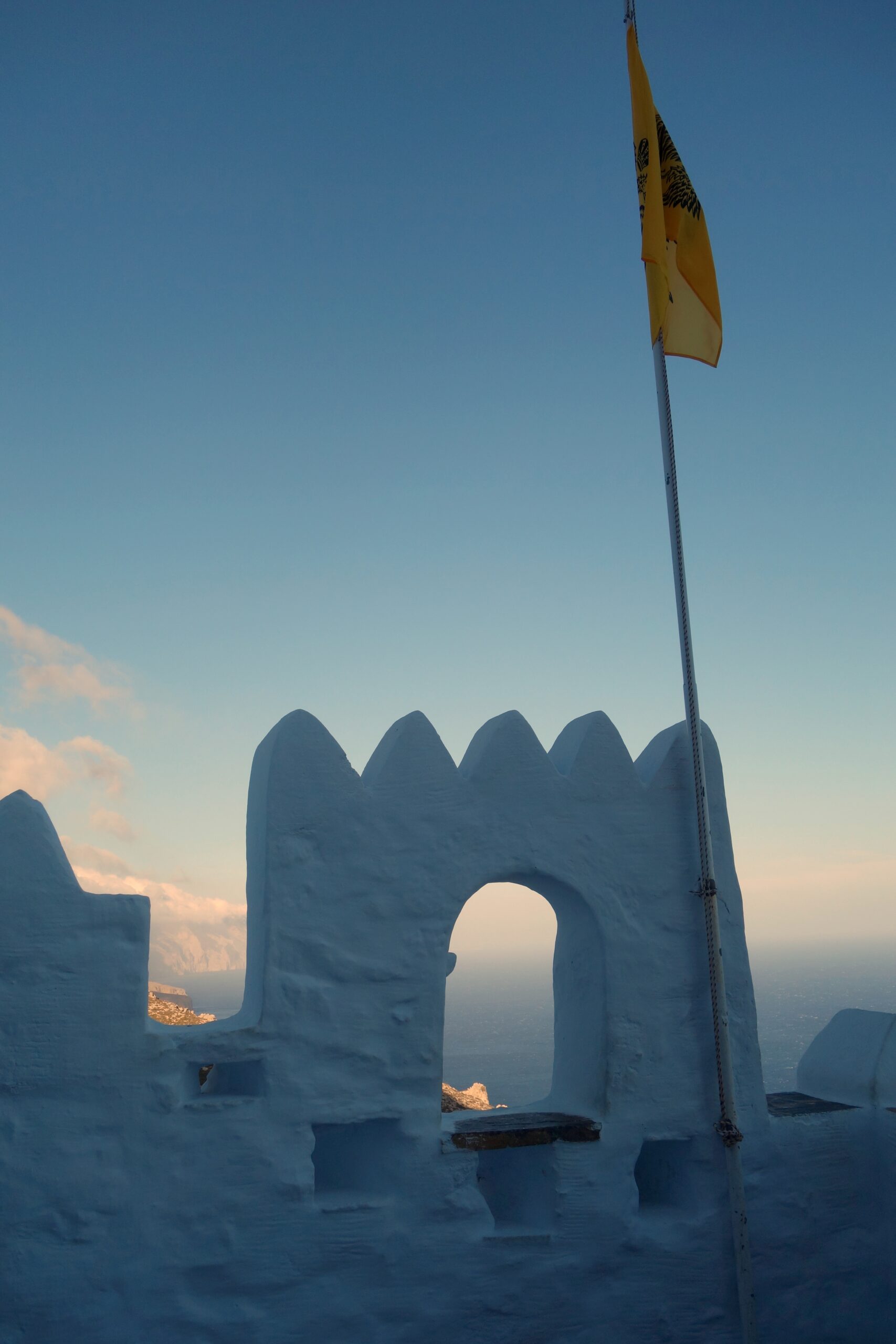
Reaching the monastery requires climbing approximately 350 stone steps carved into the cliff face. The ascent takes 15–20 minutes at a moderate pace and is not technically difficult, but it is steep and exposed to the sun. Start early in the morning — before 10am if possible — to avoid the heat and the midday crowds. The views from the steps alone are worth the climb: the sea spreading out below, the island’s southern coast curving away, the silence broken only by the wind and distant bells.
Visiting: Practical Information
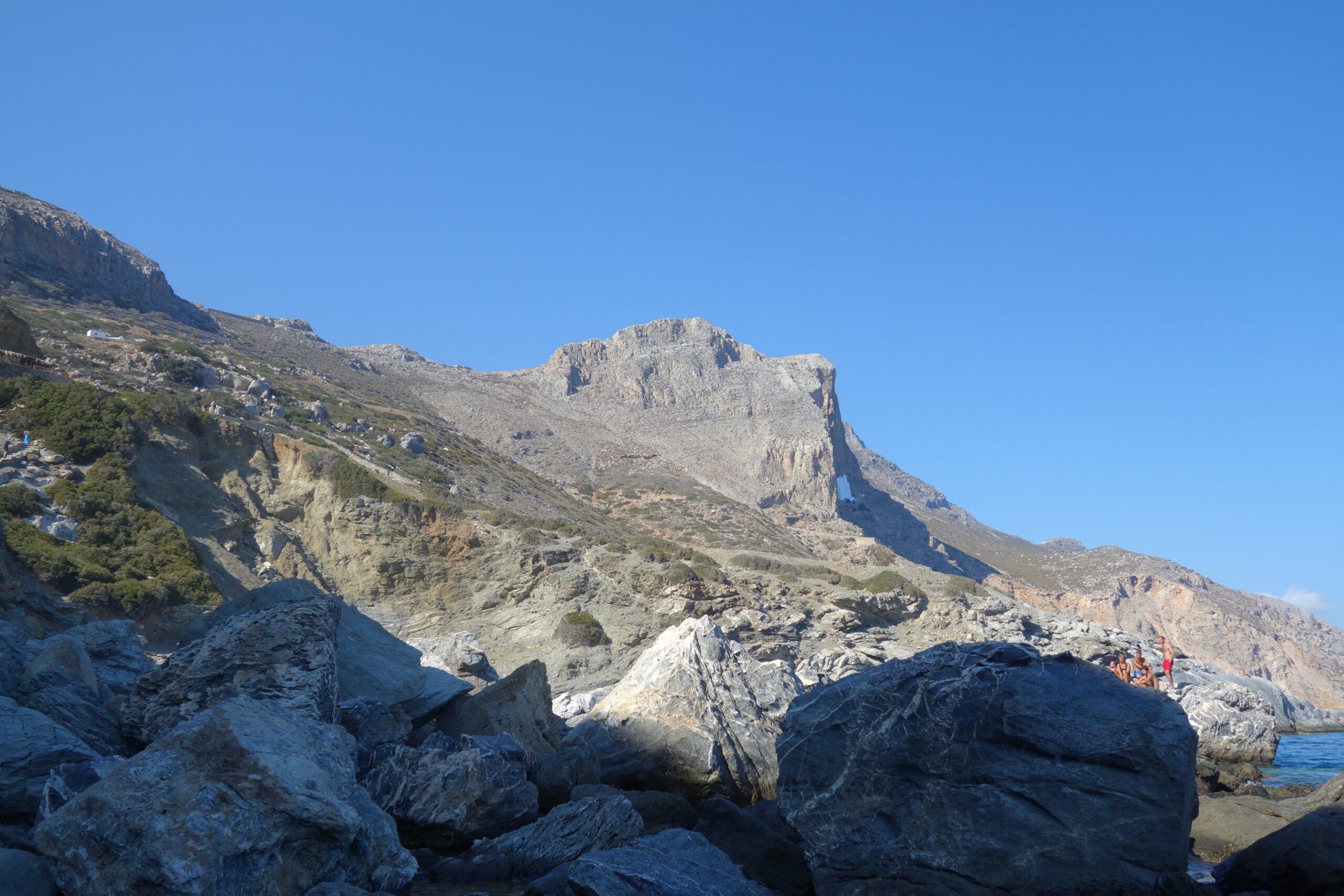
The monastery is open to visitors, though it operates on its own schedule and the monks’ hospitality is central to the experience. Upon arrival, you will be welcomed with a small glass of loukoumades (honey fritters) and a shot of raki — the monastery’s traditional greeting, offered freely and with genuine warmth.
Visiting guidelines:
– Dress code: Modest clothing is strictly required. Women must wear skirts (wraps are provided at the entrance if needed); shoulders must be covered. This is a working monastery and an active place of worship — dress accordingly and respectfully.
– Photography: Photography is generally not permitted inside the monastery. The exterior and views from the steps are fair game.
– Opening hours: The monastery typically opens morning and evening (roughly 8am–1pm and 5pm–7pm), but hours can vary. Check locally before visiting; do not rely on outdated information.
– Best time to visit: Early morning visits offer cooler temperatures and a quieter, more contemplative atmosphere.
Chora: Amorgos’ Most Beautiful Village
If the monastery is Amorgos’ soul, then Chora is its daily heartbeat. Perched on a hilltop 400 metres above sea level, the island’s Cycladic capital is one of the most genuinely beautiful villages in the archipelago — and one that still functions as a real working community rather than an open-air museum.
The windmills at the top of the ridge were built by the Venetians during their occupation of the Cyclades, and they still stand, restored and watching, above a cascade of whitewashed houses that spill down the hillside in overlapping terraces. The narrow alleys are too tight for any vehicle. Cats sleep on doorsteps painted in cobalt blue. Jasmine trails over archways. A coffee from the kafeneion on the main plateia, drunk slowly while watching the light change over the valley, is one of the simple pleasures that Amorgos does particularly well.
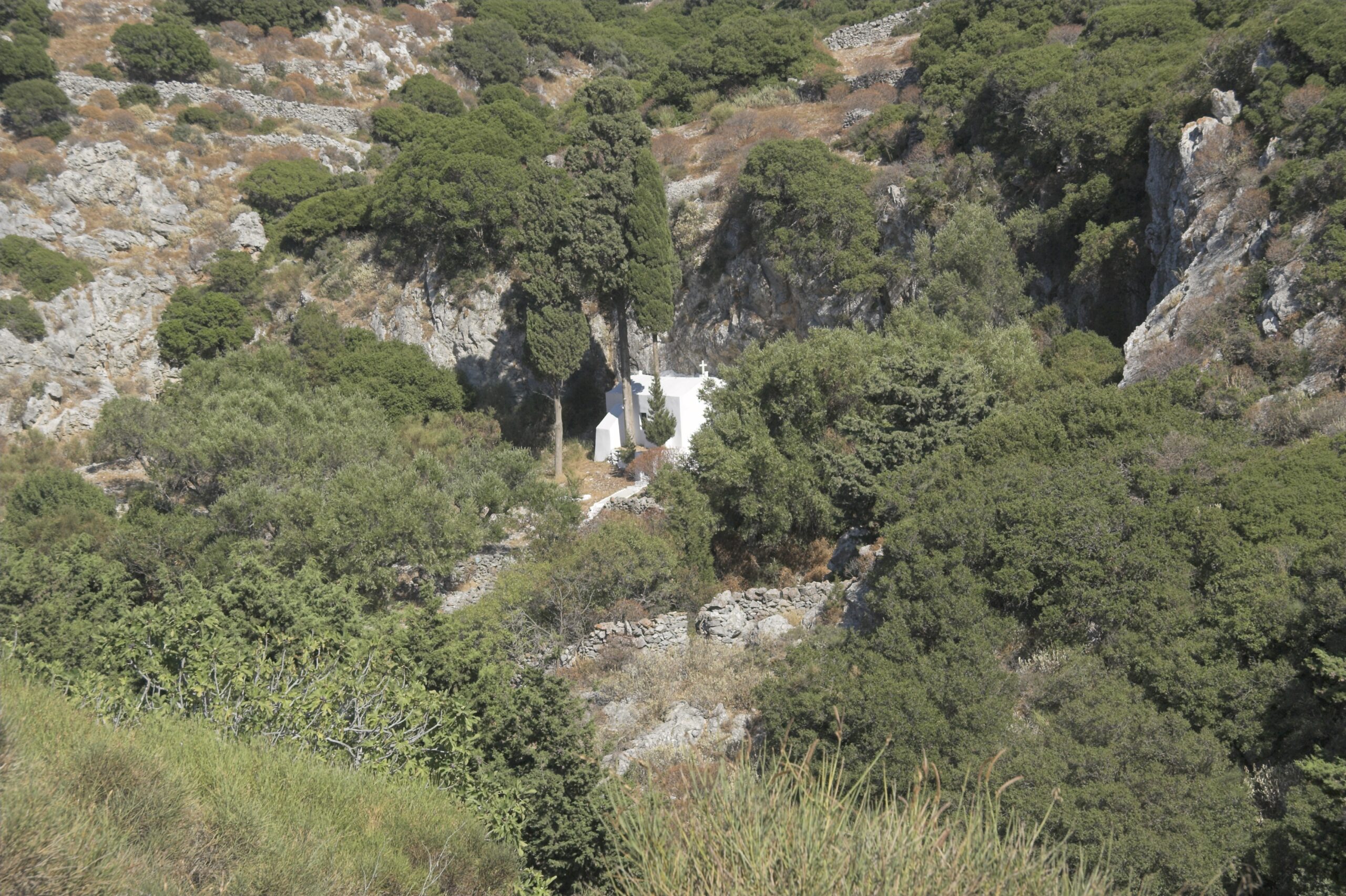
At the top of Chora sits the ruins of a Venetian castle (kastro), dating from the 13th century. The walk up takes five minutes and offers what may be the finest 360-degree view on the island: the monastery cliff to the south, the sea on both sides, and on clear days, the outlines of neighbouring islands shimmering in the distance.
For dinner, Chora’s small cluster of traditional tavernas serves grilled meats, fresh fish, and island cheeses. Prices remain reasonable, the welcome is genuine, and the views from the terrace tables, as darkness pools in the valley below, are quietly extraordinary.
Beaches: Where The Big Blue Was Filmed
Agia Anna Beach — The Big Blue Connection
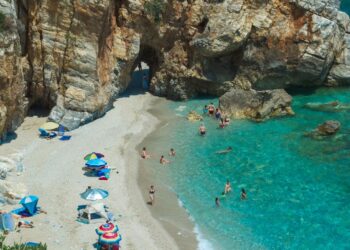
Agia Anna is a small rocky cove about 10 minutes by foot below the monastery — a short, slightly vertiginous path that deposits you onto a pebbly shore of deep turquoise water. It is not a beach for lounging with umbrellas and cocktail service. It is barely a beach at all in the conventional sense: a narrow strip of stones, a sea of extraordinary depth and colour, and a cliff wall that makes the whole setting feel both protected and theatrical.
This is the beach that The Big Blue made famous. Even without the film’s mythology, it would be worth visiting. With it, there is an undeniable frisson — a sense of standing inside a memory that millions of people share.
Mouros Beach — Rocky Seclusion & Caves
Mouros is for those who want a beach that requires a little effort to reach. Accessible by a short hike or a summer boat from Katapola, it offers rocky terrain, sea caves, and the kind of crystalline water that rewards swimmers willing to look beyond the sand. It is a favourite among free-divers and underwater photographers.
Agios Pavlos — Pebble Peninsula & Diving Hub
Agios Pavlos occupies a distinctive pebble-covered peninsula on the island’s south coast. Its exceptionally clear water has made it a centre for snorkelling and diving — the visibility here can reach 30 metres on calm days. Several diving operations on the island use it as a base for deeper explorations of the seabed.
Aegiali Beach — Sandy & Relaxed
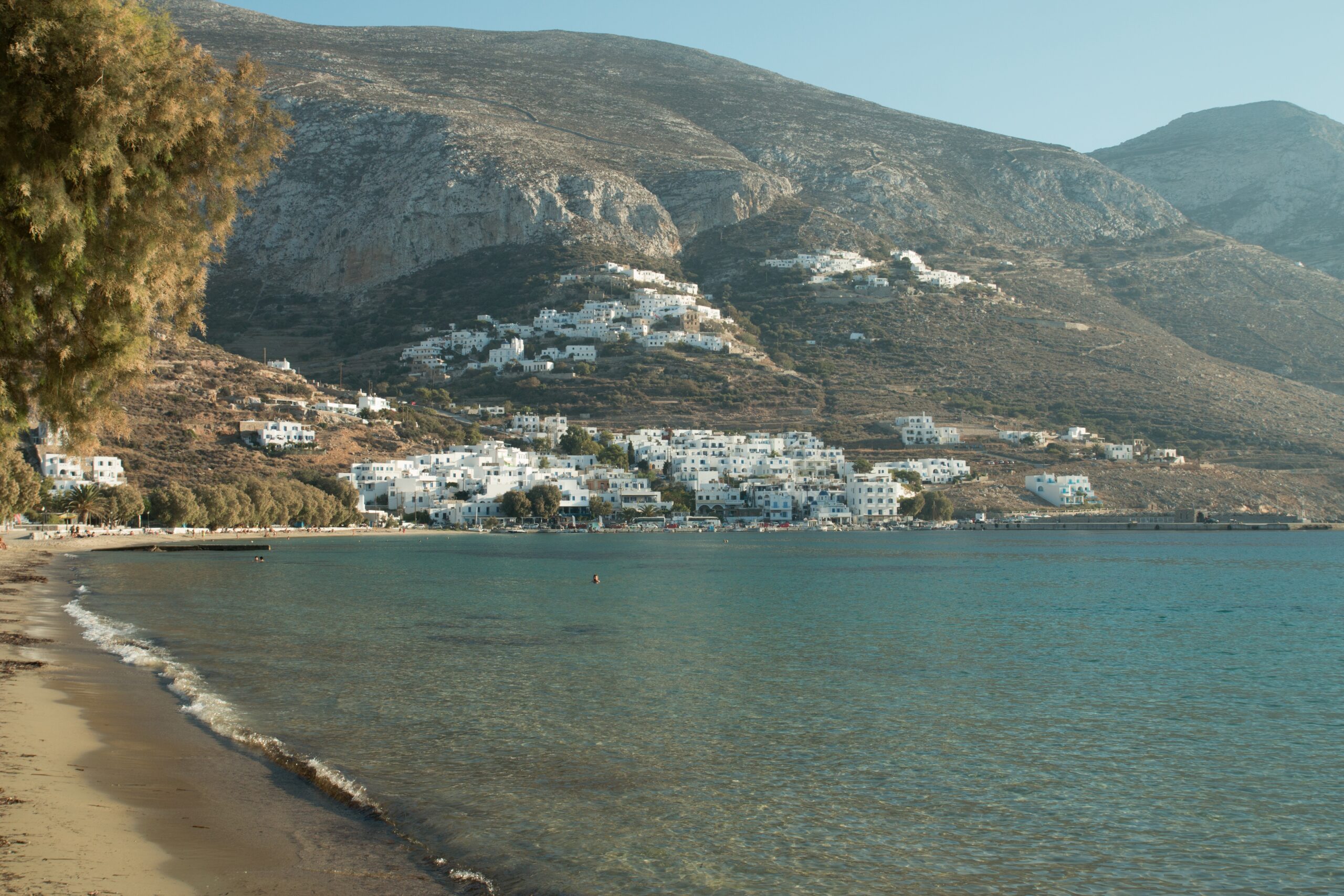
At the northern end of the island, Aegiali’s beach is the gentlest on Amorgos — long, sandy, and calm, with a shallow entry that makes it ideal for families and swimmers who prefer a softer coastline. The village behind the beach has its own small cluster of tavernas and guesthouses, making it a perfectly self-contained base for a few quiet days.
Other notable beaches include Kalotaritissa and Levrossos on the exposed north coast (rougher, wilder, genuinely remote) and Maltezi, a local favourite close to Chora with reliable shade and calm water.
Hiking & Outdoor Activities
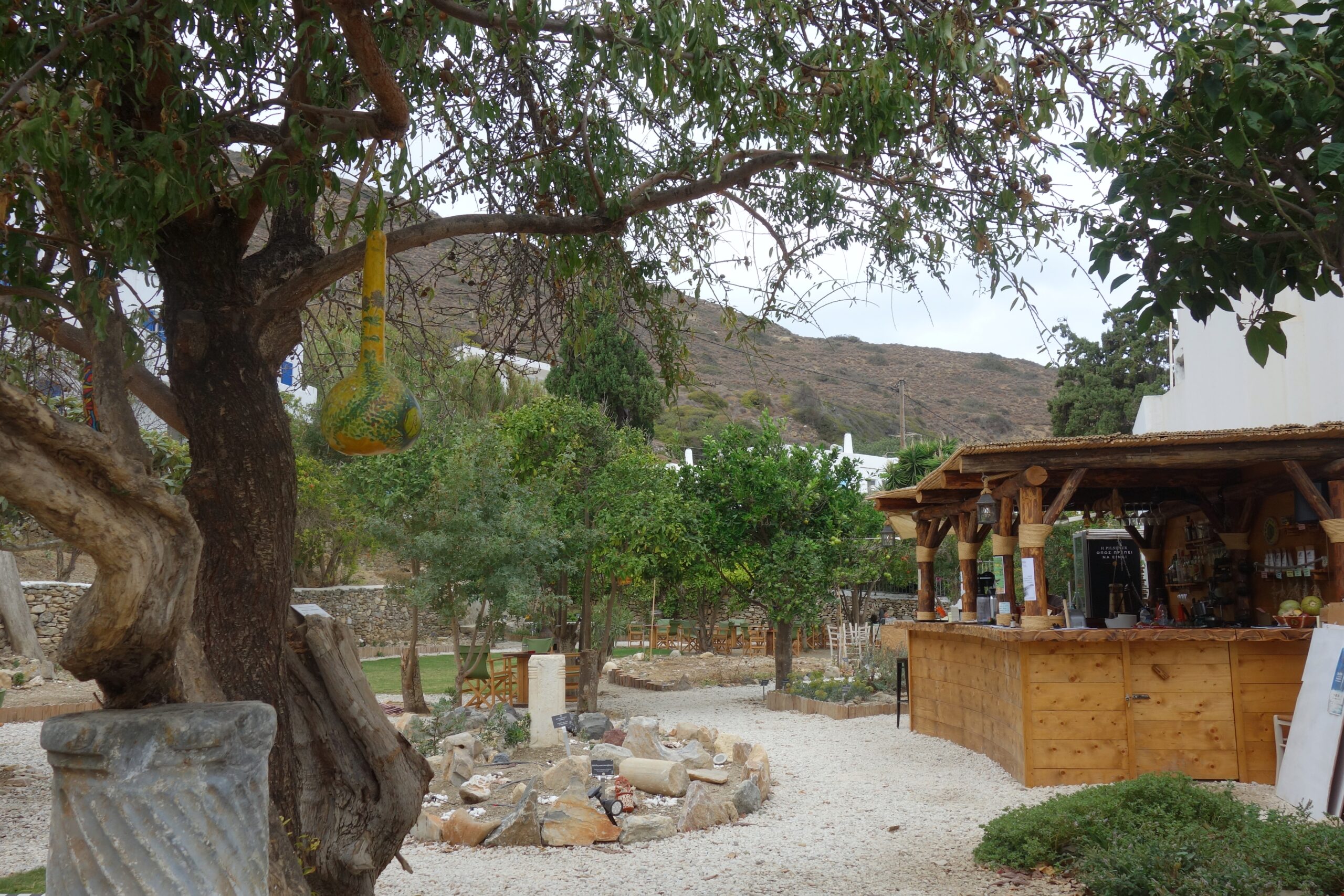
Amorgos has one of the best hiking infrastructures of any Cycladic island. Its old stone paths — the kalderimia — have been maintained and waymarked, connecting villages, monasteries, and coastline in a network that rewards both casual walkers and serious trekkers.
Old Strata Path — The Island’s Grand Trail
The Old Strata is the island’s most celebrated walk, running along the historic spine of Amorgos from the area of Chora southward toward Arkesini. This path is estimated to be over 4,000 years old, used by the island’s communities since the Bronze Age to move between settlements and farming terraces. The full route takes 4–5 hours at a moderate pace and is rated moderate to challenging — there are steep sections, rough terrain, and significant elevation change.
The rewards are considerable. The path passes through abandoned terraces, ancient threshing floors, chapels perched on ridgelines, and panoramic views that take in both coasts of the island simultaneously. Carry water, start early, and wear proper shoes.
Chora to Katapola Route
For a more accessible walk, the trail from Chora down to Katapola (via Aghios Nikolaos) takes approximately 40 minutes to 1.5 hours depending on your pace, and it is manageable for most walkers in reasonable condition. It passes through terraced hillsides, small chapels, and offers lovely views of the bay — a pleasant way to transition between the village and the port.
Chora to Hozoviotissa Monastery Trail
The direct trail from Chora to the monastery follows old kalderimia paths through the island’s southern landscape, taking roughly 1–1.5 hours. Walking this route rather than taking the road rewards you with solitude and context — you arrive at the monastery already attuned to the island’s rhythm, having passed through its terraces, herbs, and silence.
Best Hiking Season
The best hiking season on Amorgos runs from late April through June and again in September and October. July and August are too hot for long uphill walks — the midday sun is genuinely dangerous. If you are visiting in summer and want to hike, start before 8am and be back in shade by noon. Carry at minimum two litres of water per person on any trail longer than an hour.
Food & Local Cuisine: Taste the Real Amorgos
Amorgos feeds its visitors simply and well. This is not a destination for fine dining in the international sense — there are no celebrity chef outposts, no molecular gastronomy, no fusion menus. What Amorgos offers is something more valuable: a food culture that has remained substantially unchanged for generations, built around goats, pulses, wild herbs, local honey, and a spirit distilled with the kind of care that only very small places can sustain.
Psimeni Raki — Honey-Spiced Local Spirit
Every island in the Cyclades has its relationship with raki, but Amorgos has something unique: psimeni raki, a local version cooked with honey, spices, and sometimes aromatic herbs. The result is sweeter and warmer than standard raki, more complex, and dangerously easy to drink. You will encounter it at the monastery (as a welcoming gift), at traditional tavernas, and in small bottles at local shops. Buy one to take home. You will not regret it.
The food culture on Amorgos shares some DNA with the culinary traditions of Sifnos, but with a distinctly more austere, mountain-goat character. Where Sifnos is celebrated for its revithada (chickpea stew, slow-cooked in the village oven), Amorgos answers with patatato.
Patatato — The Island’s Signature Dish
Patatato is slow-cooked goat with potatoes, simmered in a sauce of tomato, onion, and spices until the meat falls from the bone and the potatoes absorb every flavour in the pot. It is the kind of dish that tastes like it has been cooking since morning — which, in most traditional Amorgos kitchens, it has. Order it wherever you see it. It will be made from goats that grazed on the island’s hillsides, and you will taste the difference.
Traditional Cheeses, Fava & Paximadi
The island produces its own cheeses from local goat and sheep milk — soft fresh cheeses and harder aged varieties that appear on every proper meze plate. Fava (yellow split peas, slow-cooked to a silky purée and dressed with olive oil and raw onion) is the Cycladic staple that appears everywhere and never gets old. Paximadi — hard twice-baked barley rusks, soaked briefly in water and dressed with local olive oil and sea salt — is the island’s answer to bread, and when made well, it is better than most bread you have ever eaten.
Xerotigana (honey-soaked fried pastries, especially at festivals) complete a sweet profile that is simple, seasonal, and satisfying.
Where to Eat
The best eating on Amorgos happens in small, family-run tavernas with handwritten menus and no Instagram presence. In Chora, the main alley has several reliable options for dinner — look for the ones with the fewest English signs and the most Greek customers. In Katapola, the seafront is lined with pleasant establishments best for lunch after arriving by ferry. In Aegiali, the pace is slower and the food reflects it — long lunches, local wine, no rush.
Attractions Beyond the Monastery
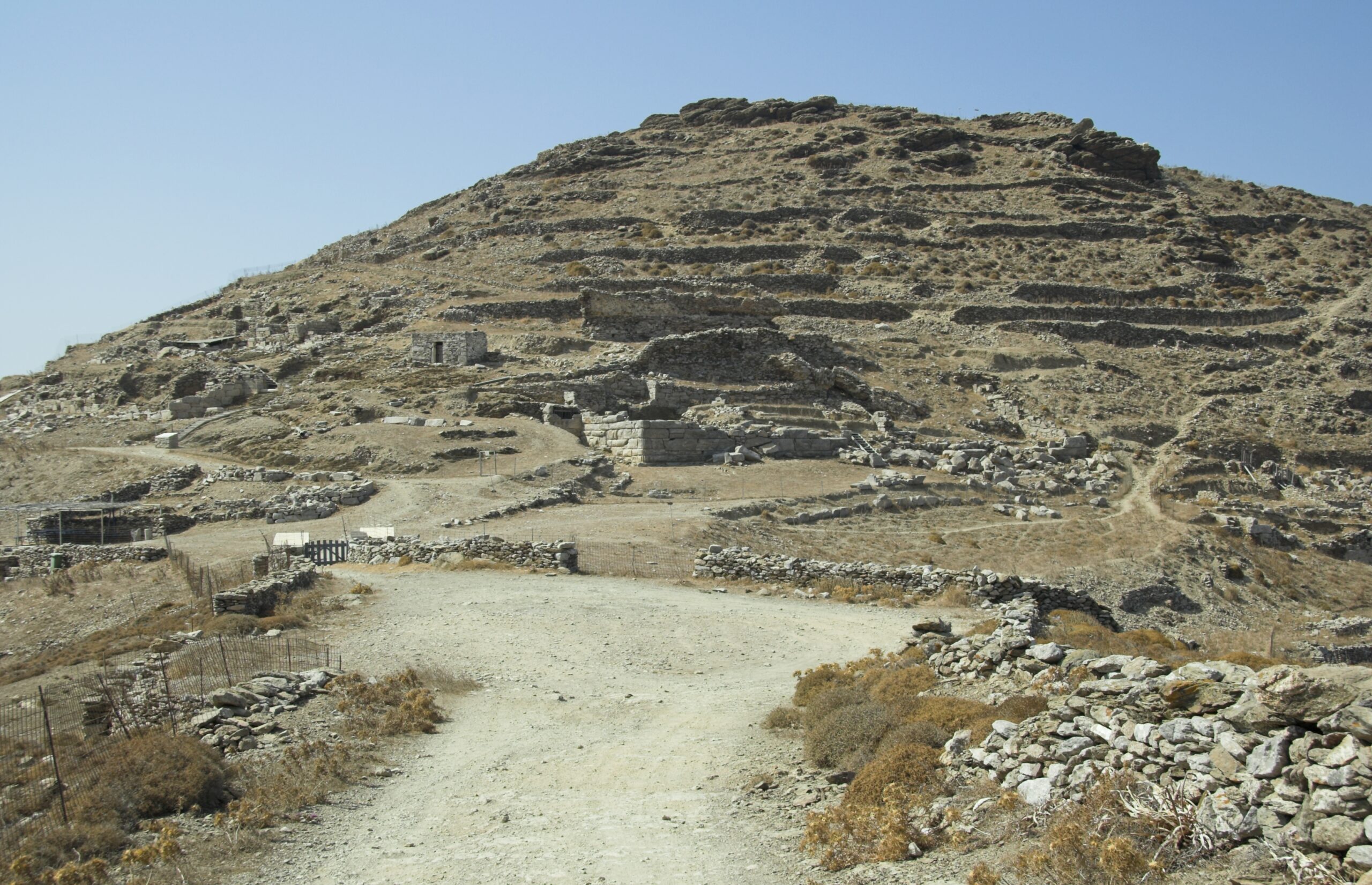
Ancient Minoa (Arkesini) — Archaeological Site
At the southern tip of the island, the ancient city of Minoa (near the modern village of Arkesini) dates to the Geometric and Classical periods of Greek history. Excavations have revealed a fortified ancient settlement, temples, and inscriptions. The site is less visited than the monastery but offers a meaningful counterpoint — a reminder that Amorgos was a significant civilisation centre long before Byzantine monks arrived.
Langada Village & Traditional Kafeneia
In the island’s interior, the village of Langada — accessible from Aegiali by a short drive or an enjoyable hike — is one of the most traditional settlements on the island. Its kafeneion is the genuine article: old men, backgammon, thick coffee, slow time. Visit in the late afternoon when the light comes sideways through the plane trees.
Tholaria & the Northern Villages
The cluster of villages above Aegiali — Tholaria and Potamos among them — sit at altitude with views over the northern bay. These are good destinations for a half-day walk from Aegiali, with enough traditional architecture and seasonal wildflowers to justify the climb.
Kato Meria — The Wild Western Region
The southwestern end of the island, known as Kato Meria, is Amorgos at its most remote. The road becomes rough and traffic thins to almost nothing. The landscape here is dramatic and largely undeveloped — rocky hillsides, scattered chapels, and a coastline that sees very few visitors even in high season. For travellers who find the monastery area busy, Kato Meria offers a different kind of solitude.
Best Time to Visit Amorgos
Summer Season (June–September)
High summer on Amorgos is warm, dry, and reliably beautiful. July and August bring the most visitors (still modest by Greek standards), the warmest sea temperatures (around 25–26°C), and the fullest ferry schedules. The island has enough space and quieter corners that even in peak season it does not feel overwhelmed.
Late August is particularly special: the Festival of Panagia Hozoviotissa — one of the most important religious celebrations on the island — takes place around the Dormition of the Virgin (15th August) with services continuing into late August. The monastery hosts pilgrims from across Greece, and the whole island takes on a more devotional, festive atmosphere. If you want to experience Amorgos at its most culturally alive, this is the moment.
Our September guide to Greece makes the case for late summer and early autumn as the sweet spot across the Greek islands — Amorgos is one of the best examples of why that argument holds.
Shoulder Seasons (May & October)
May and October are excellent months to visit Amorgos if you are not dependent on guaranteed swimming weather. Temperatures are mild and pleasant (22–26°C in May, slightly cooler in October), the sea remains warm enough for comfortable swimming in both months, and the island is quieter, greener (May), and more golden (October). Some smaller tavernas and accommodation options may operate on reduced schedules.
Winter (November–April)
Winter on Amorgos is genuine island life at its most unvarnished. Ferry connections are reduced to a few weekly services, most tourist-facing businesses close, and the island belongs again to its residents. Some travellers specifically seek this out — a winter week on Amorgos, with empty trails, cold light, rough seas, and the feeling of being somewhere that has pulled up its drawbridge. If this appeals to you, book accommodation carefully, as options are very limited.
Practical Travel Tips
Where to Stay: Katapola, Chora, or Aegiali?
Your base choice shapes your experience significantly:
- Katapola works best for families, ferry arrivals and departures, and those who want easy access to both the monastery and Chora. A range of accommodation from budget rooms to small guesthouses is available.
- Chora is the atmospheric choice — staying in the village puts you at the heart of island culture, within walking distance of the best tavernas and the castle views. Several beautiful small hotels and traditional houses to rent are available here.
- Aegiali suits those who want a beach-centric, relaxed stay in the island’s quieter northern zone. Good for families and couples who want to settle in one place and explore from there.
Renting a Vehicle
Renting an ATV or a small car is strongly recommended for exploring beyond the main villages. The island’s roads are narrow, occasionally unpaved, and require some confidence, but having wheels opens up Kato Meria, the remote northern villages, and several beaches that are unreachable on foot in reasonable time. ATVs are available at both ports. Parking in Chora itself is limited — leave the vehicle at the lower car park and walk up.
Money & Practical Matters
- ATMs: Available in Katapola and Chora. There is no guarantee of ATM access in more remote areas, so carry adequate cash before exploring.
- Cash-only: Several smaller tavernas and local shops operate cash-only. Do not rely entirely on cards.
- Getting around: A local bus service connects Katapola, Chora, and Aegiali (with limited frequency). Taxis are available but scarce — book in advance for early morning ferry departures.
What to Pack
- Sturdy walking shoes or hiking boots — essential for the monastery steps, old paths, and rocky beaches
- Sun protection — the exposed cliff trails and open sea crossings offer no shade
- Modest clothing — required for the monastery; a light scarf or wrap is easy to carry
- Cash — for tavernas, local shops, and smaller accommodation
- Water bottle — refillable; the island is hot and trails are dry
A Suggested 4-Day Amorgos Itinerary
Day 1 — Arrival & Chora
Arrive by ferry at Katapola. Settle in, walk the seafront, eat lunch by the water. In the afternoon, take the bus or drive up to Chora. Explore the alleys, climb to the kastro for the sunset views, and find a table at one of the village tavernas for dinner. Order patatato if it is on the menu.
Day 2 — The Monastery & Agia Anna
Start early and drive to the monastery trailhead. Begin the 350-step ascent before 9am to beat the heat. Visit the monastery, accept the raki and fritters, stand in silence and look out to sea. Descend and walk the short path to Agia Anna beach for a swim before noon. Afternoon rest. Evening in Chora.
Day 3 — Hiking Day
Choose your trail: the Old Strata for a serious day’s walking, or the Chora–Katapola kalderimia for a more relaxed morning. Pack water, start early. Afternoon swim at one of the southern beaches. Sundowner at a clifftop spot above Katapola.
Day 4 — Aegiali & Departure
Head north to Aegiali. Morning swim at the sandy beach. Explore Langada village on foot. Lunch in Aegiali before making your way back to catch the afternoon or evening ferry.
Conclusion: Why Amorgos Deserves Your Next Greek Adventure
Amorgos does not try to be everything to everyone. It cannot be — and that is its greatest strength. The island that has no airport, no mass market, and no interest in softening its edges for the sake of convenience is exactly the island that reminds you why you came to Greece in the first place.
The monastery will stay with you. Not just the image of it — though that image, that sliver of white against orange rock above blue infinity, is one of the most arresting things you will see in the Aegean — but the feeling of climbing toward it in early morning silence, the monks’ quiet hospitality, the sense of something that has endured for a thousand years and will endure for a thousand more.
The psimeni raki will stay with you. The patatato. The trails that follow paths older than Greece as a modern nation. The Agia Anna cove and the specific, unduplicatable blue of the water there.
And the knowledge, which is its own kind of gift, that you have found the real thing.
Like Karpathos, Amorgos belongs to that rare category of Greek islands — those without airports, without easy access, and without the ambition to compete for the crowds — that have preserved something genuinely irreplaceable. The ferry journey is not an inconvenience. It is the beginning of the transformation.
Book your ferry through Ferryhopper and start planning. Amorgos is ready when you are — and unlike most of the Aegean, it will not have been altered by the time you arrive.