Tinos: Marble Villages, Pilgrimage & the Artistic Soul of the Cyclades
While Mykonos parties and Santorini poses, Tinos creates. This small Cycladic island, just a 30-minute ferry ride from its glittering neighbor, is one of the most profoundly layered places in all of Greece — a place where ancient marble tradition and Orthodox pilgrimage weave together so tightly that separating one from the other feels almost impossible. Here, artisans still carve stone as their great-grandparents did. Here, devout pilgrims crawl on their knees up a marble-paved street to touch a sacred icon. Here, in valleys scattered with hundreds of geometrically patterned white towers, you begin to understand that even humble pigeon houses can be works of art.
Tinos is the Cyclades’ best-kept secret — and quite deliberately so.
We arrived on an ordinary Tuesday afternoon in June, when the port was quiet and the ferry exhaust had barely cleared the air. Within two hours, we were standing in a marble square, watching an old man carve stone in a doorway, and we already knew: Tinos had claimed us.
The Marble Sculpture Tradition: From Chalepas to the Present Day
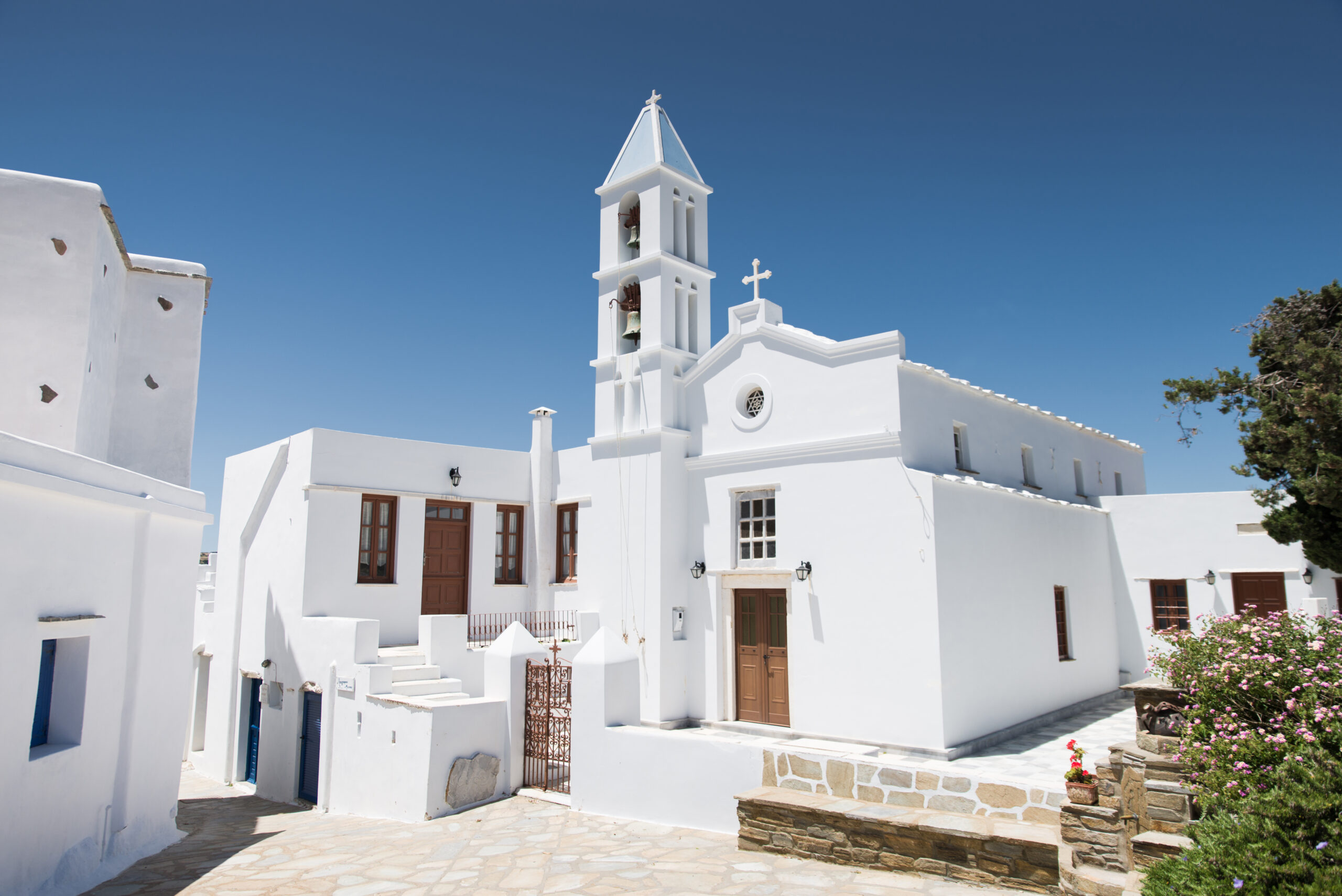
Long before tourism discovered the Cyclades, Tinos was already famous — but for marble, not beaches. The island sits atop one of the finest white and grey marble deposits in Greece, and for centuries, Tinian stone-carvers supplied churches, civic squares, and private homes across the Aegean with some of the most refined decorative marble work in the Greek world.
The tradition reached its zenith in the 19th century with the birth of Giannoulis Chalepas (1851–1938), Tinos’s greatest son and the man often called the “Greek Rodin.” Born in Pyrgos to a family of marble hewers, Chalepas showed such exceptional talent that the Foundation of Panagia Evangelistria funded his studies in Munich, where he went on to produce work that stunned European critics. His masterpiece, The Sleeping Girl (1878), displayed at the First Cemetery of Athens, is considered among the finest sculptures of 19th-century European neoclassicism — and yet Chalepas spent much of his later life back in Tinos, in quiet obscurity, carving in a village workshop.
The legacy Chalepas left behind is not merely a museum exhibit. In Pyrgos, the marble carving school remains operational. Young sculptors still learn to read stone the way their predecessors did — by listening to it, feeling where it wants to split, discovering the shape within. Visitors can find working studios throughout the village where this living tradition continues. The National Gallery of Greece holds several Chalepas works and has featured retrospectives of Tinian sculpture that underscore just how significant this small island’s contribution to Greek art truly is.
If you come to Tinos expecting whitewashed villages and Instagram sunsets, you will find those too. But if you stay long enough to visit a marble workshop, watch hands coaxing form from stone, and understand that this island has been making beauty since before Greece existed as a modern state — then Tinos will give you something far richer.
Pyrgos: The Marble Village That Earns Every Superlative
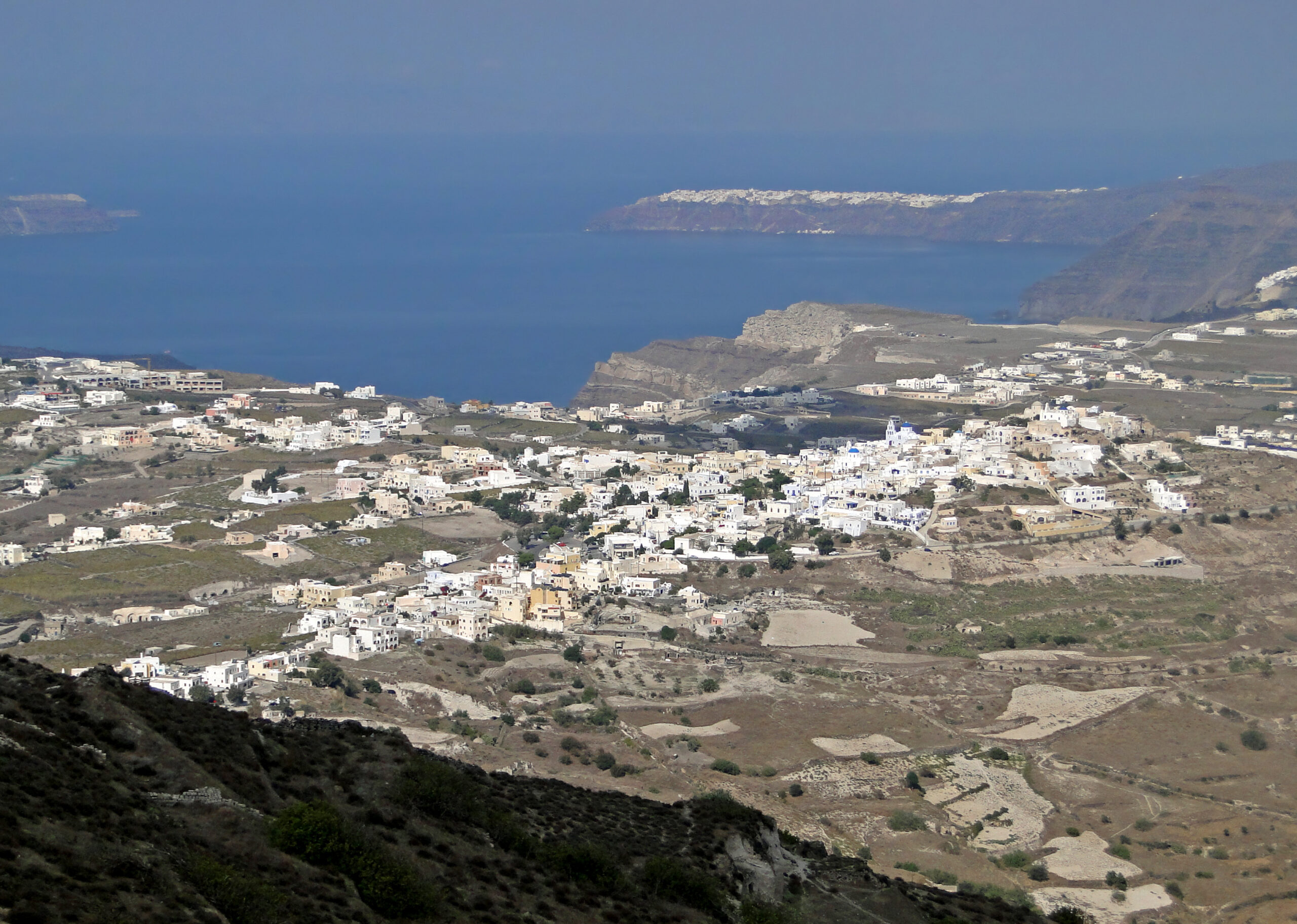
Fifteen kilometers northwest of Chora, the village of Pyrgos sits quietly in the Tinian hills as if it has never needed the world’s attention. It is an entirely marble village — and we mean that almost literally. The square is marble. The church facades are marble. The fountains, the lintels, the decorative friezes on every other building: marble. Even the graves in the village cemetery are marble-carved tributes to the island’s central art.
The square itself carries remarkable history. Pyrgos was one of the flashpoints of the Greek Revolution in 1821, and the plane tree that shades its marble paving has watched nearly two centuries of Tinian life pass beneath its branches. Sit here over a long lunch and you will understand why Greeks have always placed the plateia — the square — at the emotional center of village life.
The Museums of Pyrgos
Pyrgos holds an unusually high concentration of cultural institutions for a village of 300 winter residents. The Museum of Marble Crafts covers the full arc of Tinian stone-working — from ancient quarrying techniques to modern artisan tools — with enough hands-on exhibit detail to satisfy serious art history enthusiasts and curious travelers alike. The Tinian Artists Museum and the Giannoulis Chalepas Museum complete a trio that, taken together, offer a remarkably complete portrait of one island’s singular artistic identity.
For most visitors, though, the real museum is the village itself. Walk slowly. Look at how marble is integrated not just into decorative flourishes but into the fabric of daily life — how a street corner becomes a small architectural event, how a simple doorway might carry carved vines or geometric motifs that took a craftsman weeks to complete. This is not ornamentation for its own sake. This is a culture expressing itself through the material it knows best.
Visiting Pyrgos
Come in the morning, when the marble gleams cool and pale before the sun has had time to warm it to gold. Visit the working studios — some require advance contact, but many welcome walk-ins during summer months. Have lunch in the square. Stay longer than you planned. Pyrgos almost guarantees you will.
Dovecotes: Masterpieces of Folk Sculpture Hidden in the Hills
Nothing quite prepares you for the dovecotes. You’re driving along a Tinian valley road, olive groves on one side, dry stone walls on the other, and then suddenly there they are — white towers rising from the hillside, their facades covered in geometric patterns so intricate and deliberate that you stop the car and get out, because these cannot possibly be mere pigeon houses.
They are not. The peristerionia (dovecotes) of Tinos are one of the most remarkable expressions of folk art in the Aegean world. Tinos has over a thousand of them — more than any other Cycladic island — and no two are alike. Each one carries the geometric signature of the family that built it: triangular, rhomboid, and diamond motifs arranged in patterns that speak of Venetian influence, Byzantine geometry, and something uniquely Tinian that scholars are still struggling to fully define.
A Democratic Architecture
During the Venetian period, only wealthy landowners were permitted to build dovecotes. After Ottoman rule loosened that restriction, the peristerionia proliferated across the island’s valleys and slopes — a democratic explosion of folk architecture, each family building its own tower as a statement of presence, of pride, of aesthetic ambition. The function was practical: pigeon meat and manure for crops. But the expression was always something more.
The towers typically rise two or three stories. The lower level stores grain and tools. The upper level — elaborately patterned and ventilated — is designed with a craftsman’s attention to both functionality and beauty. They were positioned on slopes sheltered from the fierce meltemi winds, near water sources, oriented so that morning light caught their white facades just so.
Finding the Dovecotes
The highest concentration is around Tarambados, in the central valley. But scattered throughout the island’s interior, almost every hillside drive yields new encounters. The best light is morning. The best experience is to walk among them slowly, close enough to read the patterns — geometric storytelling from families whose names are mostly lost, but whose aesthetic sensibility survives in stone and lime.
The Museum of Cycladic Identity (CODE 21 project) has been documenting Tinos’s peristerionia as endangered cultural heritage, and the ARTdovecotes gallery has given new life to the tradition by using renovated dovecotes as contemporary exhibition spaces — a conversation between centuries that somehow works perfectly on this island.
Standing in the Tarambados valley at nine in the morning, the sun still low, the dovecotes catching the first light — it struck us that Tinos is a place where beauty was never meant to be obvious. You have to walk toward it.
Panagia Evangelistria: Pilgrimage & the Spiritual Heart of the Island
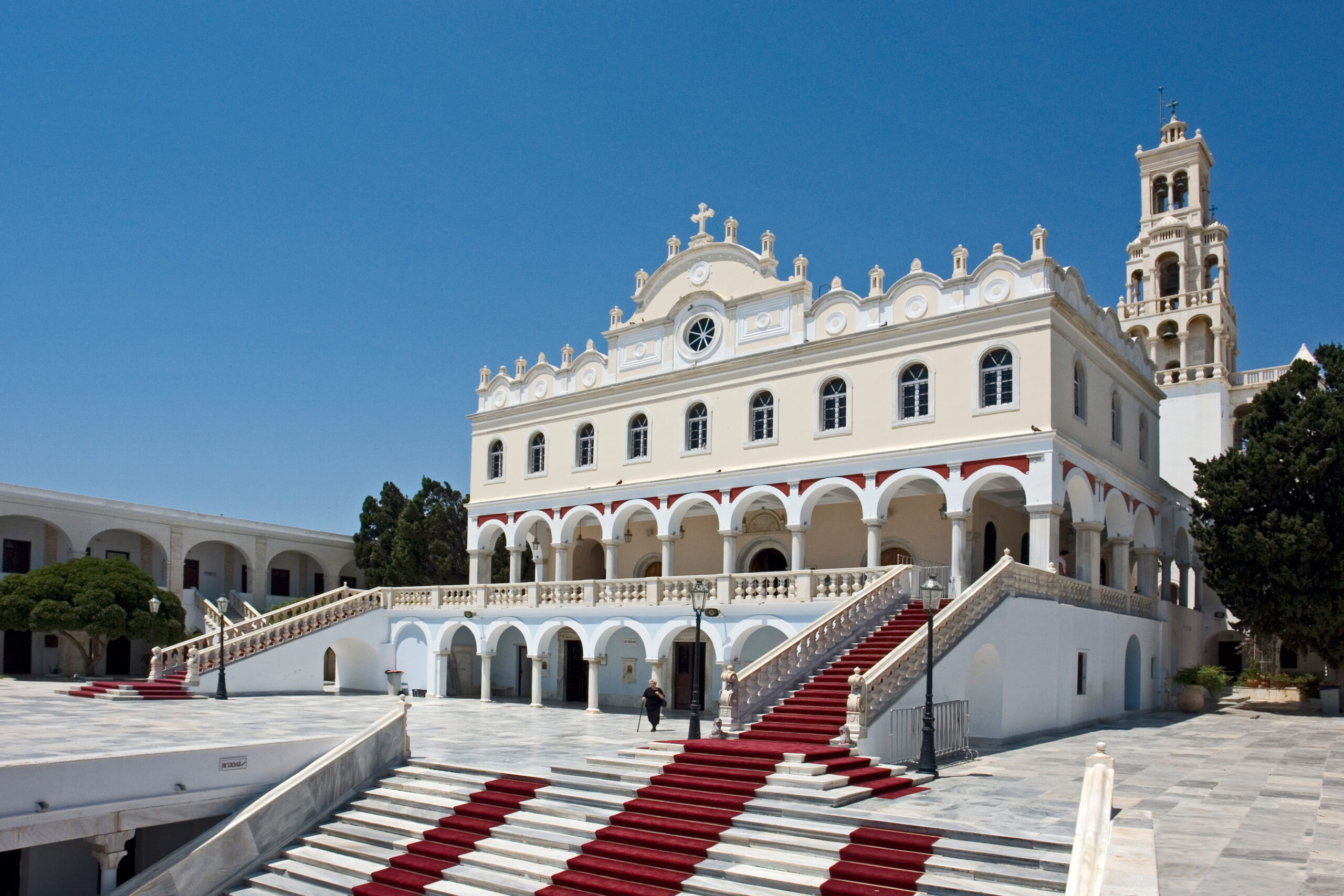
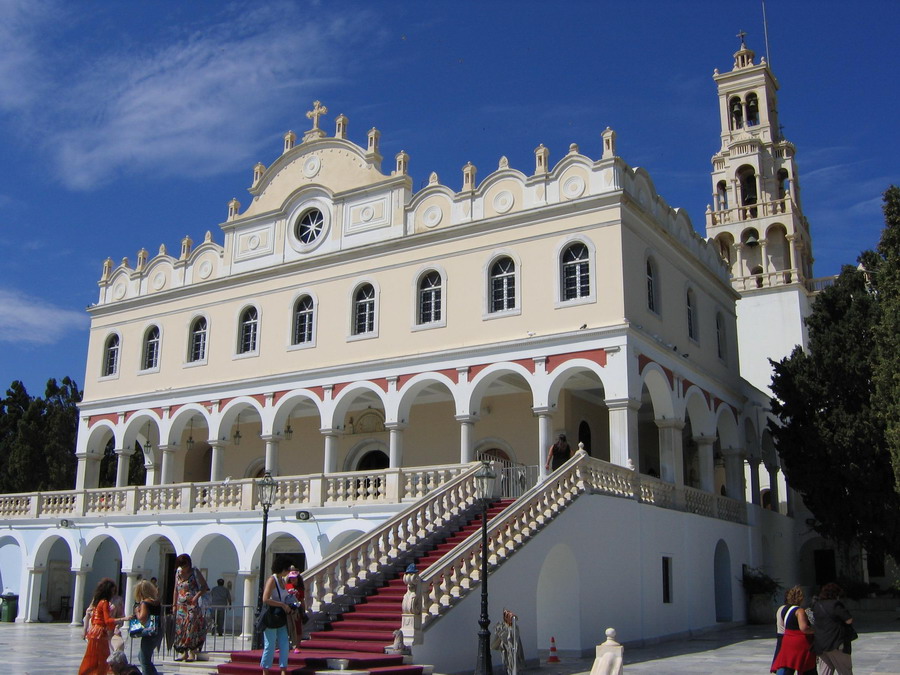
The moment you step off the ferry in Tinos Town, you understand that this is not just another Cycladic port. A wide marble-paved street rises straight up from the waterfront — the Megalocharis Street — and at the top of it stands the church of Panagia Evangelistria, its white neoclassical facade visible from the sea. On ordinary days, streams of visitors move up that street with the particular purposefulness of pilgrimage. On August 15th, the Feast of the Dormition, thousands of pilgrims from across Greece and the Orthodox diaspora arrive — some crawling the length of that marble road on their knees.
The Story of the Sacred Icon
The spiritual history of Tinos is inseparable from a single event: in 1823, the nun Pelagia reported visions directing her to a field where a sacred icon of the Virgin Mary lay buried. When the icon was unearthed, miraculous healings were reported almost immediately. Within seven years, a great church had been built to house it, and Tinos had become the most important Marian pilgrimage site in the Orthodox Christian world — Greece’s Lourdes, if you want a European reference point, though the comparison doesn’t fully capture the intensity of what happens here.
The icon — known as the Megalochari (Great Grace) — is encased in silver and gold and displayed in the church’s lower chapel. It is covered in thousands of offerings left by pilgrims: gold and silver votive objects, jewelry, photographs, and written prayers. To witness pilgrims approaching the icon is to understand that faith in Greece is not an abstraction. It is embodied, tactile, urgent, and deeply personal.
When to Visit
The main pilgrimage dates are January 30 (Finding of the Icon), March 25 (Annunciation), July 23 (Pelagia’s Vision), and the great feast of August 15 (Dormition of the Virgin). If you visit during August 15, come prepared for extraordinary crowds, overwhelmed ferries, and an atmosphere of spiritual intensity unlike anything else in the Aegean. If you prefer quiet contemplation, visit in spring or autumn — the church is open year-round, and even on quiet days, the sense of accumulated devotion inside is palpable.
Dress respectfully. Arms and shoulders covered. Take your time in both the main church and the lower chapel. Like the monastery of Panagia Hozoviotissa on Amorgos, Tinos’s pilgrimage center is a place where the sacred and the spectacular meet — and where even secular visitors find themselves moved.
Hidden Villages: Kardiani, Isternia, Volax & the Roads Less Traveled
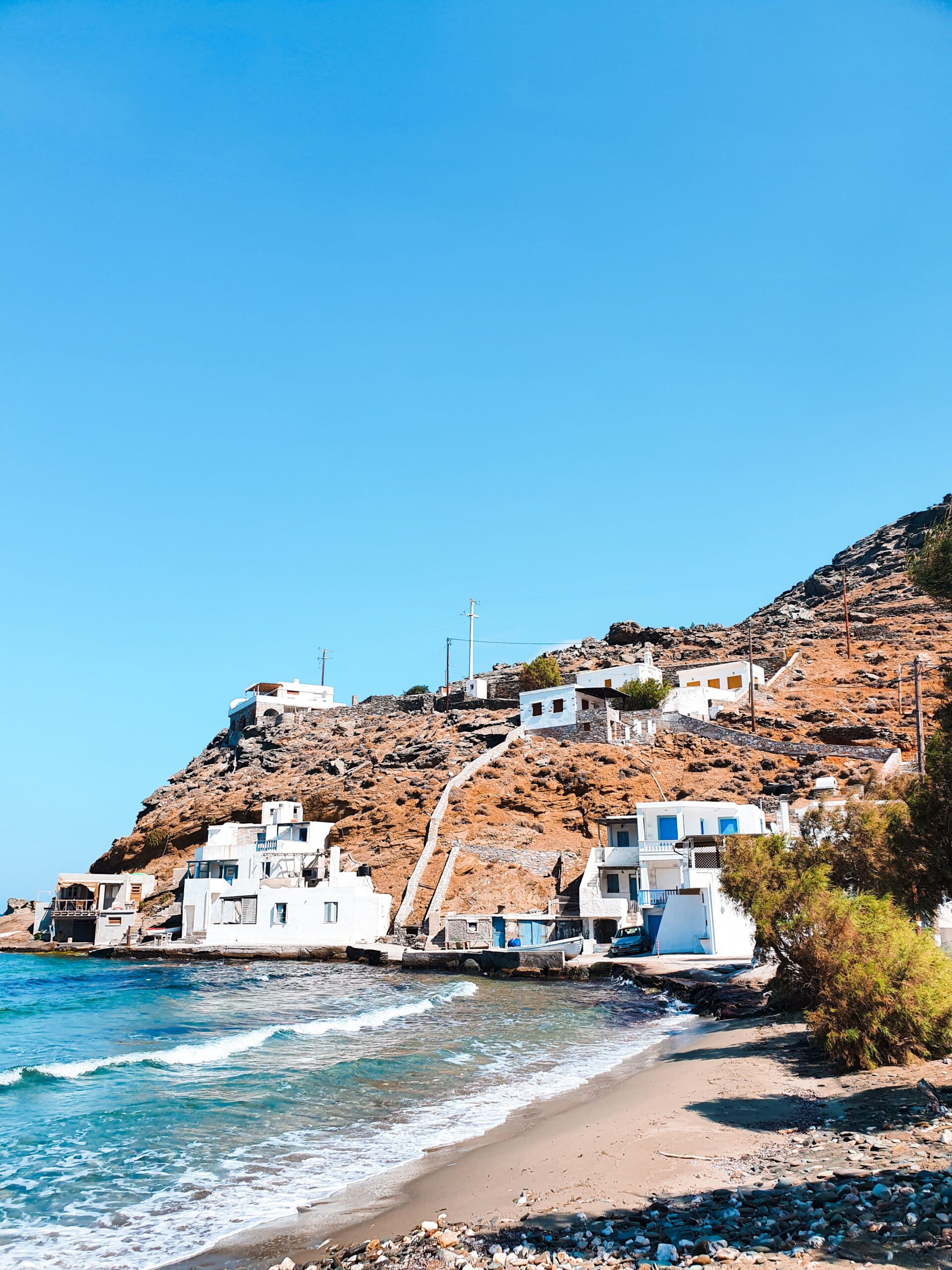
Beyond Pyrgos and Chora, Tinos unfolds into a landscape of villages that reward the traveler willing to leave the main roads. This is a geographically diverse island — marble mountains, fertile valleys, exposed northern coasts, sheltered southern bays — and its 40-plus villages each carry a distinct character shaped by location, tradition, and the particular way Tinian communities have always defined themselves through architecture and craft.
Kardiani
Perched on a steep hillside overlooking the northeastern coast, Kardiani is one of those villages that photographers fall into and struggle to leave. Whitewashed houses cascade down toward the sea, with the small beach of Giannakis Bay glimmering below. The village has attracted artists and gallery owners for decades, and its quiet streets carry a creative atmosphere that feels lived-in rather than performed. There’s accommodation here too — if you want a village base with sunset views and fewer tourists than Chora, Kardiani is hard to beat.
Isternia
On the western coast, in the heart of Tinos’s marble quarry territory, Isternia is quieter and less developed than its more famous neighbors. The village has a ceramics tradition — pottery workshops dot the streets — and a genuine slowness of pace that makes it ideal for travelers who have had enough of organized tourism. Spring water features in Isternia’s village design; the sound of water running through marble channels is one of the small pleasures of arriving here. The beach is accessible via walking trail.
Volax
Nothing in the Tinos landscape prepares you for Volax. In a small valley in the island’s north-central interior, enormous rounded granite boulders — some as large as houses — are scattered across the terrain as if deposited by a giant in some ancient geological fit. The village sits among these boulders, its houses built between and around them, creating an otherworldly landscape that has no parallel in the Cyclades. Hiking trails wind through the boulder fields. Photographers rarely shoot a bad frame here. Volax is unknown enough that most visitors to Tinos never find it — which is exactly why you should.
Like Folegandros, Tinos offers this kind of genuine village experience beyond the tourist circuit — places where the island’s real texture is preserved because visitors haven’t yet arrived in sufficient numbers to smooth it away.
Hiking Tinos: Trails Through Marble, Villages & Sacred Ground
Tinos has 152 kilometers of marked hiking trails spread across 12 thematic routes, maintained by the dedicated team at Tinos Trails. This is not a fact that most travel guides lead with, but it should be — because hiking Tinos is one of the finest ways to understand the island’s layered character.
The Road of the Marble (Route E3)
Route E3 is the essential walk for anyone interested in the marble tradition. An easy-to-moderate trail, it connects marble villages and quarries, weaving through landscapes where the raw material of Tinos’s art lies exposed — veined, luminous, occasionally still bearing the marks of centuries-old quarrying. Stops include Pyrgos and working marble workshops. This is hiking as art history, geology lesson, and cultural immersion combined.
Road of Water & Castle (Route M4)
This medium-difficulty route climbs to the ruins of Exomvourgo, the medieval Venetian-era castle that sits atop a 640-meter conical hill in the island’s center. The panoramic views from the summit — Mykonos to the south, Syros to the west, the full sweep of the Cyclades — are extraordinary. The route passes through villages, spring water sources, and agricultural terraces that have barely changed in a century. Rock climbers should note that Exomvourgo also offers established climbing routes rated 5b through 7b+.
From Sea to Sky (Route T2)
The most demanding of the featured routes: 12.5 kilometers, five hours, significant elevation gain. It connects coastal villages to mountain peaks, and the reward — a 360-degree panorama of the Cyclades — is earned rather than given. This is a route for experienced hikers with good footwear, adequate water, and an early start.
Practical Hiking Notes
The best seasons are April to May and September to October. Summer heat makes lower-elevation trails genuinely uncomfortable, and navigation can be challenging when trail markers fade in the sun. Always carry more water than you think you need. The official Tinos Trails website provides downloadable maps and difficulty ratings. AllTrails also lists user-reviewed routes with GPS tracking.
Beaches: Swimming in the Aegean with Character
Tinos is not primarily a beach destination — but its beaches are excellent, less crowded than Mykonos, and far more varied in character than most visitors expect. Unlike the geological drama of Milos’s moon-like shores, Tinos offers a softer coastal palette: emerald coves, sheltered family bays, and a working fishing harbor where the catch arrives fresh every morning.
Kolymbithra
The north coast’s showpiece: two distinct bays side by side, separated by a narrow rocky promontory. The larger bay is organized with sunbeds and a taverna; the smaller one is sheltered, quieter, and excellent for snorkeling among rock formations. The water color — deep emerald shifting to turquoise over white sand — is genuinely spectacular. Kolymbithra can catch the summer meltemi wind, which occasionally creates surf conditions that swimmers should be aware of.
Agios Fokas
On the eastern coast, a small pebble beach with very calm water, ideal for families or those who prefer swimming without waves. Nearby tavernas serve straightforward, honest food. The village atmosphere here feels untouched by mass tourism.
Pachia Ammos
Near Isternia on the western coast, this sandy beach catches the setting sun directly — a west-facing position that makes it one of the island’s finest spots for a late-afternoon swim followed by one of those long Aegean sunsets that seem designed specifically to make you reconsider all your life priorities.
Panormos
Less a swimming beach than an essential Tinos experience: Panormos is a working fishing village whose harbor hosts the island’s daily catch. Seafood restaurants serve what came in that morning — red mullet, grouper, whatever the sea offered. Locals outnumber tourists here. Eat slowly. Order more than you planned.
Food & Culinary Traditions: Island Terroir Expressed
Tinian cuisine is, in the best possible sense, an expression of the island’s geography and history. This is a place where agriculture was always shaped by stone — marble-rich soil, terraced hillsides, spring-fed valleys — and the food reflects that particular character. Like Sifnos’s quietly celebrated culinary heritage, Tinos rewards food-focused travelers who are willing to explore beyond the port’s tourist tavernas.
The Tinian Artichoke
If you visit in spring (April or May), the small Tinian artichoke is the island’s signature ingredient — a rare variety grown in the fertile Komis plain, sweeter and more delicate than the large globe artichokes most travelers know. The local preparation of choice is artichoke gratin: artichokes combined with bread, egg, and local cheese and baked to a golden crust. It is simple, seasonal, and completely specific to Tinos. Food writers including Diane Kochilas have recognized this dish as one of the authentic expressions of the island’s culinary identity.
Cheese Heritage
Tinos produces several remarkable cheeses. Kopanisti is a soft, peppery cow’s milk cheese with a flavor that builds slowly and stays with you. Volaki is a fresh cow’s milk cheese shaped in cloth — the word comes from volos, the cloth used in production. Graviera is the island’s harder aged variety, nutty and excellent with the island’s honey. The cheese tradition is ancient — documented in Byzantine-era records — and modern production continues in small dairies throughout the island’s interior.
Louza & Seafood
Louza — a spiced cured pork loin, baked and aged according to family recipes — is the island’s most distinctive meat product. Sliced thin and served as part of a mezze platter, it carries a depth of flavor that speaks of winters, slow fires, and the kind of food culture that predates refrigeration by centuries. In Panormos, the seafood takes over: barbounia me kapari (red mullet with capers and tomatoes) is the classic preparation, and on a good day, you’ll eat the freshest mullet of your life.
Traditional Sweets
Tsimbites — small pinched cheese cakes from an ancient recipe — and pasteli (sesame-honey confection) represent the island’s sweet tradition. Both are made locally, both are considerably better than they sound, and both disappear from bakery shelves faster than they’re replenished during peak season.
Contemporary Art & Culture: The Living Tradition
The marble tradition has not calcified into nostalgia. Tinos’s artistic identity is very much alive — and increasingly, that life takes contemporary forms.
ARTdovecotes Gallery
Perhaps the most inventive cultural project on the island: ARTdovecotes uses restored dovecotes as exhibition spaces for contemporary art — painting, sculpture, photography, video, and multimedia installations. The concept is quietly brilliant. The peristerionia, already folk sculpture in themselves, become containers for new creative expression. Exhibitions change seasonally; check the schedule before visiting, as the programming can be exceptional.
The Living Artist Community
Tinos has attracted younger artists drawn by the island’s cultural weight, relative affordability, and the particular quality of light that has always made the Cyclades hospitable to visual art. Studios are scattered throughout the villages — some accessible by appointment, some with open hours during summer. The Museum of Marble Crafts in Pyrgos bridges traditional and contemporary, presenting marble-working techniques alongside newer artistic applications of the material.
Workshops in marble carving basics, pottery, and painting are available through several studios and cultural centers during the summer months. For travelers who want to do more than observe, Tinos offers genuine hands-on engagement with living craft traditions.
There is a particular quality to islands that create rather than merely attract — a seriousness beneath the beauty, a sense that the place has its own purpose independent of the visitor’s gaze. Tinos has this quality in abundance. It is one of the reasons we keep returning.
Cultural Events Calendar
Summer brings a constellation of exhibitions, artist residencies, music performances (in churches, squares, and tavernas), and occasional theater productions in Chora. The pilgrimage calendar — January 30, March 25, July 23, August 15 — structures the island’s year in ways that secular festivals cannot match. Even if you are not Orthodox, arriving for one of the smaller feast days gives you an insight into Greek religious culture that no museum can replicate.
Practical Planning: When to Go, How to Get There & Where to Stay
When to Visit
The honest answer is: almost any time except deep winter. But the seasons offer very different experiences:
- Spring (April–May): The ideal season for hiking, artichoke gastronomy, and wildflower landscapes. Crowds are manageable; the light is extraordinary; temperatures are perfect for walking.
- Summer (June–August): Warm and reliable, but crowded in July and August — especially around August 15. Book accommodation far in advance for the Dormition feast.
- Autumn (September–October): Warm seas, thinning crowds, and still-accessible ferry connections. September in Greece offers particular value for travelers who want summer without the summer crowds.
- Winter (November–March): Cold, windy, and quiet. Many businesses close. For those seeking absolute solitude and a glimpse of island life without the tourist layer, the risk is worth considering — but this is genuinely off-season travel.
Getting There
Tinos has no airport. All access is by sea — which, frankly, is part of its appeal. Ferry connections from Piraeus (Athens) take 3–4 hours on a conventional ferry or slightly less on a catamaran. From Mykonos — the inevitable comparison point — it’s just 30 minutes by ferry, making Tinos an effortless island-hopping addition or even a day trip (though Tinos deserves far more than a day). From Andros, the journey takes around 45 minutes.
Ferry frequency is high in summer; book in advance for August, especially around the 15th. Off-season schedules reduce but do not eliminate connections. Blue Star Ferries and SeaJets are the main operators.
Getting Around
A rental car is essentially required for serious village exploration — the island’s interior roads are small, winding, and often gravelled, and the villages that matter most to Tinos’s character are spread across mountains and valleys that buses don’t adequately serve. ATVs and scooters work well on shorter routes. Chora itself is walkable; hiking trails are marked.
Unlike Hydra, where the absence of cars is a defining feature, Tinos benefits from having wheels — the island’s scale and topographic variety reward mobility.
Where to Stay
Accommodation choices reflect the island’s range of character:
- Chora (Tinos Town): The largest selection of hotels and apartments; best for ferry access and pilgrimage proximity.
- Pyrgos: Traditional marble-village atmosphere; fewer amenities but exceptional atmosphere. Ideal for art-focused travelers.
- Kardiani: Small hotels with artist-village energy and sunset views.
- Isternia: Quiet; ceramics workshops nearby; for slow travelers who want to disappear into the island.
- Panormos: Fishing village authenticity; limited options but genuinely local atmosphere.
- Kolymbithra area: Beach proximity; practical for families focused on swimming.
A recommended approach: spend 2 nights in Chora (pilgrimage sites, practical base) and 1–2 nights in a village (Pyrgos or Kardiani for artistic immersion). This gives you both the island’s spiritual gravity and its quieter, more contemplative character.
Budget Notes
Tinos is meaningfully cheaper than Mykonos or Santorini and broadly comparable to Naxos. Budget accommodation runs €50–70 per night; mid-range €80–150; village villas €150+. Lunch in a taverna costs €12–20; dinner €15–30. Hiking is free. Museums charge €3–5 per person. Guided marble workshops run €40–80. The ferry-only access means no Ryanair syndrome — every visitor to Tinos has chosen to come here, which shows.
A Suggested 4-Day Itinerary
Day 1 — Chora & Pilgrimage: Arrive by ferry; settle in. Visit Panagia Evangelistria (allow 90 minutes for the full experience). Walk the marble-paved Megalocharis Street down to the waterfront. Explore Chora’s central market for cheese, louza, and pasteli. Dinner at a local taverna.
Day 2 — Marble & Art: Drive or join a tour to Pyrgos. Visit the museums (Museum of Marble Crafts, Chalepas Museum); allow half a day. Lunch in the marble square. Afternoon: browse working studios; visit the Tinian Artists Museum. Return at golden hour when Pyrgos’s marble gleams warmest.
Day 3 — Hiking & Hidden Villages: Early start for Route E3 (The Road of the Marble) or the M4 route to Exomvourgo. Village lunch somewhere off the main road. Afternoon exploration of Kardiani or Volax (for the extraordinary boulder landscape). Sunset from the hillside.
Day 4 — Beaches & Dovecotes: Morning at Kolymbithra for swimming and snorkeling. Afternoon: dovecote photo safari in the Tarambados valley. Last-minute shopping in Chora. Evening ferry, or extend — Tinos has a way of making departure feel premature.
Tinos sits in the northern Cyclades, connected to Athens by ferry and to the neighboring islands of Mykonos, Andros, and Syros. It is part of one of the most rewarding island chains in Greece — a chain that includes Amorgos to the southeast, Folegandros further south, and Sifnos beyond that. Together, they form an argument that the Cyclades, beyond the famous two, are where Greek island travel finds its truest character.