Most Greek islands sell you a coastline. Chios sells you something rarer: a complete civilisation built around a single tree. The mastic tree — a species of pistacia that grows across the Mediterranean but only produces its aromatic resin here, in the fortified medieval villages of southern Chios — has shaped the island’s architecture, cuisine, economy, and even its survival through centuries of foreign rule. It is one of the few places in Greece where the landscape tells a story you cannot find replicated anywhere else.
The fifth-largest Greek island by area, Chios sits in the North Aegean just eight kilometres from the Turkish coast. It receives a fraction of the visitors that descend on the Cyclades or Crete, partly because it has never tried to market itself as a beach destination, and partly because its most compelling attractions — geometric sgraffito facades, an 11th-century UNESCO monastery, a ghost village clinging to a cliff — require time and curiosity rather than a sunbed. Travellers who reach Chios tend to return, and they tend to have strong opinions about why the rest of Greece should pay attention.
An Island That Rewards the Curious
Chios does not compete with Mykonos for nightlife or Santorini for sunsets. Its strength is depth — layers of Genoese, Byzantine, and Ottoman history pressed into stone, a harvest tradition unchanged since the 14th century, and a coastline that ranges from volcanic black pebbles to shallow sandy bays. If you travel to understand places rather than just see them, Chios belongs near the top of your Greek island list.
| Location | North Aegean, 8 km from the Turkish coast |
| Size | Approximately 842 km² — Greece’s fifth-largest island |
| Population | Around 51,000 residents |
| Known for | Mastic resin, medieval villages, Nea Moni monastery (UNESCO), volcanic beaches |
| Best time to visit | May to October, with June and September offering the best balance |
| Getting there | 50-minute flight from Athens (Aegean, Sky Express) or 7–10 hour ferry from Piraeus |
| Car needed? | Yes — essential for exploring mastic villages, beaches, and the north |
| Ideal duration | 4–5 days minimum, 7 days to explore thoroughly |
Who Chios Is Best For — and Who Should Look Elsewhere
Chios suits travellers who have visited Greece before and want something the popular islands cannot offer. It is an excellent choice for anyone drawn to medieval architecture, agricultural heritage, Byzantine art, or food with genuine regional identity. Couples looking for a quiet, culturally rich holiday will find the pace ideal, and the island works well as part of a longer North Aegean itinerary combined with Lesvos or Thasos.
It is less suitable for travellers whose priority is a polished beach-resort experience. The beaches are good — some are very good — but they are not the manicured stretches of the Cyclades or the Ionian coast. Nightlife is limited to a few waterfront bars in Chios Town, and accommodation options outside the capital and Karfas remain relatively modest. Families with young children can enjoy Chios comfortably, particularly around the shallow beaches of Komi and Lithi, though they should expect to drive between activities. If you want an island where everything is walkable from your hotel, look at Hydra instead.
Best Time to Visit Chios
The island is at its best from May through October. June and September offer warm sea temperatures, manageable heat, and fewer visitors than July and August. The mastic harvest takes place from late August through October, and visiting during this period adds a layer of agricultural activity that makes the southern villages feel particularly alive.
July and August bring peak temperatures that regularly reach 35°C, and the meltemi wind can blow strongly from the north, making some northern beaches uncomfortable while sheltering the south coast. Spring — particularly April and May — is excellent for hiking and wildflowers, though some seasonal businesses may not yet be open and the sea is still cool for swimming.
Winter is quiet. Many tourist-oriented businesses close, ferry frequency drops, and some village services operate on reduced hours. That said, Chios has a year-round population and the town remains functional, making it viable for off-season cultural travel if you are not chasing warmth.
The Mastic Villages: Eight Centuries of Living Architecture
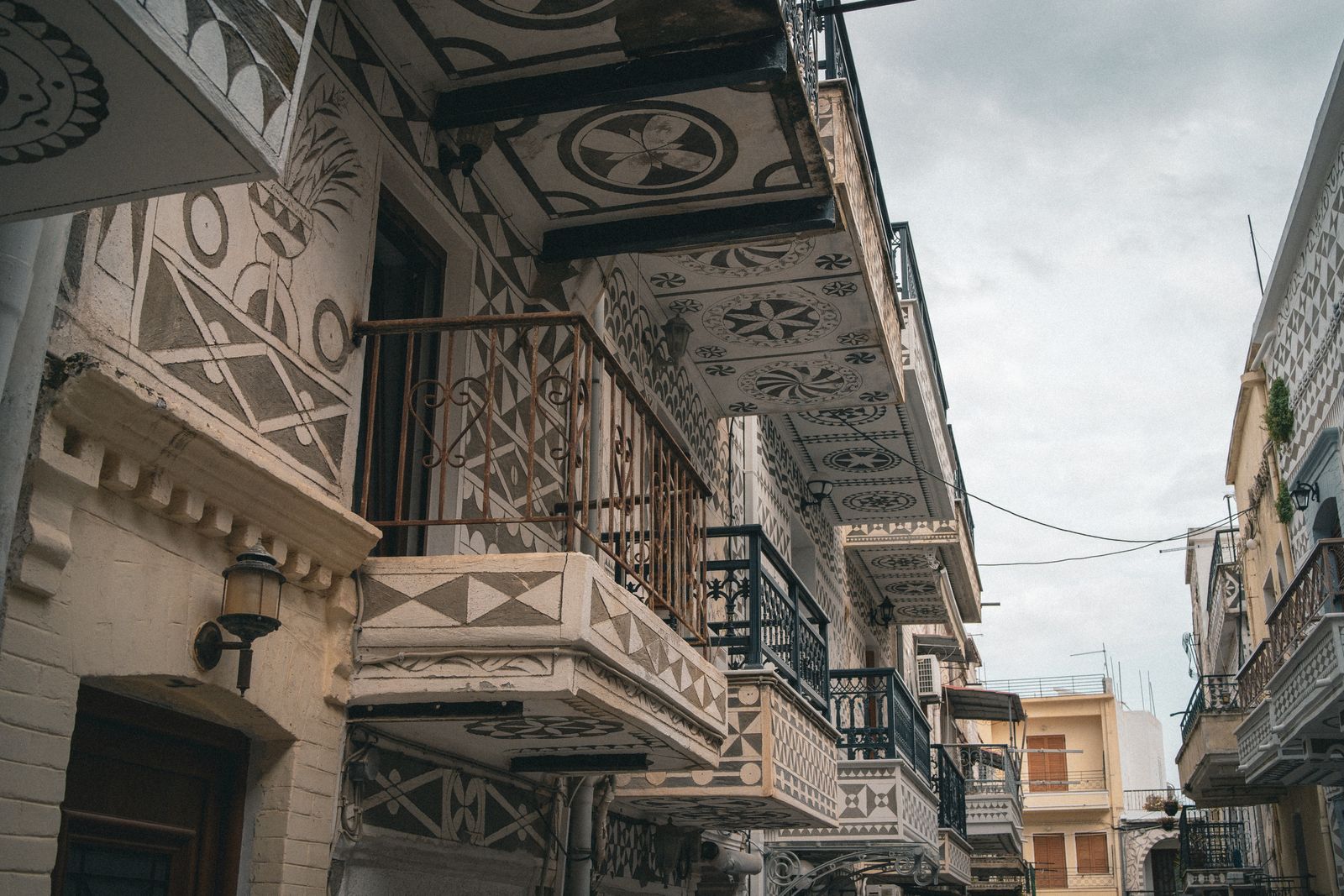
The Mastichochoria — literally “mastic villages” — are a cluster of roughly twenty medieval settlements in southern Chios that were built during Genoese rule in the 14th century. Their purpose was specific and practical: to house the families who cultivated mastic, a resin so valuable it was sometimes called “white gold,” and to protect them from the pirate raids that plagued the Aegean throughout the medieval period.
The result is some of the most architecturally distinctive villages in Greece. Three stand out for visitors, though a full circuit of the area reveals quieter settlements worth exploring on a second day.
Pyrgi
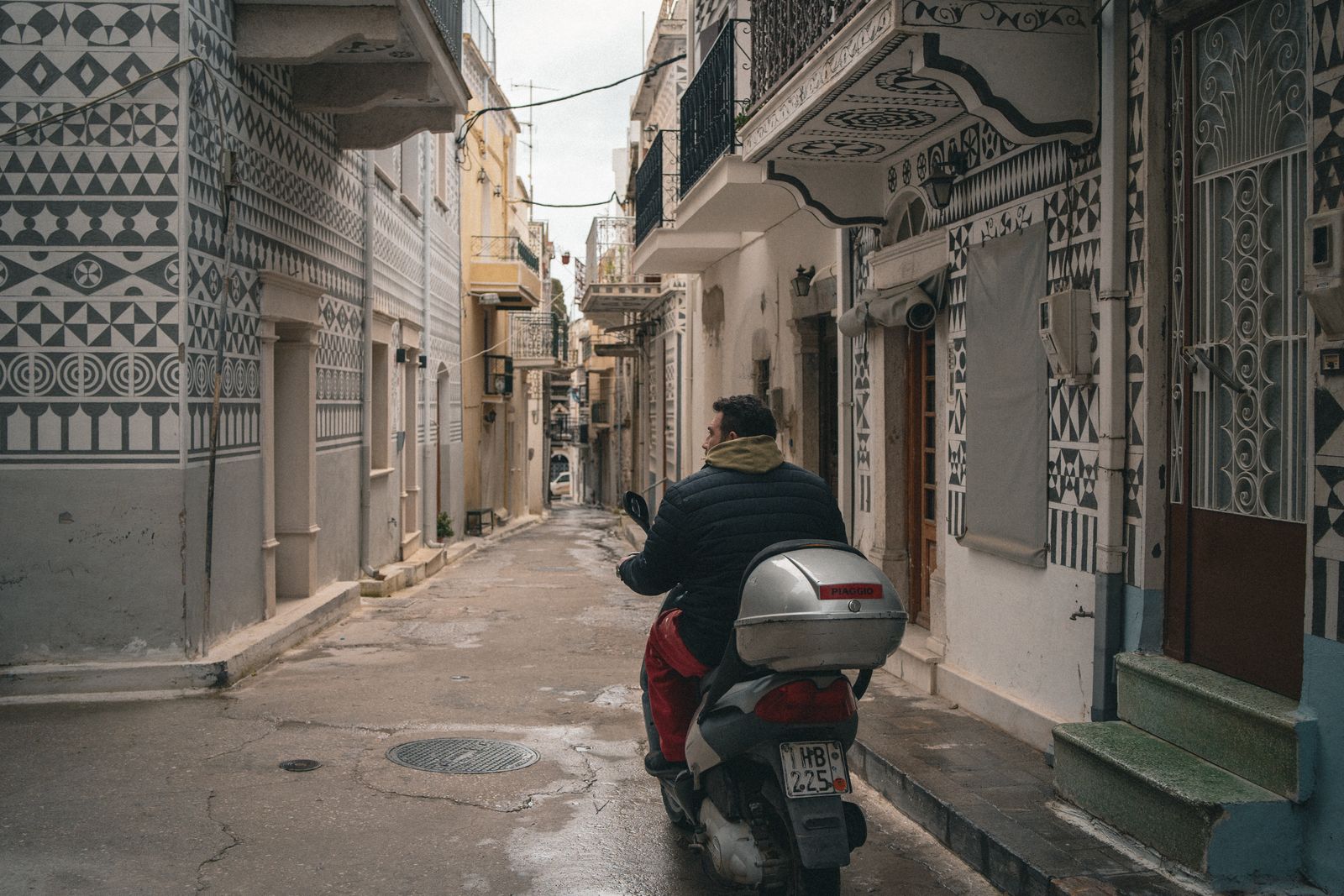
Pyrgi is the largest of the mastic villages and the one most visitors remember. Its buildings are covered in xysta, a sgraffito technique in which geometric patterns are scratched through a light plaster surface to reveal the darker layer beneath. The effect is immediately striking — whole streets of interlocking diamonds, chevrons, and floral motifs that look almost textile in their precision. The technique has been maintained by local families for generations, and the patterns vary from house to house. The village also contains the 12th-century church of Agioi Apostoloi, notable for its frescoes.
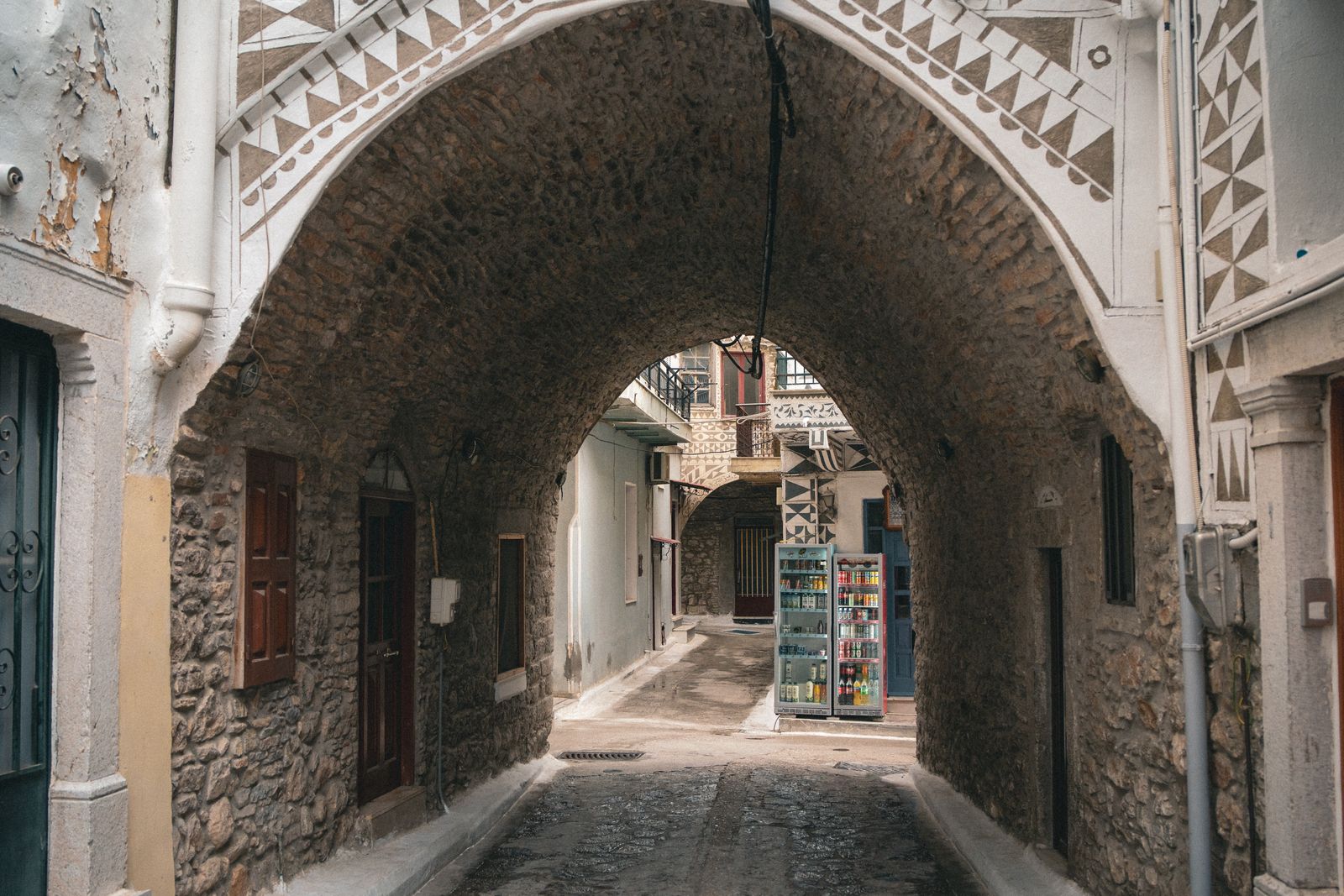
Mesta
Mesta is the best-preserved medieval village layout on the island, and possibly one of the finest surviving examples of defensive village planning in the Aegean. The entire settlement was built as a single architectural unit: a rectangular grid enclosed by an outer wall of connected houses that doubled as fortification. Inside, narrow passages and overhead arches were designed to confuse attackers, while a central tower served as a last refuge for residents. Walking through Mesta today feels like stepping into a functional medieval diagram — the logic of the design remains completely readable.
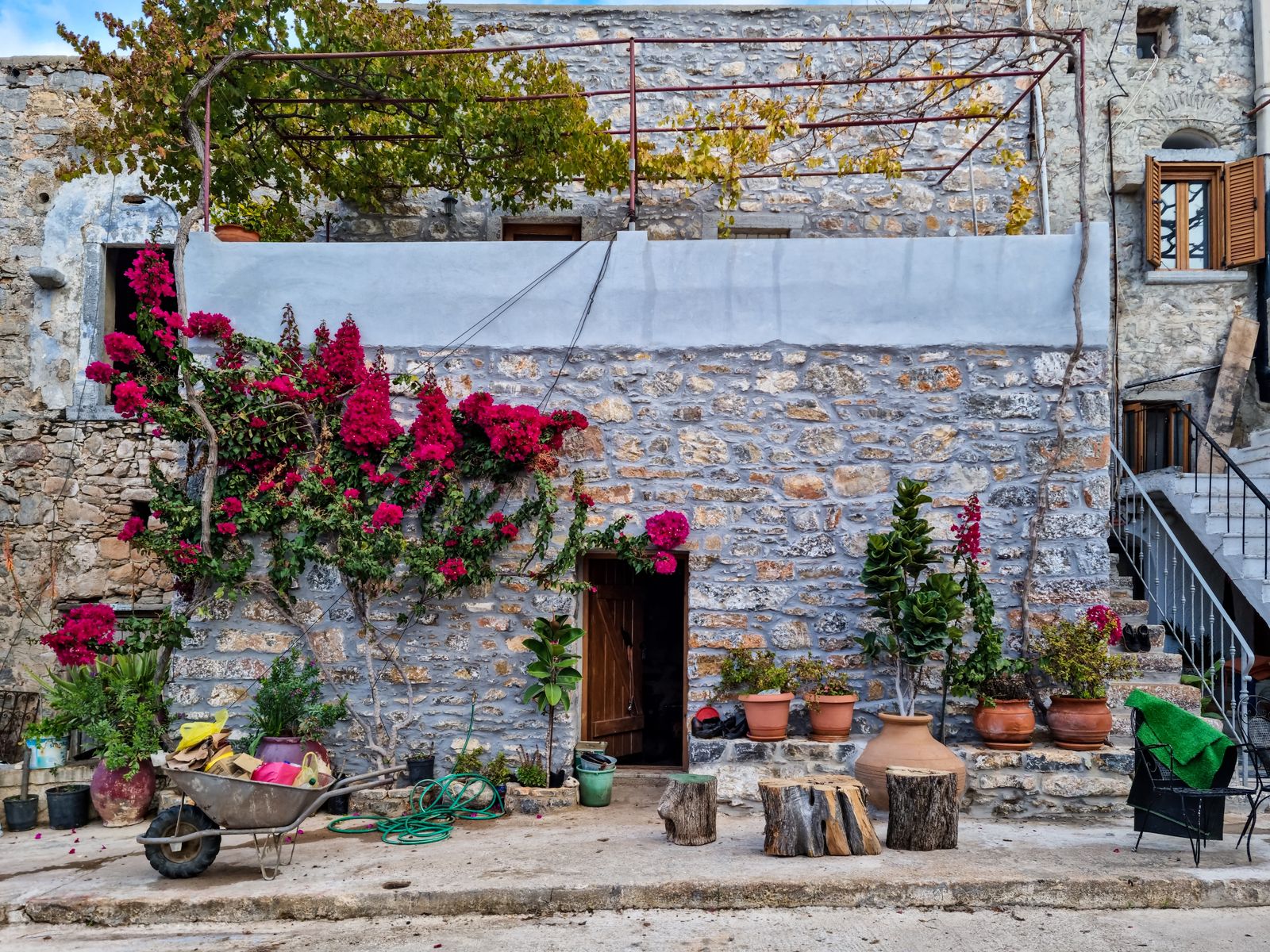
Olympi and the Cave
Olympi is smaller and quieter than its neighbours, with a well-preserved medieval square. Its main draw beyond the village itself is the Olympi Cave (Spilaio Olympon), a stalactite cave located a short drive south. The cave is open to visitors during the summer months and offers a cool break on a hot touring day. The Chios Mastic Museum, located near Pyrgi, is also worth a visit for anyone interested in understanding how mastic is harvested, processed, and used — the museum covers the complete story with strong English-language interpretation.
Understanding Mastic
Mastic is a resin harvested from the Pistacia lentiscus tree. The species grows throughout the Mediterranean, but only in southern Chios does it produce the crystalline resin drops known locally as “tears.” The exact reason remains debated — soil composition, microclimate, and specific cultivation techniques all play a role. The resin has been traded for at least two thousand years and was historically used as chewing gum, medicine, varnish, and incense.
Today, mastic production is managed by the Chios Mastiha Growers Association, a cooperative that represents the island’s mastic producers. The cultivation of Chios mastic holds Protected Designation of Origin (PDO) status. The harvest season runs from late August through October, and during this period visitors can sometimes arrange to observe the collection process through local cooperatives. The mastic finds its way into liqueurs, sweets, ice cream, bread, and cosmetics — products you will encounter throughout the island and can purchase at cooperative shops in Pyrgi and Chios Town.
Nea Moni: Byzantine Gold in the Mountains
Nea Moni is an 11th-century Byzantine monastery built into the mountainous interior of Chios, approximately 15 kilometres west of Chios Town. Inscribed on the UNESCO World Heritage List in 1990 alongside the monasteries of Daphni (near Athens) and Hosios Loukas (in Boeotia), Nea Moni is regarded as one of the finest examples of middle Byzantine religious architecture in Greece.
The monastery was founded around 1042 under the patronage of Emperor Constantine IX Monomachos. According to monastic tradition, three hermits discovered an icon of the Virgin Mary hanging from a myrtle branch at the site and later predicted that Constantine would become emperor. When he did, he funded the construction of the monastery as repayment. At its peak in the 14th century, the complex housed around 800 monks and its estates covered roughly a third of the island.
The principal reason to visit is the mosaics. Covering the interior of the katholikon (main church), these gold-ground mosaics are among the most important surviving works of the Macedonian Renaissance period in Byzantine art. The craftsmanship — using tesserae of coloured marble, glass, and gold foil — creates images of remarkable luminosity and emotional power. Some sections were damaged by an earthquake in 1881 and subsequent fires, but extensive restoration work has preserved most of the original composition.
The monastery complex also includes a chapel containing the bones of victims of the 1822 massacre, when Ottoman forces killed or enslaved the majority of the island’s Greek population during the War of Independence. Visiting Nea Moni is not just an art-historical experience; it is a direct encounter with the weight of Chios’s past.
Chios Town and the Kastro
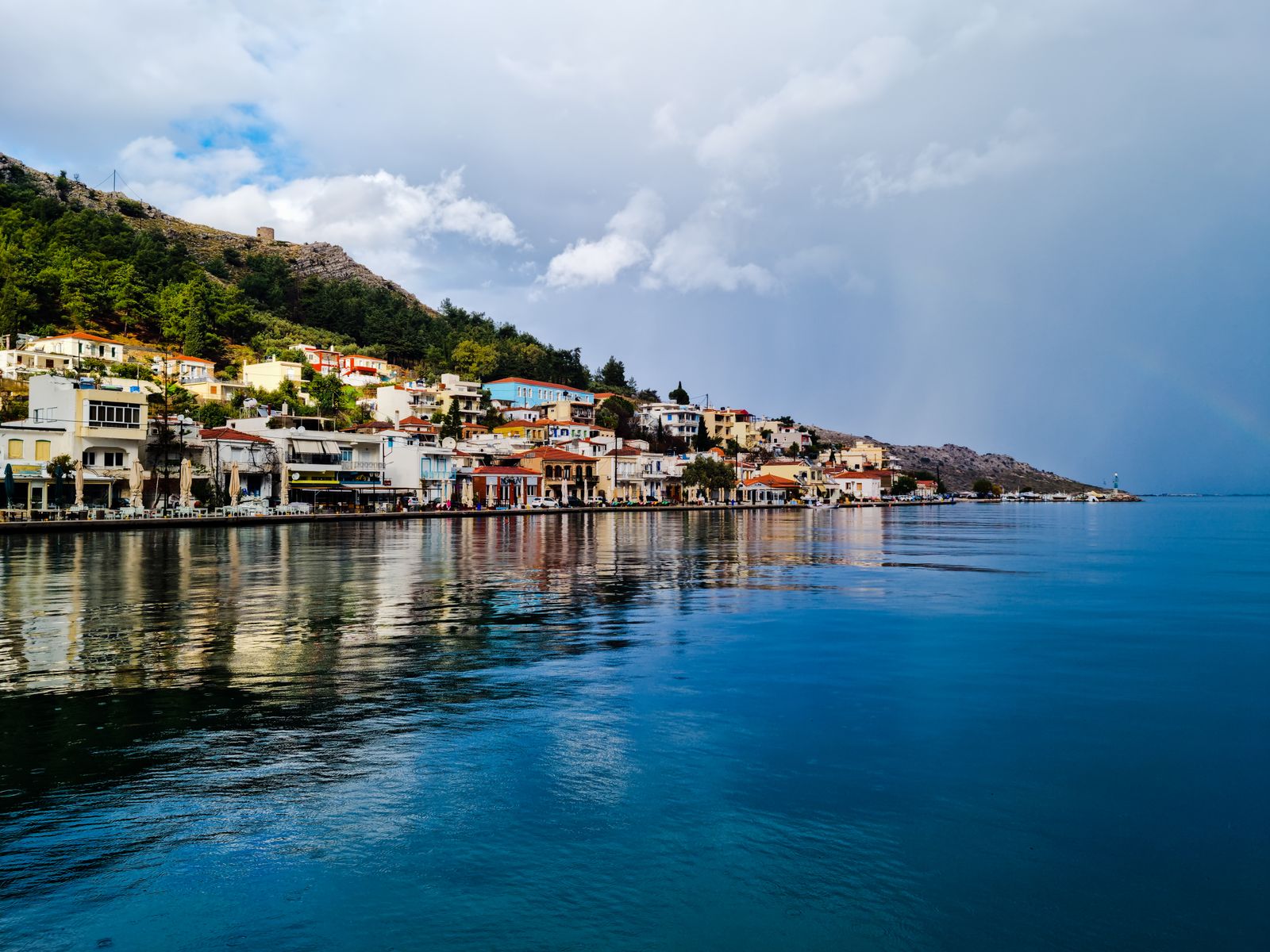
Chios Town, known locally as Chora, is a working Greek port town rather than a prettified tourist centre. The waterfront is lined with cafés and tavernas, and the commercial district along Aplotaria street has a practical energy that feels refreshingly normal compared to more visited island capitals. This is where most visitors will base themselves, and it is the logical starting point for exploring the island.
The Kastro — the medieval castle quarter — sits at the northern end of the harbour. Originally built by the Byzantines in the 10th century and substantially expanded by the Genoese in the 14th century, it became the Ottoman quarter after 1566 and later housed refugees from Asia Minor in the 1920s. Today it is still inhabited by roughly 650 residents who live among layers of architectural history that span almost a thousand years. The restored Ottoman hamam, which now operates as a small museum, is worth a brief visit. The Giustiniani Palace, built by the Genoese ruling family, gives a sense of the castle’s former administrative importance.
Outside the castle walls, Chios Town offers several small museums. The Archaeological Museum covers the island’s ancient history, while the Byzantine Museum (housed in the Mecidiye Mosque) and the Maritime Museum round out the cultural picture. None requires more than an hour, but together they provide useful context before heading into the countryside.
Kampos: The Citrus Estates
Kampos is a fertile plain stretching roughly seven kilometres south of Chios Town. During the Genoese period, noble families established country estates here, planting citrus orchards — primarily oranges, lemons, and later mandarins — behind high walls of local Thymiana stone. At its height, the area contained over 200 estates, each with its own mansion, well, cistern, and workers’ quarters.
The estates are distinctive for their warm ochre stone facades, arched gateways, and the ingenious water-wheel systems (manganopigada) that irrigated the orchards. Several have been converted into guesthouses, and a small Mandarin Museum offers tastings and preserves. Cycling or driving through the narrow lanes of Kampos, with their high walls concealing fragrant gardens, offers a completely different atmosphere from the medieval south or the commercial town. The Kampos area is best explored slowly — its appeal is in the accumulated detail rather than any single landmark.
Anavatos and Northern Chios
Anavatos is one of the most haunting places on the island. This medieval stone village was built high on a cliff face in the island’s interior, approximately 16 kilometres from Chios Town. During the 1822 massacre, many of its residents chose to jump from the cliffs rather than face capture. The village never recovered. Today it stands almost entirely abandoned — a cluster of roofless stone houses cascading down the rock, with a Byzantine church at the summit. It is sometimes called the “Mystras of the North Aegean,” though the comparison flatters neither place, since each carries its own particular weight.
The drive to Anavatos passes through the interior landscape of central Chios, which is greener and more mountainous than many visitors expect from an Aegean island. Further north, the village of Volissos sits beneath a Byzantine-era castle and serves as a base for exploring the quieter northwest coast. The suburb of Vrontados, just north of Chios Town, has a traditional association with Homer — local tradition identifies a rocky outcrop known as “Teacher’s Rock” (Daskalopetra) as the site where Homer taught his students. The claim is one of several made by Aegean locations and should be understood as local tradition rather than established historical fact.
Beaches
Chios’s beaches are more varied than most visitors expect, though they rarely appear in “best Greek beaches” lists — partly because the island’s marketing has always led with culture rather than coastline.
| Beach | Type | Best for | Notes |
|---|---|---|---|
| Mavra Volia | Black volcanic pebbles | Scenery, photography | Deep water, no facilities, dramatic landscape |
| Karfas | Sandy, organised | Families, convenience | Most popular beach, sunbeds, water sports, shallow entry |
| Komi | Sandy, organised | Families with young children | Very shallow water extends far from shore |
| Lithi | Sandy | Relaxed day, good food | West coast, seafood tavernas on shore, sheltered from meltemi |
| Agia Dynami | Rocky cove | Snorkelling, quiet swimming | Exceptionally clear water, remote access |
| Nagos | Pebble | Quiet escape | Northern coast, spring water, very peaceful |
| Vroulidia | Pebble cove | Wild swimming | Southern tip, one of the island’s most photogenic spots |
Mavra Volia, near the ancient port of Emporios in the south, is the most visually distinctive beach on the island. Its volcanic black pebbles — remnants of ancient eruptions — create a dramatic contrast with the deep blue water. The beach is unorganised, and the water becomes deep quickly, making it more suited to confident swimmers than families with toddlers. A walk over the rocks at the south end reveals progressively quieter sections.
For families, Karfas and Komi are the practical choices. Karfas is the closest organised beach to Chios Town, with sunbeds, water sports, and shallow water. Komi, further south near the mastic villages, has remarkably shallow water that stays gentle for a long way from shore. Lithi, on the west coast, combines a sandy beach with waterfront tavernas and is naturally sheltered from the prevailing northerly winds — a useful option when the meltemi makes the north and east coast uncomfortable.
The northern coast tends to be wilder and less accessible, with small pebble coves like Nagos and Avlonia offering solitude in exchange for a longer drive. Swimmers should note that sea conditions can change quickly with wind direction, and lifeguard cover outside the main organised beaches is limited during shoulder season.
Food and Drink
Chios has a genuinely distinctive food identity, which separates it from many Greek islands where the menu blurs into a national average. The island’s key products — mastic, citrus, figs, and sheep’s-milk cheese — appear throughout local cooking in ways that feel organic rather than performative.
Mastiha, the liqueur distilled from mastic resin, is served cold as a digestif in most tavernas and makes a good end to a meal. The texture is slightly resinous and not to everyone’s taste, but it is worth trying at least once as an authentic island experience. Souma is a different spirit entirely — distilled from figs in small batches, mainly in the southern villages, and not commercially bottled. If you want to try it, ask specifically; many tavernas keep a bottle but will not volunteer it.
Mastelo cheese is a hard sheep’s-milk cheese made on Chios, sometimes smoked, and particularly good grilled. You will find it on menus throughout the island, often served with honey as a starter. The island’s citrus heritage shows up in marmalades, preserves, and the mandarin-scented desserts available at shops in the Kampos area. Loukoumades — fried dough puffs served with honey — are a local obsession, and the versions made with sourdough starter are noticeably better than the mass-produced equivalents elsewhere.
For fish, the waterfront tavernas at Lagkada and Mesta’s small harbour serve reliably fresh catches. The waterfront in Chios Town has a wide selection, though quality varies — the side streets tend to outperform the most prominent harbour-front positions. Ouzo production has a long local tradition, with several family-run distilleries on the island producing lighter, smoother styles than the mainland versions.
Getting There
Chios is connected to Athens by air and sea. Flights from Athens International Airport take approximately 50 minutes, with both Aegean Airlines and Sky Express operating multiple daily services year-round. As of mid-2026, there are around 17 flights per week, though frequency increases in summer and can drop slightly in winter. This is the most practical option for travellers with limited time.
Ferries operate from Piraeus port in Athens, with Blue Star Ferries and Hellenic Seaways (both part of the Attica Group) running the route. The crossing takes between 7 and 10 hours depending on the vessel and whether the ferry calls at intermediate ports. Most departures are evening services arriving in Chios early the following morning, which allows you to sleep aboard and avoid losing a day to travel. Deck seats and cabin options are available, and booking a cabin is strongly recommended for the overnight crossing. Schedules vary by season, so confirm departure times directly with the ferry operators or through booking platforms before arranging accommodation.
There is also a short ferry connection from Chios to Çeşme on the Turkish coast, taking approximately 30 minutes. This service operates daily in summer with up to two or three crossings per day, making a day trip to Turkey feasible from Chios — an option that very few other Greek islands offer. Check visa and passport requirements before planning this crossing, as regulations may change.
Inter-island ferry connections link Chios to Lesvos, Samos, Ikaria, and Patmos, making it possible to build a North Aegean island-hopping itinerary. Connections are more frequent in summer but limited in the off-season.
Getting Around
A rental car is essential on Chios. The island is large — roughly 50 kilometres from north to south — and its main attractions are spread across several distinct regions. Public bus services exist but are infrequent, with limited or no weekend service and no buses at all serving the mastic villages as of recent schedules. Taxis are available in Chios Town but become impractical for a full day of touring.
Driving on Chios is straightforward compared to many Greek islands. The main roads are well-maintained, traffic outside the capital is light, and parking in the villages is generally free. The road from Chios Town to the mastic villages takes about 30 minutes. Roads to the north coast are narrower but manageable. Rental cars are available at the airport and in Chios Town, and booking in advance during July and August is advisable as options can become limited.
How Long to Stay
Four days is the minimum for a satisfying visit, covering Chios Town and the Kastro, the mastic villages, Nea Moni, and a selection of beaches. Five days allows you to add the Kampos area, Anavatos, and a more relaxed day exploring the north coast. A full week lets you experience the island without rushing — useful if you want to combine village touring with proper beach time, a day trip to Turkey, or some of the hiking trails on Mount Pelinaion.
A common mistake is trying to treat Chios as a two-day stop on an island-hopping itinerary. The island’s depth rewards time, and compressing it into a quick visit risks seeing nothing but the town and one or two beaches, which misses the entire point.
Where to Stay
Chios Town is the most practical base, offering the widest range of accommodation, easy access to the port and airport, and a short drive to the mastic villages and Nea Moni. The waterfront and the streets behind Aplotaria provide a good mix of options. This is also where you will find the greatest concentration of evening dining and café life.
Karfas, about seven kilometres south of town, is the main beach resort area and suits travellers who want to combine cultural day trips with easy beach access. The Kampos area appeals to visitors seeking a quieter, more atmospheric base — several of the old estates now operate as guesthouses with citrus gardens. Staying in one of the mastic villages, particularly Mesta, is an option for travellers who prefer a rural setting and do not mind driving for evening meals, though accommodation choices are more limited.
Practical Tips and Honest Limitations
Chios is not a polished tourist destination, and that is part of its appeal — and part of what may frustrate visitors with different expectations. A few things worth knowing before you go:
- English is widely spoken in Chios Town and tourist-facing businesses, but less so in smaller villages. A few words of Greek go a long way in the south.
- Mobile signal is generally reliable in the town and main villages but can drop in the mountainous interior and along some remote coastal stretches.
- ATMs and pharmacies are concentrated in Chios Town. If you are spending a full day in the mastic villages or the north, carry cash.
- Fuel stations are present in Chios Town and at major junctions, but fill up before heading to remote areas — there are long stretches in the north with no services.
- Opening hours for museums and archaeological sites follow Ministry of Culture schedules, which typically mean closures on Tuesdays and reduced hours outside summer. Confirm before driving to Nea Moni or the Chios Mastic Museum.
- The mastic harvest (late August to October) is the most culturally interesting period to visit, but it is also hot and some beaches become crowded with domestic visitors.
- Proximity to Turkey makes Chios a crossing point for migration, which has been a sensitive subject on the island. This has no practical impact on tourism, but awareness of the context is appropriate.
Suggested Itinerary: Five Days on Chios
| Day 1 | Arrive and explore Chios Town — the Kastro, waterfront, Archaeological Museum, evening meal on the harbour |
| Day 2 | Mastic villages circuit — Pyrgi, Olympi, Mesta, Mastic Museum; afternoon at Mavra Volia or Komi beach |
| Day 3 | Nea Moni monastery in the morning, Anavatos, lunch at a mountain taverna; afternoon at Lithi beach |
| Day 4 | Drive north — Volissos castle, Nagos beach; or day trip to Çeşme (Turkey) |
| Day 5 | Kampos citrus estates, Karfas beach; evening in Chios Town before departure |
This itinerary assumes a rental car. Without one, the mastic villages circuit and northern coast become impractical as day trips. If your time is limited to three days, prioritise the mastic villages, Nea Moni, and at least one beach — these are the experiences you cannot replicate elsewhere in Greece.
Combining Chios with Other North Aegean Islands
Chios works naturally as part of a longer North Aegean journey. Ferries connect it to Lesvos (2–3 hours), which offers olive groves, Ottoman-era architecture, and petrified forests. Samos, further south, adds archaeological sites and wine country. The three islands together — with four to five days on each — make an itinerary that covers a genuinely different side of Greece from the Cycladic circuit.
Travellers flying into Athens can reach Chios by a short domestic flight and return from Lesvos (or vice versa) without backtracking, since both islands have airports with direct Athens connections. For those who prefer ferry travel, an overnight crossing from Piraeus to Chios followed by island-hopping northward to Lesvos and a return flight from Mytilene is a well-tested route.
This article was researched and verified as of July 2026. Ferry schedules, flight frequencies, museum hours, and admission fees may change between seasons. We recommend confirming transport details directly with operators before travel. Vivid Greece is an independent publication and this article contains no paid placements or sponsored recommendations.