Kefalonia rarely makes the first page of anyone’s Greek island shortlist, and that works quietly in its favour. While Santorini and Mykonos absorb the social-media traffic, this mountainous island — the largest in the Ionian chain — goes about its business with a kind of rugged self-assurance that rewards travellers willing to drive its winding roads and seek out its scattered highlights. The beaches here are among the finest in Greece, from the famous white-pebble crescent of Myrtos to the red clay shores of Xi. But Kefalonia is more than coastline: it holds an underground lake lit by the midday sun, Venetian fortresses, a national park of rare black fir trees, and a wine region producing one of Greece’s most distinctive whites.
This guide covers everything you need to plan a trip that works — where to base yourself, what to expect from the roads, which beaches suit families and which require water shoes and a sense of adventure, how to reach the island, and what to eat and drink once you arrive.
| Location | Ionian Islands, western Greece |
| Area | Approximately 781 km² — largest of the Ionian Islands |
| Capital | Argostoli (population around 10,600) |
| Best for | Couples, families, road-trip travellers, nature and wine enthusiasts |
| Best time | Late May to early October; June and September for fewer crowds |
| Getting there | Direct flights from Athens (1 hour), seasonal flights from UK and Europe; ferries from Killini, Patras, Astakos |
| Car needed? | Yes — public transport is extremely limited |
| Recommended stay | Five to seven days |
Why Kefalonia
The simple case for Kefalonia is variety. This is an island where you can swim at a world-famous beach in the morning, explore an underground cave lake before lunch, drive through mountain villages surrounded by black fir forest in the afternoon, and finish the day tasting Robola wine on a vineyard terrace at sunset. Few Greek islands pack this range of landscape and experience into a single destination.
The island also carries a weight of history that shapes the way it looks today. The devastating earthquake of 1953 destroyed almost every building on Kefalonia, leaving only the northern village of Fiskardo standing. What visitors see now is largely a rebuilt island — practical, modest, occasionally surprising in its architecture. Understanding that story changes how you see the concrete-block houses in Argostoli or the eerily uniform postwar villages of the interior: they are not ugly, they are the visible evidence of an entire community starting again from rubble.
And unlike more touristic islands, Kefalonia has not yet surrendered to the Instagram economy. There are no infinity pools perched over caldera views, no curated bar strips, no drone-show sunsets. What you get instead is something closer to the working reality of a Greek island with strong local identity, a serious wine tradition, and coastline that frequently looks unreal.
Best Time to Visit
The season runs from May through October, with water temperatures climbing from around 20°C in late May to a peak of approximately 26°C in August. July and August are the busiest months — Myrtos Beach fills before mid-morning, ferry queues grow, and accommodation prices peak. The heat can be intense, regularly exceeding 33°C, with minimal shade at most beaches.
June and September offer the best balance between warm swimming conditions and manageable crowds. The sea stays comfortable well into October on the Ionian side, and autumn light gives the island’s dramatic coastline a richer quality than high summer’s flat glare. Late September also coincides with the grape harvest in the Robola wine region, making winery visits particularly rewarding.
Spring visitors in April and early May will find wildflowers, green hillsides and empty roads, but swimming temperatures are still cool, some seasonal ferry routes may not yet operate, and a few beach bars and tavernas remain closed until late May or June. Winter visitors are rare, and most tourist infrastructure shuts down by late October. Rain arrives in November and continues through March, though some walkers appreciate the cooler months for hiking Mount Ainos without the summer heat.
Myrtos, Melissani and Mountains
Kefalonia combines Greece’s most dramatic beach scenery with underground wonders and a wild mountainous interior that most visitors never expect.
How to Get There
By air
Kefalonia Airport (EFL) sits near Svoronata, about 9 km south of Argostoli. Year-round flights connect Kefalonia to Athens on Sky Express and Olympic Air, with a flight time of roughly one hour and multiple daily departures in summer. From May through October, direct seasonal flights operate from the UK (London Gatwick, Manchester, and several other cities via easyJet, Jet2, British Airways, TUI, and Ryanair), as well as from destinations across Europe including Rome, Naples, Amsterdam, Vienna, and several German cities. Around 22 airlines serve the airport during peak season, making Kefalonia well connected by European standards.
By ferry
Three mainland ports serve Kefalonia, and the best choice depends on where you are travelling from. Killini in the northwestern Peloponnese is the most frequent connection, with multiple daily crossings to Poros (on the island’s southeast coast) taking roughly 1 hour 15 minutes. Patras connects to Sami (the island’s eastern port) with a journey of approximately 2.5 hours. Astakos in western mainland Greece also links to Sami via Ionion Pelagos Lines.
For island-hopping, seasonal connections run between Kefalonia and Zakynthos (Pessada to Agios Nikolaos, approximately 1 hour 20 minutes, summer only), Ithaca (Sami to Pisaetos, around 20-30 minutes, multiple daily services), and Lefkada (Fiskardo to Vasiliki via Ionion Pelagos Lines, summer service). The Lefkada Palace ferry also operates a scenic route linking Corfu, Paxos, Lefkada, Meganisi, Ithaca, and Kefalonia on alternating days during summer — a useful option for anyone planning an Ionian Islands circuit. For more on island-hopping, see our guide to choosing the right Ionian island.
Ferry schedules vary each year and are typically announced between January and March. Always confirm current timetables directly with operators before booking accommodation.
Getting Around
A rental car is not optional on Kefalonia — it is essential. The island is large (roughly 48 km from north to south), public bus services are extremely limited even in summer, and most of the best beaches, villages and viewpoints require driving on narrow, winding mountain roads. The KTEL bus network runs a handful of routes from Argostoli to the airport, Lassi, Sami, Skala, Poros, and the monastery of Agios Gerasimos, but frequencies are low and weekend services are reduced further.
Road conditions are generally decent on main routes, though mountain roads — particularly the descent to Myrtos Beach and the north-coast road to Fiskardo — involve tight hairpin bends with occasional loose gravel. Drive cautiously, expect oncoming traffic on blind corners, and avoid driving unfamiliar mountain roads after dark. Parking is free throughout the island except for Argostoli’s waterfront, where meters apply at a modest rate.
A useful alternative for crossing the Gulf of Argostoli: the local ferry between Argostoli and Lixouri runs every 30 minutes during summer (approximately 20-25 minutes, around 3 euros for foot passengers) and accepts cars. This is far faster than driving around the bay, and the crossing itself is scenic.
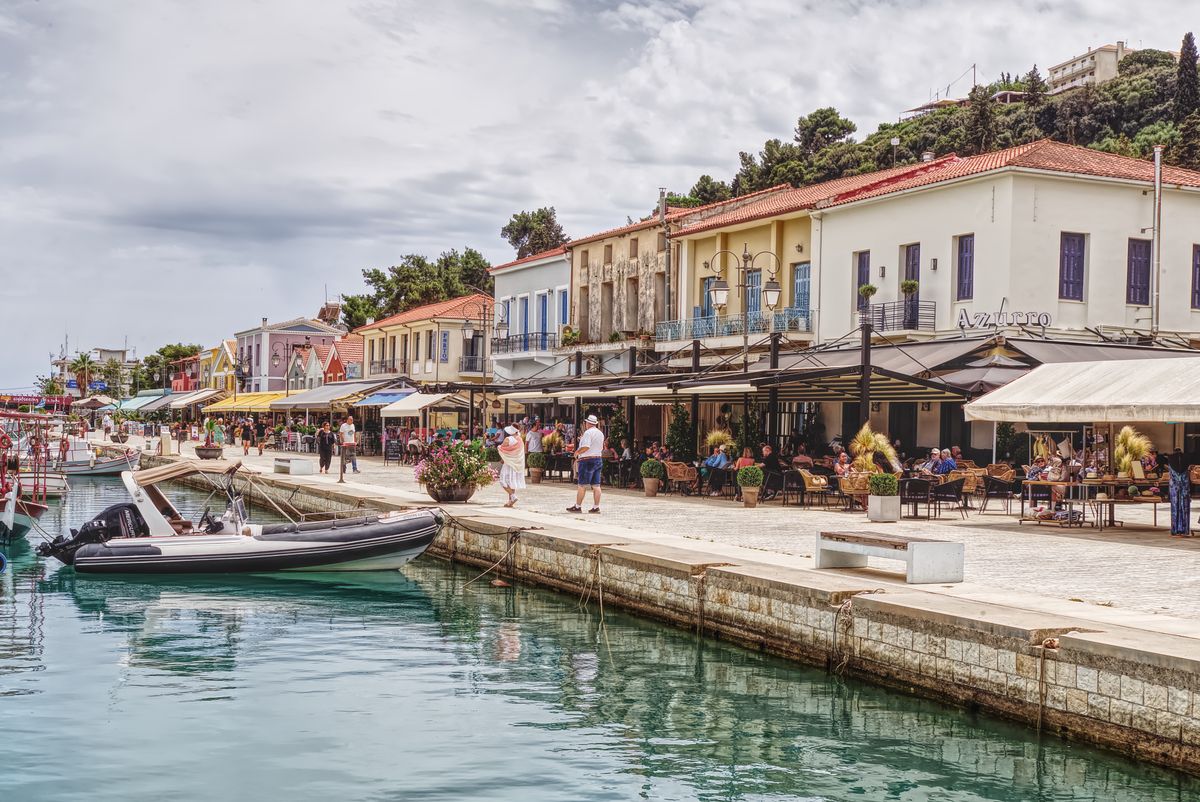
Where to Base Yourself
Kefalonia’s size means your base matters more than on smaller islands. Choosing the wrong area could mean an hour’s drive each way to the beaches or villages you want to visit most. Here is how the main areas compare.
| Area | Best For | Drawbacks | Nearest Beaches |
|---|---|---|---|
| Argostoli | Services, nightlife, restaurants, central location | Town feel, not on the best beaches | Makris Gialos, Platis Gialos (3 km) |
| Lixouri | Quieter alternative, Xi Beach, local atmosphere | Depends on ferry to reach east coast | Xi, Petani, Lepeda |
| Sami | Caves, Antisamos, port access to Ithaca | Limited evening options | Antisamos (4 km), Karavomilos |
| Fiskardo | Venetian architecture, sailing crowd, upmarket dining | Expensive, far from Myrtos and caves | Foki, Emblisi, Dafnoudi |
| Skala | Families, sandy beach, organised resort facilities | Far from north coast attractions | Skala Beach, Mounda, Kaminia |
For a first visit, Argostoli makes the most practical base. It is central enough to reach most attractions within 45 minutes, has the widest choice of places to eat, and offers the most evening activity. Travellers seeking tranquillity may prefer Lixouri or Sami, while Fiskardo suits those prioritising atmosphere over convenience. If you plan to split your stay, a few nights in Argostoli followed by two or three in the north gives the best coverage of the island.
The Beaches
Kefalonia’s coastline shifts character dramatically depending on which direction you face. The west coast is exposed, windswept and spectacular, with sheer cliffs plunging into deep blue water. The east coast is calmer, more sheltered, and better suited to swimming. The south has organised sandy beaches with sunbeds, tavernas and lifeguards. Understanding this geography saves wasted driving — there is no point heading to Myrtos on a windy afternoon hoping for calm water.
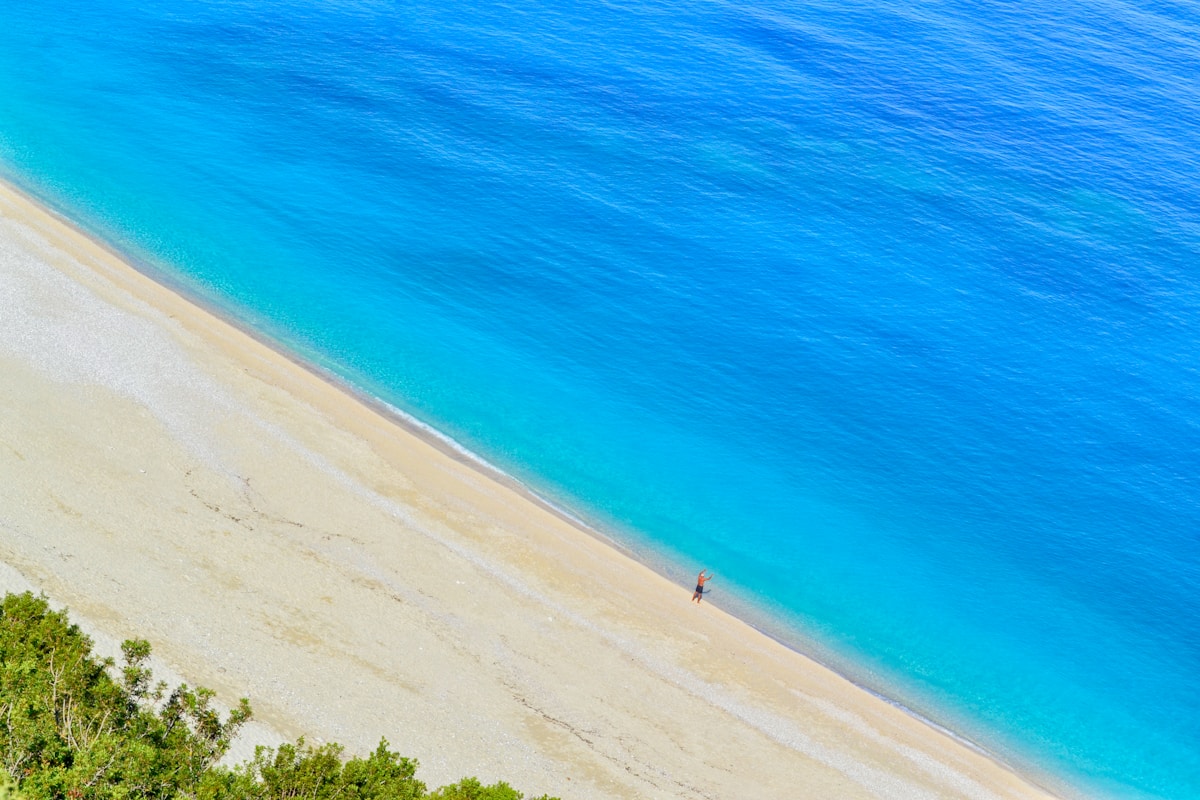
Myrtos Beach is the headline act, and it deserves the reputation. Seen from the clifftop viewpoint on the road between Argostoli and Fiskardo, the crescent of white pebbles backed by 300-metre limestone cliffs looks almost digital in its intensity. The reality on the ground is rougher: the pebbles are large (water shoes are strongly recommended), the water gets deep quickly, westerly waves can build significantly on windy afternoons, and there is no natural shade whatsoever. Arrive before 9 am in July and August to see the viewpoint without tour buses in your sightline. The access road descends steeply in switchbacks — manageable but not suitable for very nervous drivers.
Antisamos sits on the east coast near Sami, and many travellers consider it the best swimming beach on the island. The water is calmer than the west side, visibility is exceptional for snorkelling, and the setting — green cliffs wrapping around turquoise water — was dramatic enough to serve as a filming location for Captain Corelli’s Mandolin. It has Blue Flag status, some organisation with sunbeds and beach bars, and a large car park. The pebbles are smaller than Myrtos but still require footwear. The water drops off relatively quickly, making it less ideal for non-swimming toddlers.
Petani Beach delivers the same dramatic cliff-backed beauty as Myrtos but with noticeably fewer people. Located on the Paliki Peninsula (the Lixouri side), it faces west and catches the same winds and swells. The water deepens fast, and conditions can turn rough without warning — this is not a beach for weak swimmers or very young children. On calm days, though, it is extraordinary.
Xi Beach is something genuinely unusual: a long stretch of distinctive reddish-brown clay sand on the south side of the Paliki Peninsula. The water is shallow and calm, making it Kefalonia’s most family-friendly option. The clay itself is the attraction — many visitors cover themselves in it as a natural skin treatment. Xi has full organisation with sunbeds, umbrellas, and water sports, and is easily reached from Lixouri. Morning visits are best, as an afternoon breeze often picks up.
Foki Beach near Fiskardo is a small, shaded, pebble cove with calm water and old cypress trees growing down to the shore — ideal for families with young children who want shade and gentle swimming without crowds. Makris Gialos and Platis Gialos near Lassi offer golden sand, full organisation, and the closest beach experience to Argostoli. On the south coast, Lourdas combines a long sandy-and-pebble beach with mountain views, and Skala provides a classic organised resort beach with lifeguards and shallow entry.
| Beach | Type | Family Suitable | Organisation | Notes |
|---|---|---|---|---|
| Myrtos | White pebble | Older children only | Partial | No shade, deep water, can be rough |
| Antisamos | Small pebble | Yes (older children) | Good | Blue Flag, calm water, snorkelling |
| Petani | Pebble and sand | No (deep, rough) | Partial | Dramatic, often quieter than Myrtos |
| Xi | Red clay sand | Excellent | Full | Shallow, calm, natural clay spa |
| Foki | Pebble | Excellent | None | Shaded by cypress trees, calm, small |
| Makris Gialos | Golden sand | Yes | Full | Close to Argostoli, water sports |
| Lourdas | Sand and pebble | Yes | Good | Long beach, mountain backdrop |
The Villages: Assos and Fiskardo
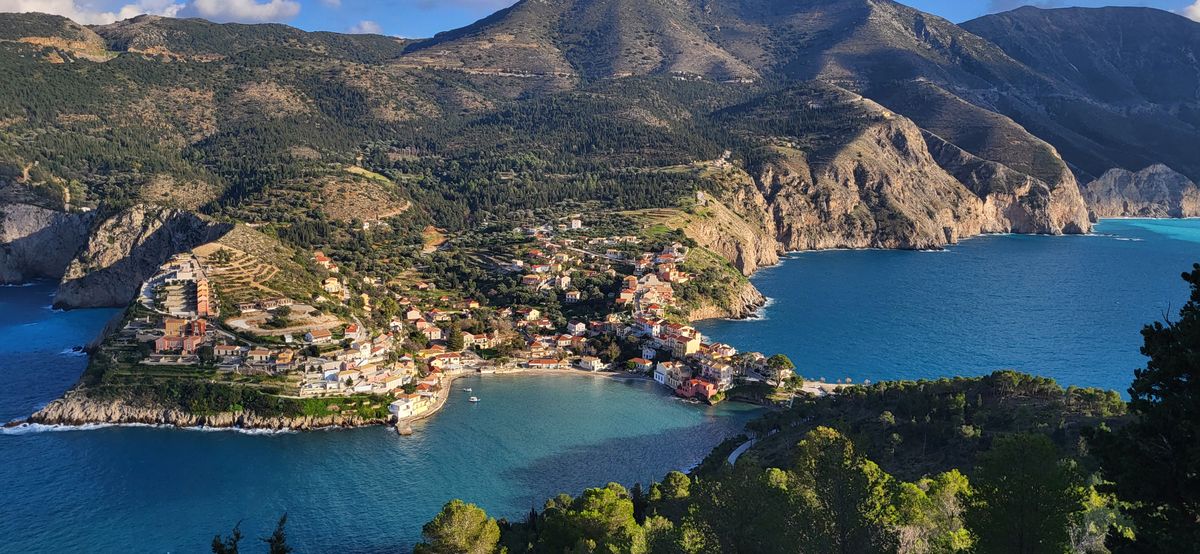
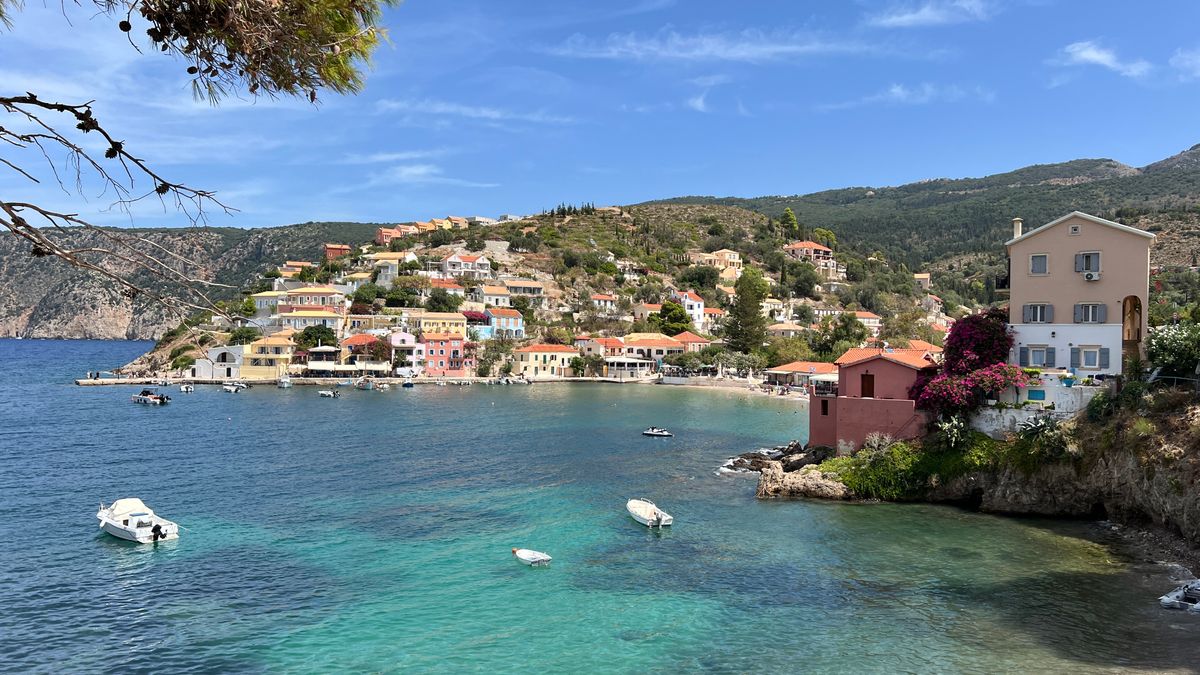
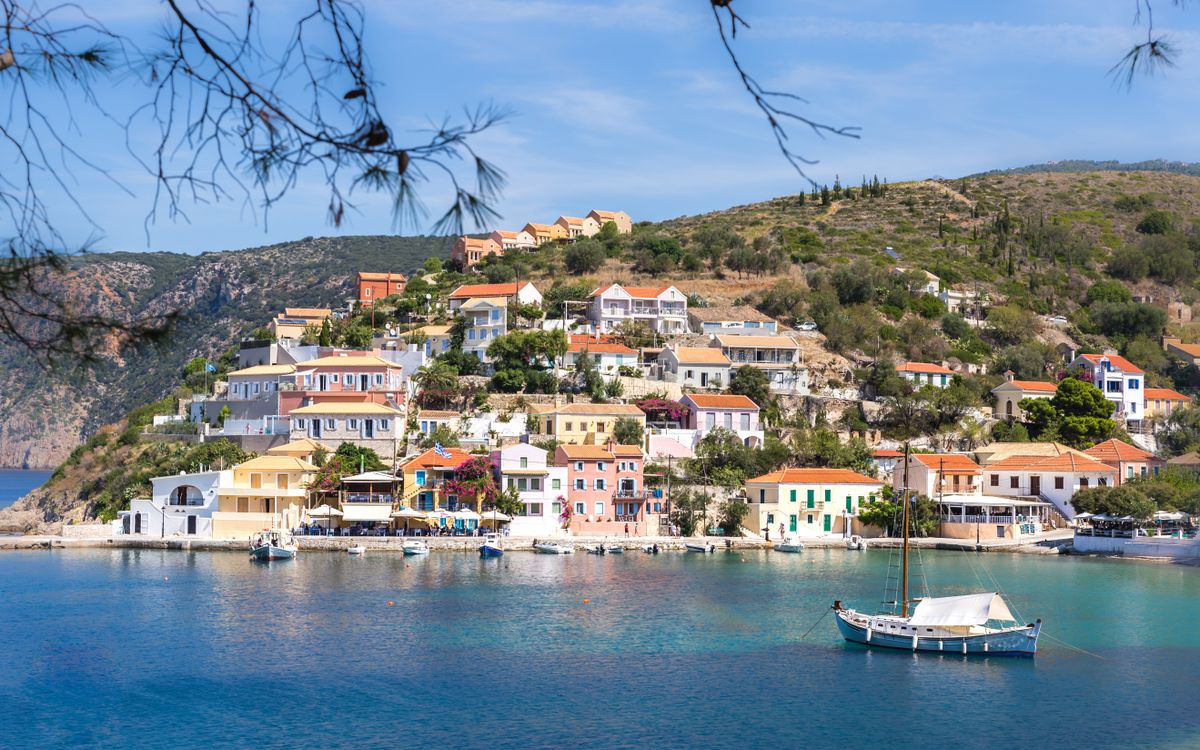
Assos is the smaller of the two northern villages, and arguably the most photogenic settlement on the island. It sits at the foot of a steep descent, wrapped around a tiny harbour on a narrow isthmus that connects the mainland to a pine-covered peninsula. Above the village, the ruins of a large Venetian fortress — built between 1593 and 1596 to protect against Ottoman raids and piracy — sprawl across the hilltop. The castle has 2,000 metres of walls, covers 44,000 square metres, and is free to visit. The walk up takes about 20 minutes and rewards with sweeping views over the bay and the open Ionian to the west.
The village itself was rebuilt by French donors after the 1953 earthquake and has a slightly different character to the rest of Kefalonia — pastel-painted houses arranged around a harbour lined with a handful of fish tavernas and a small pebble beach. It is a place to wander for an hour or two rather than a full-day destination. Parking can be difficult in July and August, so arrive early or visit in the late afternoon.
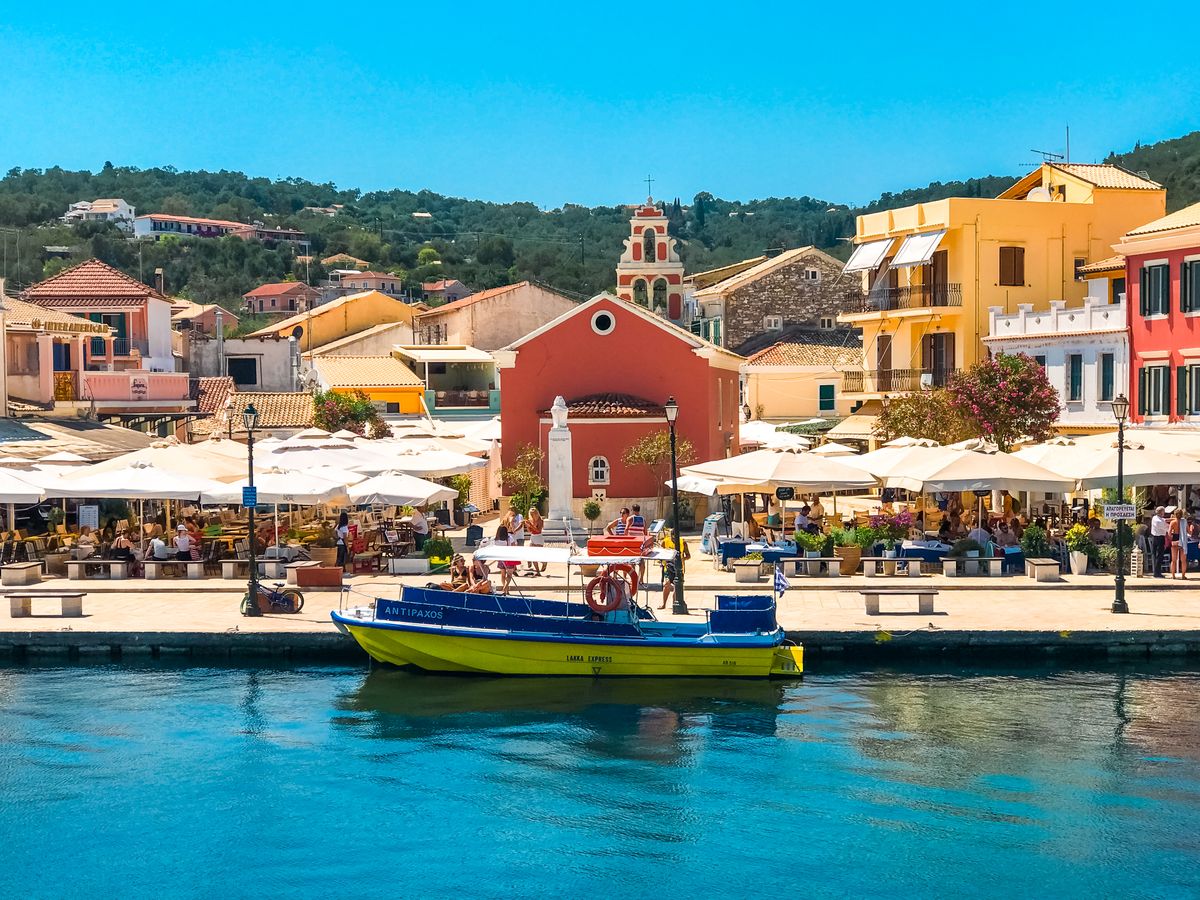
Fiskardo, at the island’s northern tip, is Kefalonia’s most upmarket and cosmopolitan village. It owes its distinctive appearance to a piece of geological luck: it was the only settlement on the island to survive the 1953 earthquake largely intact. Where every other town on Kefalonia was rebuilt in functional postwar concrete, Fiskardo kept its 18th- and 19th-century Venetian-style stone houses, arched doorways, and coloured shutters — giving it a look that feels more Corfu or even Venice than the rest of the island.
The harbour is a magnet for sailing yachts, and the waterfront is lined with restaurants and cafes at prices reflecting the clientele. Beyond the social scene, the area offers several worthwhile sights: a Roman-era cemetery with intact sarcophagi, the ruins of a 6th-century Early Christian basilica near the lighthouse path, and quiet swimming coves within walking distance (Emblisi and Foki beaches are both accessible from the village). It is about an hour’s drive from Argostoli, and the route via Assos and Myrtos viewpoint is one of the finest drives in Greece. For more on the Ionian’s character, see our guides to Corfu and Lefkada’s beaches.
Caves and Mountains
Melissani Cave, near Sami on the east coast, is Kefalonia’s single most memorable attraction. Part of its roof collapsed thousands of years ago in an earthquake, creating an opening through which the midday sun pours directly onto an underground lake of extraordinary clarity. The water, a mix of sea and fresh water, glows an intense electric blue when the light is right — typically between 11:30 and 14:00 on clear days. Visitors explore the lake by small rowing boat, guided by boatmen who navigate around a central island where ancient artefacts associated with the god Pan were once discovered.
The cave is open daily in summer from 09:00 to 18:00 (as of summer 2026). Admission is approximately 10 euros for adults and 5 euros for children aged 6 to 18 — worth confirming before your visit. A combined ticket covering both Melissani and nearby Drogarati Cave costs approximately 13 euros. Tickets are purchased at the entrance; there is no advance booking, and queues can build at midday in July and August. Arriving early in the morning or after 15:00 avoids the worst crowds, though the light effect is best around noon.
Drogarati Cave, a five-minute drive from Melissani, is a different experience — a large underground chamber filled with stalactites and stalagmites at a constant temperature of around 18°C. The cave was discovered roughly 300 years ago after an earthquake exposed an entrance, and it has been open to visitors since 1963. Its exceptional acoustics have occasionally been used for concerts. Summer hours match Melissani (09:00 to 18:00), and adult admission is approximately 6 euros. The descent involves steps and uneven surfaces — wear suitable shoes.
Mount Ainos rises to 1,628 metres at the island’s centre, making it the highest point in the Ionian Islands. The mountain is a designated National Park and Natura 2000 reserve, home to the Kefalonian fir (Abies cephalonica), a dark-needled species so densely coloured that the Venetians called the mountain “Monte Nero” — the Black Mountain. Five marked hiking trails of varying difficulty cross the park, with the most rewarding being a circular ridge route of approximately 8.6 km (around 4.5 hours, moderate difficulty) that passes the summit of Mega Soros and offers views across Kefalonia, Zakynthos, Ithaca, and the Peloponnese coastline on clear days. The drive to the trailhead takes about 40 minutes from Argostoli.
Wine, Meat Pies and a Patron Saint
Kefalonia’s food and wine traditions are rooted in its mountainous landscape, its Venetian past, and a patron saint whose monastery is the island’s spiritual centre.
Food and Wine
The headline is Robola. This white grape variety grows almost exclusively on Kefalonia, cultivated on the rocky limestone slopes of Mount Ainos at altitudes between 300 and 800 metres — conditions the Venetians described by calling it “Vino di Sasso,” the wine of the stone. The resulting wines are dry, mineral-driven, with pronounced citrus acidity and a flinty edge that reflects the terrain. Several wineries in the Omala Valley offer tastings, and the Robola Cooperative — whose vineyard sits directly below the slopes of the national park, beside the Monastery of Agios Gerasimos — is a natural stop when combining a wine visit with the monastery.
Kefalonia also holds three PDO wine designations: Robola of Kefalonia (dry white), Mavrodaphne of Kefalonia (a sweet red with distinct character from its Peloponnesian cousin), and Muscat of Kefalonia (a dessert wine). Alongside Robola, indigenous varieties including Tsaousi, Vostilidi, and Moschatela are worth seeking out at local wineries.
The island’s defining dish is kreatopita, a savoury meat pie made with slow-cooked lamb or goat, rice, tomatoes, and spices wrapped in flaky pastry. It appears on most traditional taverna menus and varies from village to village. Other local specialties include aliada (a garlic sauce typically served with fried salt cod), Kefalonian-style sofrito (a veal dish adapted from the Venetian period), and mandoles (sugar-coated almonds associated with celebrations). The fish tavernas around Argostoli’s waterfront, Assos, and Fiskardo serve fresh catches from the Ionian, with red mullet, swordfish, and octopus appearing regularly.
The Monastery of Agios Gerasimos
Saint Gerasimos is the patron saint of Kefalonia, and his monastery in the Omala Valley is the island’s most important religious site. The saint arrived on Kefalonia in 1555 and spent his final years in a cave at this location, where the monastery was later built around his burial place. His body, which according to tradition has never decomposed, is kept in a glass reliquary inside the monastery church and is displayed during services.
The main feast days are 16 August and 20 October. On 16 August — one of the island’s largest celebrations — the saint’s body is carried in procession and passed over the sick, who lie along the route in hope of healing. During the 1953 earthquake, many Kefalonians reported seeing the saint moving through the ruins, comforting the injured.
The monastery is free to visit and sits conveniently next to the Robola wine region, making a combined visit straightforward. Inside the compound, visitors can descend into the narrow cave where the saint lived and prayed — it is a tight squeeze and not for the claustrophobic, but the experience adds a human dimension to the story. The monastery grounds are well maintained, shaded by plane trees, and offer a peaceful break from the coast. Dress modestly when visiting, as this is an active place of worship.
The 1953 Earthquake
On 12 August 1953, an earthquake measuring 6.8 on the moment magnitude scale struck Kefalonia. The quake — the culmination of a series that had shaken the island for days — was so powerful it raised the entire island by 60 centimetres. Between 445 and 800 people died. Nearly every building on the island was destroyed, and tens of thousands were left without shelter in the August heat. Only Fiskardo, at the island’s northern tip, survived largely intact.
The rebuilding that followed transformed Kefalonia’s appearance entirely. Where Venetian-era mansions and neoclassical townhouses had stood, the Greek government erected functional concrete buildings known as “arogi” (assistance) houses — simple, earthquake-resistant, and deliberately modern. Unlike Zakynthos, which rebuilt partly in its traditional architectural style, Kefalonia received a wholesale replacement of its prewar character. This history matters to visitors because it explains why so much of the island looks postwar and unadorned: it is not a lack of culture but the visible scar of catastrophe and recovery.
The earthquake later entered world literature through Louis de Bernières’ 1994 novel Captain Corelli’s Mandolin, which is set on Kefalonia during the Italian occupation and climaxes with the earthquake. The 2001 film adaptation, shot partly on location with Nicolas Cage and Penélope Cruz, brought a wave of visitors to the island — Antisamos Beach served as a key filming location, and scenes were shot near Sami and at the ruined monastery of Agios Fanentes.
How Many Days You Need
Three days gives you a rushed version: one day for the north (Myrtos, Assos, Fiskardo), one day for Sami and the caves, and one day for the south or west coast. You will feel you have missed things, because you will have.
Five days is the natural length for a first visit. It allows time for the main beaches, both caves, one or two villages, a winery visit, Mount Ainos or the monastery, and at least one day without an itinerary — which is when Kefalonia tends to show its best side. Five days also gives you a buffer for weather, because wind can shut down the west-coast beaches for a day or two at a stretch, and you want the flexibility to rearrange rather than skip Myrtos entirely.
Seven days suits travellers who want to combine Kefalonia with a day trip to Ithaca (a 20-30 minute ferry from Sami) or who simply want unhurried beach days between the sightseeing. It is also enough time to explore both the Paliki Peninsula and the south coast properly, which most five-day visitors have to rush or sacrifice. Longer stays make sense if you are combining Kefalonia with other Ionian islands — Lefkada and Zakynthos are both reachable by ferry, and the circuit works well as a two- or three-week trip.
A Five-Day Itinerary
Day 1: Argostoli and the South. Settle in, walk Argostoli’s waterfront where loggerhead sea turtles often surface near the old bridge, then drive to Makris Gialos or Platis Gialos beach for the afternoon. Evening in Argostoli.
Day 2: Caves and East Coast. Drive to Melissani Cave for mid-morning (aim for 10:00 to catch the light), then visit Drogarati Cave nearby. Spend the afternoon at Antisamos Beach. Consider a stop in Sami for a late lunch before returning.
Day 3: The North — Myrtos, Assos, Fiskardo. Leave early for the Myrtos Beach viewpoint (arrive before 9:00 in peak season). Descend to the beach for a swim if conditions allow, then continue north to Assos for a harbour-side lunch. Explore the Venetian fortress if the heat permits. Continue to Fiskardo for the late afternoon, returning via the same spectacular coast road.
Day 4: Lixouri and the West. Take the morning ferry to Lixouri. Drive to Xi Beach for a morning swim and the clay experience. Visit Petani Beach on calm days, or explore the Paliki Peninsula’s quieter villages. Return to Argostoli on the evening ferry.
Day 5: Mountains and Wine. Drive to the Monastery of Agios Gerasimos and the Robola wine region in the Omala Valley. Continue to Mount Ainos for a short hike on one of the forest trails. Alternatively, take the morning ferry to Ithaca for a day trip, returning on the late afternoon crossing.
Who Kefalonia Suits — and Who It Doesn’t
Kefalonia is an excellent choice for travellers who enjoy driving, appreciate natural beauty over nightlife, and want a Greek island experience that feels less manufactured than the Cyclades. It works particularly well for couples, families with older children, wine-interested travellers, and anyone who finds an island with a complicated history more interesting than one with a simple postcard.
It is less suitable for travellers who prefer not to drive — without a car, the island is genuinely difficult to explore. It is also not the right choice for visitors seeking a party scene, as nightlife is limited even in Argostoli. Families with very young children may prefer islands with calmer, shallower beaches and shorter driving distances between attractions; for alternatives, see our guide to the best family-friendly Greek islands. And for all the beauty of its beaches, Kefalonia’s west coast can be rough and exposed — swimmers who want consistently calm conditions may prefer Zakynthos or the sheltered east-coast beaches of Corfu.
One final practical note: the distances are real. From Argostoli to Fiskardo is about 50 km, but the winding mountain road makes it a solid hour’s drive. From Skala to Myrtos is even longer. Plan your days around geography rather than trying to cover the whole island in a single circuit.
This article was researched and verified as of July 2026. Ferry schedules, cave opening hours, admission prices, and seasonal services may change — we recommend confirming time-sensitive details directly with operators before travelling. Vivid Greece has no commercial relationship with any business mentioned in this article.