Skopelos: Beyond Mamma Mia — The Emerald Gem of the Sporades
Most people know the name Skopelos because of a movie. A white chapel on a cliff, ABBA songs echoing over the Aegean, Meryl Streep dancing on sun-scorched rocks. Mamma Mia! made Skopelos globally famous — and then, in a way, left it behind.
Because the real Skopelos has almost nothing to do with the film. It is a deeply green island, cloaked in some of the densest pine forests in all of Greece, with beaches where the trees tumble right down to the waterline and the air smells of resin and salt. It is a place where the rhythm of daily life still belongs to the islanders — fishermen, cheesemakers, grandmothers who know the old almond sweet recipes — and where the Aegean has a particular shade of blue-green that you won’t find in the Cyclades.
In 2026, Euronews named Skopelos one of the world’s top “surprise destinations” — alongside fellow Sporades neighbour Andros — recognising that this island has been quietly waiting for travellers who know how to look past the obvious.
This is your invitation to look.

Why Skopelos Feels Different from the Cyclades
If you arrive on Skopelos from any of Greece’s famous Cycladic islands — Santorini, Mykonos, Milos — the contrast is immediate and almost shocking. The Cyclades are defined by their spare, wind-sculpted beauty: white cubes, bare rock, blinding light. Skopelos is their opposite.
Here, the island is clothed. Pine trees — Pinus halepensis and Pinus brutia, the fragrant Aleppo pines of the Mediterranean — cover roughly 70% of the island. They grow thick along the roadsides, lean over the clifftops, frame every beach in deep green. In the heat of summer, the shade is both literal and spiritual relief.
The Sporades — the “scattered” islands of the Northern Aegean — occupy a different ecological zone from the sun-bleached south. Moisture comes from the north, the soil holds water, and the result is a landscape that is genuinely lush in a way that is rare in the Greek island world.
For travellers who have seen all the whitewashed terraces and dried-thyme hillsides they can handle, Skopelos feels like breathing out.
There is a moment when you first see Skopelos from the ferry — the whole island rising green and improbable from the sea, pines pressed up against the water — and you think: this is not what I expected. And then you think: this is exactly what I needed.
Part 1 — Beyond the Film Set: The Real Island
Skopelos Chora — A Town Built to Be Wandered
The capital of Skopelos — always called simply Chora — is one of the great small-town experiences in Greece. It climbs in layers above the harbour, a dense cascade of white houses with Venetian-style balconies, terracotta roof tiles, and connecting lanes so narrow that you occasionally have to turn sideways to pass.
Those lanes are the soul of Chora. Paved with smooth sea pebbles set in intricate patterns, they wind upward past tiny churches — the town has a legendary 123 churches and chapels within its bounds, one for almost every family — past houses draped in bougainvillaea, past cats sleeping in doorways and old men reading newspapers under mulberry trees.
The architecture is distinctly Venetian-influenced, different from the cubic Cycladic style. Look for the carved wooden balconies, the arched doorways, the iron knockers in the shape of fish and anchors. This is a working town with real residents, not a stage set — and that is precisely what makes it worth exploring.
What to do in Chora:
– Walk up through the back streets to the Venetian Castle (Kastro) at the top for 360° views over the island
– Browse the small shops selling local honey, handmade ceramics, and the prunes (δαμάσκηνα) that Skopelos is famous for
– Visit the Folklore Museum housed in a restored mansion on the waterfront
– Sit at a harbourfront café and watch the morning ferries come and go
– Seek out the traditional tavernas in the upper alleys — places like Peparithos (known for grilled meat), Dimitraki (traditional dishes with tsipouro), and Karydia
Glossa — The Other Village
On the opposite side of the island from Chora, perched on the northwestern heights with spectacular views over the Aegean toward Skiathos, sits Glossa. This is the island’s second village and, in the opinion of many who know Skopelos well, its hidden treasure.
Glossa is older and quieter than Chora, with a Medieval feel: narrow streets, stone houses, a central square shaded by a great plane tree. The setting is dramatic — the village sits high above the sea, with the pine forest filling the valleys below and the Aegean spread out to the horizon.
Glossa’s most celebrated destination for visitors is Agnanti, a restaurant that has become quietly legendary among Greece insiders. Situated at the edge of the village with a long terrace overlooking the sea, Agnanti serves traditional dishes from recipes handed down through generations — slow-cooked goat, fresh fish, the famous Skopelos cheese pie — and is consistently rated among the finest taverna experiences in the Greek islands. Reserve well in advance in summer.
The village also has one of the island’s oldest bakeries, where the owner still bakes bread in a wood-fired oven and has been known to offer visitors a free koulouri and a smile.
Part 2 — Nature & Beaches: Where the Pines Meet the Sea
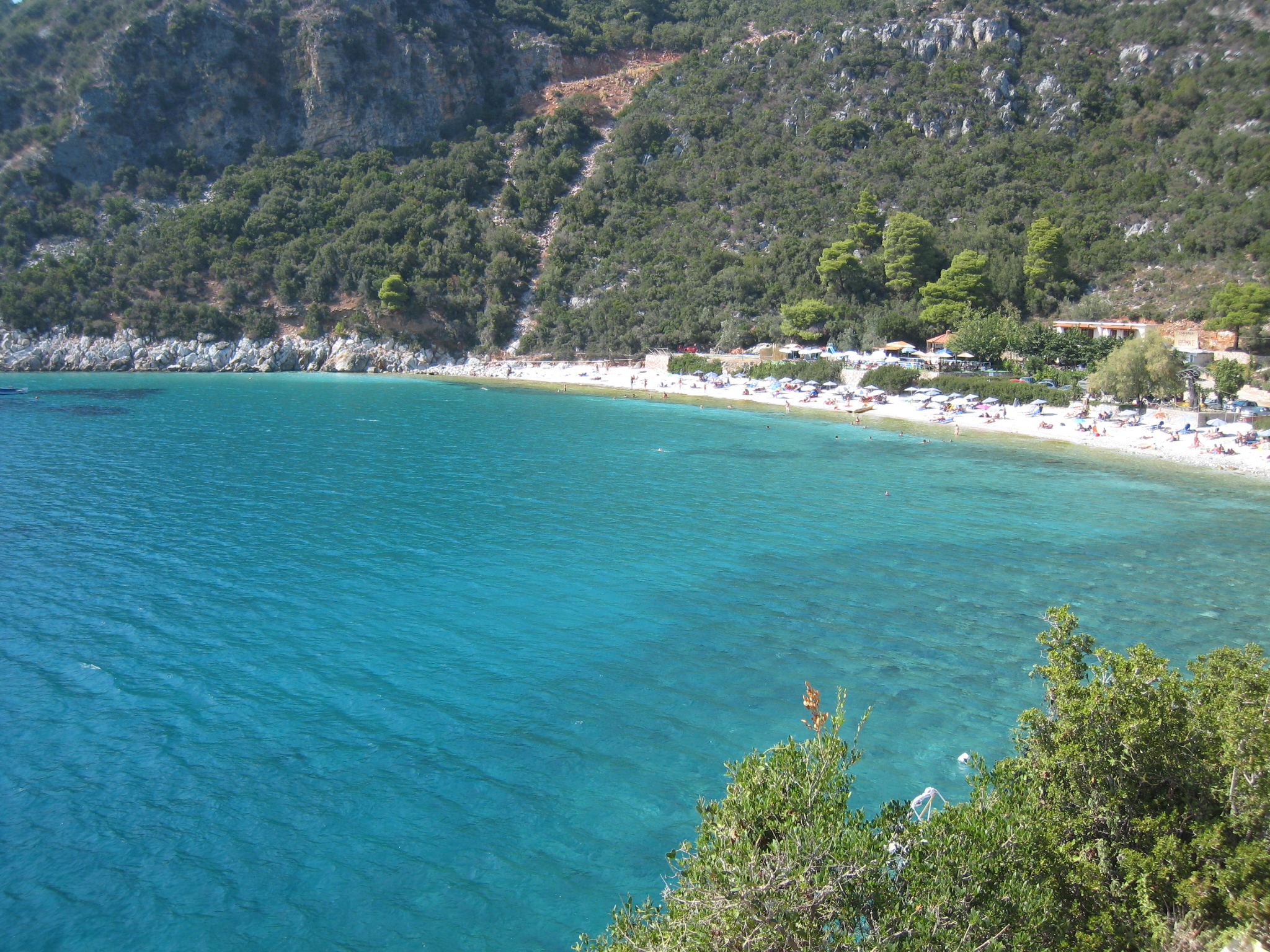
Skopelos has around 67 kilometres of coastline, most of it accessible only on foot, by boat, or via the single road that loops around the island. This inaccessibility is its greatest asset — it means beaches that stay quiet even in August, coves that feel entirely private, and the persistent sense that you are discovering something the island hasn’t given away.
The Best Beaches on Skopelos
Kastani Beach — This is the one most people come for, and it earns the attention. A gently curved bay of golden sand (rare in the Sporades — most beaches are fine pebble) backed by a wall of pine trees, Kastani has clear shallow water and a small beach bar. It was also used as a filming location in Mamma Mia! — the scene where Sophie swims while singing to her mothers — which adds a layer of cinematic recognition without overwhelming the place itself. Come early morning or late afternoon to have it closer to yourself.
Stafylos Beach — About 4.5 kilometres south of Chora, Stafylos is one of the island’s most beautiful organised beaches: a fine pebble bay in a sheltered cove, with transparent shallow water, a taverna, and sun loungers available for hire. The water colour here — a graduated shift from pale mint to deep turquoise — is extraordinary. Just over the headland is the clothing-optional Velanio Beach, quieter and wilder.
Milia Beach — One of the longer beaches on the island, with a mix of sand and pebble and pine trees pressing almost to the waterline. Swimming here at midday, with the resinous scent drifting off the trees and the water cool against the heat, is one of Skopelos’s defining sensory experiences.
Limnonari Beach — A gorgeous small bay of golden sand tucked between forested headlands in the south of the island. One of the finest beaches in the Sporades and consistently praised for its water quality and relative seclusion. There is a taverna above the beach.
Panormos Beach — A larger, more organised beach on the west coast, good for families and for those who want facilities (sun loungers, beach bar, taverna). The setting is beautiful — a wide bay backed by low hills — and watching the sunset from the beach bar here in late evening is a classic Skopelos experience.
Agnontas Beach — A small shingle beach at the end of a picturesque fishing village, with a handful of tavernas where the fishing boats come in. The village is the setting for the Money, Money, Money scene in Mamma Mia!, which means a pleasant combination of film geography and genuine local atmosphere.
Hovolo Beach — Arguably the most dramatic of Skopelos’s beaches: a series of rocky platforms, sea caves, and crystal pools carved into the shoreline, accessible by a short hiking path from the road. Not a swimming beach in the traditional sense, but one of the island’s most photographed natural features.
I spent a morning at Milia with no one else on the beach. The pines were so close I could reach out and touch them. The water was the colour of deep glass. I understood, finally, why Skopelos doesn’t need to be Santorini.
The Agios Ioannis Chapel — More Than a Film Set
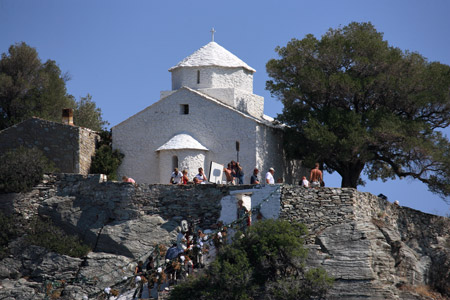
Perched 100 metres above the sea on a dramatic limestone rock in the northeast of the island, the tiny chapel of Agios Ioannis sto Kastri was the location for the wedding finale of Mamma Mia!. You reach it by climbing 198 rock-cut steps — a genuinely vertiginous ascent that rewards with one of the most spectacular views in Greece: the full breadth of the Sporades sea, islands in every direction, the deep blue of the Aegean uninterrupted to the horizon.
The chapel itself is very small — barely enough room for a small wedding party — but deeply beautiful, its whitewash brilliant against the dark rock. Beyond the film associations, Agios Ioannis is a genuinely ancient sacred place, and locals still make pilgrimages here on the Saint’s feast day.
Part 3 — Local Life: Taste and Rhythm
The Food of Skopelos
Skopelos has a distinct culinary identity rooted in its geography — forest, sea, and a productive agricultural interior. The island’s signature products tell the story.
The Skopelos cheese pie (τυρόπιτα Σκοπέλου) is the most famous single dish on the island: a thick, rich pie made with local goat’s cheese — pungent and flavourful in a way that supermarket feta never approaches — baked in a wood-fired oven and served warm. Both Skiathos and Alonissos claim it as their own, but Skopelos makes the strongest case. Ask for it at any bakery in Chora.
Skopelos prunes (δαμάσκηνα Σκοπέλου) are a protected designation of origin product — sweet, intensely flavoured dried plums grown on the island and used in everything from meat stews (meatballs with sweet-and-sour plum sauce) to desserts and liqueurs.
Almonds and almond sweets — The haimalia (fried dough with almond filling) and various almond pastries made by the traditional women’s cooperative in Glossa are a Skopelos speciality worth seeking out.
Fresh seafood — The fishing boats still go out daily from Agnontas and Chora, and the tavernas receive whatever they bring back. Grilled local fish, fried anchovies in tomato sauce, and lobster with orzo (astakos me kritharaki) are among the standout dishes.
Goat dishes — The island’s hills support a small population of local goats, and the traditional kitchen uses them extensively: goat with wild greens and egg-lemon sauce, goat with hilopites (pasta), goat with artichokes.
In Glossa, the restaurant Agnanti remains the island’s benchmark for traditional cooking. In Chora, the upper-alley tavernas offer more neighbourhood-style dining — simpler menus, lower prices, and a sense of genuine local eating that is increasingly hard to find in the more visited Greek islands.
In 1999, a women’s culinary cooperative was formed in Glossa to preserve and promote the island’s gastronomic traditions. Their legacy — the cheese pies, the almond sweets, the old recipes written in exercise books — continues in the island’s food culture today.
The Rhythm of Island Life
Skopelos has a permanent population of around 5,000 people. They are not — yet — overwhelmed by tourism. The ferry brings visitors in summer, the tavernas fill up, the beaches get busier. But come September and the island exhales. The roads empty, the villages reclaim their pace, and you can sit in the square in Glossa on a Tuesday afternoon with nothing to hear but the wind in the pines and two old men arguing about football in the kafeneion across the street.
This is the unhurried Sporades rhythm that neither Santorini nor Mykonos can offer anymore. Skopelos still has it — for now.
Part 4 — Getting There & When to Go
How to Reach Skopelos
Skopelos is part of the Northern Sporades island group, accessible by ferry from the Greek mainland.
From Athens (Agios Konstantinos):
The primary mainland port for the Sporades is Agios Konstantinos, approximately 160 km north of Athens. High-speed ferries connect Agios Konstantinos to Skopelos Town (Chora) in approximately 3 hours, and to the island’s second port at Loutraki/Glossa in slightly less. Hellenic Seaways and other operators run daily services in summer.
Tip: From Athens, take a bus from Liosion terminal to Agios Konstantinos (around 2.5 hours) or a taxi/transfer. Combined journey time from Athens to Skopelos: approximately 5-6 hours.
From Volos (Thessaly):
Alternatively, ferries depart from Volos (the port of Thessaly) to Skopelos, passing through Skiathos and Alonissos. This offers a scenic Sporades island-hopping route.
Via Skiathos:
Skiathos has an international airport with direct summer flights from many European cities. From Skiathos, a short ferry crossing (approximately 35-45 minutes) connects to Glossa/Loutraki port, making Skiathos a practical gateway for visitors flying from abroad.
By car or on foot:
Skopelos has no bridge connection — you arrive by sea. Rental cars, scooters, and ATVs are available in Chora for exploring the island.
Best Time to Visit
May–June is arguably the finest time to visit Skopelos. The island is green from the winter rains, the wildflowers are still in bloom, the beaches are accessible but uncrowded, and the temperatures are warm without the intense summer heat. Tavernas are open but you can walk into Agnanti without a reservation.
September–October runs a close second. The summer crowds have thinned, the sea is at its warmest (Aegean water temperature peaks in late August and stays warm through September), the light has turned golden, and the island reclaims its local character. For photographers and slow travellers, this is the sweet spot.
July–August sees Skopelos at its busiest — though “busy” by Skopelos standards is still gentle compared to Santorini or Rhodes. Kastani Beach fills up, the ferries are packed, and accommodation should be booked well in advance. The atmosphere is festive and energetic.
November–March: Many businesses close. Ferry connections reduce significantly. The island becomes very quiet — beautiful in its own way, but not suitable for the standard beach holiday.
Bonus — Island Hopping: The Sporades Triangle
One of Skopelos’s great advantages is its position within the Northern Sporades chain. The three islands of Skiathos, Skopelos, and Alonissos are connected by regular ferries and form one of the best island-hopping itineraries in Greece.
The classic 7–10 day Sporades circuit:
Skiathos (2–3 days) — The most developed and party-forward of the three, with the famous Koukounaries beach, a lively town, and excellent nightlife. Fly in here if coming from abroad.
Skopelos (3–4 days) — The green heart of the Sporades. Focus on Chora, the chapel, and the beaches. Day trip to Glossa for lunch at Agnanti.
Alonissos (2–3 days) — The quietest and wildest of the three, home to the National Marine Park of Alonissos and the last surviving monk seals in the Mediterranean. The Old Village (Palio Chorio) perched on its hill is one of the most atmospheric settlements in northern Greece.
The ferry connections between the three islands are regular and take between 20 minutes (Skiathos–Skopelos) and 1.5 hours (Skopelos–Alonissos). For a day trip, you can visit Alonissos from Skopelos and return the same day.
For travellers coming from the Cyclades — perhaps after visiting Andros, the cultured emerald of the Cyclades — the Sporades offer a completely different but equally compelling version of the Greek island experience: lusher, quieter, and rooted in a distinct northern Aegean character.
Essential Information
| Getting there | Ferry from Agios Konstantinos (Athens ~3h drive + 3h ferry) or via Skiathos airport |
| Ferry operator | Hellenic Seaways |
| Main port | Skopelos Town (Chora) + Loutraki (Glossa side) |
| Best time | May–June and September–October |
| Avoid | Weekends in August if possible — busiest period |
| Getting around | Rent a car, scooter, or ATV in Chora for maximum flexibility |
| Accommodation | Book well ahead for July–August; wide choice from boutique hotels to studio apartments |
| Don’t miss | Agnanti restaurant in Glossa (reserve in advance), Kastani beach early morning, the 198 steps to Agios Ioannis |
A Final Note on Expectation
Skopelos will not overwhelm you. It will not offer the volcanic drama of Santorini, the architectural brilliance of Oia at sunset, or the party energy of Mykonos. It offers something else — something that is, in truth, harder to find in modern Greece.
It offers a place that is still itself.
The pines are still there. The prune orchards still produce. The cheese pie still comes from a wood-fired oven. The old women still make almond sweets from their grandmothers’ recipes. The lanes still wind upward through Chora in the afternoon heat, and somewhere up near the kastro, a cat is always sleeping in the sun.
For all the Mamma Mia excitement — and it is a genuinely charming little chapel, those 198 steps are worth every one — the real reason to come to Skopelos is older and quieter than any film. It is simply this: a green island in the northern Aegean, where the pines lean over the sea and the living is still, blessedly, slow.
For more hidden island discoveries, explore our guide to Serifos: the untouched Cycladic escape, or discover what makes Folegandros the most authentic cliff island of the Cyclades. And if you’re planning a broader Greek adventure, the Ionian Islands comparison guide will help you choose between six very different island characters.