Paros sits in the middle of the Cyclades, roughly four hours from Piraeus by conventional ferry, and it occupies a comfortable space between the polish of Mykonos and the rugged independence of islands like Amorgos or Serifos. It has excellent beaches, a pair of port towns with genuine personality, a mountain interior that most visitors never reach, and an ancient marble legacy that shaped some of the greatest sculptures of the classical world.
This guide covers the practical decisions that matter: where to base yourself, which beaches suit which conditions, how to plan around the wind, when a car is worth renting, and what you can realistically see in three to five days. It is designed for travellers who want useful detail rather than generic encouragement.
| Location | Central Cyclades, between Naxos and Antiparos |
| Area | Approximately 196 km² — third largest in the Cyclades |
| Population | Around 15,500 (2021 census) |
| Main settlements | Parikia (capital/port), Naoussa, Lefkes, Marpissa, Aliki |
| Ferry from Piraeus | 2 h 40 min (high-speed) to 4–5 h (conventional), daily year-round |
| Airport | Paros National Airport (PAS) — flights from Athens, approximately 40 minutes |
| Best for | Couples, families, first-time Cyclades visitors, windsurfers, island-hoppers |
| Less suited to | Travellers seeking large-scale nightlife or completely uncrowded beaches in August |
Who Paros Suits Best
Paros works well for travellers who want a Cycladic island with real substance but without the intensity of Mykonos or the cruise-ship density of Santorini. It has enough infrastructure to make a holiday comfortable — reliable buses, good roads, a small airport, frequent ferries — while retaining a working-island character that its more famous neighbours have largely traded away. Fishing boats still unload their catch in Naoussa harbour each morning, and the mountain village of Lefkes empties down to a handful of residents by October.
Families will find shallow, sandy beaches on the south and east coasts, with enough tavernas and shade nearby to keep the logistics simple. Couples tend to gravitate toward Naoussa for evening atmosphere and the quieter coves around the northern coastline. Windsurfers and kitesurfers know Paros already: Golden Beach and New Golden Beach have hosted PWA World Cup stages, and the summer meltemi funnels reliably through the channel between Paros and Naxos. Solo travellers and island-hoppers benefit from the frequent ferry connections — Naxos is twenty minutes away, Santorini roughly ninety minutes by high-speed catamaran, and Antiparos is accessible by a seven-minute crossing from Pounta.
Paros is less suited to travellers who want complete isolation. In July and August, the main beaches and harbour areas become busy, and accommodation books out early. If a quieter Cycladic experience is the priority, consider Sifnos or Serifos.
Best Time to Visit
The island is at its liveliest from mid-June to mid-September, with late June and early September offering the best balance of warm water, functioning services, and manageable crowds. July and August bring the peak season, when accommodation prices roughly double and beaches along the north coast can fill by late morning. The meltemi wind blows strongest between mid-July and mid-August, which suits windsurfers but can make north-facing beaches uncomfortable for swimming.
May and early June are attractive for walking, especially the network of paths connecting Lefkes to Prodromos and further south. The sea is still cool in May, typically around 19–20°C, but it warms to swimmable temperatures by mid-June. Most accommodation, ferry routes from Rafina, and beach services operate from late April to October, though the core season is tighter — some smaller beach bars and seasonal restaurants open only from June.
Visiting between November and March is possible but requires adjustment. Many hotels and restaurants close, bus frequency drops, and ferry schedules thin considerably. What remains is an island that belongs entirely to its residents, with clear light, empty trails, and the kind of quiet that feels earned rather than curated. For a wider look at why autumn works well across the country, see our guide to September in Greece.
How to Get to Paros
Daily ferries connect Piraeus to Paros year-round, with additional seasonal routes from Rafina. High-speed catamarans with Seajets reach Paros in around 2 hours 40 minutes from Piraeus, while conventional Blue Star Ferries take 4 to 5 hours and offer a more spacious, relaxed crossing. Deck fares start from approximately €41 on conventional ferries and €62 on high-speed services. From Rafina, Golden Star Ferries and Fast Ferries operate seasonal routes between April and October, with crossings taking 3.5 to 6.5 hours.
Flights from Athens to Paros take about 40 minutes and run year-round, though frequency increases in summer. The airport is small, located near the centre of the island between Parikia and Aliki, and a taxi to either Parikia or Naoussa takes around 10 to 15 minutes.
For island-hoppers: Paros connects to Naxos in 20–40 minutes, to Santorini in 1.5–2 hours, to Milos in 2–3 hours, and to Mykonos in approximately 50 minutes. Schedules vary by season, so always confirm with the operator before booking accommodation.
Parikia: The Island Capital
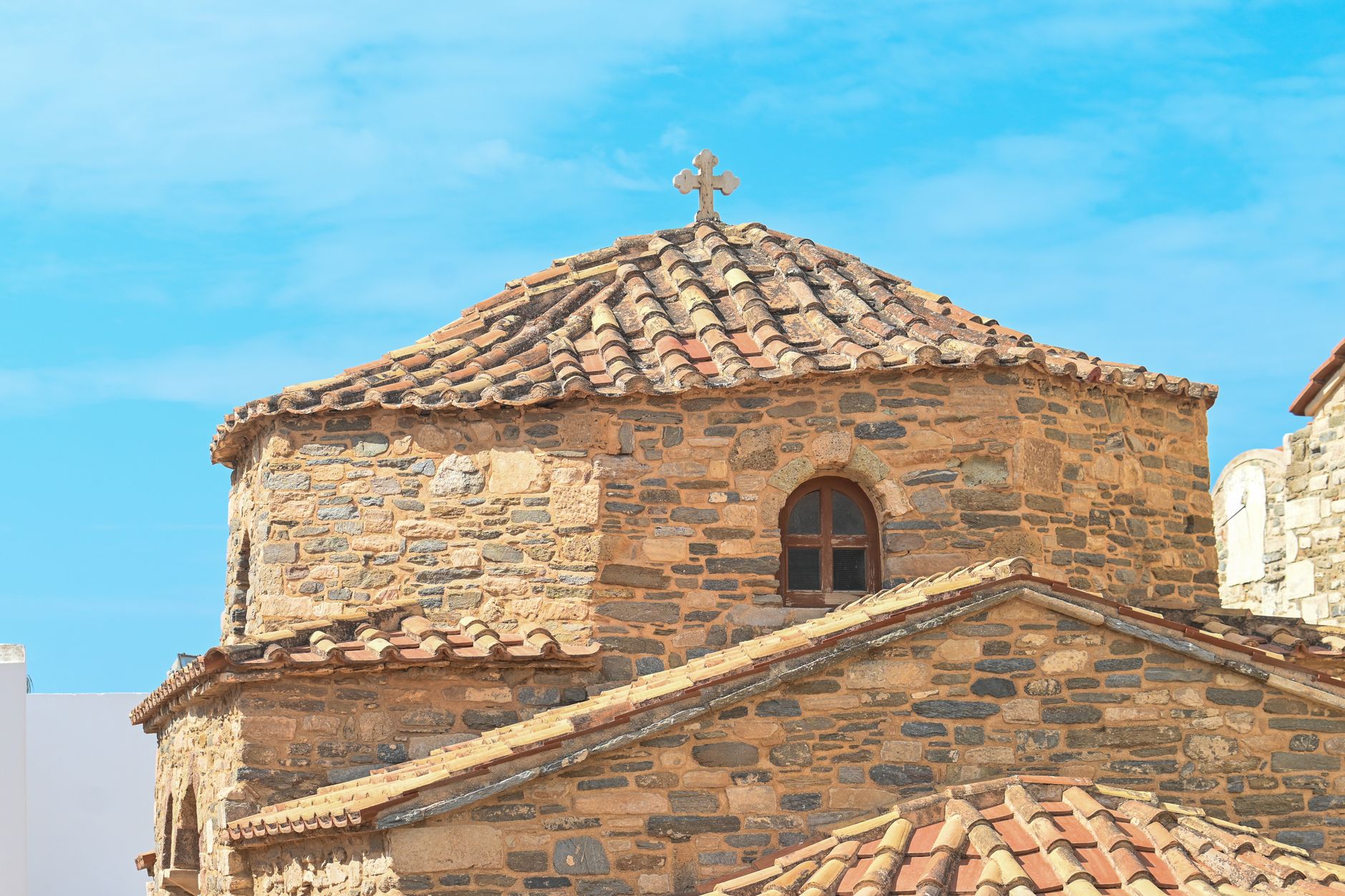
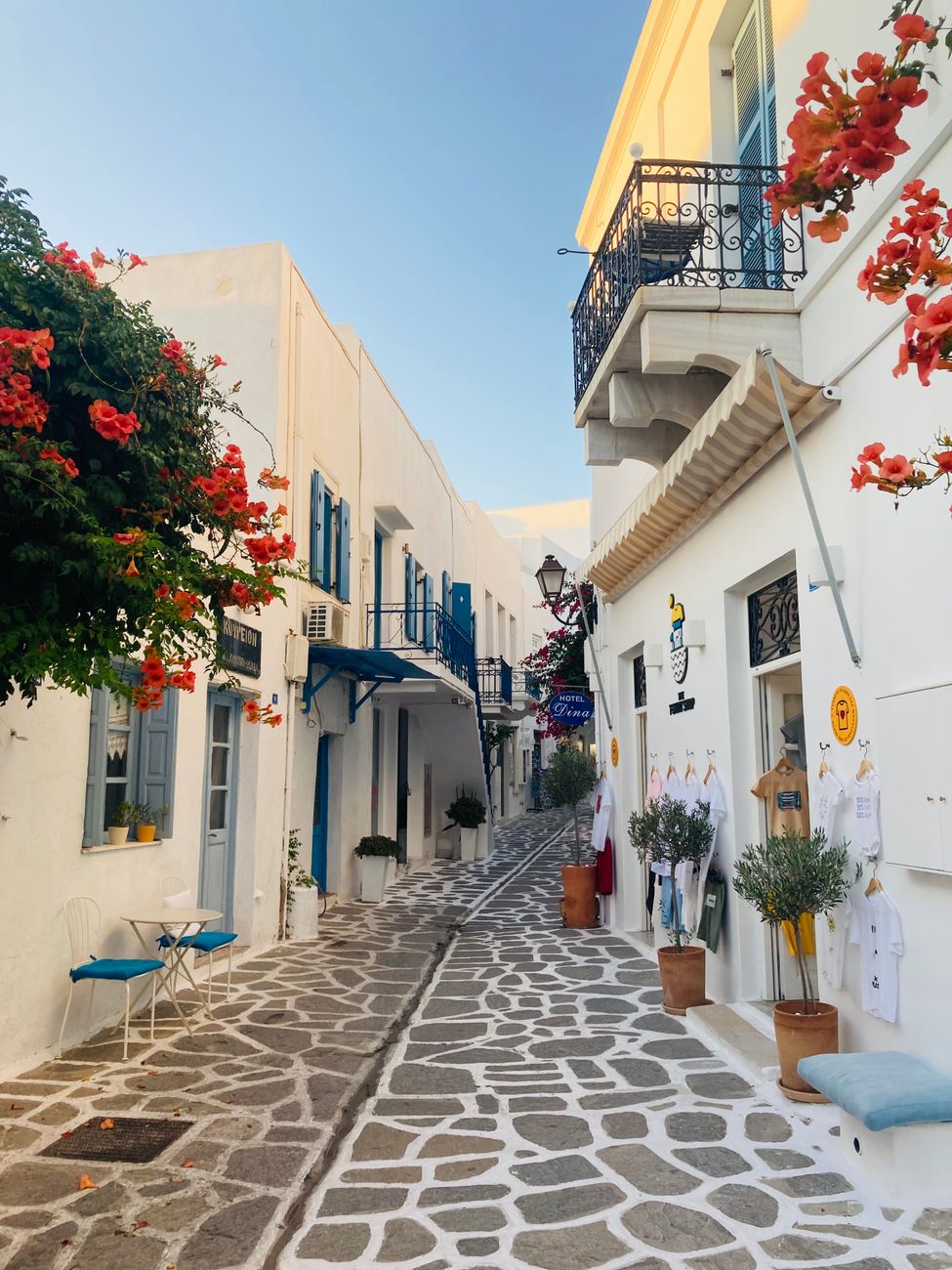
Parikia is the main port, the administrative centre, and where most visitors arrive. First impressions from the ferry are mixed — the waterfront is functional rather than beautiful, lined with ticket offices, car-rental counters, and a bus station that could belong to any mid-sized Greek town. But walk five minutes inland and Parikia transforms into a genuinely engaging old quarter of whitewashed lanes, low arches, and unexpected small squares shaded by mulberry trees.
The old town grew organically around a 13th-century Venetian kastro, fragments of which are still visible — some of the walls incorporate ancient marble blocks and columns salvaged from earlier temples. It rewards slow wandering more than any structured tour, and even in August there are alleys where the tourist current barely reaches.
The major cultural attraction in Parikia is the Panagia Ekatontapiliani, one of the best-preserved early Christian church complexes in Greece. Its core dates to the 4th century AD, with significant rebuilding during the reign of Emperor Justinian in the 6th century. The name translates roughly as “Church of a Hundred Doors,” though the more likely origin is a corruption of Katapoliani, meaning the church below the town. A local legend holds that only 99 doors have been found, and the hundredth will appear when Constantinople’s Hagia Sophia becomes an Orthodox church again. The interior is spacious and cool, with marble columns, early frescoes, and a cruciform baptistery that is remarkable for its age. It sits a short walk from the port and is free to enter.
The Archaeological Museum of Paros, also in Parikia, houses finds from excavations across the island and Antiparos, including Cycladic figurines, an Archaic marble Gorgon, and a fragment of the Parian Chronicle — a marble tablet recording key events in Greek history. The museum is small but well-curated, and worth an hour if you are interested in the island’s ancient past.
Naoussa: The Second Town
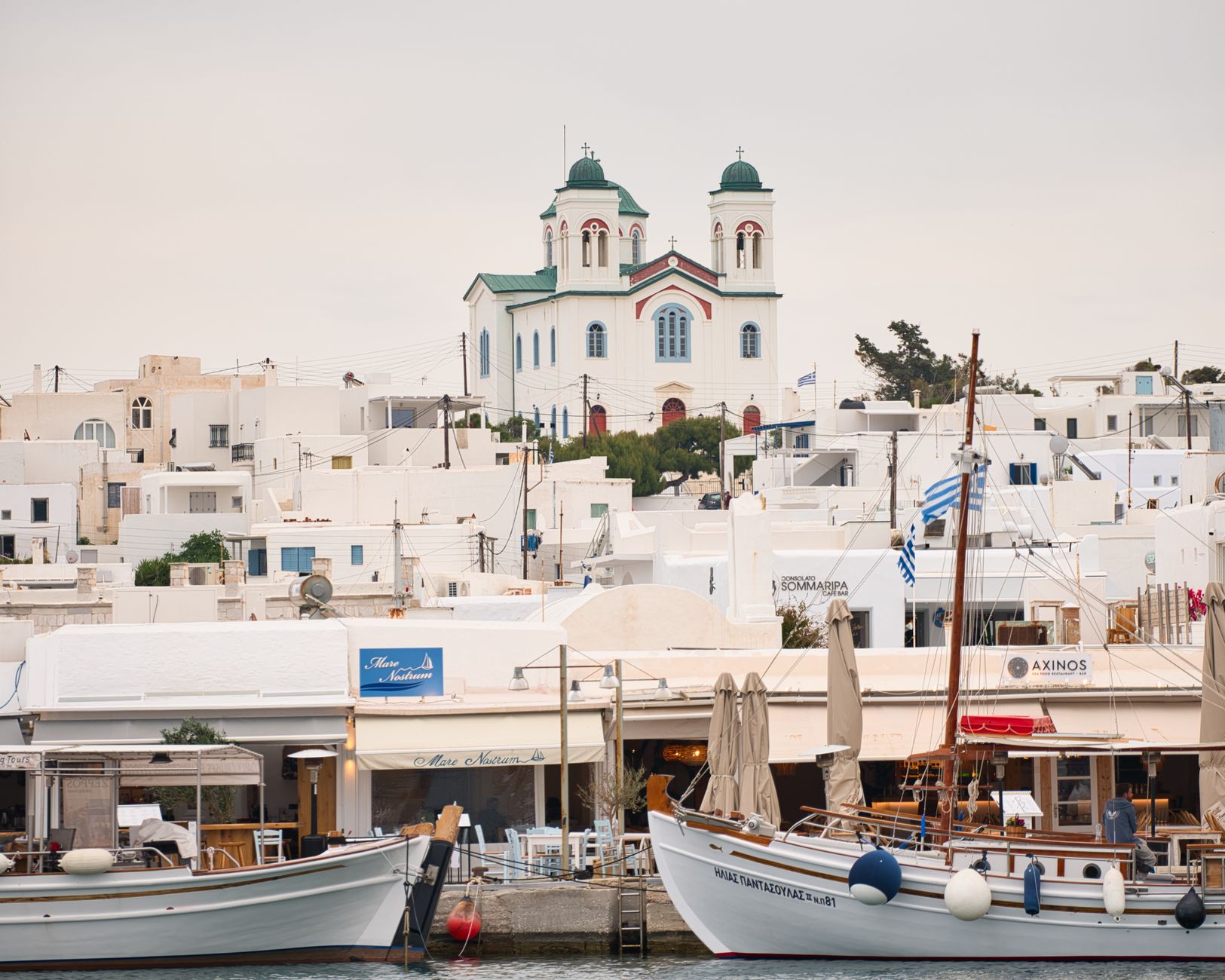
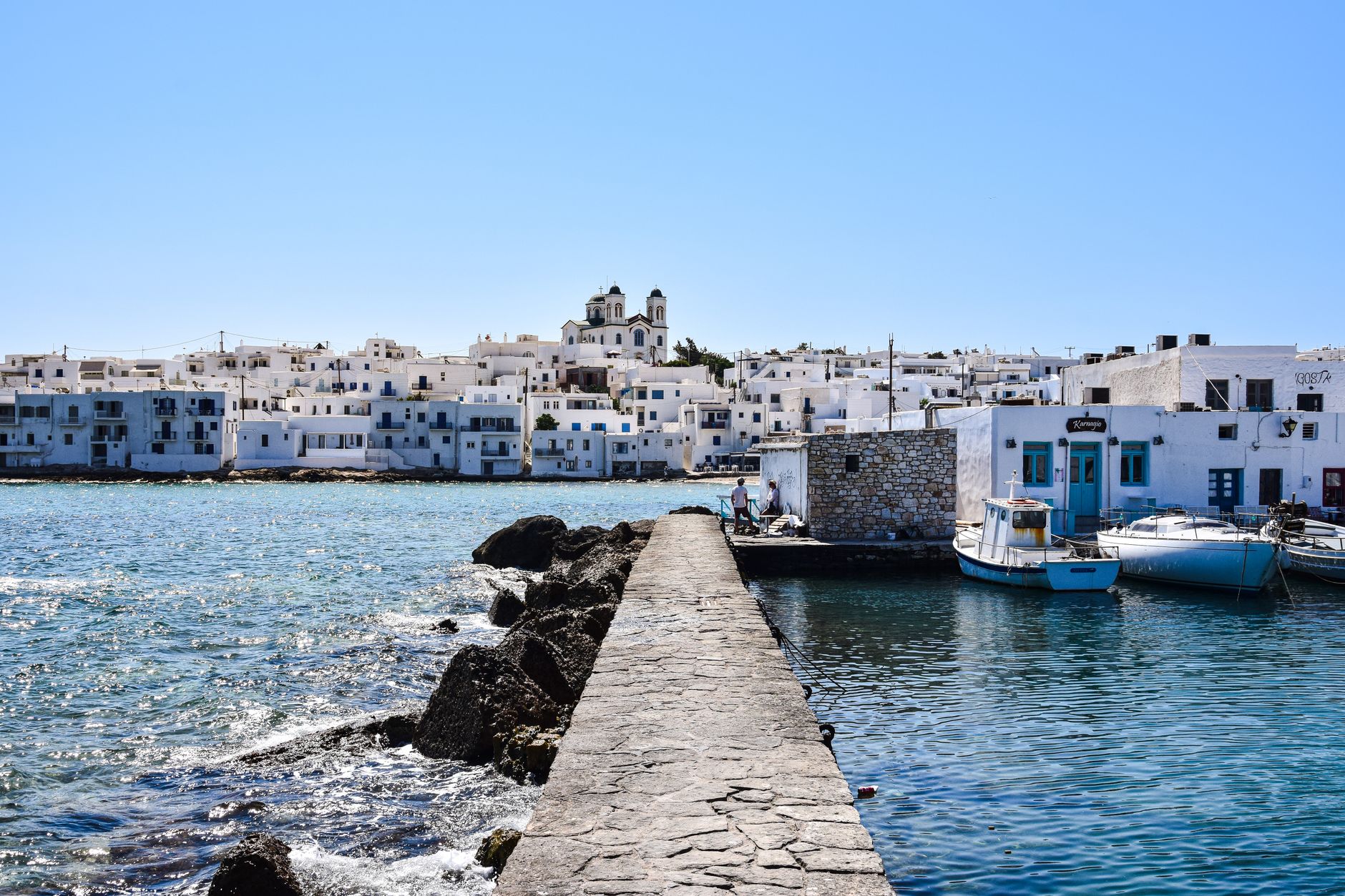
Naoussa, on the northern coast about 12 kilometres from Parikia, is the island’s second settlement and its most photogenic. The old harbour is small enough to cross in three minutes and beautiful enough to hold you there for three hours, particularly in the golden hour before sunset when the light softens the white walls and the fishing boats return. A half-submerged Venetian fortress marks the harbour entrance, and the lanes behind it contain the island’s best concentration of independent shops, galleries, and evening dining.
Naoussa has grown considerably as a destination over the past decade, and during July and August the harbour area becomes genuinely crowded in the evenings. The restaurants with waterfront tables tend to charge a noticeable premium, and locals as well as returning visitors often prefer the tavernas a few streets back, where the food is typically better and the prices more honest. The town has a cosmopolitan polish that Parikia lacks, but it has not tipped into the self-conscious exclusivity of some Mykonos resort areas — not yet, at least.
Naoussa is also the practical starting point for several of the island’s best beaches. Water taxis run from the harbour to Kolymbithres, Santa Maria, and Laggeri during summer, and the KTEL bus connects to Parikia roughly every hour. If you base yourself in Naoussa without a car, you can reach the main northern beaches easily, though the south coast will require a rental or a bus connection through Parikia.
Lefkes and the Mountain Villages
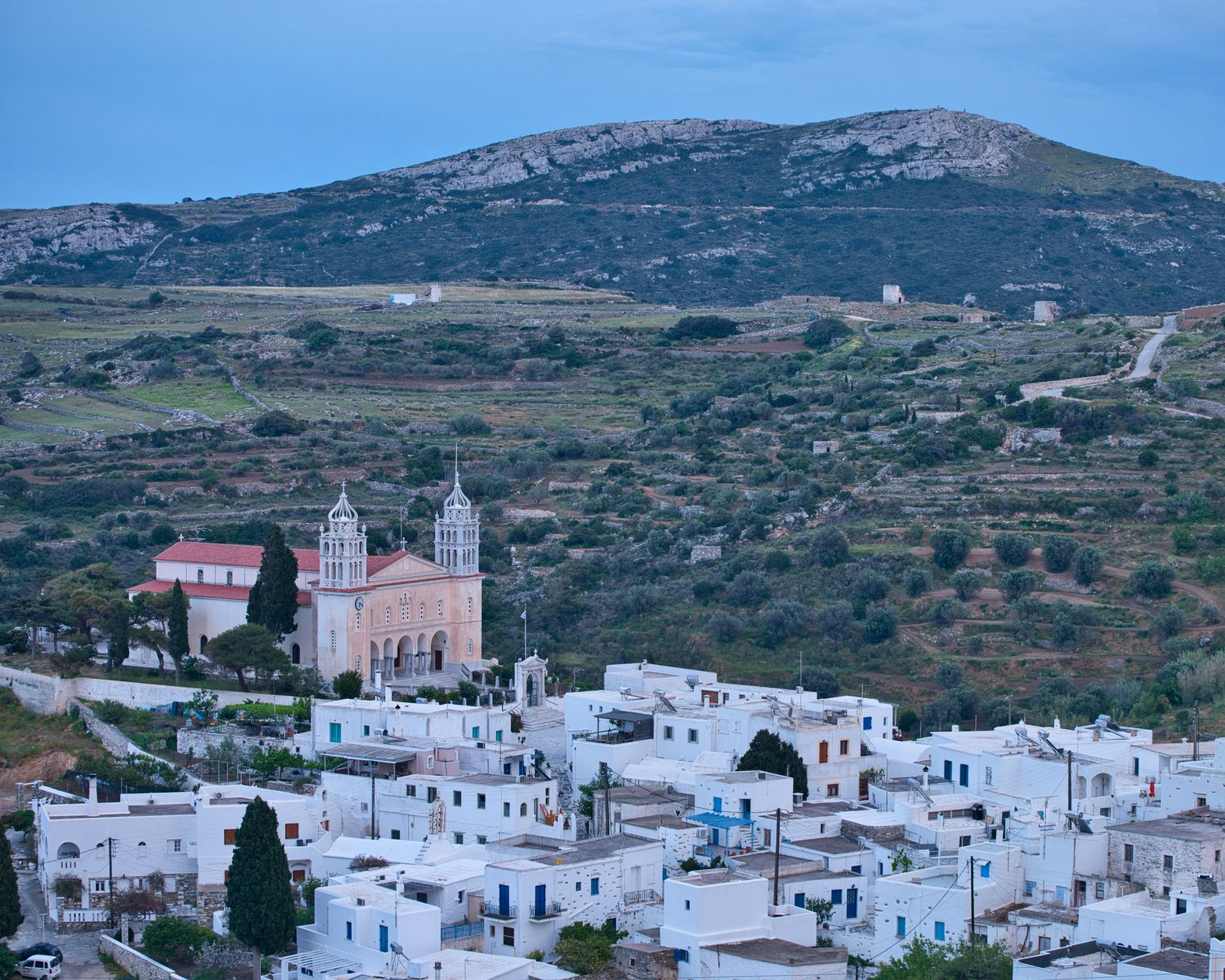
Lefkes sits at roughly 300 metres elevation in the island’s interior, surrounded by olive groves and with long views toward Naxos. It was Paros’s first capital, before the port of Parikia grew in importance, and it still feels like a settlement that was built for protection rather than tourism. The houses step up the hillside in the amphitheatric arrangement typical of Cycladic mountain villages, and the main street is a marble-paved lane lined with a few cafes, a folk museum, and some craft shops that manage not to feel contrived.
The Church of Agia Triada, built from local marble in 1835, is Lefkes’s most recognisable landmark. It is handsome rather than grand, but the quality of the stonework reflects the island’s long relationship with its quarries. From the village, the Byzantine Road — an ancient marble-paved path — leads downhill to the village of Prodromos, roughly a one-hour walk through terraced hillside with occasional sea views. The path is well-maintained and suitable for most fitness levels, though it can be hot by mid-morning in summer. Walking it early is strongly recommended.
Other inland villages worth a stop include Marpissa, which has its own small Venetian kastro and a cluster of 16th-century churches, and Prodromos, a very quiet settlement known for its pottery workshops. The village of Kostos, further south, sees very few visitors and gives a fair sense of what Paros looked like before mass tourism. These villages are connected by bus, though service is infrequent outside summer. A car makes inland exploration significantly easier.
Beaches
Paros has more than 40 beaches, and their character changes dramatically with the wind. Understanding this is the single most useful piece of beach knowledge on the island. The prevailing summer wind is the meltemi, blowing from the north. When it is strong — which happens regularly in July and August — the north-facing beaches around Naoussa, Kolymbithres, and Santa Maria can become choppy and uncomfortable. On those days, the south and east coasts offer shelter: Golden Beach, Drios, Aliki, and Faragas are better options. On calmer days or when rare southerly winds blow, the northern beaches are at their best.
| Beach | Coast | Best for | Wind notes | Facilities |
|---|---|---|---|---|
| Kolymbithres | North | Families, scenery | Exposed in meltemi | Sunbeds, tavernas |
| Santa Maria | Northeast | Water sports, families | Sheltered in rare south winds | Full organisation, beach bars |
| Golden Beach | Southeast | Windsurfing, families | Reliable meltemi, manageable for swimming | Sunbeds, bars, water-sports centres |
| Marcello | West | Families, easy access from Parikia | Sheltered in north wind | Beach bars, tavernas |
| Faragas | South | Quieter swimming | Sheltered from meltemi | Beach bar, sunbeds |
| Kalogeros | East | Solitude, therapeutic mud | Some meltemi exposure | None — bring water and shade |
| Laggeri | North | Peace, naturism | Exposed in meltemi | None |
| Aliki | South | Families, calm water | Well sheltered | Tavernas, sunbeds |
Kolymbithres is the beach most visitors see first, and for good reason. The smooth granite rock formations that divide the shoreline into small sandy coves are genuinely unlike anything else in the Cyclades. The water is shallow and clear, which makes it excellent for young children on calm days. But in meltemi conditions it can be uncomfortable, and the small coves fill quickly in peak season. Access is by road or by water taxi from Naoussa harbour.
Golden Beach (Chrissi Akti), on the southeast coast, is one of the island’s longest stretches of sand — roughly 700 metres. It is the island’s primary windsurfing destination and has hosted stages of the Professional Windsurfers Association World Cup. The meltemi channels through the strait between Paros and Naxos with particular strength here, making conditions excellent for experienced riders. For swimmers, the bay remains swimmable most days, though the wind can make it unpleasant when conditions are strong. Nearby, New Golden Beach serves as the main kitesurfing hub.
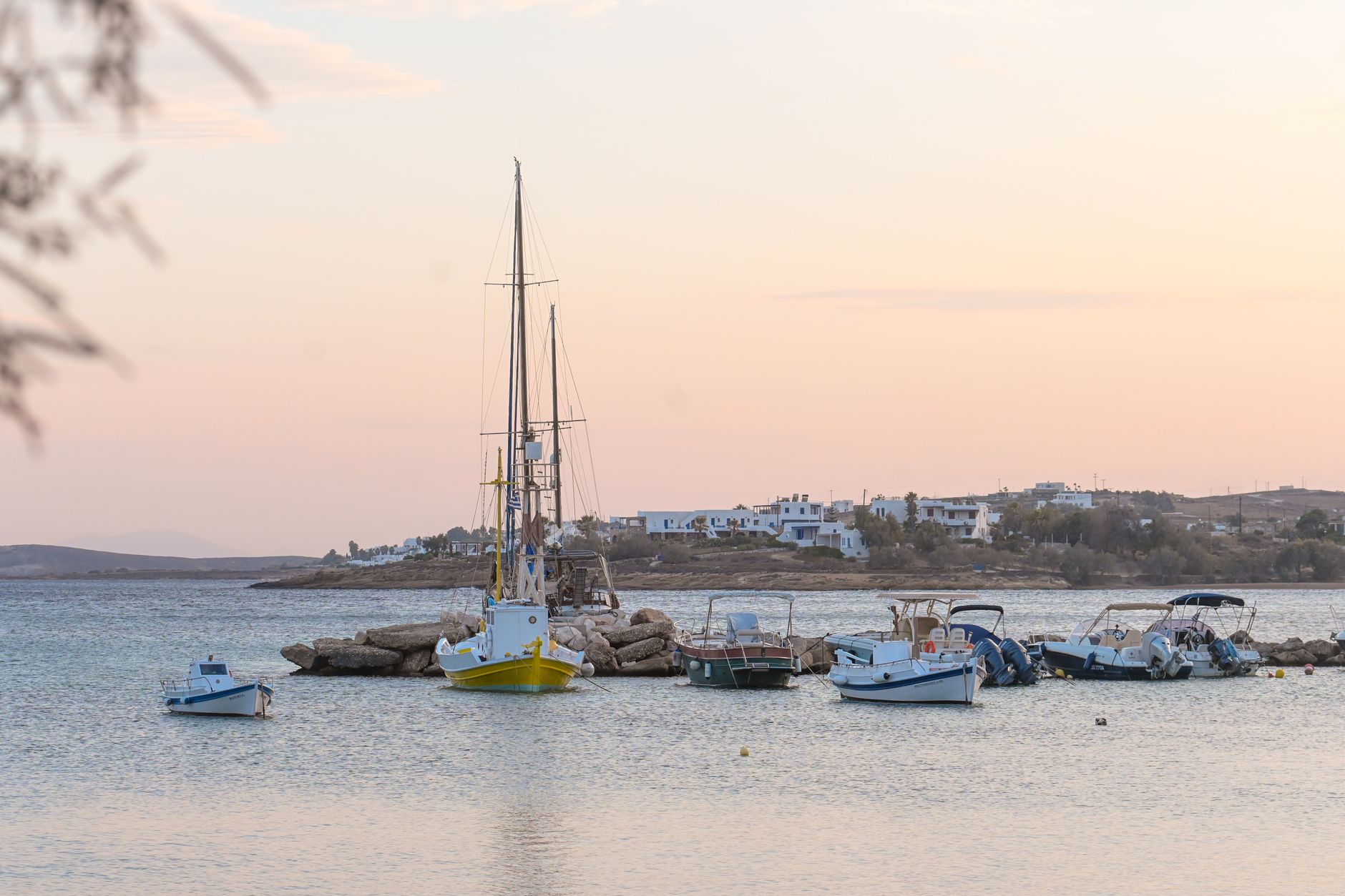
Marcello, just west of Parikia, is the most convenient beach if you are staying near the port. It has a gentle sandy entry, some organised sections with beach bars, and it benefits from shelter during northerly winds. It is reachable by a short boat ride from Parikia port or by road. For families arriving by ferry with tired children, this is an easy first stop.
Faragas, on the southern coast, is quieter than the headline beaches and reasonably sheltered from the meltemi. It has a beach bar and a few sunbeds but does not feel over-organised. Kalogeros, on the east coast, is known for its clay deposits — visitors sometimes apply the natural mud as a skin treatment. It has no facilities at all, so bring water, food, and shade. Laggeri, on the north coast beyond Santa Maria, is a long stretch of sand that attracts naturists and those who want genuine quiet. It is exposed in meltemi conditions.
Antiparos: A Day Trip Worth the Crossing
Antiparos sits just across a narrow strait from Paros, reachable in about seven minutes from the small port of Pounta. Ferries run frequently in summer, and you can take a vehicle across. The island is substantially smaller and quieter than Paros, with one main town, a handful of beaches, and a pace that feels distinctly unhurried even when its bigger neighbour is at full capacity.
The main town has a 15th-century Venetian castle at its centre, and the lanes around it contain a good selection of small shops and places to eat. The Cave of Antiparos, in the southern hills, is the island’s primary attraction: a vertical cave reaching approximately 85 metres deep, accessed by 411 steps. It contains stalactites and stalagmites estimated to be millions of years old, and historical graffiti from as early as the 18th century — including inscriptions attributed to figures from much earlier periods. The cave is manageable for most visitors but involves a fair number of steps in warm conditions.
For beaches, Faneromeni and Soros on Antiparos are worth the trip. The uninhabited island of Despotiko, accessible by small boat from Antiparos, has an important ongoing archaeological excavation of an archaic sanctuary of Apollo, though visitor access varies by season. A half-day is enough for the town and cave; a full day allows for a beach and a more relaxed pace.
Marble and Ancient History
Paros’s historical significance rests substantially on its marble. Parian marble, quarried from the slopes of Mount Marpissa near the village of Marathi, was considered the finest sculptural stone in the ancient world. Its grain is exceptionally fine and its translucency remarkable — light penetrates Parian marble to a depth of approximately 3.5 centimetres, compared with 2.5 centimetres for Italian Carrara marble. This quality gave Parian sculptures a luminous, almost flesh-like warmth that was unmatched.
Some of the most celebrated works of classical sculpture were carved from stone quarried here: the Venus de Milo (now in the Louvre), the Winged Nike of Samothrace (also in the Louvre), and the Hermes of Praxiteles (in the Olympia Museum). An estimated 70 per cent of ancient sculptures found in the Aegean region were carved from Parian marble. The quarries operated from at least the 7th century BC and remained active into the 19th century, though large-scale ancient extraction ended long before that.
The ancient quarries at Marathi can be visited. Two underground gallery entrances are accessible — the Quarry of the Nymphs and the Quarry of Pan, named for carved reliefs near their entrances. A local non-profit organisation, the Paros Ancient Marble Quarries Park, is working toward creating a formal archaeological park at the site, with a long-term ambition of UNESCO World Heritage recognition. Visits are currently possible on an organised basis; check locally for current arrangements. In 2025, archaeologists from the Ephorate of Antiquities of the Cyclades uncovered the remains of a marble sculpture workshop in Parikia, dating to the 3rd or 2nd century BC, containing unfinished marble statues of Aphrodite.
Food and Wine
The dish most closely associated with Paros is gouna — mackerel split open, salted, and sun-dried, then grilled over coals. It is a traditional fisherman’s method of preservation that produces something much better than it sounds: salty, slightly smoky, and excellent alongside horta (boiled wild greens) and a glass of the island’s souma, a local grape spirit similar to tsipouro. You will find gouna hanging alongside octopus at the old fishing ports, especially in Naoussa. It is genuinely local and worth trying at least once.
Paros produces several noteworthy cheeses. Kopanisti, a soft, sharp, fermented cheese with a spicy kick, is probably the most distinctive. It is a Cycladic specialty but Paros makes particularly good versions. Xinomyzithra, a fresh sour cheese, appears in salads and pies. Local graviera and ladotyri (an oil-preserved cheese) are also produced on the island.
Wine production on Paros centres on two indigenous varieties: Mandilaria (red) and Monemvasia (white). The island has PDO (Protected Designation of Origin) status for its wines. The Moraitis Winery, the largest producer, offers tastings and is located between Naoussa and the airport. The resulting wines tend to be dry and mineral-driven, reflecting the island’s stony soils and maritime exposure.
Getting Around
The KTEL Paros bus network connects Parikia to Naoussa, Lefkes, Aliki, Pounta (for the Antiparos ferry), the airport, and several beaches including Golden Beach. The Parikia–Naoussa route runs roughly every hour in summer, takes about 20 minutes, and costs approximately €3. A day pass covering all routes is available for around €10. Schedules change several times during the season, so check the KTEL Paros website before planning your day.
Taxis exist but the island has a limited fleet of around 40–50 vehicles, and wait times of 30 minutes or more are common during peak arrivals and late evenings in Naoussa. There is no ride-hailing app on the island.
Renting a car is the most practical option if you plan to explore beyond Parikia and Naoussa. It gives access to the mountain villages, the less-visited southern beaches, and the marble quarries at Marathi — none of which are well served by public transport. Rates in peak season are typically €40–70 per day for a small car, and booking in advance is strongly recommended for July and August. Scooter rental is popular and cheaper (roughly €20–25 per day), but Paros has some steep inland roads where a scooter can feel precarious. If you are based solely in Naoussa and plan to use water taxis for nearby beaches, you can manage without a vehicle for two or three days.
Where to Base Yourself
Parikia is the practical choice. The main bus station, ferry port, and airport connections are here. The old town has character, and you are within walking distance of the Ekatontapiliani, the archaeological museum, and Marcello beach. It is less atmospherically polished than Naoussa but more convenient as a hub, especially if you plan to take day trips to other islands or move around by bus.
Naoussa is the aesthetic choice. The harbour is the most attractive spot on the island, the dining options are stronger, and the northern beaches are close. The trade-off is that you are further from the ferry port and from the south-coast beaches. If you rent a car, Naoussa works well as a base for the full island. Without one, you will depend on buses or taxis for anything beyond the immediate area.
Aliki and the south coast suit travellers who want a quieter base with sheltered swimming. Aliki is a small resort village with tavernas, a calm bay, and a much more relaxed atmosphere than either Parikia or Naoussa. It is a good option for families who value easy beach access over nightlife. Bus service exists but is less frequent.
Drios and Piso Livadi on the east coast appeal to those who want proximity to Golden Beach and the windsurfing scene. These are smaller, quieter settlements with a handful of tavernas and straightforward accommodation. They are well positioned for the southeast beaches but further from the island’s cultural sites and ferry connections.
A Three-to-Five-Day Itinerary
Day 1 — Arrive, settle, Parikia. If you arrive by ferry, explore the old quarter of Parikia in the afternoon. Visit the Ekatontapiliani, walk the kastro lanes, and have dinner in the old town. If time allows, take the short trip to Marcello beach for a late swim.
Day 2 — Naoussa and the northern beaches. Take the morning bus or drive to Naoussa. Spend the morning at Kolymbithres if wind conditions are favourable, or take a water taxi to Santa Maria. Return to Naoussa in the late afternoon to explore the harbour lanes and stay for dinner at sunset.
Day 3 — Mountain villages and the east coast. Drive or take the bus to Lefkes in the morning. Walk the Byzantine Road to Prodromos (approximately one hour), then continue by car or bus to Golden Beach or Drios for the afternoon. If walking is not your priority, visit Marpissa and its small kastro instead, then head to the beaches.
Day 4 — Antiparos. Take the ferry from Pounta to Antiparos. Visit the cave in the morning before it gets hot, explore the town, swim at Faneromeni or Soros, and return to Paros in the late afternoon.
Day 5 — Southern beaches and local food. Spend the day on the south coast: Faragas, Aliki, or the quieter stretches near Agios Nikolaos. Visit the marble quarries at Marathi if you have a car and have not yet been. Try gouna for lunch at a waterfront taverna, and finish with a final evening in whichever town you prefer.
Three days is enough for the main highlights. Five days allows a genuinely relaxed pace with time for Antiparos, the interior, and repeated returns to your favourite beach. Spending fewer than three nights on Paros is possible but means choosing between beaches and culture — you will not comfortably do both.
What Many Visitors Get Wrong
Ignoring the wind. Choosing a beach without checking the wind direction is the most common mistake on Paros. The meltemi can turn a calm-looking beach into an unpleasant experience within an hour. Check conditions in the morning and pick your coast accordingly: north wind means south-coast beaches, calm days open up the north.
Skipping the interior. Most visitors shuttle between Parikia, Naoussa, and the beaches without ever seeing Lefkes, Marpissa, or the marble quarries. The interior is where the island’s history and character are most visible, and a half-day spent there changes your understanding of the place considerably.
Underestimating August crowds. Paros in August is busy. The harbour area of Naoussa fills with evening crowds, popular beaches require early arrival for a good spot, and accommodation at reasonable prices needs to be booked months in advance. If flexibility allows, late June or September offer a noticeably more comfortable experience.
Not booking a car early enough. Available vehicles thin out rapidly in July and August. Visitors who plan to rent on arrival sometimes find themselves paying a significant premium or settling for whatever is left. If you know you want a car, book it before you book your ferry.
Treating Antiparos as optional. The crossing takes seven minutes and the island offers a different register entirely — quieter, slower, with an excellent cave and some of the calmest beaches in the area. Skipping it means missing one of the most accessible and rewarding day trips in the Cyclades.
This article was researched and verified as of July 2026. Ferry schedules, transport options, admission arrangements, and seasonal services can change. We recommend confirming time-sensitive details directly with operators before travelling. Vivid Greece is an independent publication and this guide contains no sponsored content or paid recommendations.