Patmos Travel Guide: Monastery, Beaches and Chora
Most Greek islands sell themselves on beaches and nightlife. Patmos doesn’t bother. This small Dodecanese island — barely 34 square kilometres of dry hills and blue inlets — earned its place on the map through something far older: a Roman exile, a cave, and a vision that became the Book of Revelation. Nearly two thousand years later, the fortified monastery built above that cave still dominates the skyline, and the island beneath it moves at a pace that makes even slow travellers feel rushed.
What keeps people coming back to Patmos isn’t the sacred history alone, though the UNESCO-listed monastery and cave are genuinely extraordinary. It’s the way the island conspires to quiet you down — the whitewashed maze of Chora where lanes lead nowhere useful, the harbour at Skala where fishing boats creak against their ropes at dawn, and the scattered coves where the Aegean is so clear you can count pebbles from the cliff path above.
Why Patmos Is Different
There’s no airport on Patmos. No resort complexes. No nightclubs thumping bass until sunrise. Forbes once called it “Europe’s most idyllic place to live” in 2009, and while that sounds like marketing copy, the reasoning was sound: a tiny island that attracted artists, writers, and the kind of travellers who bring books instead of selfie sticks — without sacrificing its identity to do so.
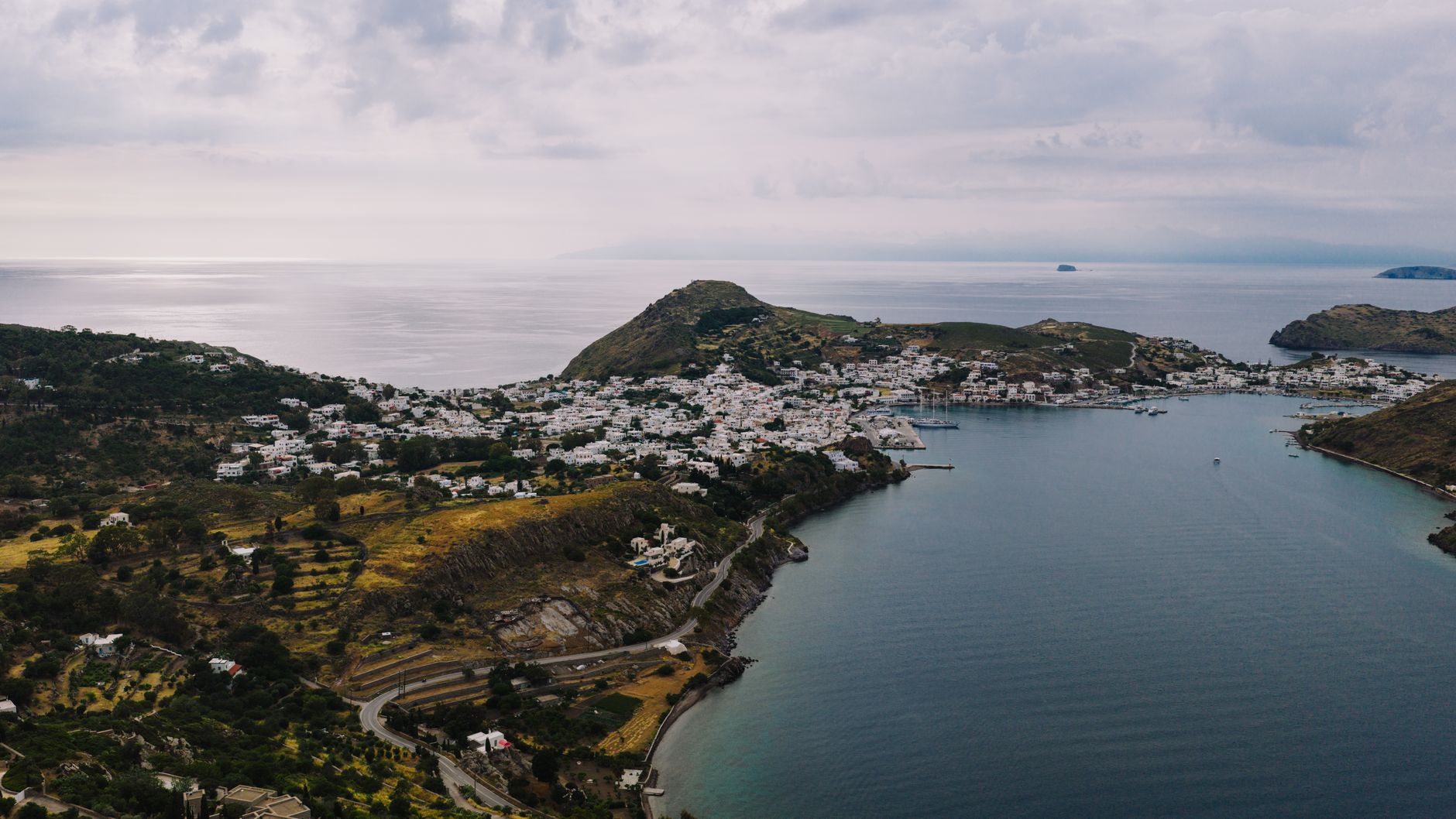
The Monastery of Saint John sits at the island’s highest point in Chora, visible from almost everywhere on Patmos. Below it, the Cave of the Apocalypse marks the spot where John the Apostle is said to have received his divine visions. Between these two sacred anchors, Patmos scatters its villages, beaches, and windmills across a landscape of olive groves, terraced hillsides, and sudden blue inlets that catch you mid-sentence.
The population hovers around 3,300 people — enough to keep a handful of tavernas open through winter, not enough to lose yourself in a crowd even in August. Compared to Kos or Symi elsewhere in the Dodecanese, Patmos asks more of its visitors and gives back something harder to find on the tourist trail: genuine quiet.
Skala — Where Every Arrival Begins
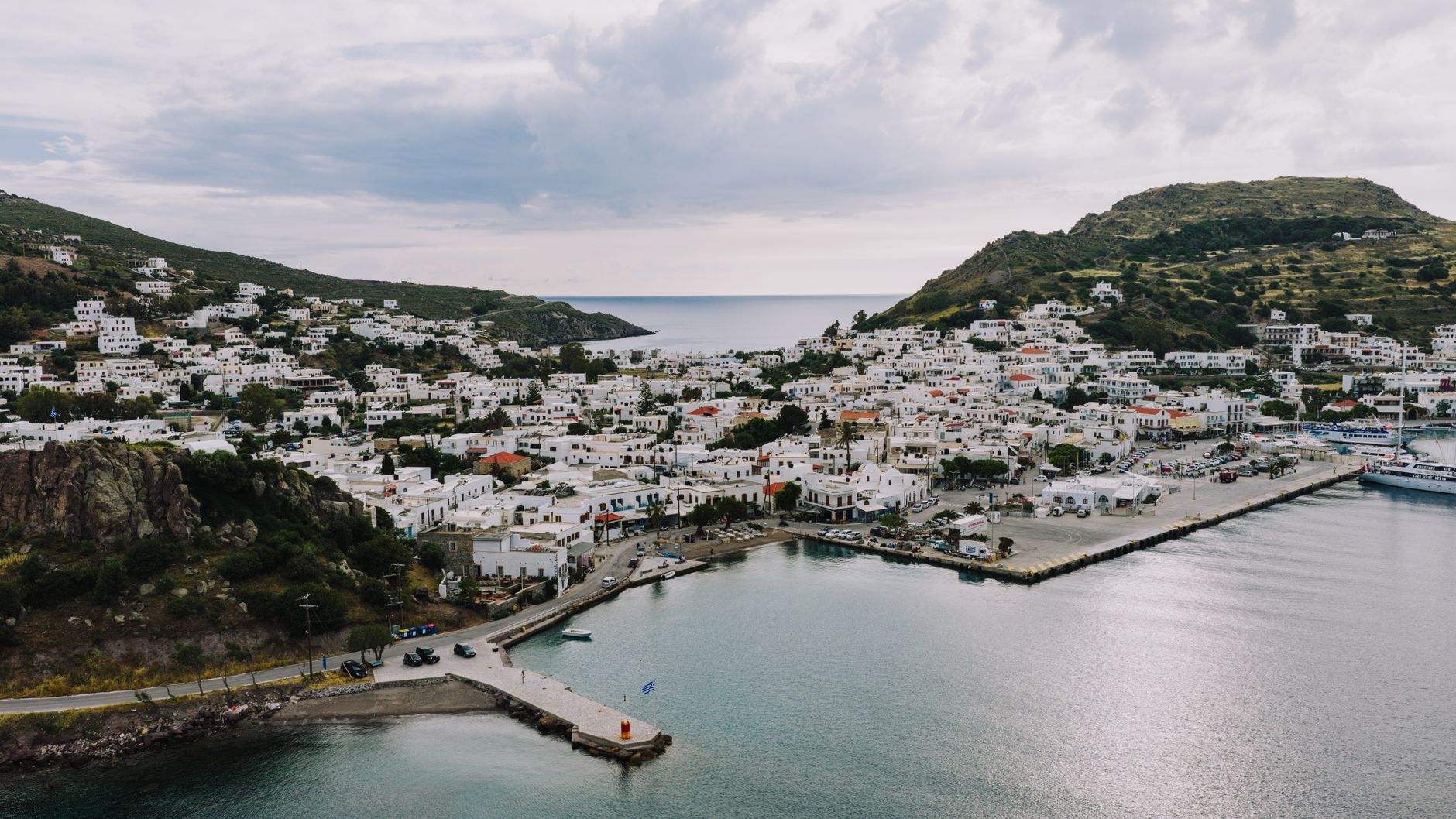
Every ferry passenger’s introduction to Patmos is Skala, the port town that curves around a deep natural harbour on the eastern coast. It’s the island’s commercial centre — which, on Patmos, means a single main street with a few shops, a pharmacy, a bank, and a cluster of waterfront tavernas where you can watch yachts and caïques negotiate for mooring space.
Skala doesn’t have the architectural drama of Chora, but it carries a quiet dignity. The neoclassical mansions along the harbour were built by wealthy merchant families in the 18th and 19th centuries, and they give the waterfront a grace that most Greek island ports traded away for neon bar signs decades ago. Walk south along the quay in early evening and you’ll find tavernas where the owner still knows everyone by name — and where grilled octopus arrives without anyone having to ask.
The practical reason to know Skala is its role as transport hub. Buses, taxis, and scooter rentals all operate from here, and it’s the starting point for the ancient cobblestone path that climbs through the Cave of the Apocalypse to Chora. That walk takes roughly forty minutes, passes through some of the island’s most atmospheric landscape, and is — by a comfortable margin — the best way to arrive at the monastery for the first time.
The Monastery of Saint John the Theologian
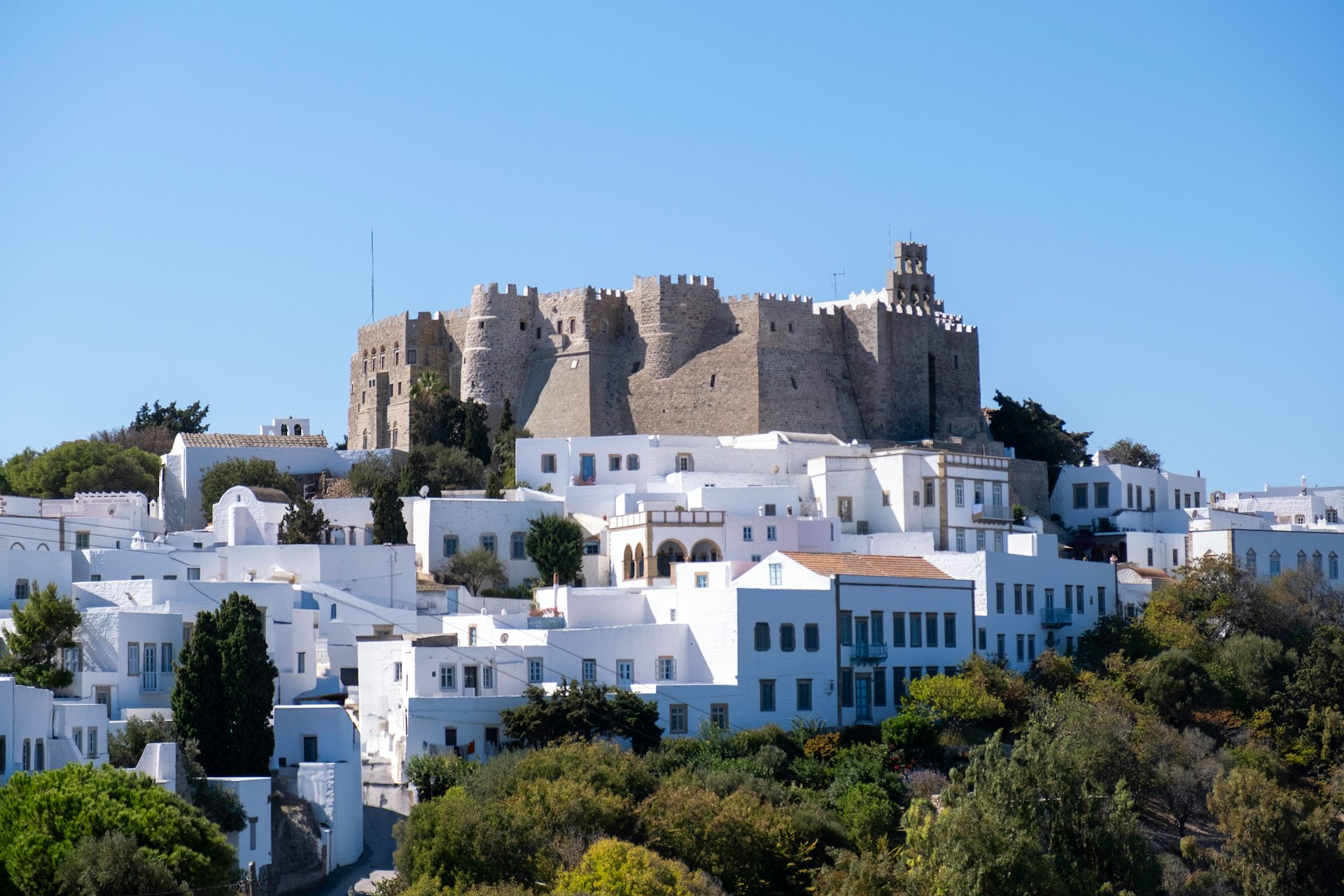
The Monastery of Saint John the Theologian looks more like a medieval fortress than a place of worship — and that’s entirely deliberate. When the monk Hosios Christodoulos founded it in 1088, with a charter from Byzantine Emperor Alexios I Komnenos, the Aegean was thick with pirates. The result is a building that combines thick defensive walls and watchtowers with the spiritual infrastructure of one of Orthodoxy’s most important monastic centres.
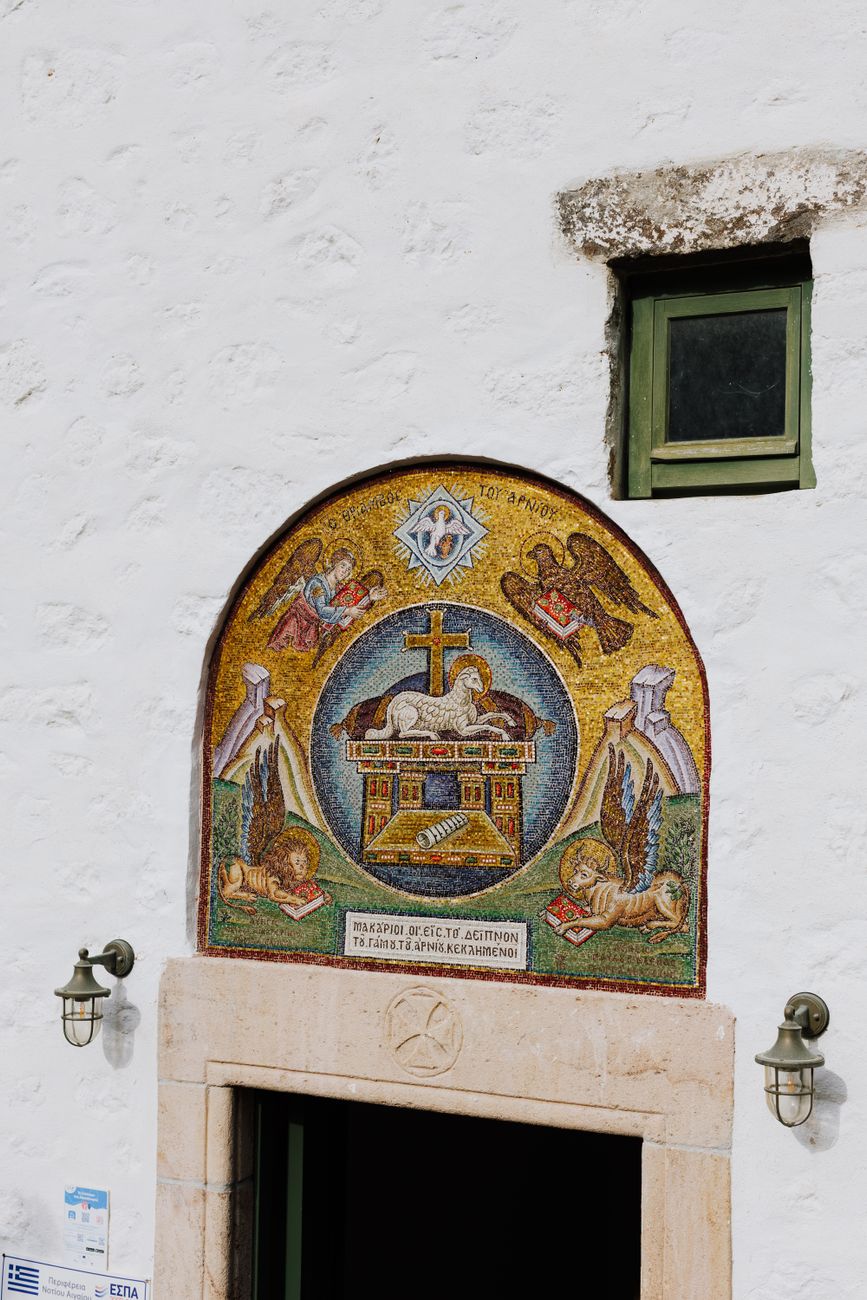
What survives today is a complex of 99 cells, ten chapels, and a library that would make any serious bibliophile’s pulse quicken. The collection includes 890 handwritten codices, some dating to the 6th century, along with more than 13,000 documents and a treasury of icons, vestments, and ecclesiastical art spanning nearly a millennium. Not everything is on public display, but the treasury and main chapel hold extraordinary pieces — particularly the 11th-century frescoes that have survived earthquakes, raids, and nine centuries of candle smoke.
The monastery remains an active Orthodox monastic community, which means visiting requires covered shoulders and knees, and a degree of respectful quiet that not everyone manages. Entry is free. Opening hours are typically limited to mornings and some afternoons, shifting with the liturgical calendar and season — check locally rather than trusting any printed schedule, including this one.
An island small enough to walk across in a morning, yet dense enough with history that you could spend a week and still find something new — from Roman exile to Byzantine fortress to the quiet rhythms of a working monastery.
The Cave of the Apocalypse
Halfway between Skala and Chora, cut into the hillside along the ancient cobblestone path, sits the cave where tradition holds that John the Apostle received the visions he recorded in the Book of Revelation around 95 AD. Whether or not you take the theology literally, standing in that low-ceilinged grotto — where a silver band marks the crack in the rock said to represent the voice of God, and a stone ledge indicates where John rested his head — is one of those rare travel moments that demands silence.
The cave has been enclosed within a chapel since the 11th century, and together with the monastery and the historic centre of Chora, it earned UNESCO World Heritage status in 1999. The site is modest in size but heavy with atmosphere. Natural light filters through a small opening, and the rock walls press close enough that even on a busy day you feel cut off from everything outside. This is one of Christianity’s most sacred sites, ranked alongside Jerusalem and Mount Athos in Orthodox tradition — and it looks nothing like what you’d expect a major pilgrimage destination to look like, which is part of what makes it so affecting.
Visiting takes perhaps twenty minutes, but arriving on foot along the ancient path from Skala transforms a quick stop into something more meaningful. The walk itself — paved with stones worn smooth over centuries and lined with low dry-stone walls — ranks among the best short walks on any Greek island.
Chora — Walking Through Centuries
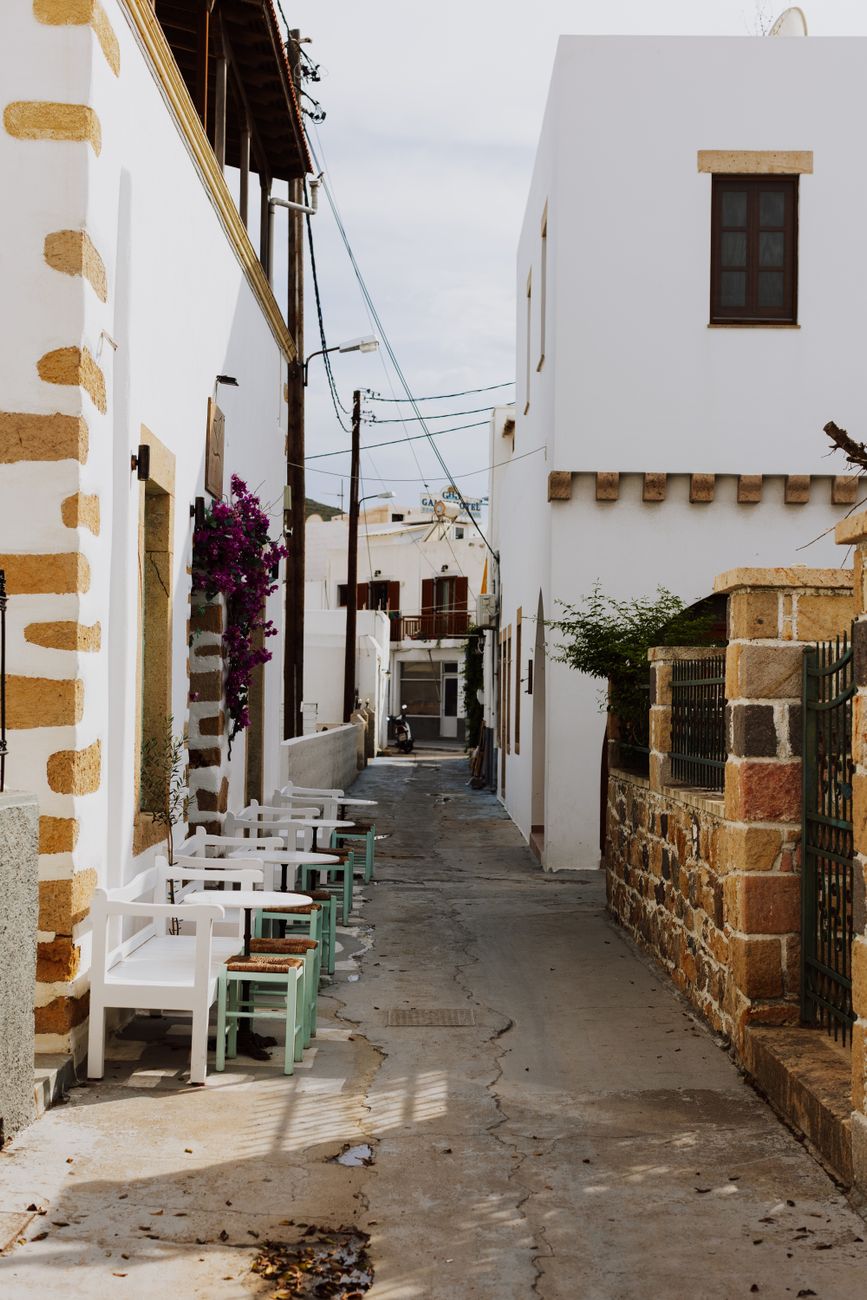
Chora crowns the hilltop around the monastery like a protective ring, and walking its lanes is one of those experiences that photographs never quite capture. The settlement grew organically over centuries into a tangle of whitewashed mansions, small Byzantine churches, arched passageways, and dead-end lanes that seem designed to get you pleasantly lost. Cars can’t enter — the streets are far too narrow — so the only sounds are footsteps on stone, church bells on the hour, and the occasional territorial disagreement between neighbourhood cats.
The architecture mixes Greek, Italian, and Ottoman influences in a way unique to Patmos. Many of the grander houses feature mantomata — decorated stone entrance frames with carved motifs that identified the family living within. These 17th- and 18th-century mansions are startlingly well-preserved, partly because Patmos never suffered the devastating earthquakes that flattened towns on other Dodecanese islands, and partly because the community guarded its heritage long before UNESCO got involved.
The views from Chora’s upper terraces repay every drop of sweat from the climb. On a clear day you can see across the water to Lipsi, Leros, and the Turkish coast beyond — a panorama of the eastern Aegean that explains why the Byzantines chose this hilltop for their fortress-monastery. In late afternoon, when the stone walls turn honey-gold and shadows stretch long across the cobbles, Chora becomes one of the most beautiful settlements in the Greek islands. That’s not promotional fluff — it’s the honest response of anyone who has stood on those terraces at golden hour.
Beaches Worth the Effort
Patmos won’t win any beach-count competitions with larger Dodecanese neighbours, but the beaches it has range from genuinely impressive to pleasantly serviceable. Most are pebbly rather than sandy — this is the Aegean, after all — and the water clarity everywhere borders on absurd.
| Beach | What to Expect | How to Get There |
|---|---|---|
| Psili Ammos | Fine golden sand, shallow turquoise water, tamarisk shade — the island’s best | Water taxi from Skala or 30-min hiking trail from Diakofti |
| Kambos | Organised beach with sunbeds, tavernas, windsurfing — the family favourite | Paved road from Skala, bus service in summer |
| Grikos | Sheltered bay, calm shallow water, good for children and nervous swimmers | Paved road from Skala, regular bus service |
| Lambi | Multicoloured pebbles polished by centuries of waves — more scenic than swimmable | Road to north tip of island, short walk from parking |
| Agriolivado | Pebble beach near Skala with a taverna, good for a quick swim after sightseeing | Walking distance from Skala, north along the coast |
Psili Ammos is the one beach that draws superlatives even from well-travelled island-hoppers. The sand is fine and golden, the water shelves gradually to swimming depth, and the setting — tucked into a cove backed by tamarisk trees — would look at home in a Caribbean brochure if you swapped the scrubby Greek hillside for palms. The catch is access: no road reaches it, so you either hike from Diakofti (roughly thirty minutes on a rough path) or take a water taxi from Skala. The effort filters out casual visitors, which is precisely the point.
Kambos, on the northern coast, is the island’s most developed beach — meaning sunbeds, a couple of tavernas, and enough wind to keep the windsurfers happy. Families cluster here because the water stays shallow far out and the road from Skala is paved and painless. Grikos, on the eastern side, sits in a sheltered bay that rarely sees waves — a good choice for small children and anyone who finds the open Aegean intimidating.
Lambi, near the north tip, doesn’t offer much swimming but draws visitors for its unusual multicoloured pebbles — volcanic stones in grey, rust, and deep red, polished smooth by millennia of wave action. It’s genuinely unusual and worth the detour even if you don’t stay long.
Beyond the Highlights
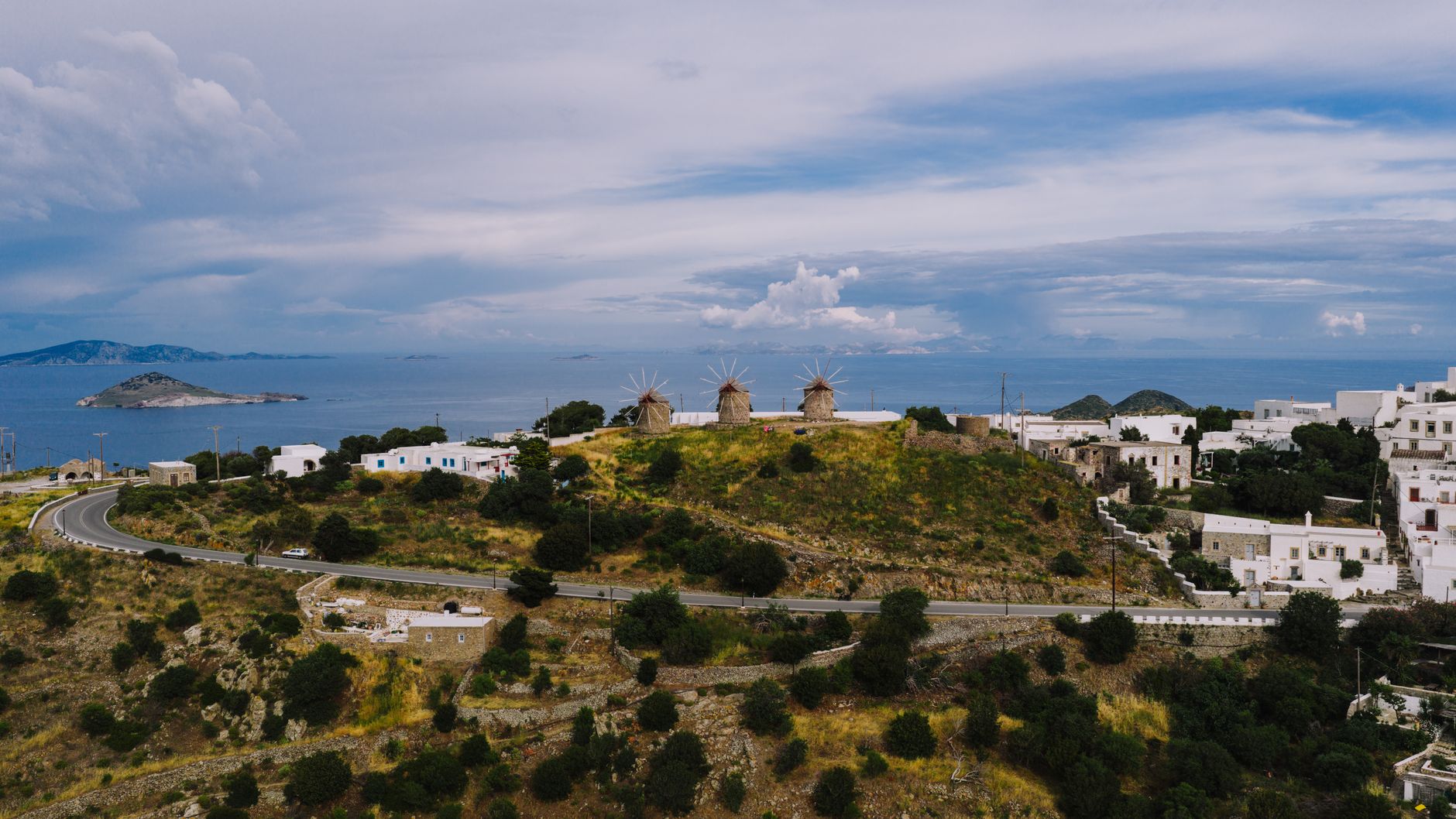
Most visitors follow the monastery-cave-beach circuit and leave satisfied, but the island rewards people who look harder. The path network connecting villages across the interior is excellent for walking — nowhere on Patmos is more than a couple of hours from anywhere else on foot, and the terrain ranges from coastal scrub to surprisingly green valleys with old olive groves and crumbling dry-stone walls.
The hilltop chapel of Profitis Ilias stands at 269 metres — the island’s highest point — and offers panoramic views in every direction. On a clear day the view extends to Turkey and surrounding Dodecanese islands: Astypalaia to the south, Leros and Kalymnos to the north, and the scattered small islands in between. The tiny island of Arkoi, visible to the northeast, has a permanent population of around forty and is reachable by boat — one of those genuinely off-grid Greek experiences that still exist if you go looking.
If you have time for a day trip, Lipsi sits roughly an hour away by local ferry. It offers sandy beaches, a handful of tavernas, and almost no tourists outside the yacht crowd. The kind of place where the bus driver waits if he sees you running, and where the best beach has neither sunbeds nor a paved access road — just a path through the scrub, some shade under tamarisks, and the open Aegean stretching to the horizon.
Where the Dodecanese reaches toward Asia Minor and the ferry engines finally fall silent, Patmos sits in that particular Aegean light — half-sacred, half-wild, entirely its own.
Eating and Drinking on Patmos
Patmos punches above its weight when it comes to food. The island has long attracted a more discerning crowd than most Dodecanese neighbours, and the taverna culture has risen to meet those expectations — without tipping into pretension. You’ll eat well here on straightforward Greek ingredients prepared with genuine care.
The waterfront in Skala is where most visitors eat, and the standard is reliable across several options. Look for places that grill their fish fresh rather than deep-frying it, and order whatever the waiter says came in that morning — the catch changes daily and the best dishes are rarely on the printed menu. Grikos and Kambos each have a couple of beachside options where you can eat with sand between your toes. Up in Chora, the handful of small places tend toward slightly more refined cooking — the same ingredients, but with a bit more thought behind the plating and presentation.
Local specialities lean toward wider Dodecanese traditions: pitaroudia (chickpea fritters found across the island group), dolmadakia made with vine leaves from local grape arbours, and honey-soaked pastries that appear at festivals and name days. The wine scene is modest but worth exploring — several tavernas now pour well-chosen Greek wines alongside the house retsina, and a few local producers are experimenting with small-batch bottles that make good souvenirs.
How to Get to Patmos
Patmos has no airport, which is both its greatest blessing and its main logistical challenge. The only way in is by sea. From Piraeus (Athens), Blue Star Ferries runs the route several times a week during summer. The journey takes between seven and twelve hours depending on the vessel and stops — expect fares starting from approximately €44 for a deck seat, though worth confirming current pricing before you book. The overnight ferry departs in the evening and arrives at Skala harbour early the next morning, which lets you sleep through the travel and wake up to your first view of the monastery on the hilltop.
A faster approach is to fly into Kos, which has an international airport with direct flights from many European cities during summer, and take a connecting ferry. The Kos-to-Patmos route runs around two hours fifteen minutes and costs from approximately €20 — making total travel time from London or Berlin around half a day rather than a full one.
From Symi, Rhodes, or other Dodecanese islands, local ferries and catamarans connect through the island chain. In peak summer there are also connections to Samos, Lipsi, and Leros. For general advice on planning ferry routes and timing, the island hopping guide covers booking strategy and seasonal schedules across all Greek island groups.
Getting Around the Island
Patmos is small enough that you could theoretically walk everywhere, though the hills and summer heat make that ambitious between June and September. A local bus connects Skala with Chora, Grikos, and Kambos — running frequently enough to be useful during the day but stopping in the early evening. Schedules are posted at the bus stop in Skala and change each season.
Scooter rental is popular and practical — the roads are quiet, distances are short, and parking is never a problem outside Skala’s immediate harbour area. A car is unnecessary unless you plan to visit every beach and aren’t keen on the last stretches of unpaved road. Taxis exist but are limited in number, and calling ahead is wise — especially for early-morning port runs.
The most rewarding way to move around Patmos is on foot. The ancient path from Skala to Chora via the Cave of the Apocalypse is the obvious highlight, but the network of trails connecting villages and beaches across the island is surprisingly well-maintained. Most walks clock in under an hour, and signposting has improved markedly in recent years. Wear proper shoes — the volcanic rock and loose stone paths are not flip-flop territory.
When to Visit Patmos
The island’s character shifts dramatically with the calendar. July and August bring the warmest water, the longest days, and the most visitors — though Patmos’s “crowd” would barely register on Mykonos or Santorini. For beach weather without competition for taverna tables, June and September are the sweet spot: warm enough to swim, cool enough to walk the hilltop paths, and quiet enough to feel the island’s real personality.
Easter on Patmos is extraordinary, and if Greek Orthodox traditions interest you, this is one of the finest places in the country to experience Holy Week. The Monastery of Saint John hosts deeply atmospheric ceremonies, and the Thursday evening Niptiras — a re-enactment of the Washing of the Feet in Skala’s main square — draws pilgrims from across the Orthodox world. Book accommodation months in advance if you plan an Easter visit.
October through March is genuinely quiet. Many tavernas close for the season, ferries run less frequently, and the population contracts to its year-round core. But the monastery stays open, the walking conditions improve in cooler weather, and you’ll have Chora’s cobblestoned lanes almost entirely to yourself — which, depending on your temperament, is either lonely or perfect.
Three Days on Patmos
Day 1 — Skala and the Ancient Path: Arrive by ferry and settle into accommodation near the harbour. Explore Skala’s waterfront through the afternoon, then walk the ancient cobblestone path from Skala through the Cave of the Apocalypse to Chora. Time it to arrive for sunset from the upper terraces — the light over the Aegean at that hour is worth every bead of sweat. Dinner in Chora or back down in Skala.
Day 2 — Monastery and Beaches: Start early at the Monastery of Saint John, when mornings are quieter and the light inside the chapel is at its best. Spend the rest of the morning exploring Chora’s lanes and mantomata doorways, then head to Psili Ammos for an afternoon of swimming — either by water taxi from Skala or the hiking trail from Diakofti. Return via Grikos for a second swim in the sheltered bay before dinner.
Day 3 — Northern Patmos and Departure: Head to Kambos beach for a morning swim and a long beachside lunch. Continue to Lambi to see the coloured pebble shore, then loop back through the island’s quiet interior — old agricultural terraces, roadside chapels, and views that belong on postcards. If your ferry departs in the evening, a final waterfront coffee in Skala makes a fitting farewell while watching the harbour boats come and go.
The information in this article was researched and verified as of July 2026. Prices, transport options, schedules, and conditions may have changed since publication — we recommend double-checking key details before your trip.