Where the Mountains of Epirus Meet the Ionian Sea
A coastal town that looks like it should be on an island but sits firmly on the Greek mainland, backed by the mountains that run all the way to Zagori and Ioannina.
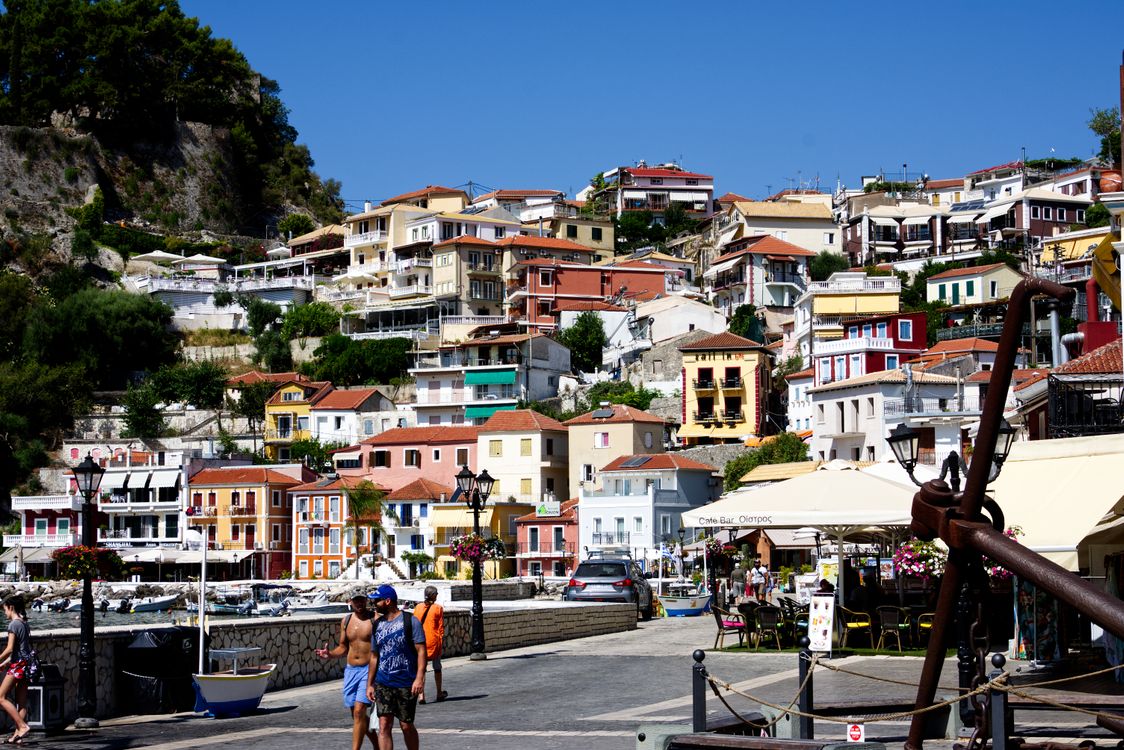
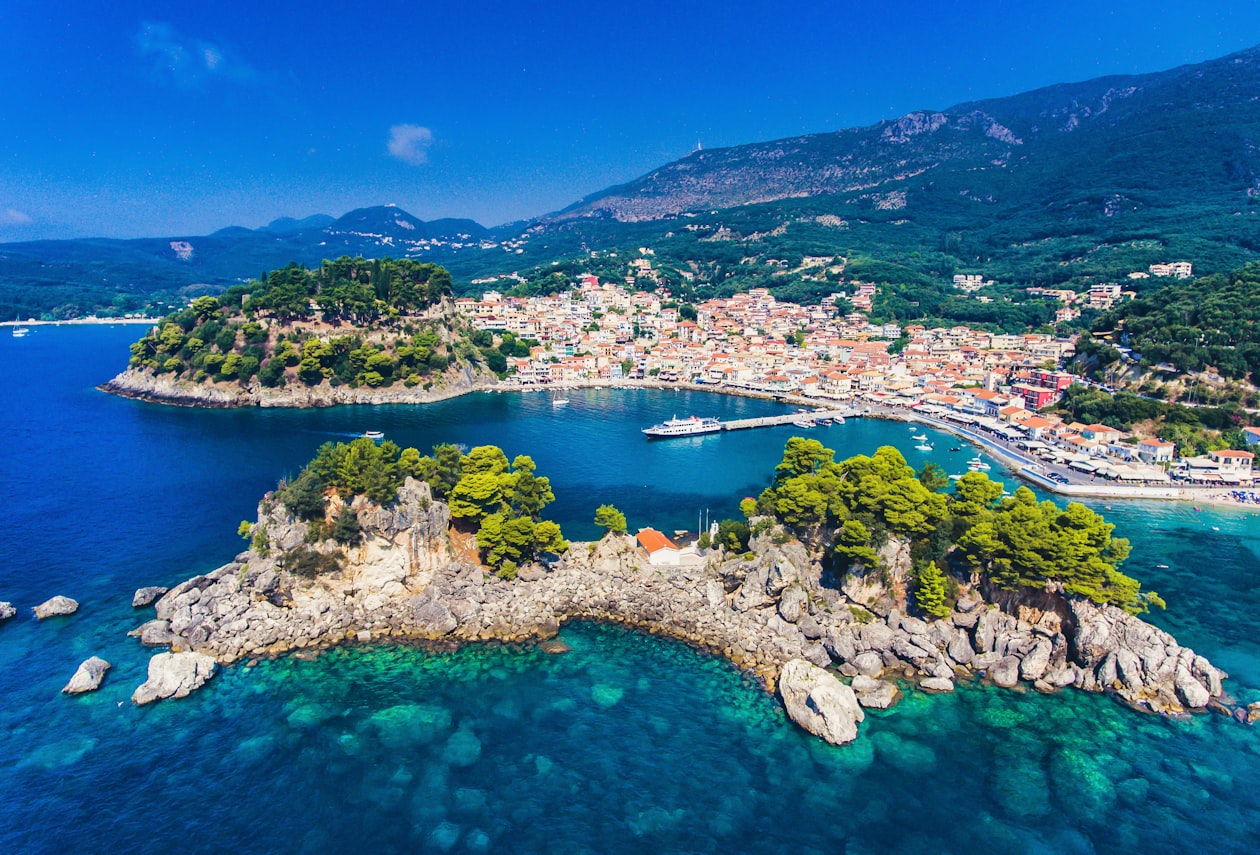
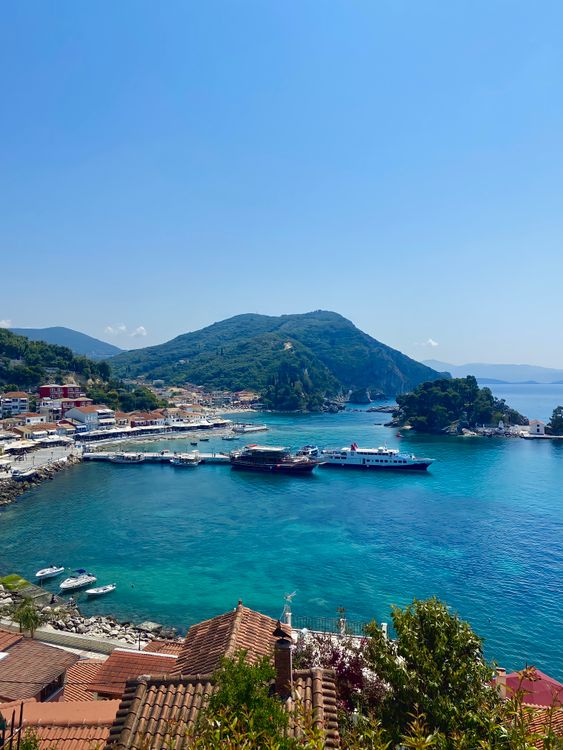
Parga occupies an unlikely position on the Greek travel map. It sits on the Ionian coast of Epirus, roughly halfway between the port town of Igoumenitsa and the city of Preveza, looking out across the same turquoise water that laps at Corfu and Paxos. The houses climb a steep hillside in terracotta, ochre, and faded pink, a Venetian castle anchors the headland between two bays, and a small church-topped islet floats just off the harbour wall. Most travellers who arrive for the first time say it looks more like a Greek island than anything on the mainland, and they are not wrong.
What makes Parga worth the journey, though, is not only the postcard scenery. This is the Epirus coast, the least-visited stretch of shoreline in mainland Greece, where the mountains of the interior descend to the sea in a matter of kilometres. You can swim at a beach that rivals anything in the Cyclades in the morning, wade through the cold springs of the Acheron River after lunch, and visit the ancient Oracle of the Dead before dinner. That combination of coast, myth, and mountain does not exist anywhere else in Greece, and it is the reason Parga has quietly become one of the country’s most interesting destinations for travellers who want something beyond the usual island circuit.
Parga at a Glance
| Location | Ionian coast of Epirus, northwestern Greece |
| Population | Approximately 2,500 (town), 10,762 (municipality, 2021 census) |
| Nearest airport | Preveza/Aktion (PVK), approximately 65 km south |
| Nearest port | Igoumenitsa, approximately 50 km north |
| Best months | May to September (June and September offer the best balance) |
| Car needed? | Helpful for day trips; town itself is walkable |
| Ideal stay | 4–6 nights (3 minimum, 7–10 if combining with Epirus interior) |
Who Parga Suits — and Who Should Look Elsewhere
Parga works particularly well for couples and families who want a relaxed beach holiday with enough variety to fill a week without repeating themselves. The town is walkable, the food is good, the beaches are clean, and the surrounding area offers genuinely interesting day trips that go well beyond the usual tourist routine. If you have been to the Cyclades and want to see a different side of Greece, Parga makes a strong case for itself.
It is less suitable for travellers who want intense nightlife, large resort infrastructure, or the specific island-hopping dynamic that the Aegean provides. Parga is a mainland town, and while it has bars that stay open late in summer, nobody would describe the after-dark scene as a reason to visit. If you are coming from northern Europe on a direct charter to Preveza, you will find the transfer comfortable and the destination immediately rewarding. If you are island-hopping through the Ionian, Parga makes a worthwhile detour by road from Igoumenitsa, but it is not connected by ferry the way the islands are.
Best Time to Visit
The swimming season runs from late May through October, with sea temperatures peaking at around 25–26°C in August and September. July and August bring consistent heat, often above 30°C, along with the largest crowds and the highest accommodation prices. The town fills with Greek families during the first three weeks of August, and the main beaches become genuinely busy.
June and September offer the strongest overall experience: warm enough for comfortable swimming, quiet enough to get a sunbed without arriving at dawn, and priced more reasonably than peak summer. Late September is particularly appealing because the sea remains warm while the town returns to a calmer rhythm. On clear days in early autumn, the views from the castle extend all the way to Paxos, Antipaxos, and the southern tip of Corfu.
May is pleasant for walking, exploring the castle, and driving to the Acheron River, but the water can feel bracing at around 20–22°C, and a few seasonal restaurants and beach bars may not yet be open. Winter is quiet. Some accommodation shuts entirely, though the town does not empty the way a small island would, since Parga serves as a weekend destination for residents of Ioannina throughout the year.
How to Get There
Most visitors arrive by car or by transfer from Preveza/Aktion Airport (PVK), which sits on a narrow peninsula about 65 kilometres south of Parga. The drive takes roughly one hour along a well-maintained but mostly single-carriageway road. Aktion receives seasonal direct flights from several European cities as well as domestic connections from Athens. Car rental agencies operate at the airport, and a rental car is the most practical option if you plan to explore the coast and the interior.
A second common approach is through Igoumenitsa, the mainland port that receives ferries from Corfu (approximately 1 hour 20 minutes) and from Italy (Ancona, Bari, Brindisi, Venice). From Igoumenitsa, Parga is about 50 kilometres south, a 40-minute drive. This route makes sense if you are combining Parga with a stay on Corfu or arriving by car from Italy.
Driving from Athens takes approximately five hours via the Ionia Odos motorway and the Rion–Antirion bridge, a manageable day’s drive if you leave early. From Thessaloniki, the Egnatia Odos motorway runs west to Igoumenitsa in about four and a half hours, with the final stretch south to Parga adding another 40 minutes. KTEL buses connect Parga with Preveza and Igoumenitsa, and indirect services run from Athens and Thessaloniki, though schedules are limited and the journey is long enough that a rental car makes more practical sense for most visitors.
The Old Town and Harbour
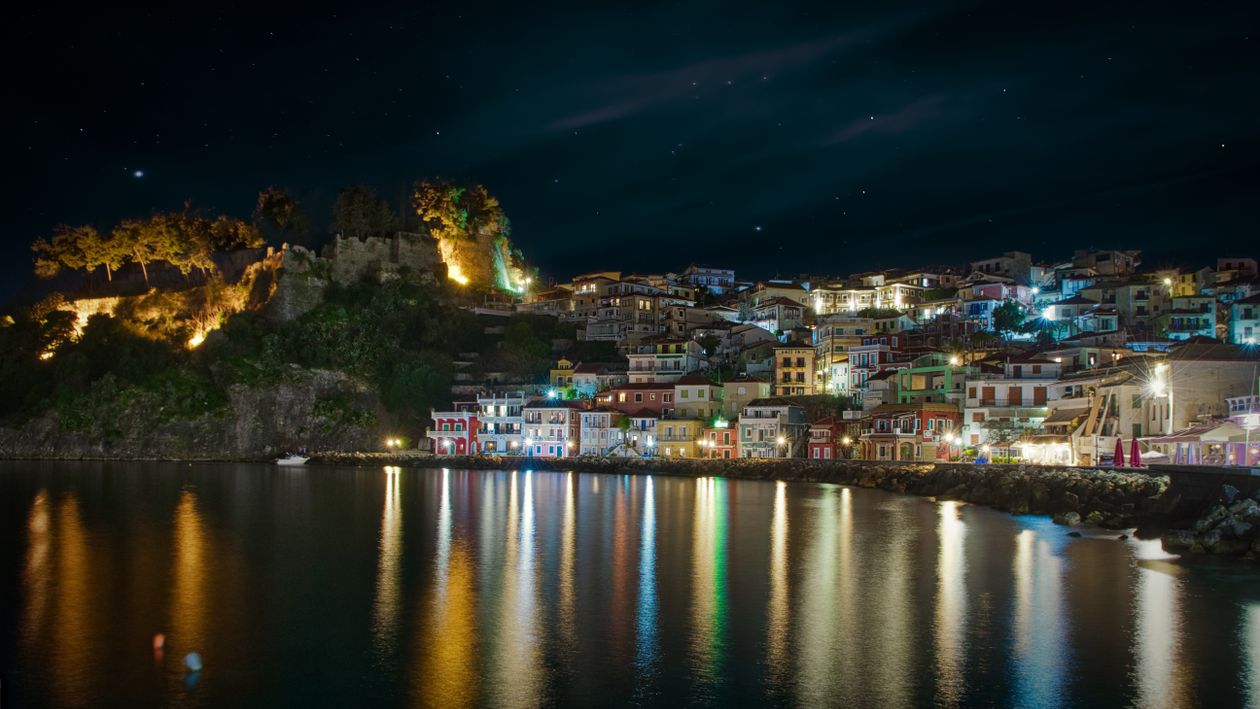
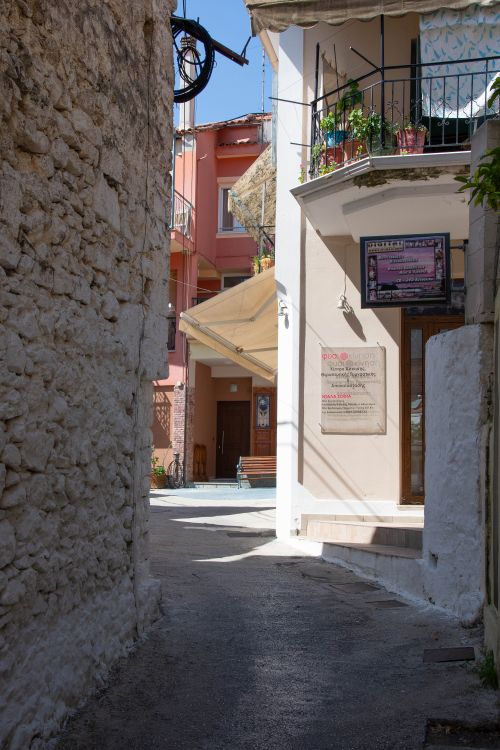
Parga’s old town is built amphitheatrically on a steep hillside that drops down to a small, curving harbour. The lanes are narrow, stepped, and largely car-free, weaving between houses whose pastel walls owe their palette to four centuries of Venetian rule. At the bottom, the waterfront wraps around the harbour, lined with fish tavernas and cafés that fill in the evenings when the heat drops and the lights come on across the water.
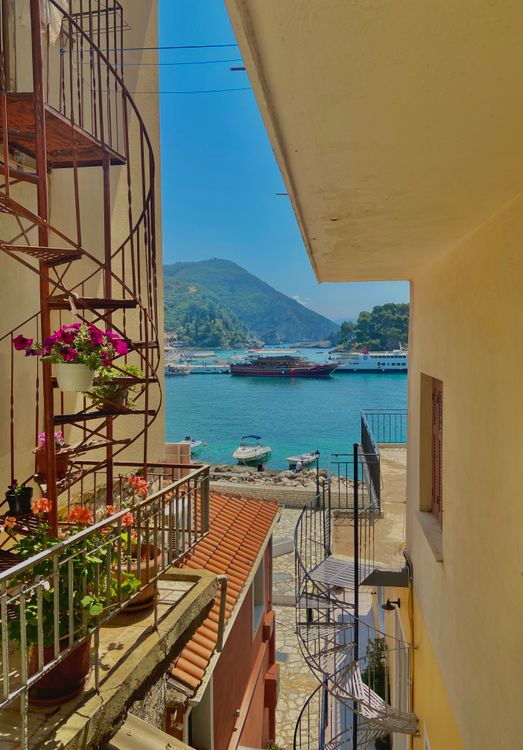
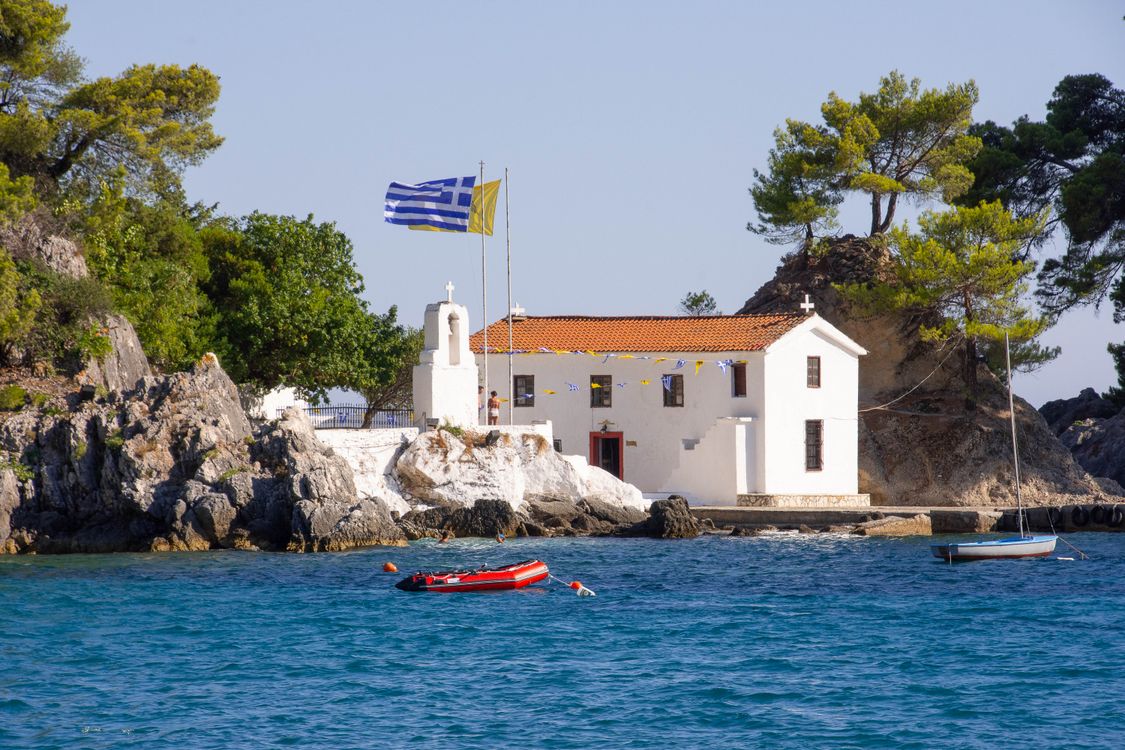
Directly opposite the harbour entrance sits the islet of Panagia, a small tree-covered rock topped with a church dedicated to the Virgin Mary and a cluster of medieval Venetian and French buildings. You can reach it by swimming from the town beach or by renting a pedal boat, and it is worth the short trip for the view back toward the old town and the castle. On 15 August each year, the harbour hosts the Varkarola, a festival that commemorates the Pargiot diaspora’s return from Corfu, with decorated boats, music, and fireworks.
The town is compact enough to walk from end to end in fifteen minutes, which is part of its appeal. There is no need for transport within Parga itself, and the rhythm of the day tends to organise itself naturally around the harbour, the beaches, and the castle path that connects them.
The Venetian Castle
The castle sits on the rocky headland that divides the harbour and town beach to the east from Valtos beach to the west. It is reached by a short, steep walk from the upper lanes of the old town, and the entrance is free.
The fortifications have a layered history. The first walls were raised with Norman assistance in the late 14th century, when the Pargians relocated their settlement closer to the coast for protection against raids. The Venetians rebuilt and expanded the castle repeatedly — after Ottoman attacks in the 15th century, after the destructive raid by the corsair Hayreddin Barbarossa in 1537, and again in the 1570s following more Ottoman assaults. In 1792, the Venetians began a third major reconstruction, which the French completed after 1797. The castle remained unconquered until 1819, when the British controversially sold Parga to Ali Pasha of Ioannina, the powerful semi-independent Ottoman governor who had been besieging it for years. Ali Pasha added his own citadel, a harem, and a Turkish bath within the walls.
Today the castle is partly ruined and partly overgrown, which gives it an atmospheric quality that polished restorations sometimes lack. The main reason to visit is the view: from the top, the panorama takes in the harbour, the Panagia islet, the town’s pastel rooftops, and the sweep of Valtos beach curving away to the west. Late afternoon light is best for photographs. A small café operates in the restored barracks building, and there is a photo exhibition covering Parga’s history inside the main structure.
The Beaches
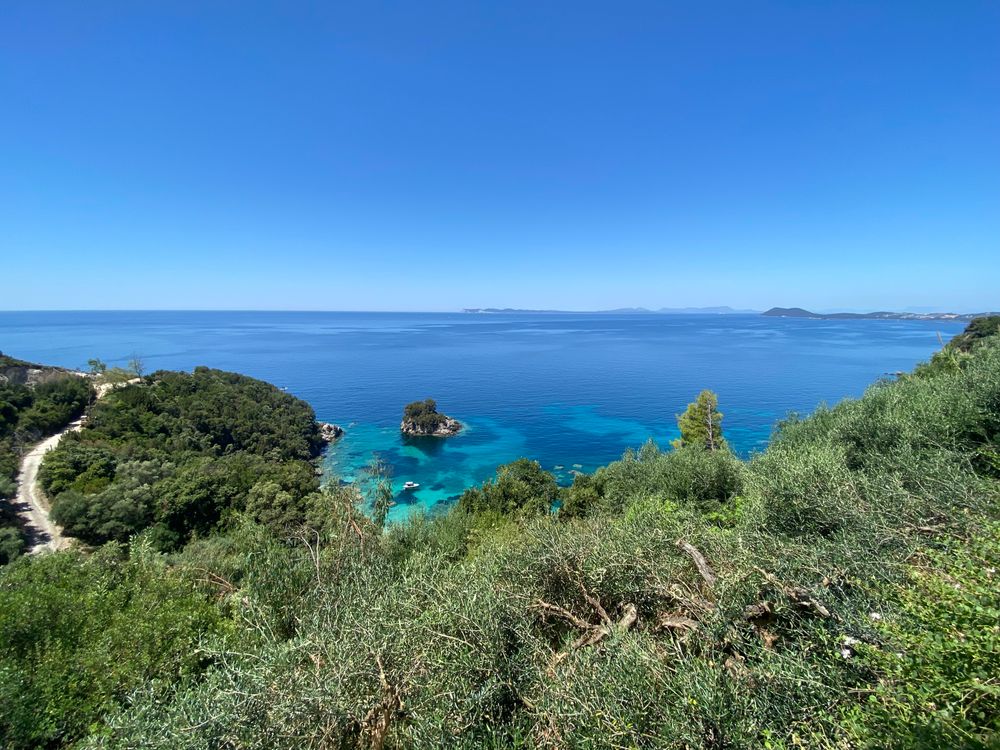
Parga’s coast is broken into a series of bays and coves, each with a different character. The water is Ionian — clear, warm, and generally calmer than the Aegean — and the coastline faces west, which means it catches the sunset but can also be exposed to afternoon westerly winds in summer.
| Beach | Distance | Shore | Best for | Notes |
|---|---|---|---|---|
| Valtos | 2 km west (15-min walk or water taxi) | Sand and fine pebbles, 3 km long | Families, water sports, long beach days | Largest and most popular; organised with sunbeds and bars |
| Krioneri | Town centre (5-min walk) | Sand, shallow entry | Quick swims, convenience, snorkelling | Town beach; small islet offshore adds character |
| Lichnos | 3–4 km south (10-min drive) | Sand with large pebbles, deep water | Diving, snorkelling, sheltered swimming | Sheltered bay; less exposed to afternoon wind |
| Sarakiniko | 12 km west (near Agia village) | Sand and pebbles, olive trees | Quieter days, kayaking, atmosphere | Named after pirates in local legend; less crowded |
| Piso Krioneri | South of town (short walk) | Rocky, pebbles | Rock jumping, experienced swimmers | Smaller and rockier; good for snorkelling around the boulders |
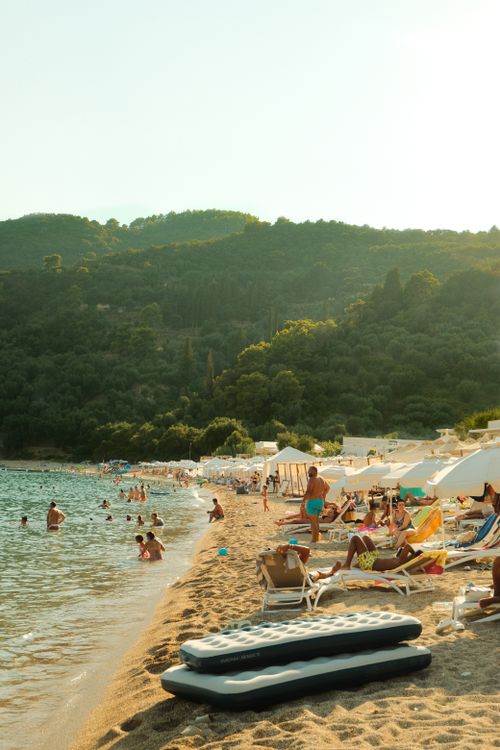
Valtos is the main event: a three-kilometre curve of sand and fine pebbles that stretches west from the castle headland. It is organised with sunbeds, beach bars, and water sports centres, and there is enough space that even in August you can find quieter stretches toward the far end. The path from town takes about fifteen minutes through olive groves, or you can take the water taxi across the harbour for a few euros.
Lichnos, about ten minutes south by car, sits in a sheltered bay that tends to stay calmer than the more exposed western beaches. The water is deep and clear, making it popular with snorkellers and divers. Several tavernas line the shore, and the bay has a more low-key feel than Valtos.
Sarakiniko, twelve kilometres from town near the village of Agia, is where locals go when they want space. Old olive trees reach toward the water, the beach mixes sand with pebbles, and a local legend says the bay takes its name from Saracen pirates who shipwrecked here and were defeated by villagers at a wedding feast. It is quieter than the closer beaches and worth the drive if you have a car.
A practical note: while the Ionian coast is generally calmer than the Aegean, conditions do change with the wind. On days with strong westerly or southwesterly winds, the town-side beaches can develop chop. Lichnos, being more sheltered, is often the better choice in those conditions.
The Acheron River and the Oracle of the Dead
The inland excursion that defines Parga is the trip south to the Acheron River and the Nekromanteion, and it is the kind of day out that you will not find attached to any beach resort in the Cyclades or the Dodecanese. The Acheron — Homer’s River of Woe, the waterway that Odysseus crossed to reach the realm of the dead — is not a metaphor here. It is a real river fed by cold karst springs that emerge from the limestone mountains above the village of Glyki, about 22 kilometres south of Parga.
At the springs near Glyki, the water runs at around 11°C year-round, which provides a memorable contrast after a morning on a hot beach. Visitors can wade upstream through the shallow river toward a narrow gorge sometimes called the Gates of Hades, where the limestone walls close in and the water deepens in places. The walk takes about 45 minutes each way and involves getting wet up to the waist in several spots, so bring shoes that can handle water and rocks. Kayaking, rafting, and horse riding along the river are also available through local operators near Glyki.
Fifteen kilometres downstream from the springs, near the village of Mesopotamos, sits the Nekromanteion — the Oracle of the Dead. This was the most important necromanteion (oracle for communicating with the dead) in the ancient Greek world, a sanctuary devoted to Hades and Persephone where pilgrims came to speak with deceased relatives and seek prophecies. The site sits at the confluence of the Acheron, the Pyriphlegethon (“burning coals”), and the Cocytus (“lament”) — three of the five rivers that mythology placed in the underworld. The archaeological site, excavated from the 1950s onward, includes subterranean chambers, thick Hellenistic walls, and an Ottoman-era building. It is open daily during summer, though hours change with the season, so check before visiting. The river delta at the fishing village of Ammoudia, where the Acheron meets the sea, offers boat tours through wetlands that are excellent for birdwatching.
More Day Trips from Parga
Parga sits within reach of several compelling destinations, which is one of the reasons a longer stay pays off.
Syvota, approximately 30 minutes north by car, is a coastal village with a cluster of small islands, clear-water coves, and a natural swimming pool known as the Blue Lagoon. Boat trips from Parga to the Syvota islands are popular in summer and usually include swimming stops.
Paxos and Antipaxos are accessible by summer day-trip boats from Parga harbour. The crossing takes a few hours each way, and the trip typically includes stops at the sea caves on the western coast of Paxos and swimming time at the famous Voutoumi beach on Antipaxos.
The Epirus interior opens up an entirely different dimension. Ioannina, the regional capital, is about 100 kilometres east — roughly 90 minutes by car — and from there you can reach the stone villages and gorges of Zagori and the mountain town of Metsovo. Combining a few days at Parga with a few days in the mountains creates one of the most varied short trips in Greece, moving from Ionian beach to one of Europe’s deepest gorges in under two hours.
Food and Drink
The cuisine around Parga draws from two traditions: the mountain cooking of Epirus, built on pies, slow-cooked meat, and dairy, and the Ionian seafood tradition that dominates the coast. The result is a table that feels more varied than what you typically find on the islands.
Epirus is the homeland of the Greek pie, and the local versions are worth seeking out. Kasopita, sometimes called alevropita, is a savoury bread-pudding pie made differently in every household; wild-greens pies (hortopita) use whatever the season provides; and cheese pies made with local feta are everywhere. The region also produces excellent tsipouro (pomace brandy), and the PDO wines of Zitsa, from the area around Ioannina, are increasingly well-regarded.
On the seafood side, the waterfront tavernas along the harbour handle fresh fish, grilled octopus, and shrimp saganaki. The Acheron and Louros rivers supply trout to the inland villages. Locally produced olive oil is a constant. For the most interesting eating, look beyond the first row of waterfront restaurants and ask around for places that lean into the Epirote kitchen rather than serving a generic tourist menu — the distinction is noticeable.
Where to Base Yourself
The choice comes down to three areas, each with a different rhythm.
Parga town centre puts you within walking distance of the harbour, the castle, the old town’s lanes, and Krioneri beach. Evening dining and evening strolls start at your door. The trade-off is that accommodation here tends to be smaller and older, with less pool space and fewer resort-style amenities. It suits couples and travellers who prefer atmosphere over facilities.
Valtos beach area offers direct access to the longest beach and the water-sports centres, with a mix of hotels and apartments that generally offer more space. The walk into town takes about fifteen minutes through olive groves, or you can catch the water taxi. It works well for families who want the beach as their daily default with the town accessible for dinners.
Lichnos, three kilometres south, is the quietest option. The bay is sheltered, the pace is slower, and the surrounding accommodation tends toward small hotels and studios. You will need a car or taxi to reach town, so it suits visitors who are happy to be beach-based during the day and drive in for the evening.
How Many Days
Three full days give you enough time to see the town, visit two or three beaches, walk the castle, and make one day trip (either the Acheron River or a boat trip to the Syvota islands). Five to six days allow a more comfortable pace, with time for the Nekromanteion, a day on the Acheron, a boat excursion, and lazy beach mornings without pressure. If you plan to combine Parga with the Epirus interior — Ioannina, Zagori, Metsovo — a full week in the region makes sense, splitting your time between the coast and the mountains.
Getting Around
Parga town is entirely walkable, and you do not need a car to enjoy the harbour, the castle, Krioneri beach, or the waterfront restaurants. A water taxi crosses the harbour to Valtos beach in summer, which is faster and more pleasant than the overland path in the heat of the day.
For anything beyond the town — Lichnos beach, Sarakiniko, the Acheron springs, the Nekromanteion, Syvota, or any of the inland destinations — a rental car is the most practical option. The roads in the Parga area are generally in good condition, though some of the smaller coastal roads are narrow and winding. Parking in town during peak summer can be tight; arrive early or park at the larger lots on the edge of town and walk in.
Local KTEL buses connect Parga with Preveza and Igoumenitsa but run on limited schedules, especially outside peak summer. They are useful for getting to and from the airport or port but not practical for day-to-day exploration. Taxis are available but should be booked in advance during August.
Common Mistakes
Arriving without a car and expecting to reach the beaches. The town beach (Krioneri) is walkable, and Valtos is reachable on foot or by water taxi, but Lichnos, Sarakiniko, and all inland day trips require transport. If you are not renting a car, plan around what you can reach on foot or by boat.
Visiting only in August. Parga is at its most crowded from late July through mid-August, when Greek families take their summer holidays. June, early July, and September offer the same beaches with significantly fewer people and lower prices.
Skipping the Acheron River. Many visitors treat Parga as a pure beach destination and never go inland. The Acheron springs and the Nekromanteion are the most distinctive experiences in the area, and missing them means missing what makes Parga different from a dozen other coastal towns.
Expecting an island. Parga looks like one, but it is firmly on the mainland. There is no ferry network, no island-hopping itinerary, and no casual boat service to neighbouring beaches the way you would find on, say, Kefalonia. Plan your transport accordingly.
The Epirus Coast, Without the Crowds
Parga gives you island-quality beaches, a Venetian castle, the mythological Acheron River, and the warmth of a mainland Greek town that has not been reshaped by mass tourism. Whether you come for a long weekend or build it into an Epirus road trip, it is one of the most rewarding coastal destinations in Greece.
This article was researched and verified as of July 2026. Opening hours, transport schedules, and prices may change seasonally. We recommend confirming time-sensitive details directly with official sources before travelling. Vivid Greece does not accept payment for editorial recommendations.