Monemvasia sits on the southeastern tip of the Peloponnese, a massive limestone rock rising from the Myrtoan Sea and connected to the mainland by a single 400-metre causeway. The name itself tells you what to expect: moni emvasis, meaning “single entrance.” From the mainland, the rock reveals nothing. Walk through the tunnel gate in its western wall, and a complete medieval town unfolds on the seaward side — stone houses lining narrow lanes, Byzantine churches still in use, and the Aegean stretching towards the Cyclades.
This is not a place for nightlife, island-hopping convenience, or large sandy beaches. Monemvasia suits travellers who appreciate quiet historical depth, couples looking for a romantic setting that earns the word rather than borrowing it, and anyone willing to drive three and a half hours from Athens for something they will not find anywhere else in Greece.
Monemvasia at a Glance
| Detail | Information |
|---|---|
| Location | Southeastern Peloponnese, Laconia |
| Distance from Athens | Approximately 285 km (3.5–4 hours by car) |
| Nearest airport | Kalamata (KLX), approximately 160 km |
| Best for | History, couples, quiet relaxation, photography |
| Recommended stay | 2–3 nights |
| Car needed? | Strongly recommended |
| Lower Town entry | Free, open year-round |
| Peak season | July–August |
A Fortress Built on Refuge
Monemvasia was founded in 583 AD, during the reign of the Byzantine Emperor Mauricius, when inhabitants of the surrounding Laconian plain fled to this natural rock fortress to escape Slavic and Avar invasions. The choice was pragmatic: a steep-sided rock with a single narrow approach that could be defended indefinitely. That decision shaped the next fourteen centuries.
The settlement grew into one of the most important commercial centres in the eastern Mediterranean. From the 10th century, its port handled trade routes stretching from Constantinople to Venice. Byzantine, Frankish, Venetian, and Ottoman powers all fought for control of this rock — not for its land, but for its harbour and its wine.
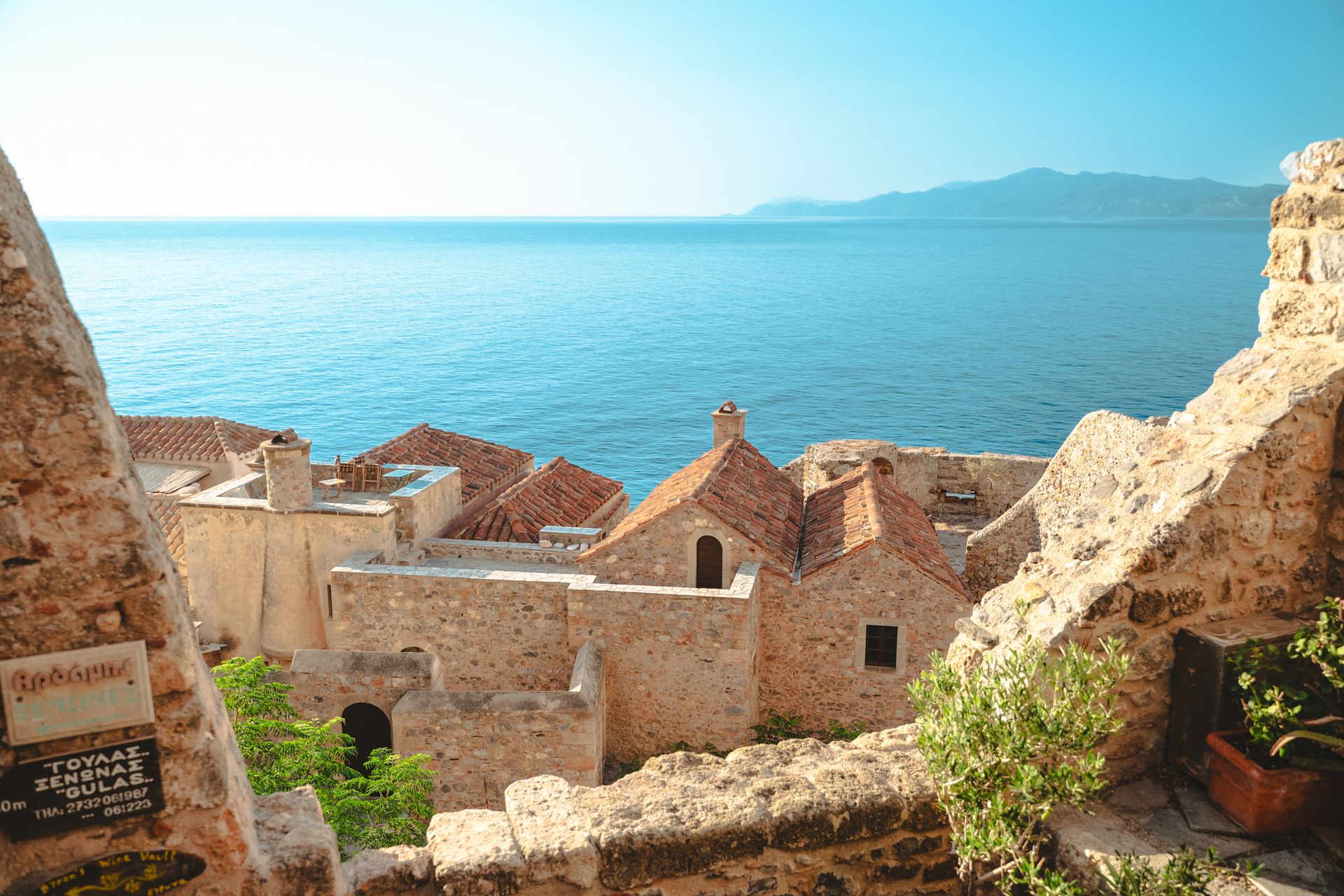
Photo: Kostas Dimopoulos, Pexels
It was from Monemvasia’s port that the sweet wine later known as Malvasia was shipped across Europe. The Italian name for the town — Malvasia — became synonymous with the wine itself, and Venetian wine shops in Venice were called malvasie in honour of their most profitable import. The English called it Malmsey, most famously associated with the legend that George Plantagenet, Duke of Clarence, was drowned in a butt of it in 1478.
The town eventually declined under Ottoman rule, when vineyards were destroyed and the Upper Town was gradually abandoned. By the early 20th century, the Lower Town had only a handful of residents. Careful restoration since the 1970s has brought it back as a living settlement — not a museum, but a functioning community of guesthouses, restaurants, churches, and approximately 30 permanent residents.
A single entrance. Fourteen centuries of siege, trade, and prayer behind it. Walk through the gate and the modern world stays on the other side of the wall.
Who Monemvasia Is Best For
Couples and history enthusiasts will find Monemvasia at its strongest. The car-free Lower Town, candlelit restaurant terraces, and stone-built guesthouses create an atmosphere that few Greek destinations can match. Photographers will find the contrast of medieval stone against deep blue sea endlessly rewarding, particularly during the soft light of early morning and late afternoon.
Travellers combining Monemvasia with a broader Peloponnese road trip — taking in Mystras, the Mani Peninsula, Nafplio, or ancient Epidaurus — will find it an ideal two or three-night stop within a larger itinerary.
Less suitable for
Families with young children may find the steep stone paths, lack of car access within the fortress, and limited beach infrastructure challenging. Travellers seeking nightlife, busy beach resorts, or easy island-hopping connections will be better served by the Cyclades or the Ionian Islands. Visitors with significant mobility limitations should note that the Lower Town involves cobblestone streets with steps, and the Upper Town requires a steep 20 to 30-minute climb on rough paths.
Best Time to Visit
Late April through June and September through mid-October offer the best combination of pleasant weather, manageable visitor numbers, and open businesses. Temperatures during these months typically range from 20°C to 27°C, warm enough for swimming at nearby beaches while comfortable for the uphill walk to the Upper Town.
July and August bring peak heat — often exceeding 30°C — and the highest visitor density. The stone streets radiate heat during the middle of the day, making the Upper Town climb genuinely demanding. Accommodation rates rise accordingly, and the most popular restaurants may require advance booking.
Winter brings a different character entirely. Many guesthouses and restaurants close between November and March, though a handful remain open for visitors willing to experience the rock in dramatic solitude. Storm-watching from the sea-facing walls can be spectacular, but services are limited and some days may feel isolated.
How to Get There
By car from Athens
The most practical route follows the A7 motorway south from Athens through Corinth and Tripoli, then continues east via Sparti towards Monemvasia. The total distance is approximately 285 km, with a realistic driving time of three and a half to four hours. The motorway section is modern and fast; the final hour is on smaller regional roads through the Laconian countryside.
A longer but scenic alternative follows the eastern coast from Corinth through Argos, Astros, and Leonidio, then crosses the mountains via the villages of Kosmas and Geraki. This route adds approximately 45 km and at least an hour of driving time, but passes through genuinely beautiful mountain and coastal landscapes. The mountain roads are winding and narrow in places.
By bus
KTEL Lakonias operates bus services between Athens (Kifissos bus station) and Monemvasia. Journey times are typically four to five hours depending on the route. Schedules vary by season and should be confirmed directly with the operator at ktel-lakonias.gr before travelling. A bus is viable for travellers without a car, though it limits flexibility for visiting nearby beaches and combining Monemvasia with other Peloponnese destinations.
By air
The nearest airport is Kalamata International Airport (KLX), approximately 160 km west, with a driving time of around two and a half hours. Kalamata receives seasonal flights from several European cities. Athens International Airport is approximately 285 km away. There is no airport at Monemvasia.
Parking and access
The Lower Town of Monemvasia is entirely car-free. Visitors arriving by car park either in the modern town of Gefyra, on the mainland side of the causeway, or in a smaller car park near the entrance gate at the end of the causeway. From there, a ten-minute walk leads to the tunnel entrance of the fortress. Most guesthouses within the castle town can advise on luggage assistance, as wheeled suitcases are difficult on cobblestone streets.
How Long to Stay
A minimum of one night is essential to experience Monemvasia properly. Day-trippers from Athens face seven to eight hours of total driving and will see only a fraction of what the town offers. The Lower Town comes alive after the day visitors leave in the late afternoon, when restaurant terraces fill quietly and the fortress walls glow in the evening light.
Two nights is the ideal stay for most visitors. This allows an unhurried afternoon exploring the Lower Town on arrival, a morning climb to the Upper Town, time for a beach visit to Pori or Xifias, and at least one evening dinner within the castle walls.
Three nights suit travellers who want to combine Monemvasia with day trips to Elafonisos island, the nearby beaches of Plytra, or the ancient site of Epidaurus Limera, or who simply want to settle into the slow rhythm of the place.
Exploring the Lower Town
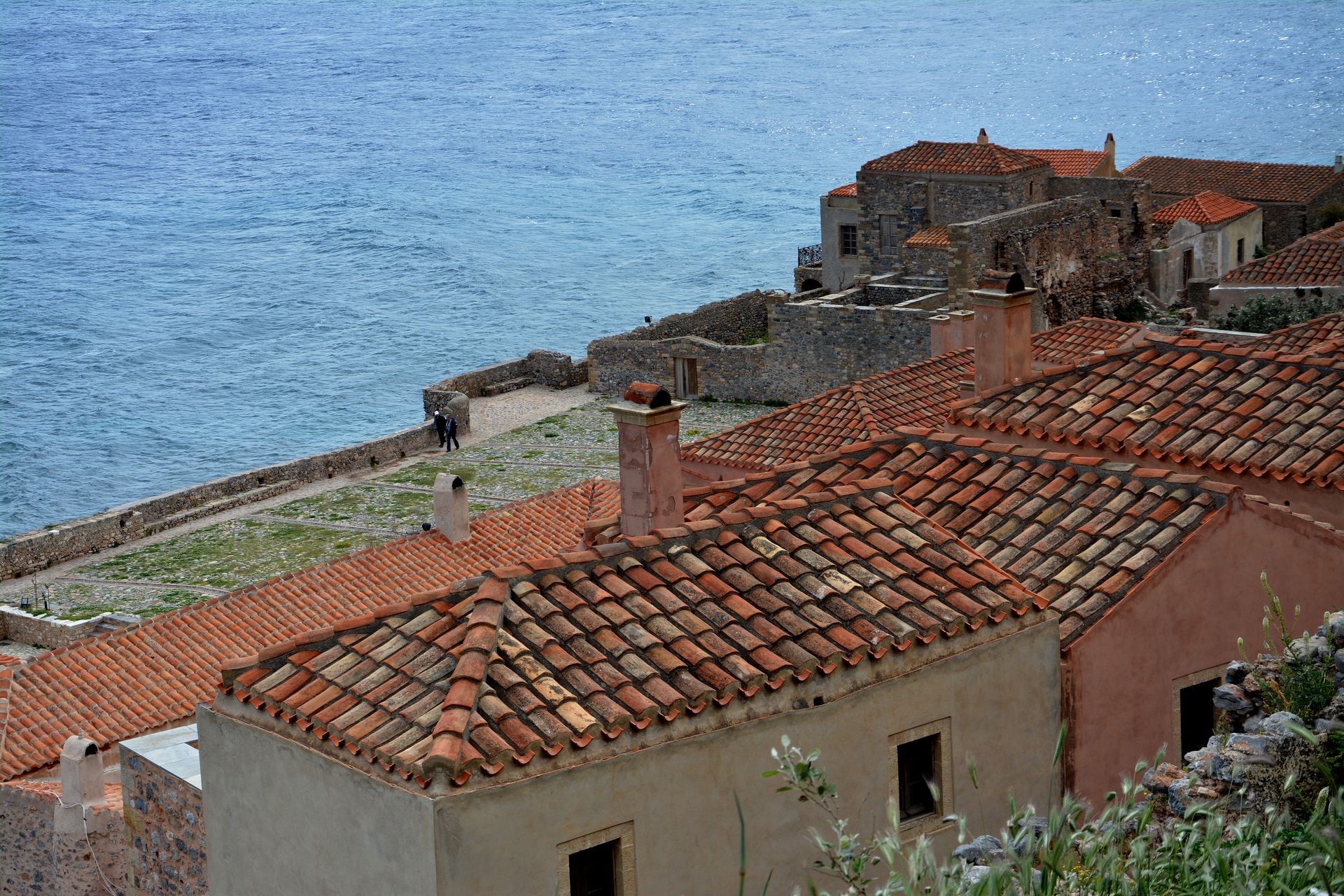
Photo: DESPOINA APOSTOLIDOU, Pexels
The inhabited Lower Town sits on the south-facing slope of the rock, invisible from the mainland. Entry is through a single vaulted gate in the western wall — a deliberate defensive feature that has defined life on the rock for more than a thousand years.
A single main street runs roughly east from the gate, lined with stone-built houses converted into guesthouses, small shops, and restaurants. Side alleys branch uphill and downhill, many leading to small chapels, hidden terraces, or views of the sea through gaps in the stone walls.
The Cathedral of Christos Elkomenos
Near the centre of the Lower Town stands the Cathedral of Christos Elkomenos (Christ in Chains), the town’s principal church and one of the oldest continuously used buildings in Monemvasia. The church contains Byzantine-era stonework and later frescoes, though access to the interior may depend on the time of year and day of the week.
Panagia Chrysafitissa
The small church of Panagia Chrysafitissa, recognisable by its dome and position overlooking the sea, is one of several post-Byzantine churches scattered through the Lower Town. Its setting against the deep blue of the Myrtoan Sea makes it one of the most photographed buildings in Monemvasia.
The Yannis Ritsos Museum
The poet Yannis Ritsos (1909–1990), one of the most important figures in modern Greek literature, was born in Monemvasia. His birthplace in the Lower Town was converted into a municipal museum, which opened to visitors in July 2025. The museum documents his life, work, and connection to the town. Ritsos’s poetry remains deeply tied to the landscapes of Laconia, and visiting the museum adds a literary dimension that few Greek fortress towns can offer.
The main street and evening atmosphere
During the day, the main street carries a gentle flow of visitors browsing shops selling local olive oil, Malvasia wine, pottery, and handmade jewellery. Most shops and some restaurants close between approximately 14:00 and 17:00 for siesta — a useful window for visiting churches or retreating indoors during summer heat.
The real character of the Lower Town emerges in the evening. Once the day visitors return to Gefyra and the causeway empties, the narrow streets become quietly atmospheric. Restaurant tables are set on terraces overlooking the sea, lit by candles and low lamps. The stone walls retain the day’s warmth. This is when Monemvasia most rewards those who stay overnight.
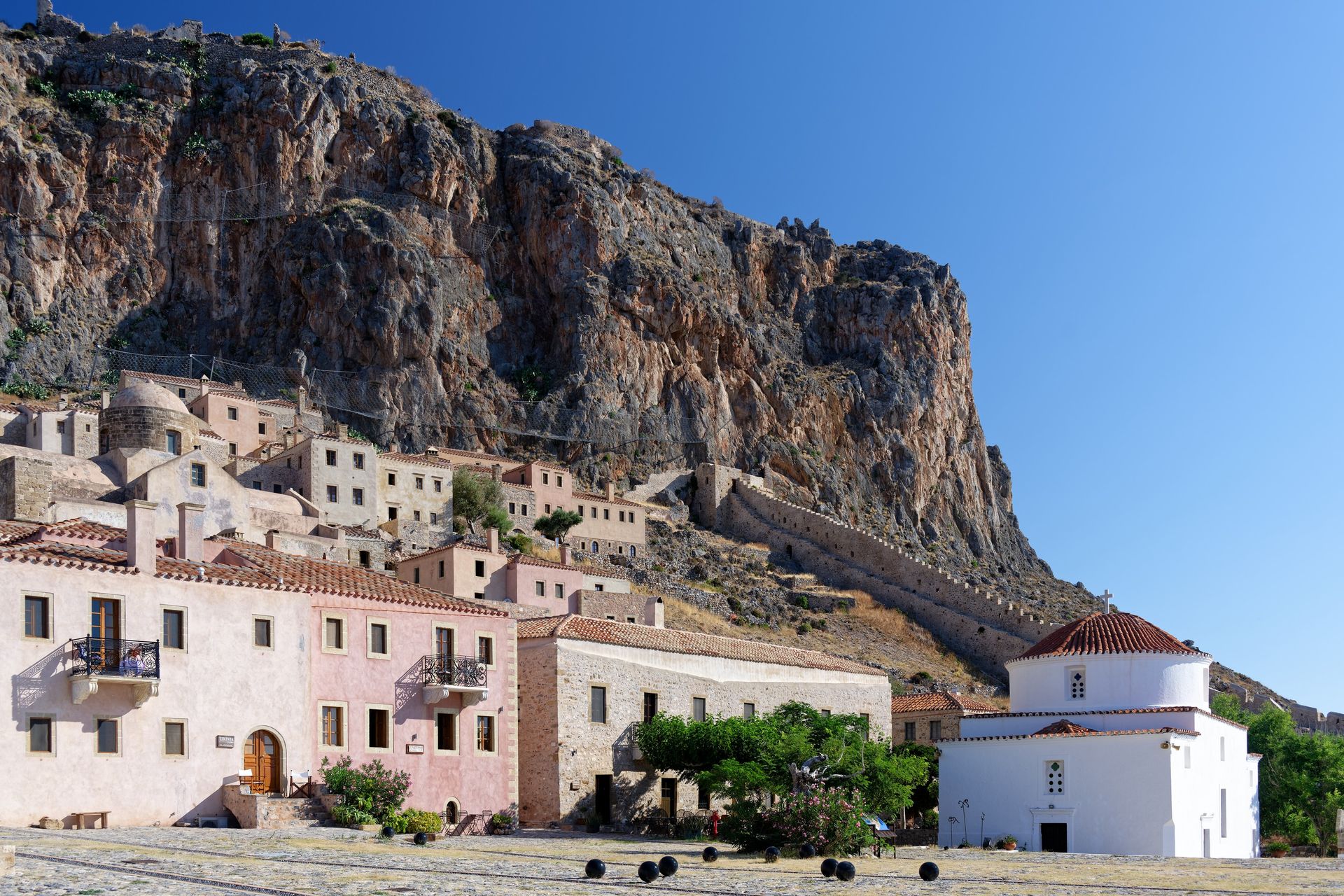
Photo: Gu Bra, Pexels
Climbing to the Upper Town
The Upper Town occupies the broad plateau on top of the rock, roughly 100 metres above sea level. In its medieval prime, this was home to the fortress’s aristocracy — at one point containing more than five hundred mansions, multiple churches, and the administrative heart of the settlement.
Today, almost all of the Upper Town lies in atmospheric ruin. Collapsed walls, empty cisterns, and fragments of churches are scattered among wildflowers and low bushes, giving the plateau the feel of a quiet, open-air archaeological park. Entry is free and there is no time limit.
The path
The climb begins from the eastern end of the Lower Town’s main street and follows a steep, roughly paved path that zigzags up the cliff face. Allow 20 to 30 minutes for the ascent depending on fitness. The path is uneven and exposed to wind and sun — sturdy footwear and water are essential, particularly in summer. The climb is not suitable for visitors with significant mobility limitations or very young children.
The Church of Agia Sophia
The only fully preserved building in the Upper Town is the Church of Agia Sophia (Holy Wisdom), built around 1150 AD on the edge of the cliff. It is one of the few remaining octagonal-plan Byzantine churches in Greece and has been compared architecturally to its more famous namesake in Constantinople. The church served as an Orthodox cathedral, a Catholic church under Venetian rule, and a mosque under Ottoman occupation — each era leaving visible traces in its stonework and decoration. Restoration work was completed in recent years.
Opening hours have historically varied by season. In the off-season, the church has been open Friday to Monday, typically from 08:30 to 15:00, and closed on Tuesdays. Summer hours may extend. Check locally on arrival, as schedules are not always published online.
Photo by Job Neeleman on Unsplash.
The views
From the plateau of the Upper Town, the panorama extends across the open sea towards the Cyclades on clear days, and along the Laconian coastline in both directions. The view alone justifies the climb, particularly in the soft light of early morning or the golden hour before sunset.
Beaches Near Monemvasia
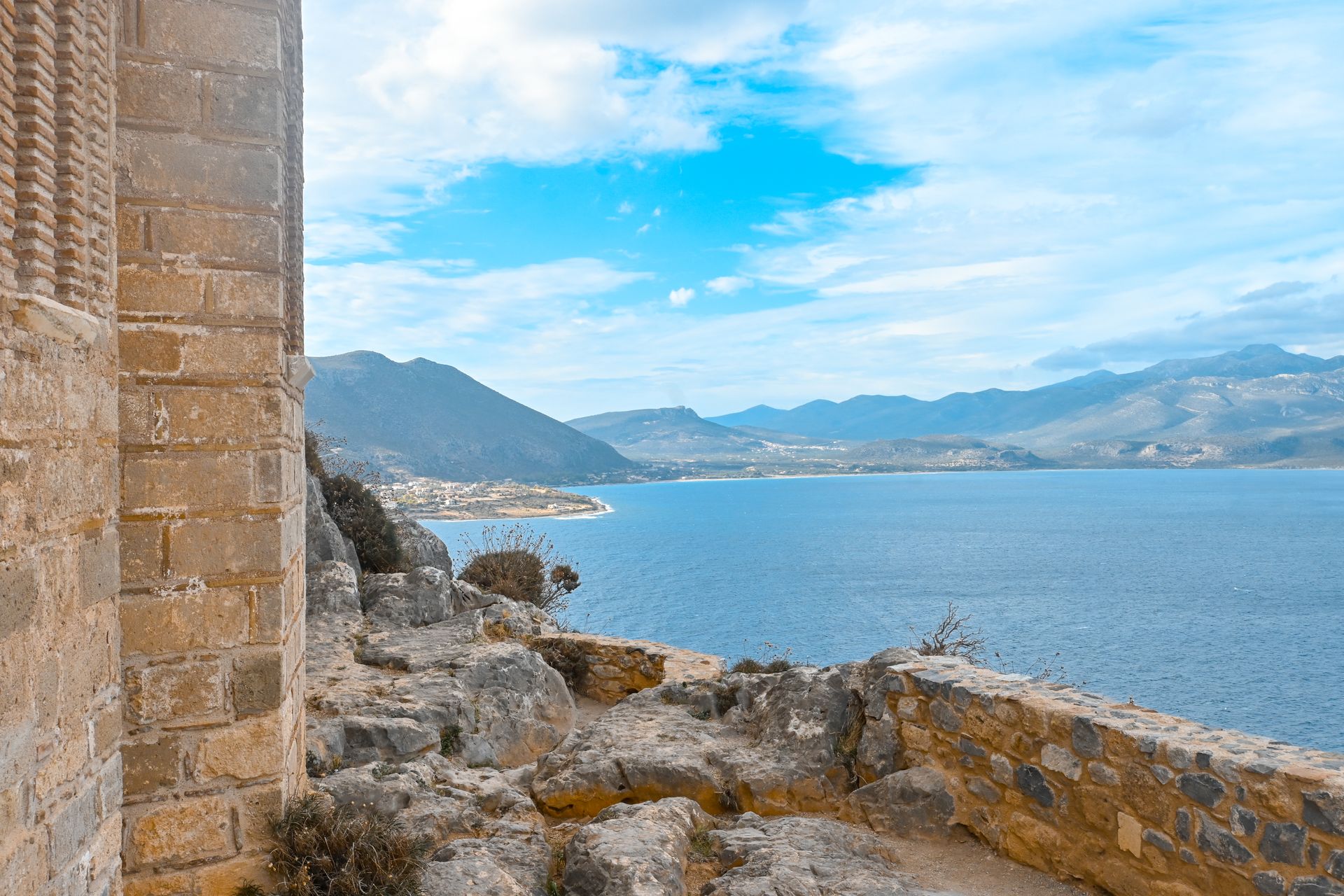
Photo: Ala J Graczyk, Pexels
Monemvasia is not a beach destination in the way that Naxos or Lefkada might be, but several good beaches lie within easy reach.
| Beach | Distance | Type | Best for |
|---|---|---|---|
| Portelo | Within the fortress walls | Rocky cove | Quick swim with castle views |
| Pori | 2 km north | Sandy, 2 km long | Families, full beach day |
| Ambelakia | 3 km south | Sandy, organised | Easy access, views of the rock |
| Xifias | 7 km south | Sandy, sheltered | Wind protection, families |
Portelo
A small cove tucked at the base of the fortress walls, accessible through a sea gate in the southern wall. Portelo is not a conventional beach — it is a rocky entry point with deep, clear water and the castle walls rising directly above. It works best as a brief, atmospheric swim during a day exploring the Lower Town rather than a dedicated beach visit.
Pori
The main beach for the area, Pori stretches for roughly 2 km along the coast approximately 2 km north of Monemvasia. The beach is sandy with shallow water near the shore, making it reasonably suitable for families. A canteen operates during summer, and sun loungers are available in the organised section. The view back towards the rock of Monemvasia from Pori is one of the best in the region.
Xifias
Located approximately 7 km south of Monemvasia, Xifias is a long sandy beach that benefits from natural protection against the north and meltemi winds that can make other nearby beaches choppy. Shallow water and tamarisk trees for natural shade make it a practical family choice. A car is needed to reach it.
Elafonisos
The island of Elafonisos, accessible by a short car ferry from the village of Pounta (approximately 45 minutes’ drive south of Monemvasia), has some of the finest sand beaches in Greece. Simos beach, in particular, is well known for its Caribbean-like turquoise water and fine white sand. Elafonisos makes a rewarding day trip for travellers staying two or more nights in Monemvasia.
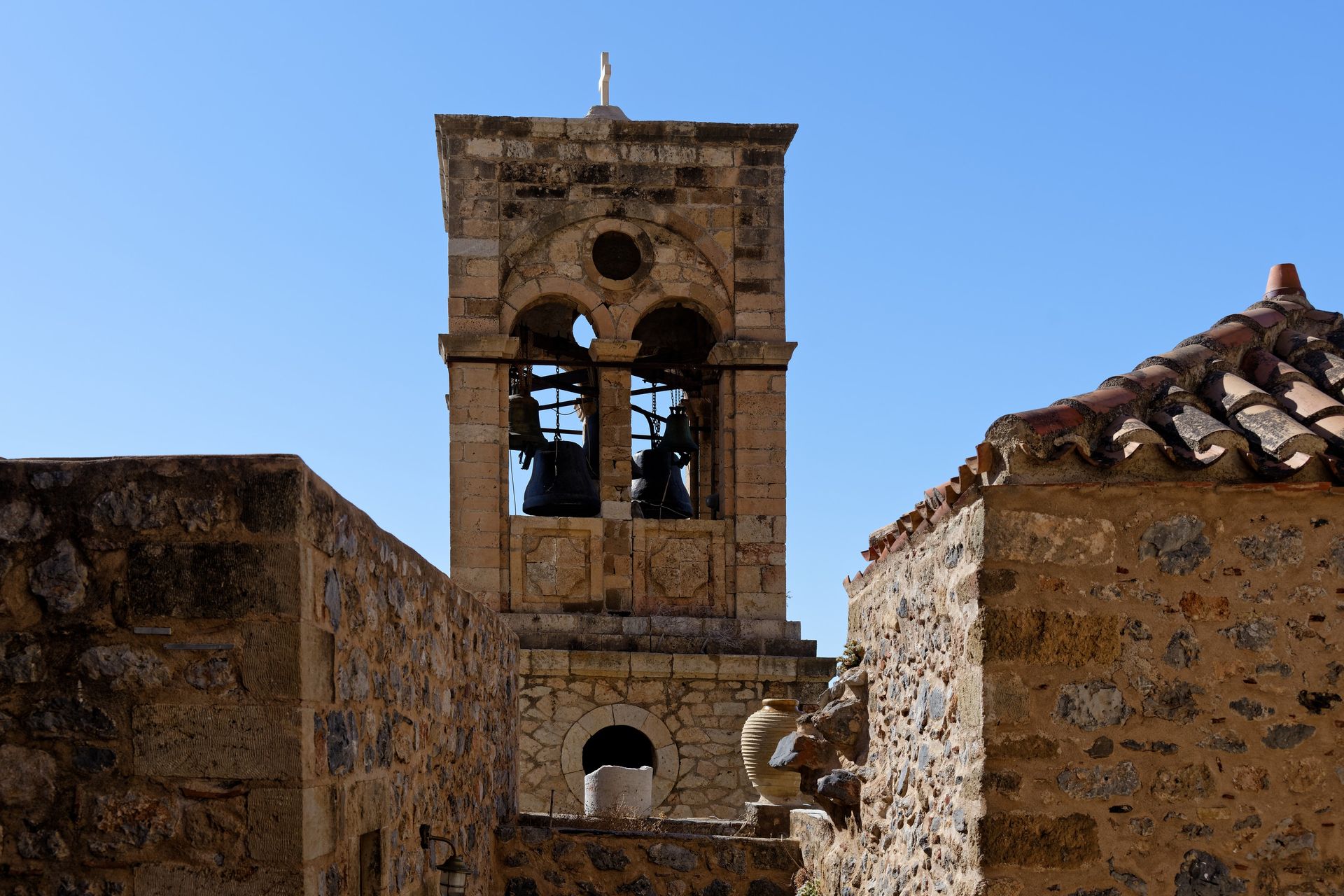
Photo: Gu Bra, Pexels
The Malvasia Wine Revival
For approximately five centuries — from the 12th to the 17th — Malvasia was among the most famous wines in Europe. Sweet, sun-dried, and shipped from Monemvasia’s harbour to Venice, France, and England, it became so valuable that Venetian merchants named their wine shops after it. The name Malvasia eventually spread to grape varieties planted across the Mediterranean, from Italy to Madeira, though these later varieties often bore little resemblance to the original Monemvasian wine.
The Ottoman conquest of Monemvasia in the 16th century led to the destruction of local vineyards, and production ceased for several centuries. Since the early 2000s, a revival effort has re-established Malvasia wine production in the Monemvasia region. Four PDO (Protected Designation of Origin) Malvasia wines are now produced in Greece — in Monemvasia, Paros, and Crete. Local wineries offer tastings, and the annual Malvasia Festival celebrates the wine’s history and its return.
Several restaurants and wine bars in the Lower Town serve local Malvasia alongside regional olive oils. For visitors interested in wine history, the connection between this small fortress town and one of medieval Europe’s most celebrated wines adds a dimension that most Greek destinations cannot offer. Those curious about Greek wine more broadly may enjoy reading about Crete’s indigenous grape varieties and village tastings.
Venetian merchants named their wine shops after this rock. The wine vanished for three centuries; the rock did not. Both are back.
Where to Eat
Dining in Monemvasia divides naturally between two settings. The Lower Town offers atmospheric restaurant terraces in medieval stone buildings, with prices reflecting the unique setting. Gefyra, the modern mainland town across the causeway, provides more casual and typically more affordable options along its small harbour.
Inside the castle, several well-regarded tavernas serve traditional Peloponnesian cooking — grilled fish, slow-cooked meat dishes, local cheeses, and seasonal salads — in settings that are difficult to find elsewhere in Greece. Expect dinner prices of approximately €20 to €40 per person including wine. Making a reservation during July and August is advisable for the most popular restaurants.
In Gefyra, waterfront restaurants offer fresh seafood and standard Greek taverna fare at lower prices, with views across to the illuminated rock in the evening. For everyday meals, especially lunch after a beach visit, Gefyra is the more practical choice.
Where to Stay
Accommodation falls into three categories, each with distinct advantages.
Inside the castle (Lower Town)
Staying within the medieval walls is the most atmospheric option. Guesthouses and small boutique hotels occupy restored stone buildings, many with sea views from private terraces. Rooms feature stone walls, wooden beams, and antique furnishings. Rates typically range from €120 to €300 per night during peak season, with luxury suites exceeding this range. The trade-off is that reaching your accommodation requires walking from the car park on cobblestone streets, and luggage logistics can be challenging — many properties offer porter assistance.
Gefyra (mainland town)
Hotels and guesthouses in Gefyra offer modern comfort, easier car access, and generally lower prices (typically €60 to €150 per night). Some waterfront properties have direct views of the rock. Gefyra is more practical for families and travellers who prefer driving convenience, though it lacks the historical atmosphere of the castle town.
Rural surroundings
A few estate-style properties sit in the countryside within a short drive of Monemvasia, offering more space, swimming pools, and a quieter rural setting. These suit travellers who want the Monemvasia experience during the day but prefer more spacious accommodation in the evening. A car is essential.
Getting Around
Within the Lower Town, everything is on foot. The main street is roughly 500 metres long, and most churches, shops, and restaurants lie along or near it.
For beaches, day trips, and dining in Gefyra, a car is the most practical option. There is no local bus service connecting Monemvasia to nearby beaches. Taxis can be arranged through accommodation, but availability is limited outside peak season.
The causeway connecting the rock to Gefyra is approximately 400 metres long and takes about ten minutes to walk. Some visitors drive across and park at the small area near the gate, though spaces are limited during busy periods.
Suggested Three-Day Itinerary
Day 1: Arrival and the Lower Town
Arrive in the afternoon after the drive from Athens or another Peloponnese destination. Park in Gefyra or at the causeway entrance and walk into the fortress. Spend the remaining daylight exploring the Lower Town — the main street, the Cathedral of Christos Elkomenos, the smaller churches along the side alleys, and the Yannis Ritsos Museum. End the day with dinner at a terrace restaurant inside the walls.
Day 2: Upper Town and beaches
Begin early in the morning with the climb to the Upper Town before the heat builds. Allow at least an hour on the plateau to explore the ruins and the Church of Agia Sophia, and to take in the panoramic views. Descend by late morning. After lunch, drive to Pori beach for a relaxed afternoon of swimming and sunbathing with views back to the rock. Return to the castle or Gefyra for an evening of Malvasia wine tasting and dinner.
Day 3: Day trip or departure
Options include a half-day trip to Elafonisos for its exceptional beaches, a visit to the nearby archaeological site of Epidaurus Limera, or a drive south along the coast to explore the smaller beaches of Xifias and Ambelakia. Travellers continuing through the Peloponnese might head northwest towards Mystras and the Mani Peninsula. Those returning to Athens should allow four hours for the drive.
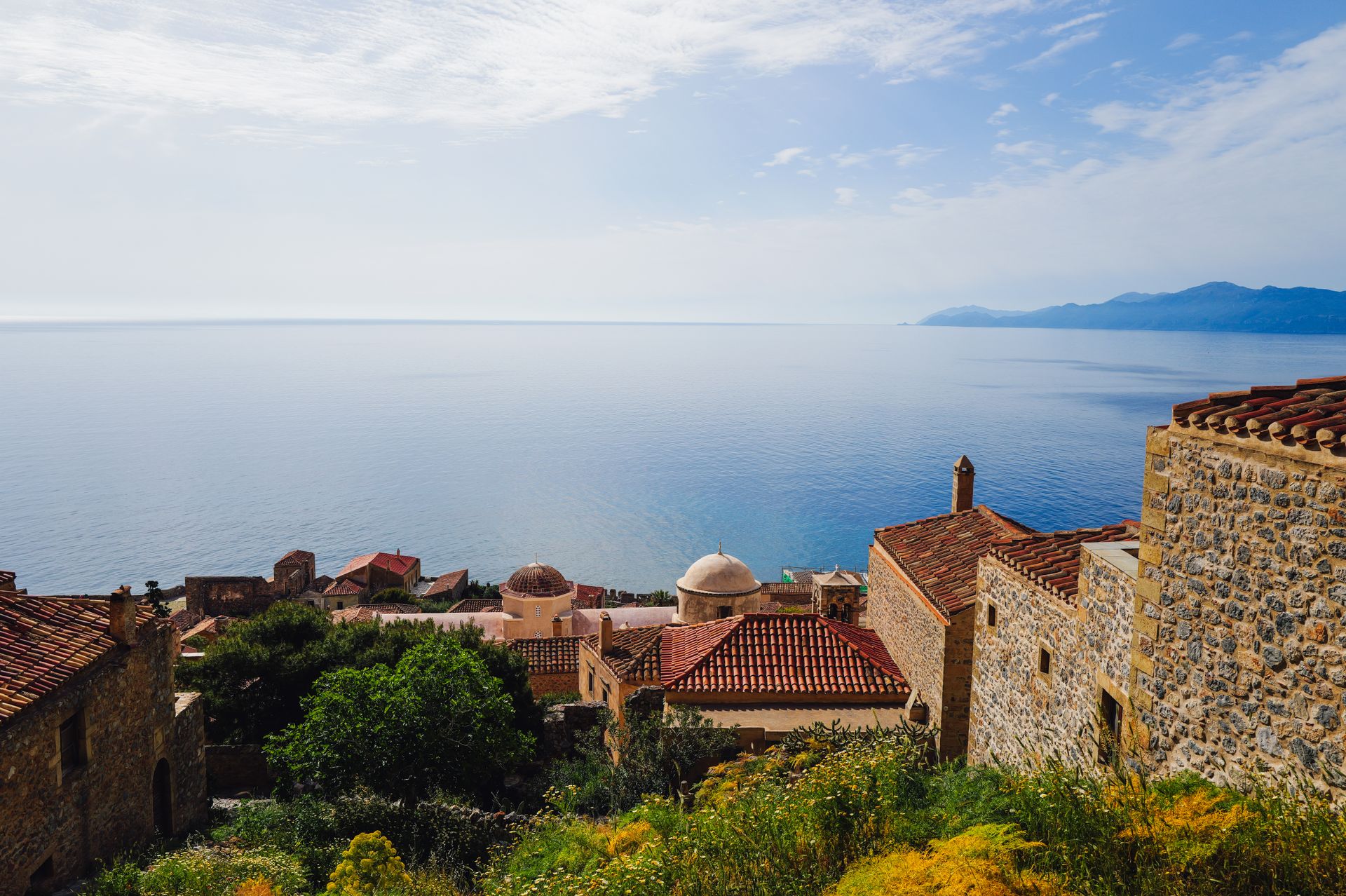
Photo: Adrien Olichon, Pexels
Combining Monemvasia with Other Peloponnese Destinations
Monemvasia works well as part of a broader Peloponnese circuit. The most natural combinations include:
- Mystras — The ruined Byzantine city near Sparti, approximately 90 km northwest. Together with Monemvasia, these two sites offer the strongest concentration of medieval Byzantine heritage in the Peloponnese.
- The Mani Peninsula — The wild, tower-studded southern peninsula of the Peloponnese, roughly two to three hours’ drive west. Mani appeals to travellers interested in dramatic coastline, traditional stone architecture, and remote villages.
- Nafplio — The elegant Venetian harbour town, approximately 180 km northwest. Nafplio provides a softer, more accessible counterpart to Monemvasia’s fortress austerity. Travellers drawn to car-free settings may also appreciate Hydra, another Greek destination where engines give way to footsteps.
- Epidaurus — The ancient theatre and sanctuary, approximately 230 km northwest. Summer performances of classical drama in the theatre are among the most memorable cultural experiences in Greece.
A practical loop from Athens might follow: Athens → Nafplio (2 hours) → Monemvasia (3 hours) → Mystras/Sparti (1.5 hours) → Mani (1 hour) → Kalamata (2 hours) → Athens (3 hours). Allow at least seven to ten days for this itinerary at a comfortable pace.
Practical Tips
- Footwear: Sturdy shoes with good grip are essential for the Upper Town climb and useful throughout the Lower Town’s cobblestone streets. Sandals and flip-flops are inadequate.
- Water: Carry water, especially for the Upper Town. There are no facilities on the plateau.
- Cash: Some smaller shops, churches collecting donations, and parking areas may not accept cards. Bring some cash.
- Luggage: If staying inside the castle, pack light or use a backpack. Wheeled suitcases are impractical on cobblestone streets. Ask your hotel about luggage transfer.
- Photography: The contrast between bright stone and deep sea creates challenging exposure conditions. Early morning and the hour before sunset provide the best light. The Upper Town is most photogenic when wildflowers bloom in spring.
- Wind: The rock is exposed to coastal winds, especially the north-facing Upper Town. Even in summer, carry a light layer for evenings on restaurant terraces.
- Accessibility: The Lower Town involves cobblestone streets and occasional steps. The Upper Town is accessible only via a steep, rough path. Wheelchair access within the fortress is extremely limited.
Common Mistakes
- Visiting as a day trip from Athens: Seven to eight hours of driving for four hours in the town is exhausting and misses the evening atmosphere entirely. Stay at least one night.
- Skipping the Upper Town: Many visitors see only the Lower Town. The Upper Town, despite the climb, offers the most dramatic views and the strongest sense of the fortress’s historical scale.
- Arriving with heavy luggage: Wheeled suitcases on cobblestone streets inside the fortress are a common source of frustration. Pack a smaller bag for your castle stay.
- Not booking ahead in summer: The castle town has limited accommodation capacity. During July and August, rooms can fill weeks in advance.
- Expecting a beach holiday: The beaches are pleasant but secondary to the fortress experience. Travellers prioritising beaches should consider Elafonisos as a separate stop.
Final Recommendation
Monemvasia belongs to a shrinking category of Greek destinations where the history is genuine, the setting has not been softened for mass consumption, and the experience does not depend on perfect weather or a long checklist of attractions. It asks relatively little of the visitor — walk through the gate, climb the rock, sit on a terrace in the evening — and delivers a quiet, lasting impression that louder destinations struggle to match.
It is not the right choice for everyone. The driving distance is significant, the beaches are elsewhere, and the nightlife is non-existent. But for travellers who value atmosphere over amenity and depth over breadth, Monemvasia remains one of the most compelling stops in the Peloponnese — and one of the most distinctive small towns in all of Greece.
The information in this article was researched and verified as of July 2026. Prices, transport options, schedules, and conditions may have changed since publication — we recommend double-checking key details before your trip.