Heraklion is the largest city on Crete and the gateway to one of the most important archaeological sites in the Mediterranean. Most visitors arrive here by air or overnight ferry, and many head straight out to a resort along the coast. That is a reasonable approach, but it means missing a city with genuine depth — one shaped by Minoan kings, Venetian engineers, Ottoman rulers, and a literary tradition that produced both El Greco and Nikos Kazantzakis.
This guide covers the practical details needed to plan a visit to Heraklion and its surroundings: what to see, where to base yourself, how to reach the main attractions, and how to combine the city with Crete’s wider coastline and wine country.
Who Heraklion Is Best For
Heraklion suits travellers who care about archaeology, Minoan history, and food culture more than postcard-perfect harbour scenery. The city centre is honest rather than manicured — the old town mixes Venetian grandeur with modern Greek urban life, street markets with museum-quality artefacts, and congested avenues with quiet pedestrian lanes. It rewards curiosity, but it does not perform for visitors expecting a polished resort experience.
The city works particularly well as a base for exploring central and eastern Crete, combining Knossos, the Archaeological Museum, wine villages, and the south-coast beaches within day-trip distance. It is also the most practical starting point for Cycladic island-hopping, with frequent ferry connections to Santorini, Mykonos, and the wider Aegean.
Limitations worth knowing
Heraklion does not have a good swimming beach within walking distance of the old town. The nearest stretch at Ammoudara, about five kilometres west, is a functional city beach rather than a scenic destination. Travellers whose priority is daily beachgoing from a waterfront setting may prefer Chania or Rethymno as a base. The city can feel congested in midsummer, and parking in the centre is consistently difficult. Public transport works well for the main corridor along the north coast, but a rental car becomes necessary for the south coast and mountain villages.
Best Time to Visit
Heraklion is a year-round destination, unlike many seasonal Greek island towns. The Archaeological Museum and Knossos remain open throughout the winter, although hours are shorter from November to March. The city itself has a resident population of roughly 175,000, so shops, markets, and restaurants operate normally outside the tourist season.
For the best combination of manageable crowds and warm weather, the periods from mid-April to mid-June and from September to late October are the most comfortable. Summer temperatures in Heraklion regularly exceed 30 degrees Celsius, and the archaeological site at Knossos offers limited shade. Visiting Knossos early in the morning during July or August is strongly advisable.
The Palace of Knossos
The ceremonial heart of Europe’s earliest advanced civilisation, five kilometres south of the city centre
Knossos is the reason many people visit Heraklion, and it justifies the trip. The site lies approximately five kilometres south of the city centre and is well connected by city bus, taxi, or a short drive. It was the ceremonial and political centre of the Minoan civilisation, Europe’s earliest advanced society, and its palace complex once covered more than 20,000 square metres with over 1,300 rooms.
The palace was first excavated by Sir Arthur Evans beginning in 1900, and his extensive reconstructions — the red columns, the repainted frescoes, the concrete restorations — remain controversial among archaeologists. Some scholars view the reconstructions as misleading interpretations; others credit Evans with making the site accessible to visitors who would otherwise struggle to read bare foundations. Whatever one’s view, the result is a site that communicates the scale and sophistication of Minoan culture more vividly than any other Bronze Age ruin in Greece.
In 2025, Knossos was inscribed as part of the UNESCO World Heritage Site Minoan Palatial Centres, alongside Phaistos, Malia, Zakros, Zominthos, and Kydonia. This formal recognition reflects the site’s global significance and may affect visitor numbers in coming years.
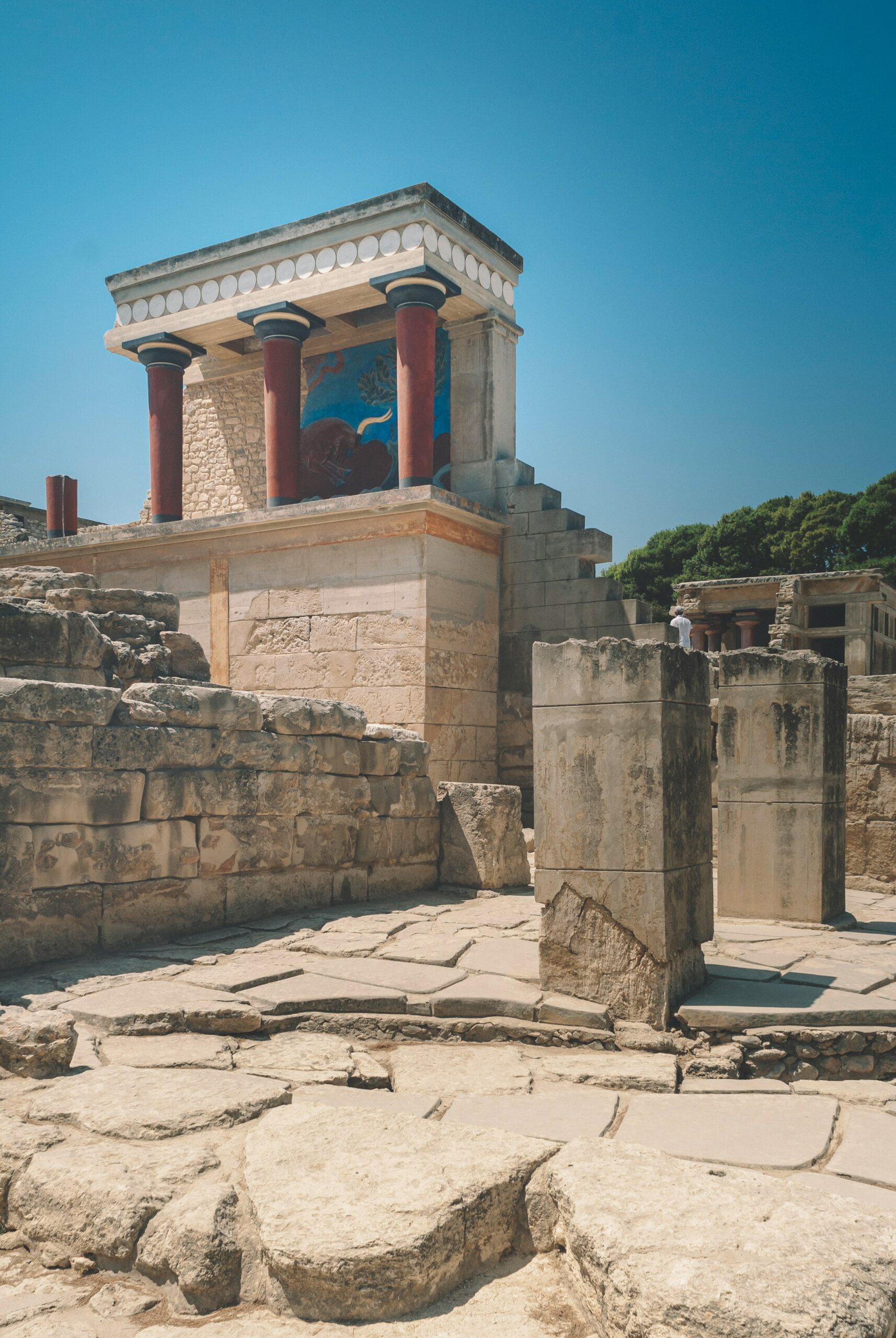
Photo: Egor Myznik, Unsplash
Practical details
The standard admission fee is 20 euros (reduced 10 euros). Tickets are timed and should be purchased in advance through the official e-ticketing platform of the Hellenic Ministry of Culture. Summer opening hours typically run from 8:00 to 20:00, with last admission 15 minutes before closing. Winter hours are reduced to 8:30 to 17:00 from November onwards. Hours change several times during the autumn transition, so it is worth checking the official schedule before visiting.
EU citizens aged under 25 and non-EU visitors under 18 receive free admission. EU citizens over 65 receive the reduced rate between October and May. A visit typically takes between one and a half and three hours. Bringing water, sunscreen, and comfortable walking shoes is essential during the warmer months.
City bus number 2 runs from Heraklion’s bus station to Knossos and costs approximately one to two euros. The journey takes about 20 minutes. Taxis from the city centre cost roughly 8 to 12 euros.
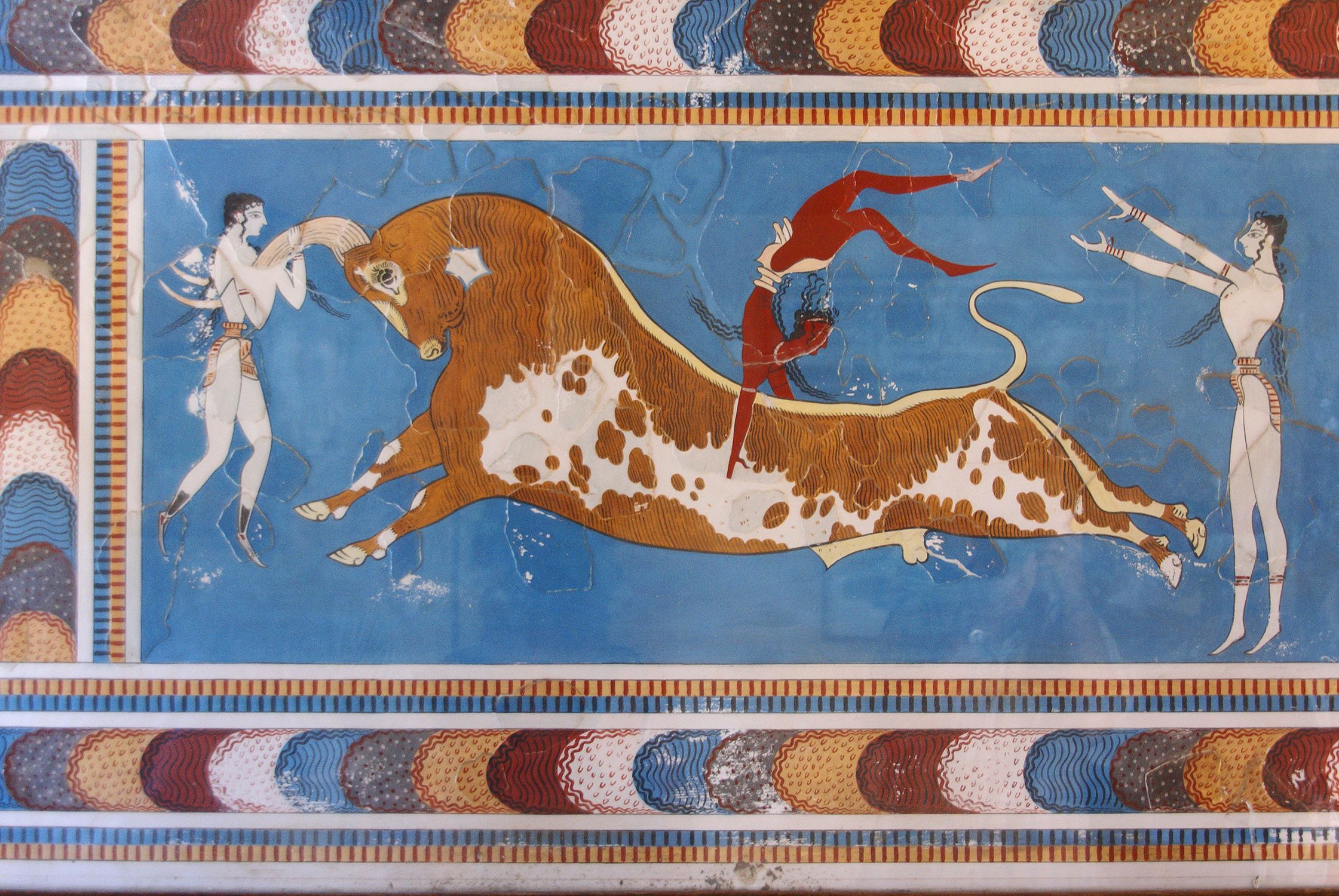
Photo: Gu Bra, Pexels
Heraklion Archaeological Museum
The Archaeological Museum of Heraklion holds the most comprehensive collection of Minoan artefacts in the world. It is the essential companion to a visit to Knossos, because many of the original frescoes, pottery, jewellery, and administrative tablets discovered at the palace are displayed here rather than at the site itself.
The museum’s collection spans more than five millennia, organised across 27 galleries on multiple floors. Highlights include the Phaistos Disc, the Snake Goddesses, the Harvester Vase, the bull-leaping fresco, and the gold Bee Pendant from Malia. The presentation is modern, well-lit, and accessible, with lift access between floors.
Standard admission is 20 euros. The museum is located beside Eleftherias Square in the city centre, within easy walking distance of the harbour and the main pedestrian streets. Summer hours are generally 8:00 to 20:00, though these vary by day of the week and season. Check hours directly before visiting, especially on Tuesdays when reduced hours may apply.
A combined visit to Knossos and the Archaeological Museum comfortably fills a full day. Many experienced visitors recommend seeing the museum first, because understanding the original artefacts enriches the experience of walking through the palace grounds.
Walking the Old Town
Heraklion’s historic centre is compact enough to explore on foot in half a day, though a full day allows for a more relaxed pace. The city’s layers of history — Venetian, Ottoman, Byzantine, modern Greek — are visible in its architecture, its street plan, and the fortifications that still define its boundaries.
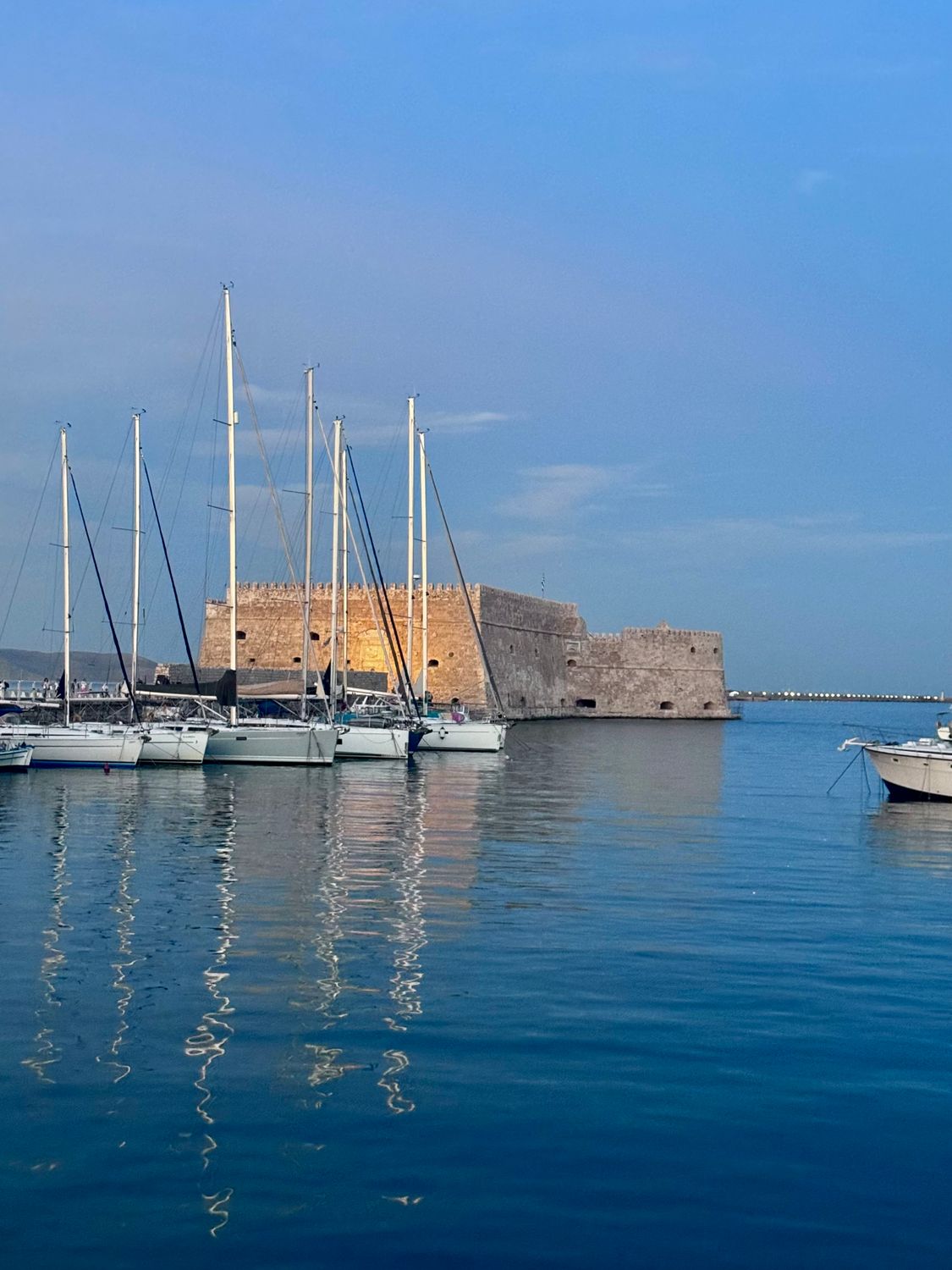
Photo: Katy Ramm, Pexels
The Venetian harbour and Koules Fortress
The old harbour is the most naturally appealing part of the city. Fishing boats and small yachts sit in the water below the fortress, and the Venetian shipyards — a series of restored arched stone buildings — line the eastern side. The Koules Fortress (also known as Rocca al Mare) was built in the early sixteenth century and guards the harbour entrance. Inside, the restored rooms house a small exhibition, and the rooftop offers views across the harbour and out to sea. Admission is 10 euros.
Lions Square and the Morosini Fountain
The focal point of the old town is Plateia Venizelou, commonly called Lions Square after the four carved lions that support the basin of the Morosini Fountain. The fountain dates from 1628 and was commissioned by the Venetian governor Francesco Morosini to supply the city with fresh water. The square is surrounded by cafes and serves as the principal meeting point in the pedestrian centre.
The Venetian Loggia and 25th of August Street
Walking south from the harbour along 25th of August Street — one of the city’s finest Venetian-era thoroughfares — leads past the Church of Agios Titos, which houses the skull relic of the island’s patron saint. The Venetian Loggia, a two-storey building completed in 1628, now functions as the city hall. Its careful restoration earned a Europa Nostra first prize in 1987. Nearby stands the Basilica of St Mark, now used as an exhibition space.
The Venetian walls and the tomb of Kazantzakis
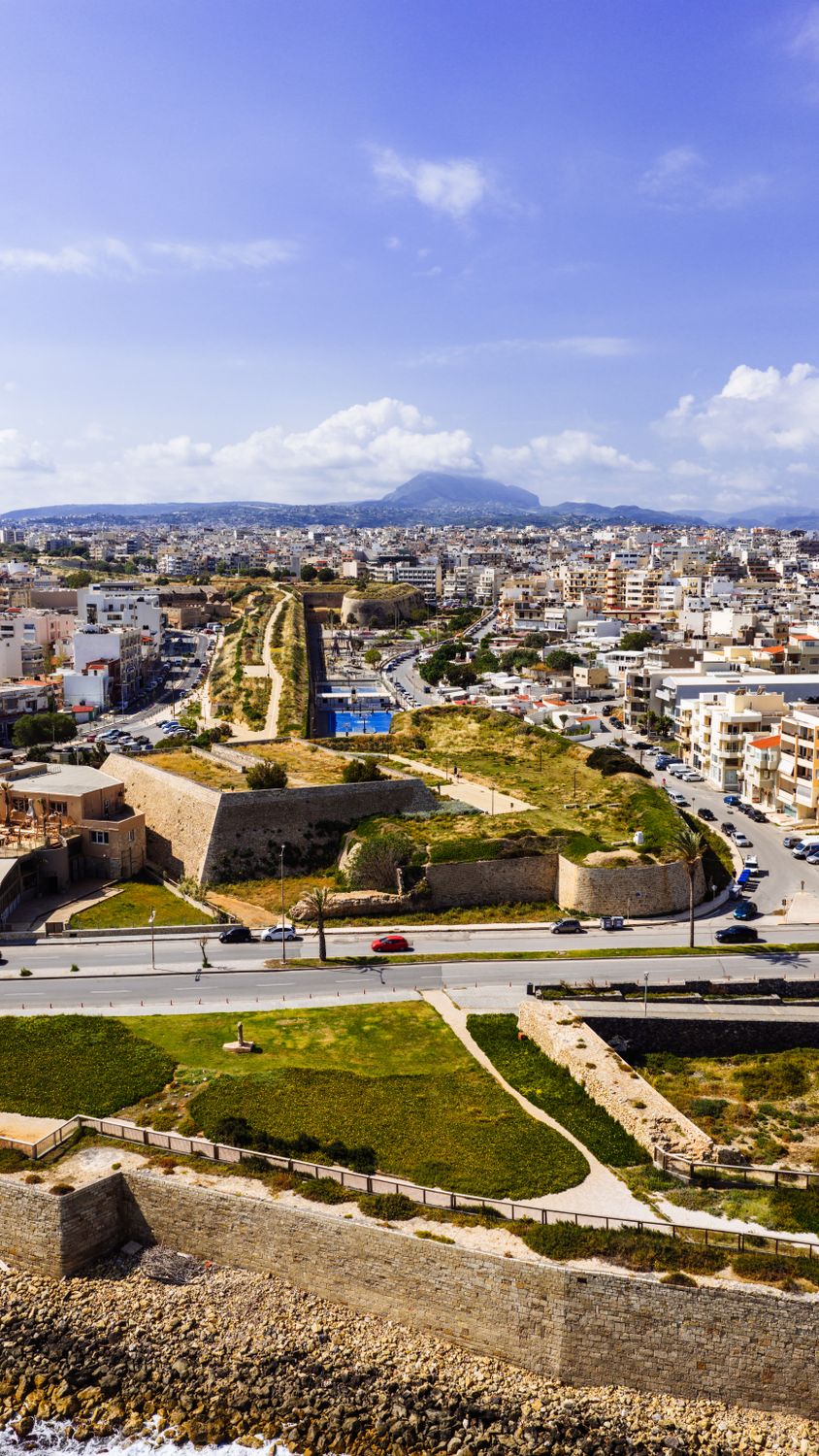
Photo: K, Pexels
The Venetian walls encircling the old city are approximately three kilometres long. Their construction began in 1426 and continued for more than 150 years, making them one of the most ambitious fortification projects in the Mediterranean. The walls feature four original gates and seven bastions. Walking along the top of the walls is possible in several sections and offers panoramic views over the city and its harbour.
On the Martinengo Bastion, the southernmost point of the walls, lies the tomb of Nikos Kazantzakis, the Heraklion-born writer best known internationally for Zorba the Greek. His tombstone carries the inscription: I hope for nothing. I fear nothing. I am free. The spot offers one of the broadest views in the city and is worth the walk even for visitors unfamiliar with his work.
Heraklion’s connection to El Greco (Domenikos Theotokopoulos) adds another cultural dimension. The painter was born in 1541, most likely in or near Candia, as Heraklion was then known under Venetian rule. He trained in the Byzantine icon tradition before leaving for Venice and eventually settling in Toledo, Spain. A small exhibition space near the cathedral occasionally hosts related displays.
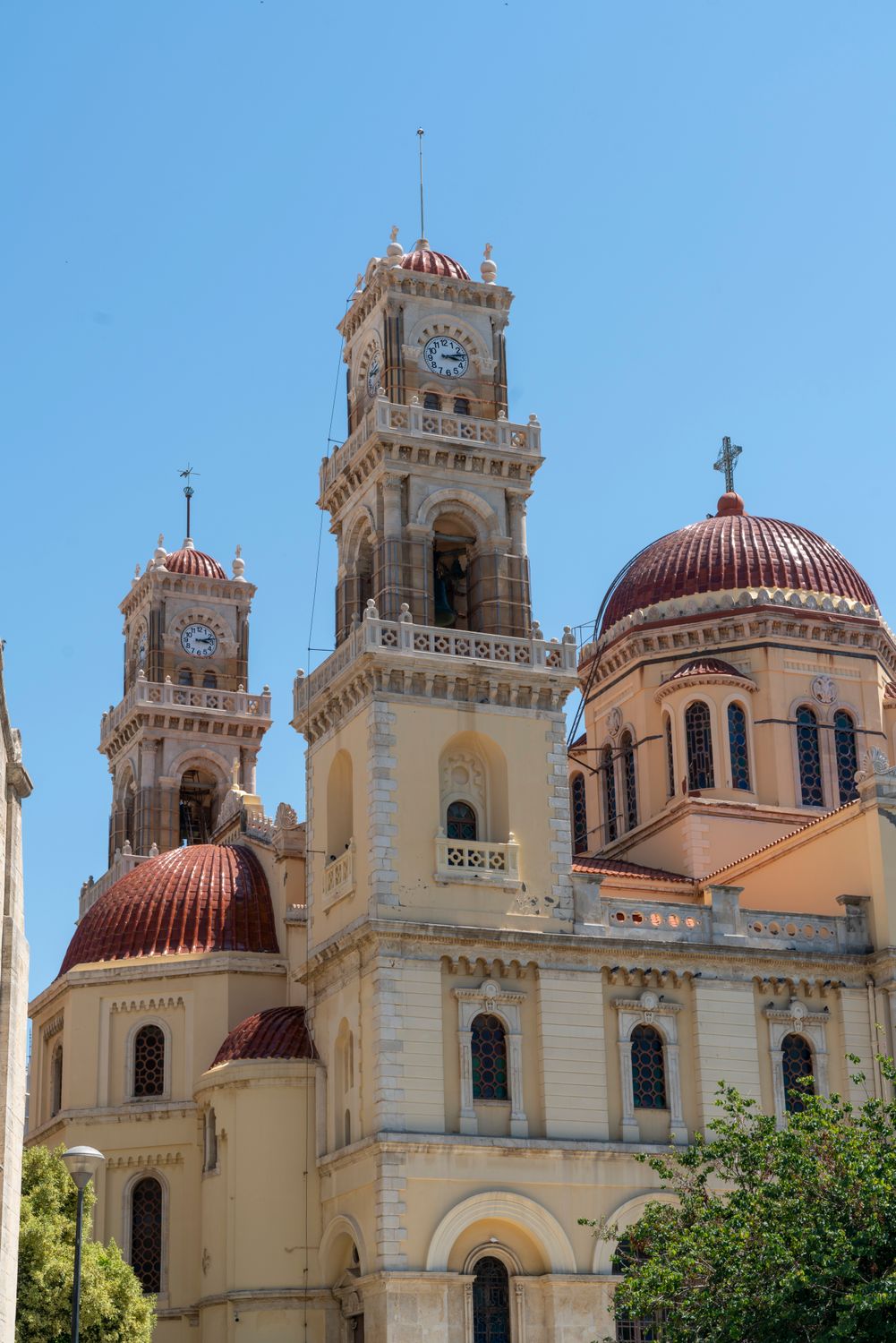
Photo: Busra Salkim, Pexels
Agios Minas Cathedral
The Cathedral of Agios Minas is one of the largest churches in Greece. Its imposing dome and twin bell towers are visible from many parts of the old town. The interior features a large iconostasis and detailed frescoes. Next to it stands the smaller, older church of Agios Minas, and across the square is the Church of Agia Aikaterini (Saint Catherine of Sinai), which houses a collection of Byzantine icons including works attributed to the Cretan school of icon painting.
The Central Market & Cretan Food
Graviera, bougatsa, wild herbs and raki — the market on 1866 Street feeds you like a local
The Central Market runs along 1866 Street, south from Lions Square. It is one of the most genuine food markets in Greece, selling olive oil, graviera cheese, dried herbs (diktamos, malotira, sage), honey, snails, cured meats, and seasonal produce. The market tavernas within and around the covered street are some of the most reliable lunch destinations in the city, cooking directly from the ingredients sold nearby.
Heraklion’s food culture reflects Crete’s wider culinary tradition, which has been studied extensively for its health benefits and its roots in the traditional Mediterranean diet. Several dishes are particularly associated with the city and its region.
Bougatsa is perhaps the most emblematic Heraklion food experience. This flaky filo pastry filled with semolina custard is traditionally eaten for breakfast or as a morning snack. The best-known bakeries open between 6:00 and 7:00 in the morning and serve it freshly made. Savoury variations filled with cheese or minced meat also exist.
Dakos is a Cretan appetiser of barley rusk topped with chopped tomato, crumbled local cheese (usually mizithra or anthotyro), olive oil, and oregano. It appears on menus across Crete but is rooted in the rural diet of the island. Kalitsounia — small pies filled with soft cheese and sometimes greens — are another widely available Cretan speciality. Lamb and goat dishes, snails (chochlioi boubouristi), and wild greens (horta) served with olive oil and lemon are staples of the broader Cretan table.
The wine country around Archanes, just 15 kilometres south of the city, has produced wine for at least 4,000 years. Several family-run wineries offer tastings and tours, making the area an easy half-day excursion from Heraklion. Cretan grape varieties such as Vidiano, Vilana, and Kotsifali are increasingly well-regarded among Greek wine enthusiasts.
Day Trips from Heraklion
Heraklion’s central position on Crete’s north coast makes it a practical hub for day trips in several directions.
| Destination | Distance | Drive time | Public transport | Best for |
|---|---|---|---|---|
| Archanes & wine country | 15 km south | 20 to 25 min | Local bus available | Wine tasting, Minoan sites, village lunch |
| Phaistos | 63 km south | 1 h | KTEL bus available | Second-largest Minoan palace, Phaistos Disc site |
| Matala | 67 km southwest | 1 h 10 min | KTEL bus (infrequent) | Beach, cliff caves, south-coast atmosphere |
| Agia Pelagia | 20 to 24 km west | 25 to 30 min | Limited bus service | Calm swimming, sheltered bay, seafood |
| Malia Palace | 34 km east | 30 min | KTEL bus available | Minoan archaeology, less crowded than Knossos |
| Rethymno | 78 km west | 1 h 15 min | KTEL every 30 to 60 min, approx 8 euros | Venetian old town, Fortezza, south coast |
| Chania | 140 km west | 1 h 50 min | KTEL every 30 to 60 min, approx 15 to 16 euros | Venetian harbour, markets, western Crete access |
| Agios Nikolaos | 66 km east | 1 h | KTEL bus, approx 7.70 euros | Elounda, Spinalonga, eastern Crete |
Archanes and the wine villages
The village of Archanes sits at the foot of Mount Giouchtas and has been restored with care over the past decades. Its narrow paved streets, neoclassical houses, and central square make it one of the most attractive villages within easy reach of Heraklion. The surrounding hills contain several wine estates offering tastings, along with the Minoan site of Vathypetro, where one of the oldest known wine presses in the world was discovered. Combining Archanes with a visit to Knossos makes for a well-paced full day.
Phaistos and the south coast
Phaistos, the second-largest Minoan palace on Crete, occupies a commanding hilltop with views across the Messara Plain to the Asterousia Mountains. The site is less reconstructed than Knossos and more atmospheric for visitors who prefer unadorned ruins. Admission is 15 euros. It can be combined with a visit to Matala beach, approximately 15 minutes further south by car, where sandstone cliffs riddled with ancient caves frame a wide sandy bay. Travellers interested in the wilder end of Crete’s south coast may also enjoy the Sfakia region further west, though that is best treated as a separate trip.
Beaches Near Heraklion
Heraklion’s beaches serve a practical purpose rather than a scenic one. The coastline immediately adjacent to the city is not the most attractive stretch of Cretan shoreline, but several reasonable options exist within a short drive.
Ammoudara is the main city beach, about five kilometres west of the centre. It is a long sandy stretch with organised sunbeds, beach bars, and water-sports facilities. It is accessible by city bus and is the most convenient option for a quick swim. The sand is brownish rather than golden, and conditions can become rough in northern winds.
Karteros, about seven to eight kilometres east near the airport, is popular with windsurfers thanks to consistent wind exposure. It has sandy stretches and organised sections. Its proximity to the airport means occasional aircraft noise, though this bothers some visitors less than others.
Agia Pelagia, roughly 20 to 24 kilometres west, offers the most appealing swimming near Heraklion. The sheltered bay is calmer than the open north-coast beaches, with clearer water and a more traditional village atmosphere. Several waterfront tavernas serve fresh fish. It is reachable by car in 25 to 30 minutes, making it a practical half-day excursion for beach-minded travellers based in Heraklion. Limited bus connections exist but are less reliable for return journeys.
Travellers who want daily access to exceptional beaches should consider basing themselves further west along the coast, near Rethymno or Chania, or exploring the south coast, where beaches such as Matala, Agiofaraggo, and Tsoutsouros offer more dramatic settings.
Where to Stay
Heraklion’s accommodation divides into two broad zones: the city centre inside or beside the Venetian walls, and the coastal strip at Ammoudara to the west.
Inside the old town is the best choice for most visitors. Staying within walking distance of the Archaeological Museum, Lions Square, the harbour, and the market makes it easy to explore on foot and reach bus connections. This area suits travellers focused on Knossos, museums, food, and the city’s historical fabric. The harbour side of the centre is also the most practical location for early-morning ferry departures.
Ammoudara suits travellers who want beach access and a more resort-like setting, though the area lacks the character of the old town. It works for families who want a pool or beachfront, with the city centre reachable by a short bus ride or taxi.
Heraklion is not the most atmospheric base for a purely scenic Cretan holiday. Travellers prioritising old-town aesthetics may prefer Chania or Rethymno. Those seeking luxury resorts may prefer the Elounda area further east. But for a combination of archaeology, food, transport connections, and access to central Crete, Heraklion is difficult to match.
Getting There
By air
Heraklion International Airport (Nikos Kazantzakis, code HER) is the second-busiest airport in Greece. As of mid-2026, it serves 126 destinations across 30 countries, with 55 airlines operating routes. Direct flights arrive from most major European cities throughout the year, with significantly increased frequency from April to October. The airport is approximately five kilometres east of the city centre, reachable by city bus (around 2 euros) or taxi (around 10 to 15 euros).
A new airport at Kastelli, approximately 39 kilometres southeast of Heraklion, is currently under construction. As of early 2026, the project was roughly 67 to 70 percent complete, with commercial operations tentatively expected in 2028. Travellers should check for updates closer to their travel dates, as the transition from the current airport will affect transfers and logistics.
By ferry
Heraklion port is one of the best-connected in Greece. Overnight ferries to and from Piraeus (Athens) operate daily and take approximately 7 to 9 hours depending on the operator and route. The main operators are Minoan Lines, ANEK Superfast / Blue Star Ferries, and SeaJets.
Heraklion also has direct ferry connections to Santorini, Mykonos, Naxos, Paros, Ios, Milos, Syros, Tinos, and Serifos in the Cyclades, as well as Rhodes and Karpathos in the Dodecanese. This makes it a practical starting point for Aegean island-hopping itineraries. Most Cycladic connections are seasonal and operate primarily from April to October. Confirm schedules directly with operators or through booking platforms such as Ferryhopper.
Getting Around
Within the city centre, walking is the most practical way to move. The main attractions — the museum, the harbour, Lions Square, the market, the Loggia — all lie within a compact area inside the Venetian walls.
For Knossos, beaches, and day trips, the options are:
- City buses connect the centre to Knossos (line 2), Ammoudara, Karteros, and the airport. Fares range from 1 to 2 euros. More information is available at astiko-irakleiou.gr.
- KTEL intercity buses serve Rethymno, Chania, Agios Nikolaos, and other major destinations. The north-coast corridor runs every 30 to 60 minutes in summer. Services to the south coast are less frequent, often two or three departures daily. Schedules are available at ktelherlas.gr for the Heraklion-Lasithi region and e-ktel.com for western Crete.
- Rental cars are available from agencies at the airport and in the city. Expect to pay roughly 25 to 50 euros per day in low season and 50 to 90 euros per day in peak summer. Advance booking is recommended for July and August. Driving in Heraklion city is manageable but parking is difficult; a car is most useful for reaching the south coast, mountain villages, and archaeological sites away from the main bus corridor.
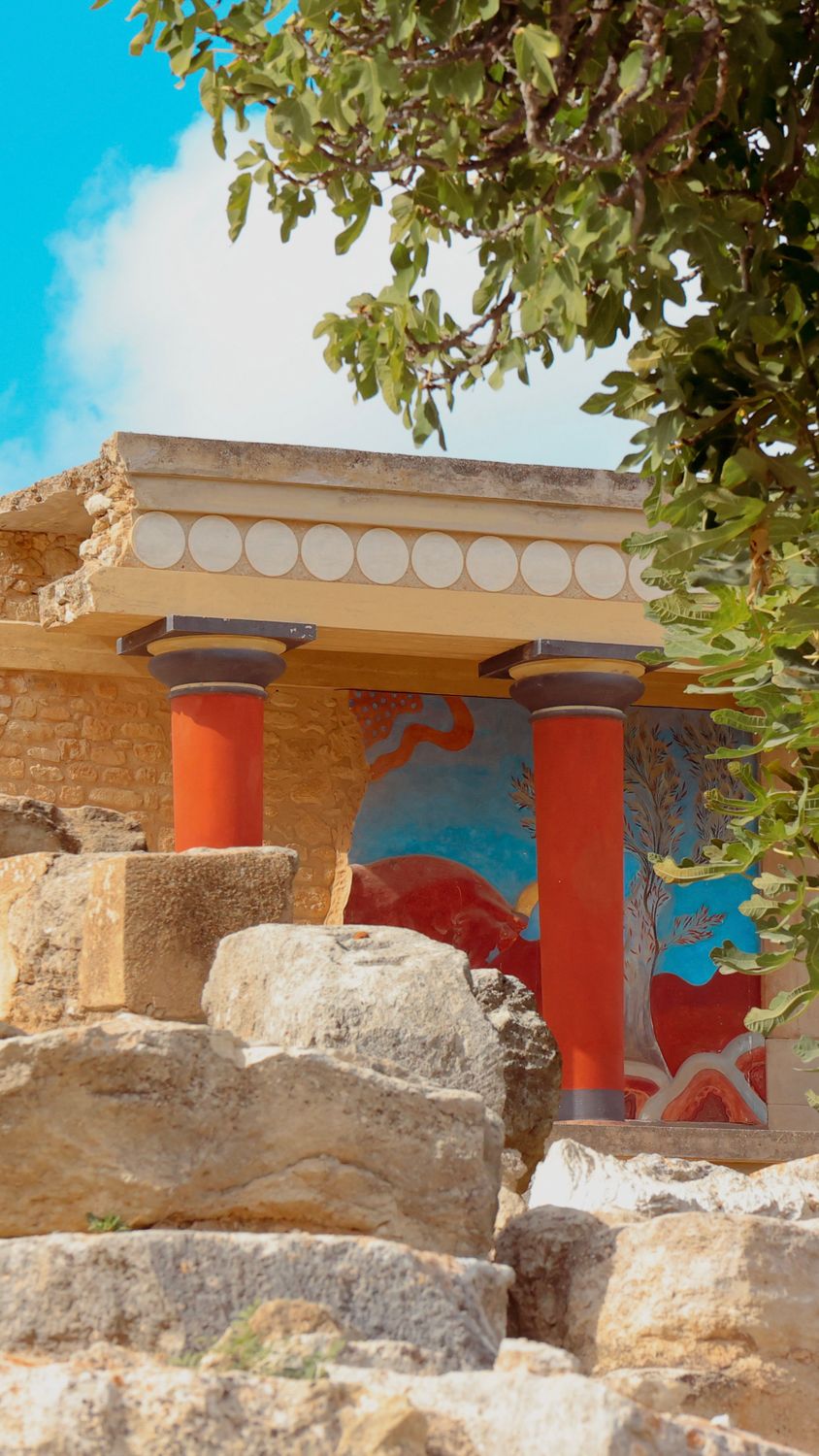
Photo: Martina, Pexels
How Many Days to Spend
Two full days in Heraklion allows a comfortable visit to Knossos, the Archaeological Museum, the old town, and the Central Market. Three days adds time for a day trip to Archanes and the wine villages, or a visit to Phaistos and Matala. Four or five days is appropriate for travellers who want to combine the city with eastern Crete, Rethymno, or several south-coast beaches at a relaxed pace.
For travellers touring all of Crete by car, Heraklion typically functions as a one- or two-night stop rather than a week-long base. Its greatest value lies in the concentration of world-class archaeology and the practical advantage of its transport connections.
Common Mistakes
- Skipping the Archaeological Museum. Many visitors go to Knossos and leave the city without seeing the museum. The original artefacts are in Heraklion, not at the site. Missing the museum means missing the most important part of the story.
- Visiting Knossos at midday in summer. The site has limited shade, and temperatures can exceed 35 degrees Celsius. Arriving when the gates open at 8:00 avoids both the heat and the tour-bus crowds, which typically arrive between 10:00 and 13:00.
- Expecting a scenic coastal town. Heraklion is a working Greek city, not a curated tourist setting. Visitors who arrive expecting the atmosphere of Chania’s Venetian harbour may find the city abrupt. Adjusting expectations helps — the rewards are cultural and culinary rather than purely scenic.
- Driving into the centre without a plan. Parking is genuinely difficult inside the walls, especially in summer. Staying at accommodation with parking or leaving the car outside the walls and walking in is strongly recommended.
- Using Heraklion only as an airport transfer. Many visitors land at Heraklion airport and drive straight to a resort. The city deserves at least one full day, ideally at the end of a Crete trip when the context of Minoan history has accumulated.
Practical Costs
| Item | Approximate cost (2026) |
|---|---|
| Knossos admission | 20 euros full / 10 euros reduced |
| Archaeological Museum | 20 euros full / 10 euros reduced |
| Koules Fortress | 10 euros |
| City bus to Knossos | 1 to 2 euros |
| KTEL bus to Chania | approx 15 to 16 euros |
| KTEL bus to Rethymno | approx 8 euros |
| KTEL bus to Agios Nikolaos | approx 7.70 euros |
| Ferry to Piraeus (standard) | from approx 27.50 euros |
| Ferry to Santorini | from approx 15 euros |
| Car rental (summer, per day) | 50 to 90 euros |
| Taverna meal (per person) | 12 to 25 euros |
| Coffee | 2 to 4 euros |
| Bougatsa | 3 to 5 euros |
Prices are indicative and should be confirmed before travel, particularly for admission fees and transport fares, which may change between seasons.
A Brief History
Heraklion’s layered history is part of what makes it compelling. The site has been continuously inhabited since at least the Neolithic period. During the Bronze Age, the nearby palace of Knossos served as the centre of Europe’s first advanced civilisation. After the decline of the Minoans, the city passed through Greek, Roman, and Byzantine hands before being conquered by Arab forces in the ninth century, who founded the fortified settlement of Chandax.
The Venetians took control in the early thirteenth century and renamed the city Candia. Under Venetian rule, Crete experienced a cultural renaissance that produced El Greco, the epic poem Erotokritos by Vitsentzos Kornaros, and a distinctive school of icon painting that blended Byzantine and Western traditions. The massive fortifications visible today were largely constructed during this period.
The Siege of Candia (1648 to 1669) — one of the longest sieges in recorded history, lasting 21 years — ended with Ottoman conquest. The city remained under Ottoman control until Crete was unified with Greece in 1913. The twentieth century brought further upheaval, including heavy bombing during the Battle of Crete in 1941. Modern Heraklion has grown rapidly since the 1960s, driven by tourism, agriculture, and the university, and is now the fourth-largest city in Greece.
Final Recommendation
Heraklion is not the prettiest city on Crete, and it does not try to be. Its value lies in the density of what it offers: Europe’s most important Bronze Age archaeological site, a museum collection that belongs in any conversation about the ancient Mediterranean, a food market that educates as much as it feeds, Venetian fortifications that outlasted a 21-year siege, and a transport network that connects to the rest of the Aegean. For travellers willing to look past the modern traffic and concrete, Heraklion repays attention with substance that few Greek cities can match.
Information in this guide was researched and verified in July 2026. Admission fees, opening hours, ferry schedules, and bus timetables are subject to change. We recommend confirming time-sensitive details directly with official operators before travelling.
Vivid Greece is an independent travel publication. This article contains no sponsored content or affiliate links.