Delphi sits on the southern slope of Mount Parnassos, roughly 180 kilometres northwest of Athens, in a landscape that makes most archaeological sites look like suburban parking lots. Below, the Pleistos Valley drops away in an ocean of silver-green olive trees, all the way to the Corinthian Gulf. Above, the Phaedriades — the “Shining Rocks” — rise like vertical walls of grey limestone, catching light in ways that genuinely explain why the ancient Greeks believed a god lived here.
This was the centre of the world, or at least the Greeks said so. For roughly a thousand years, rulers, generals, and ordinary citizens came to consult the Oracle of Apollo before making decisions that ranged from founding colonies to choosing a spouse. Today, Delphi is a UNESCO World Heritage Site, one of Greece’s most important archaeological destinations, and the anchor of a wider area that includes the mountain village of Arachova, the coastal town of Galaxidi, and some of the best hiking in Central Greece.
This guide covers the archaeological site, the museum, the surrounding area, and the practical details you need to plan a visit — whether as a day trip from Athens or a longer stay.
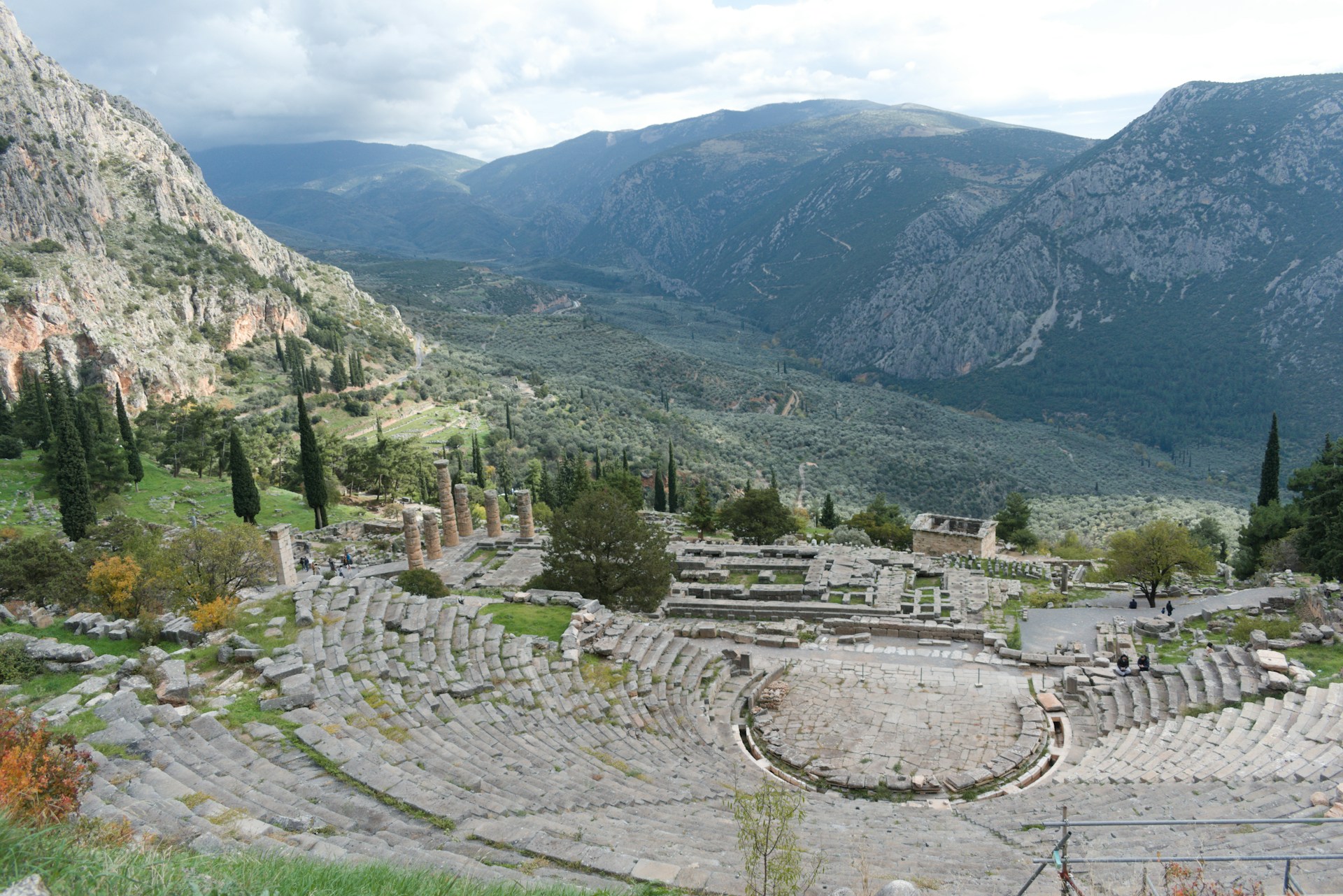
Photo by DiChatz on Unsplash.
| Location | Central Greece (Phocis), 180 km northwest of Athens |
| UNESCO status | World Heritage Site since 1987 |
| Nearest town | Modern Delphi village (400 m from site); Arachova (10 km east) |
| Combined ticket | Approximately €20 full / €10 reduced (site + museum) — confirm before visiting |
| Best for | History and archaeology, day trips from Athens, mountain-and-coast combinations |
| Time needed | 3–4 hours for site + museum; 2–3 days to include surrounding area |
A Brief History of the Navel of the World
The mythology is irresistible. According to ancient Greek tradition, Zeus released two eagles from opposite ends of the earth, and they met directly above Delphi — which therefore became the omphalos, the navel of the world. A stone marker representing this cosmic centre was kept in the Temple of Apollo, and fragments of omphalos stones can still be seen in the museum.
The reality, as far as archaeology can reconstruct it, is nearly as remarkable. Evidence of habitation at Delphi dates to the Mycenaean period, around 1500–1100 BC, but the sanctuary of Apollo developed from roughly the 8th century BC onward. By the 6th century BC, the Oracle — the Pythia, a priestess who delivered prophecies while seated on a tripod over a fissure in the rock — had become the most influential religious authority in the Greek world. City-states consulted her before going to war, founding colonies, or changing their constitutions. The sanctuary accumulated extraordinary wealth through offerings, and the surviving treasuries built by various Greek cities are physical evidence of that competitive piety.
The Oracle’s influence declined during the Roman period and ended when the Emperor Theodosius I ordered the closure of pagan sanctuaries in the late 4th century AD. The site was gradually buried and forgotten, eventually covered by a small village called Kastri. Systematic excavation began in 1892 under the French School of Athens — after the village was relocated — and has continued in various phases since.
The Pythia and the Oracle
The Pythia was chosen from among the local women of Delphi — not from noble families, but from ordinary peasant households. She delivered prophecies from the inner sanctum (adyton) of the Temple of Apollo, reportedly seated on a tripod over a natural chasm from which vapours rose. Modern geological research has identified the presence of ethylene gas in the rock faults beneath the temple, which may explain the trance-like state ancient sources describe. Her pronouncements were famously ambiguous: when King Croesus of Lydia asked whether he should attack Persia, the Oracle replied that he would destroy a great empire — which turned out to be his own.
The Archaeological Site
The main site occupies a steep hillside, and visiting it means walking uphill for most of the route. This is not a flat, neatly manicured ruin — it is a climb through ancient sacred geography, from the entrance near the Roman Agora up through the Sacred Way to the Temple of Apollo, then higher still to the theatre and the stadium at the top. The total elevation gain is around 60 metres, and the path is uneven stone in several places. Comfortable shoes are essential, and in summer you will want water and a hat.
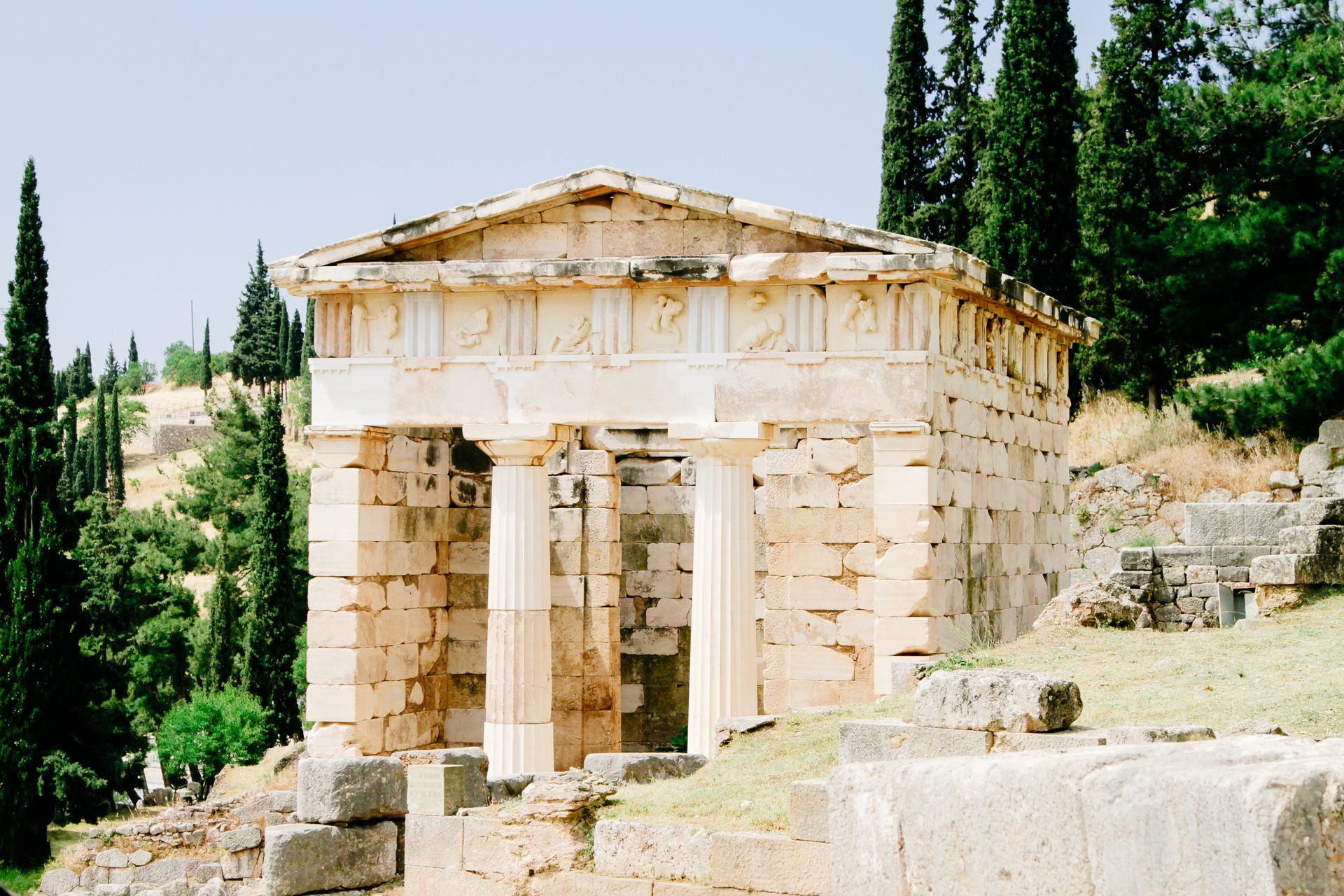
Photo: Jeff Stapleton, Pexels.
The Sacred Way
The visit begins on the Sacred Way, the ancient processional road that pilgrims followed uphill toward the Temple of Apollo. Along the way, you pass the foundations and remains of the treasuries — small temple-like buildings erected by Greek city-states to house their offerings. Most are foundations only, but the Treasury of the Athenians was reconstructed by French archaeologists in the early 20th century and gives a clear sense of scale and proportion. It was built around 490 BC, likely to celebrate the Athenian victory at Marathon, and its metopes (now displayed in the museum) depicted the labours of Heracles and the deeds of Theseus.
The Temple of Apollo
The temple stands on a large terrace supported by a polygonal retaining wall — itself a masterpiece of ancient masonry, with its precisely fitted irregular stones. The visible ruins belong to the fourth temple on this site, built in the 4th century BC after its predecessor was destroyed by earthquake. Six Doric columns have been re-erected and are the most photographed feature of the site. The temple’s inner chamber, the adyton, was where the Pythia delivered her prophecies, though this area is not accessible to visitors. The scale of the terrace and the surviving columns give a reasonable impression of the building’s former presence, even in ruin.
The Theatre and the Stadium
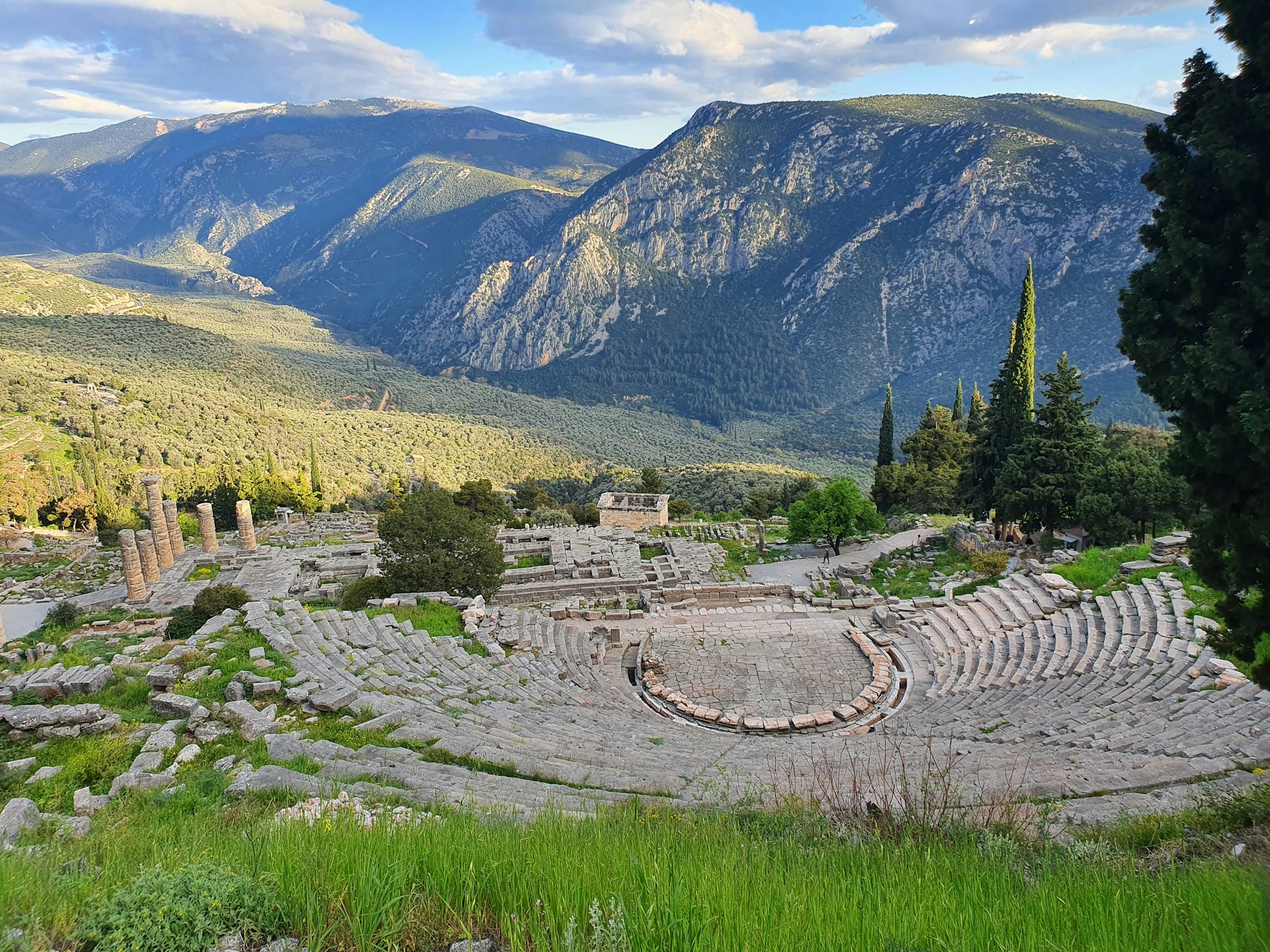
Photo by Pavle Đurakić on Unsplash.
Above the temple, the theatre is remarkably well preserved, with most of its 35 rows of limestone seating intact. Built in the 4th century BC and renovated by the Romans, it could seat approximately 5,000 spectators for musical and dramatic performances during the Pythian Games. The view from the upper rows — across the temple, the valley, and the gulf — is one of the best reasons to visit Delphi in person rather than looking at photographs.
The stadium sits at the highest point of the site, another five to ten minutes of climbing above the theatre. It hosted the athletic competitions of the Pythian Games, which were held every four years and were second in importance only to the Olympic Games. The running track is approximately 178 metres long, and some of the stone seating rows survive. Many visitors skip the stadium, but the walk is worth the effort for the quiet and the views.
The Sanctuary of Athena Pronaia
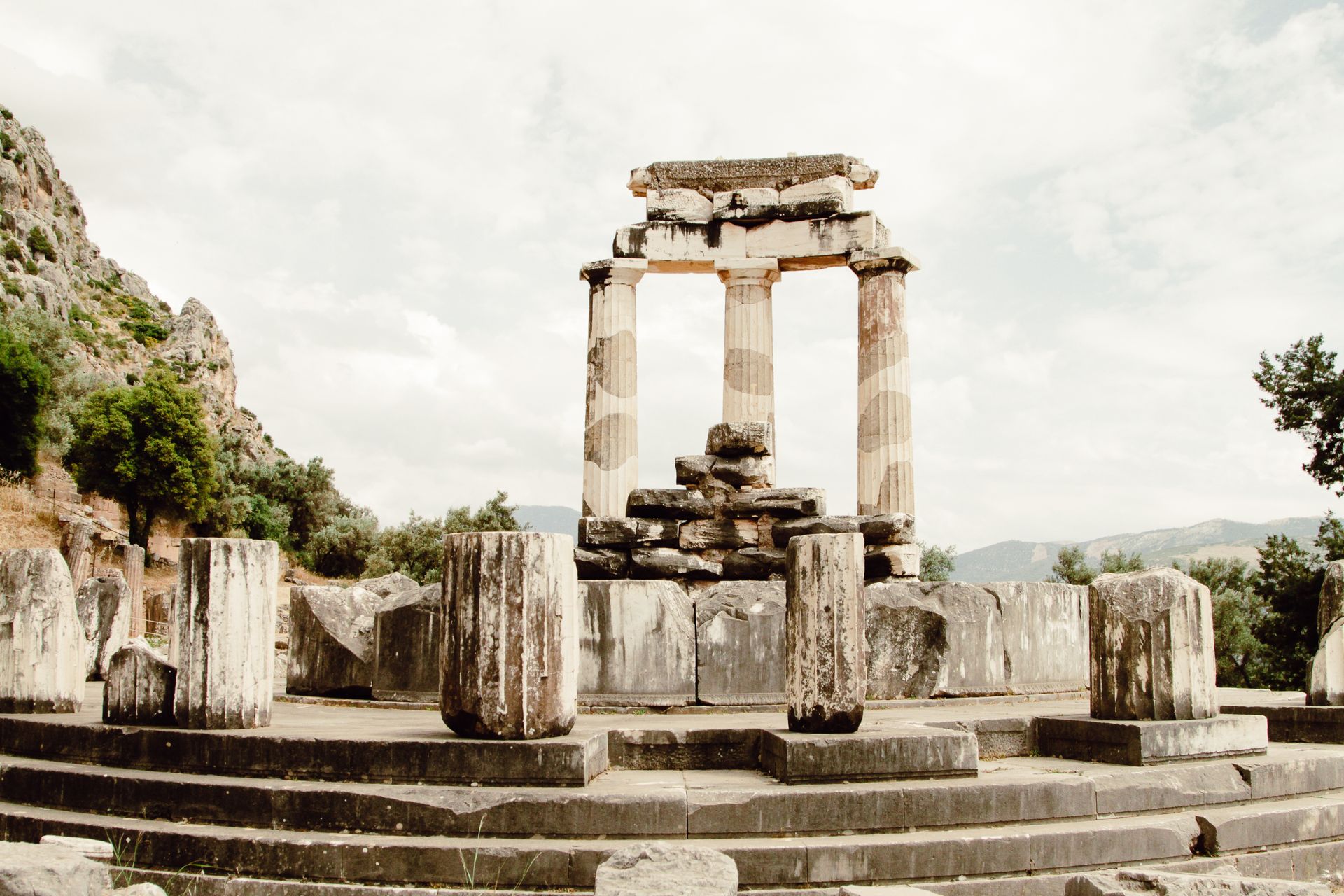
Photo: Jeff Stapleton, Pexels.
A ten-minute walk east along the main road from the museum (or a two-minute drive) brings you to the Sanctuary of Athena Pronaia, a separate sacred precinct that is free to enter. This is where you will find the Tholos, the circular building with three re-erected Doric columns that has become one of the most photographed monuments in Greece. Built between 380 and 370 BC, the Tholos originally had twenty outer columns and ten interior Corinthian half-columns, though its exact purpose remains debated by archaeologists. The gymnasium, visible below the road, was used for athletic training and included a covered running track.
Many organised day trips skip this sanctuary entirely, which is a significant loss. If you are visiting independently, allow twenty to thirty minutes here. The site is smaller and quieter than the main sanctuary, and the Tholos is genuinely worth seeing in person — its proportions are elegant, and the mountain backdrop above makes for exceptionally good photographs, particularly in the late afternoon light.
The Archaeological Museum
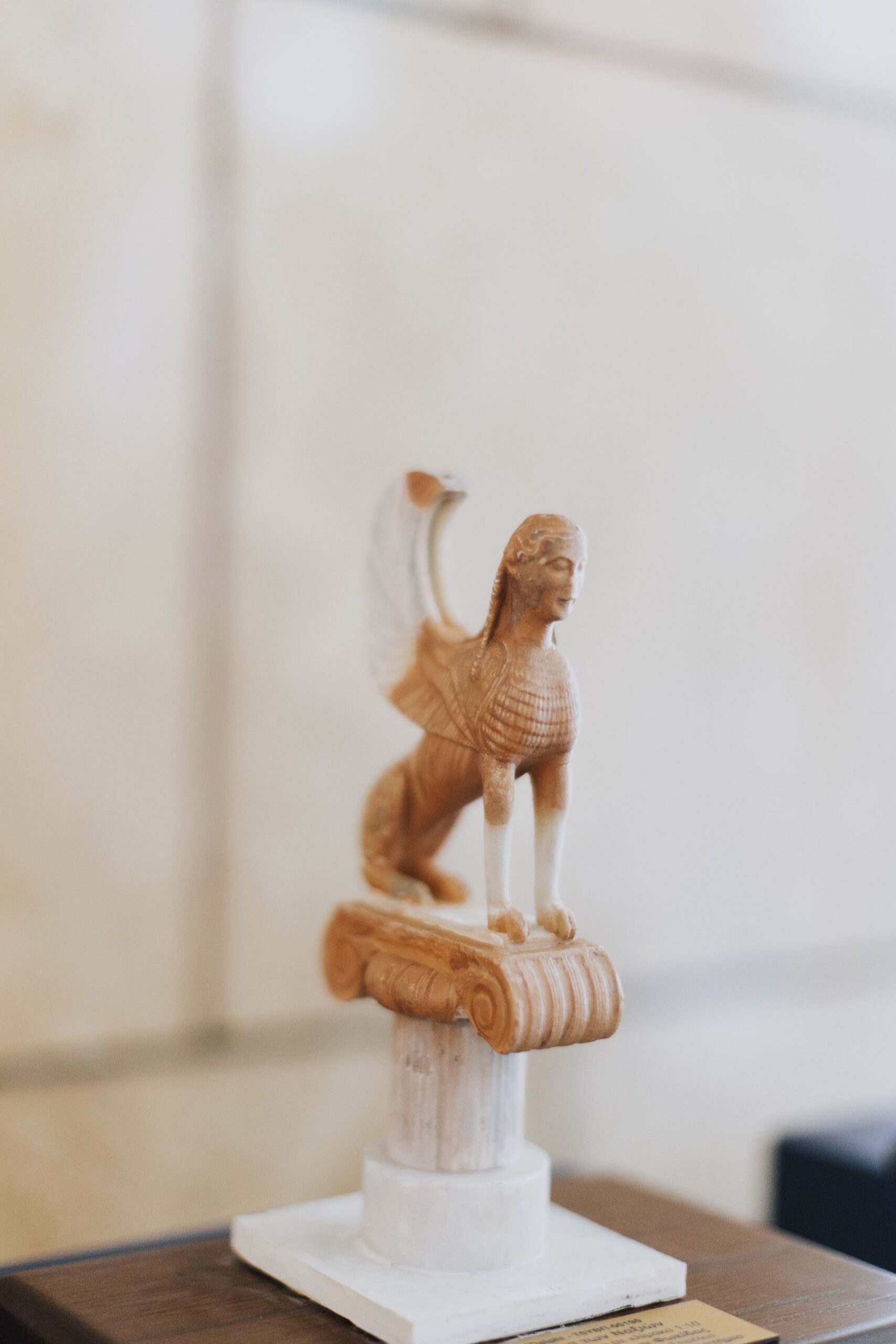
Photo: K, Pexels.
The Delphi Archaeological Museum sits adjacent to the main site and is included in the combined ticket. It is one of the finest archaeological museums in Greece, and it deserves at least an hour — ideally longer. The collection spans from the Mycenaean era to the Greco-Roman period, and the star pieces are genuinely world-class.
The Charioteer of Delphi is the museum’s centrepiece. Cast in bronze around 478–470 BC, this life-size statue of a young chariot driver is one of the best-preserved Classical bronzes in existence. The detail is extraordinary: the folds of his heavy robe, the veins on his bare feet, the inlaid eyes that once shone with glass and onyx, the victory ribbon tied around his head. He was part of a larger monument — including the chariot and horses — commemorating a victory in the Pythian Games, but only the charioteer survived largely intact.
Other highlights include the Sphinx of Naxos, a 2.2-metre marble figure that originally sat atop a column over 10 metres high; the Twin Kouroi (Kleobis and Biton), two life-size Archaic statues from around 580 BC; the carved frieze from the Treasury of Siphnos, with scenes from the Trojan War and the battle between gods and giants; and chryselephantine (gold and ivory) fragments from cult statues that hint at the extraordinary wealth once concentrated here. Fragments of the Delphic Hymns, inscribed in stone, represent the oldest known musical notation in the Western world.
Consider visiting the museum before the archaeological site rather than after. Understanding what the buildings once looked like and what they contained makes the ruins themselves considerably more meaningful.
Best Time to Visit
| Season | Weather | Crowds | Best for |
|---|---|---|---|
| April – May | Mild, wildflowers in bloom, occasional rain | Moderate | Photography, comfortable walking, spring colour |
| June | Warm, dry, long daylight | Busy | Combining with coast, longer evenings |
| July – August | Hot (up to 34°C), dry, strong sun | Very busy, tour groups peak | Early morning visits only; combine with Arachova or coast |
| September – October | Warm, pleasant, morning haze common | Declining | Comfortable sightseeing, autumn light, fewer groups |
| November – March | Cool to cold, possible rain or snow at altitude | Low | Quiet visits, reduced hours, combined with Arachova ski season |
The best months for visiting Delphi are April, May, September, and October. Temperatures are comfortable for the uphill walk through the site, the light is excellent for photographs, and the crowds — particularly the large organised tour groups that arrive from Athens around mid-morning — are smaller than in summer. If you visit in spring, the olive groves and mountainside are green, and wildflowers grow between the ancient stones in a way that makes the site feel alive rather than purely monumental.
July and August are manageable only if you arrive early, ideally when the gates open at 08:00. By 10:00, the site fills with tour buses, and the heat on the exposed hillside becomes genuinely unpleasant. If you are visiting in high summer, plan to be at the site by opening time, move to the air-conditioned museum by late morning, and save the afternoon for Arachova or the coast. For more on why early autumn is an excellent time for mainland Greece, see our guide to September in Greece.
Winter visits have their own appeal. The site is peaceful, often shrouded in atmospheric mountain mist, and you may have the theatre and stadium largely to yourself. Note that winter opening hours are significantly shorter (08:30–15:30), and some services in the modern town of Delphi may be limited. Arachova, however, comes alive in winter thanks to the Parnassos Ski Centre.
How to Get There
By car from Athens
The drive from Athens to Delphi takes approximately 2 to 2.5 hours via the E75 motorway northward, then west through Livadeia toward Arachova and Delphi. The total distance is roughly 180 kilometres. The route is straightforward, well-signposted, and almost entirely on good roads. The final approach through the olive groves below Arachova is particularly scenic, and arriving by car gives you the flexibility to visit the Sanctuary of Athena Pronaia, stop at Arachova, and reach Galaxidi or Itea on the coast — none of which are easily managed on a bus day trip.
There is no dedicated parking lot at the main archaeological site or museum. Street parking is available along the main road in modern Delphi village, and a parking area exists near the Sanctuary of Athena Pronaia. In summer, spaces fill quickly after 09:00, so arriving early helps here too. Parking is free but limited.
By bus from Athens
KTEL buses to Delphi depart from the Liossion Terminal (Terminal B) in Athens. At the time of writing, departures run several times daily on weekdays (typically around 05:30, 11:00, 16:00, and 18:30) with fewer services on weekends. The journey takes approximately 2.5 to 3 hours, and a one-way ticket costs around €16–17. Buses stop at the Delphi bus terminal at the edge of the village, a short walk from the museum and site. Some services also stop directly at the museum.
To reach Liossion Terminal from central Athens, take the green metro line to Kato Patissia station and walk approximately one kilometre, or take a taxi. From Athens airport, the X93 express bus connects directly to the KTEL terminals. Always check the current timetable on the KTEL Fokidas website before travelling, as schedules may change seasonally.
Organised day trips
Numerous guided day trips run from Athens to Delphi, typically departing early morning and returning by evening. Most include the archaeological site, museum, and a stop in Arachova for lunch. They are convenient but inflexible: you will spend significant time on the bus, arrive when tour groups peak, and have limited time at the site itself. If you want to visit the Sanctuary of Athena Pronaia, hike above the site, or explore Galaxidi, independent travel is considerably better.
How Long to Stay
A day trip from Athens is feasible and common. If you leave Athens by 08:00, you can reach Delphi by 10:30, spend three to four hours at the site and museum, have lunch in Delphi or Arachova, and return to Athens by evening. This works, but it is tiring and leaves no room for the surrounding area.
Two nights is a better allocation. Stay in either Arachova or modern Delphi, visit the archaeological site and museum on one day (arriving early to beat the groups), and use the second day for some combination of the Sanctuary of Athena Pronaia, Arachova, Galaxidi, or a walk on the Parnassos trails. Three nights make sense if you want to add Osios Loukas Monastery or serious hiking.
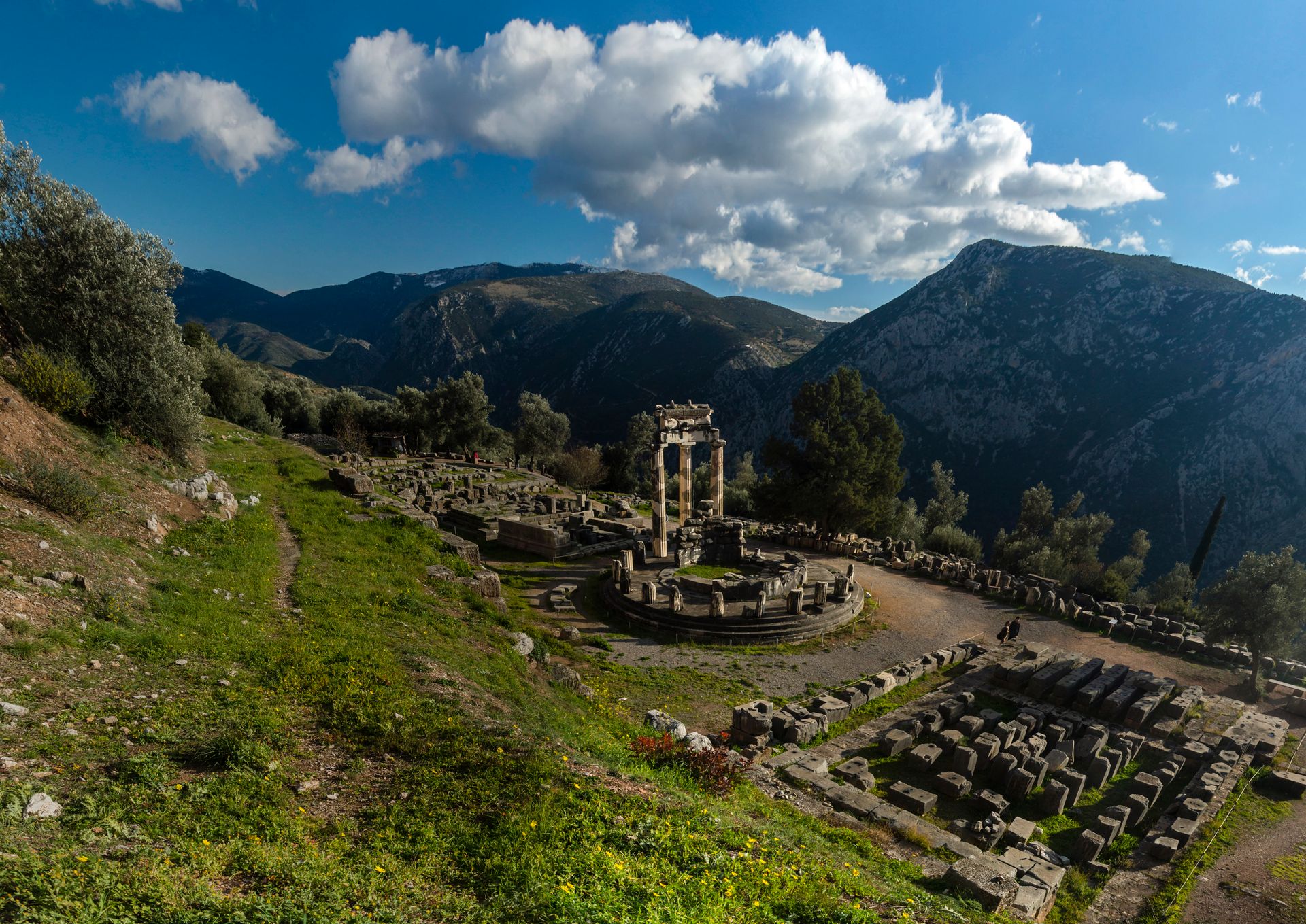
Photo: Lachcim Kejarko, Pexels.
Where to Base Yourself
Three areas make practical bases for a Delphi visit, each with a different character. No single choice is wrong — it depends on what you want from the trip beyond the archaeological site.
Modern Delphi village
The small village of modern Delphi sits directly above the archaeological site, essentially one main street with a handful of side roads, lined with guesthouses and tavernas. The advantage is proximity: you can walk to the site and museum in minutes, and arrive early without needing a car. The main street has sweeping views across the valley. It is quiet, practical, and unflashy — a solid choice for visitors whose primary interest is the archaeology.
Arachova
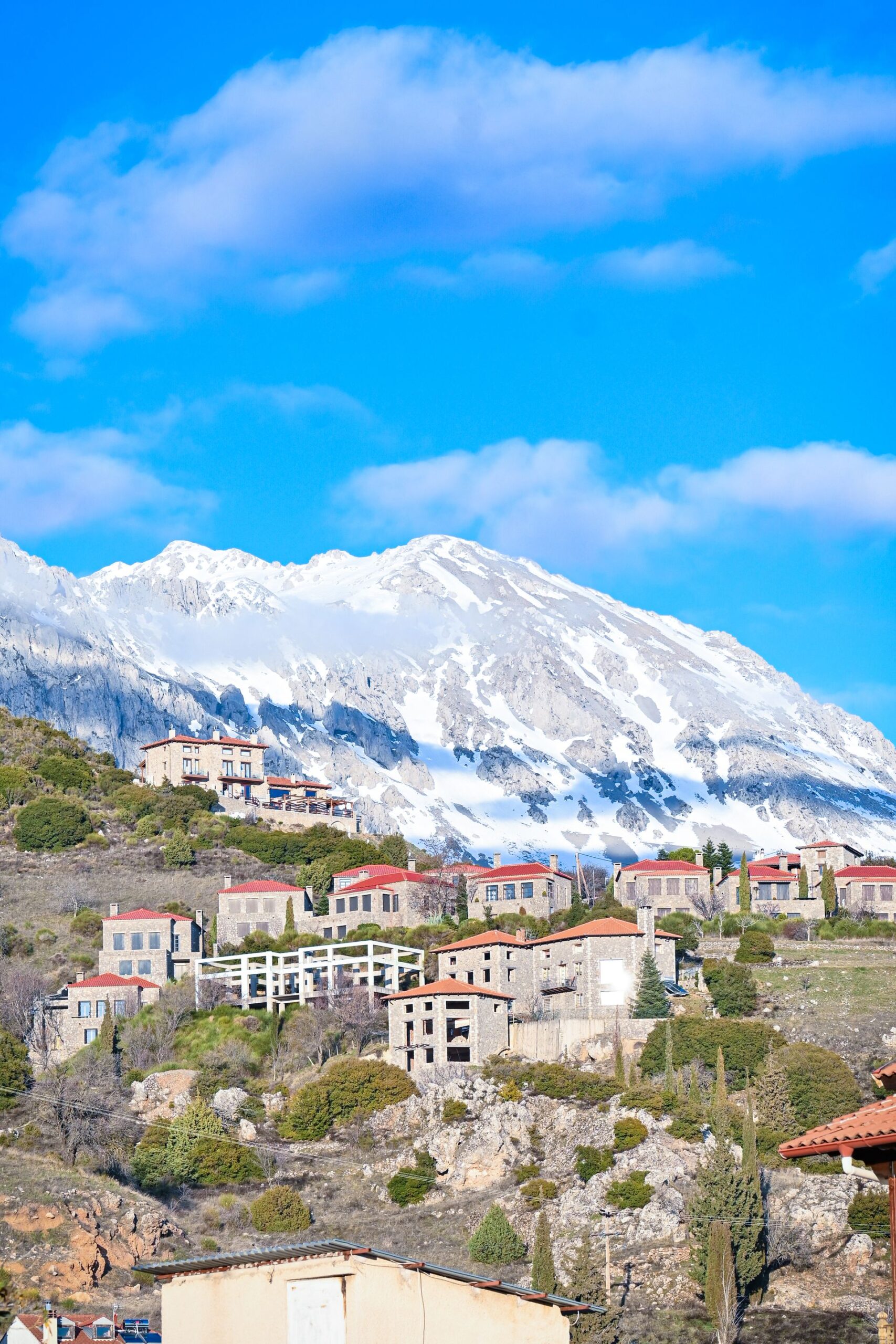
Photo: Ala J Graczyk, Pexels.
Arachova is a different proposition entirely. This mountain village sits at approximately 960 metres on the slopes of Parnassos, about 10 kilometres east of Delphi — roughly a 15-minute drive. It has a year-round population of around 3,500 and a reputation as one of Greece’s most popular winter destinations thanks to the nearby Parnassos Ski Centre. Stone-built houses with red-tiled roofs line its steep streets, a prominent clock tower marks the village centre, and the commercial street has a density of cafes and shops that feels surprisingly metropolitan for a village in the mountains of Central Greece.
In terms of food, atmosphere, and evening activity, Arachova has more to offer than Delphi village, particularly if you are staying for two or more nights. The tavernas along the main street and the side alleys serve hearty mountain food — grilled meats, local cheeses, handmade pasta — and several remain open late. The downside is that on winter weekends and some summer evenings, Arachova attracts weekend crowds from Athens and can feel busier than you might expect. Midweek stays are generally quieter. If you do not have a car, getting between Arachova and Delphi requires a short taxi or local bus ride.
Galaxidi
For something completely different, Galaxidi is a small maritime town on the Corinthian Gulf, roughly 35 kilometres southwest of Delphi (about 45 minutes by car, descending through the olive valley). It was a significant shipbuilding centre in the 19th century, and the legacy is visible in the neoclassical sea captains’ houses, two small harbours, and a maritime museum. Galaxidi is quieter, slower, and more coastal in atmosphere — a good choice if you want to combine your Delphi visit with sea air, swimming, and long harbour-front dinners rather than mountain village energy.
The town has a handful of bakeries, fish tavernas around the older harbour (called Hirolakas, or “Widows’ Port,” in tribute to the wives who waited for sailors who never returned), and pine-forested trails on the hills above. It suits couples looking for calm, readers who want to sit on a waterfront and do nothing productive, and anyone who has already spent several days in more obviously touristic Greek destinations. The drawback is distance: you will need a car to visit Delphi comfortably from here.
Beyond the Site: What Else to See
Osios Loukas Monastery
About 35 kilometres southeast of Delphi, near the town of Distomo, the Monastery of Osios Loukas is a UNESCO World Heritage Site and one of the finest examples of Middle Byzantine architecture in Greece. Its 11th-century mosaics are extraordinary — gold-ground figures that rank alongside the best surviving Byzantine art anywhere. The monastery complex includes the main Katholikon church, the smaller Church of the Virgin Mary, a crypt with centuries-old frescoes, and a small museum. Admission to the monastery is free, and visiting hours are generally 09:00 to 17:00 (with some seasonal variation). It pairs naturally with a drive to or from Delphi if you are travelling by car.
Osios Loukas was inscribed as a UNESCO World Heritage Site in 1990, alongside two other Middle Byzantine monasteries: Daphni in Attica and Nea Moni on Chios. If you have any interest in Byzantine history or art, this is a detour well worth making. Allow one to two hours. Dress modestly — shoulders and knees covered — as it is an active monastery.
Mount Parnassos and hiking
Parnassos National Park offers genuine mountain walking above the archaeological zone. The most popular hike from Delphi leads to the Corycian Cave, an ancient sanctuary of Pan and the nymphs at approximately 1,360 metres altitude. The trail follows part of the E4 European Long-Distance Path, beginning at the upper edge of Delphi village and climbing steeply through forest. The round trip is approximately 9–10 kilometres with around 870 metres of elevation gain — a moderately demanding half-day hike that takes roughly 3.5 to 4 hours up and 2.5 to 3 hours down. The cave itself is large, atmospheric, and has yielded archaeological evidence of worship stretching back to Neolithic times.
An easier walk is the ancient footpath from Delphi down to the village of Chrisso, descending through olive groves with views of the Corinthian Gulf. This is roughly two hours round trip and gives a sense of how pilgrims once approached the sanctuary from the coast.
For hikers with more time and ambition, the summit of Parnassos — Liakoura, at 2,457 metres, the highest point — is accessible from various trailheads on the mountain. These routes require proper preparation, good boots, and water, and are best attempted with a map or a local guide. The mountain is also home to Greece’s largest ski centre, which operates during winter months.
Itea and the coast
Itea is a small coastal town directly below Delphi on the Corinthian Gulf, approximately 15 kilometres by road. It has a long waterfront promenade, a decent beach fringed by trees, and a handful of seaside tavernas — a practical spot for a swim and lunch if you are visiting Delphi in summer and want to cool off after the site. It was the ancient port that served Delphi, and the road connecting them runs through one of the largest olive groves in Greece, containing an estimated million trees. The drive down is straightforward but winding.
Combining Delphi with Other Mainland Destinations
Delphi pairs well with several other mainland Greece destinations. Meteora, roughly 230 kilometres to the north, is a natural companion — many travellers combine the two in a multi-day mainland loop from Athens. Nafplio and the Argolid (Epidaurus, Mycenae) work as a southern extension of the same trip. If you are heading north, the Pelion peninsula offers a dramatically different landscape of forested mountains and Aegean beaches, and Thessaloniki is a rewarding city destination with strong Byzantine and Ottoman heritage.
Getting Around the Delphi Area
A rental car is the most practical way to explore the wider Delphi area. The archaeological site and museum are walkable from Delphi village, but reaching Arachova, Galaxidi, Osios Loukas, and the Parnassos trailheads without a car ranges from inconvenient to impossible. Roads in the area are generally well maintained, though the descent to Itea involves tight hairpin bends, and mountain roads above Arachova can be narrow.
Without a car, you can manage a satisfactory visit by staying in Delphi village (for walking proximity to the site) or Arachova (with a short taxi or local bus connection). The KTEL bus connects Athens and Delphi directly, and there are occasional local bus services between Delphi and Arachova, though these are limited and should not be relied upon without checking schedules. Galaxidi and Osios Loukas are effectively inaccessible without a car or a guided tour.
Practical Tips
- Arrive early. The archaeological site opens at 08:00 in summer (08:30 in winter). Arriving at opening time lets you walk the Sacred Way and reach the Temple of Apollo before the tour buses arrive around 10:00. The difference in experience is substantial.
- Wear proper shoes. The paths are uneven ancient stone, and the climb to the stadium is steep. Sandals and smooth-soled shoes are a poor choice.
- Bring water and sun protection. There is very little shade on the main site. In summer, the heat on the exposed hillside is intense by late morning.
- Visit the museum first if you prefer context. Seeing the Charioteer, the treasury sculptures, and the architectural models before walking the site makes the ruins more intelligible.
- Do not skip the Sanctuary of Athena Pronaia. It is free, uncrowded, and contains the Tholos — arguably the single most elegant structure at Delphi.
- Check opening hours before visiting. Hours vary by season and are adjusted gradually from September through October as daylight shortens. Confirm with the official Delphi museum website or the Greek Ministry of Culture before your visit.
- Free admission days exist. These include 6 March, 18 April, 18 May, the last weekend of September, 28 October, and the first and third Sunday of each month from November through March. EU citizens under 25 enter free year-round.
- Accessibility is limited. The site occupies a steep mountainside with uneven stone paths. Wheelchair access is partial at best, and the upper areas (theatre, stadium) involve significant climbing. The museum is more accessible than the outdoor site.
Who Delphi Suits — and Who Might Prefer Somewhere Else
Delphi is one of the most rewarding archaeological experiences in Greece, but it suits some travellers more than others.
It is an excellent choice for anyone with a genuine interest in ancient Greek history, archaeology, or mythology. The combination of the site, the museum, and the dramatic physical setting creates something that photographs and guidebooks cannot fully communicate — the sense of a place that was genuinely important for a very long time, in a landscape that explains why.
It also works well for travellers who want to see mainland Greece beyond Athens, particularly when combined with Meteora, the Peloponnese, or the mountain villages. Couples, solo travellers, and older travellers tend to appreciate Delphi more than families with young children, simply because the visit involves reading, looking, and walking uphill rather than swimming or playing.
If your priority is beaches, nightlife, or island-style relaxation, Delphi is not the right destination. If you have limited mobility, the steep terrain of the site may be frustrating, though the museum alone is still worthwhile. And if you are visiting Greece for only a few days and must choose between Delphi and the islands, the choice depends entirely on whether your primary interest is history or sea — both are valid, but they satisfy different needs.
Suggested Two-Day Itinerary
Day 1: The archaeological site and museum
Drive from Athens (or take the early KTEL bus) and arrive by mid-morning. Visit the archaeological site first, walking the Sacred Way to the Temple of Apollo, continuing up to the theatre and stadium. Allow two to two and a half hours. Move to the museum for at least an hour. Have lunch in Delphi village or drive the ten minutes to Arachova for a more atmospheric meal. In the afternoon, visit the Sanctuary of Athena Pronaia (free, 20–30 minutes). If energy and light remain, walk the old footpath toward Chrisso through the olive groves. Stay overnight in Arachova or Delphi.
Day 2: The wider area
Spend the morning in Arachova, walking the stone-built streets, exploring the clock tower and upper village, and having a Greek mountain breakfast. Then choose your afternoon: drive down to Galaxidi for a harbour lunch and a swim at Itea, or drive to the Monastery of Osios Loukas for its Byzantine mosaics. Alternatively, hike part of the E4 trail toward the Corycian Cave — allow at least half a day for this. Return to Athens in the late afternoon or evening.
This article was researched and verified as of July 2026. Travel details — including transport schedules, ticket prices, and opening hours — may change. We recommend confirming time-sensitive information with official sources before travelling. Vivid Greece is an independent publication and was not paid or sponsored by any destination, business, or tourism authority mentioned in this article.