Leros Travel Guide 2026: Art Deco, War Tunnels and the Deepest Harbour in the Aegean
There is an island in the south-eastern Aegean where you step off a ferry and find yourself standing in what looks like a small Italian town from the 1930s, complete with wide eucalyptus-lined boulevards, a restored Art Deco cinema and a clock tower that would look entirely at home in Asmara or Tirana. This is Lakki, the main port of Leros, and it is unlike anything else you will encounter in the Greek islands. Walk ten minutes inland and you are back among whitewashed chapels, fishing boats drawn up on pebble beaches and the familiar scent of oregano drying on a doorstep. The dissonance is deliberate, historical, and deeply strange — which is precisely what makes Leros worth the trip.
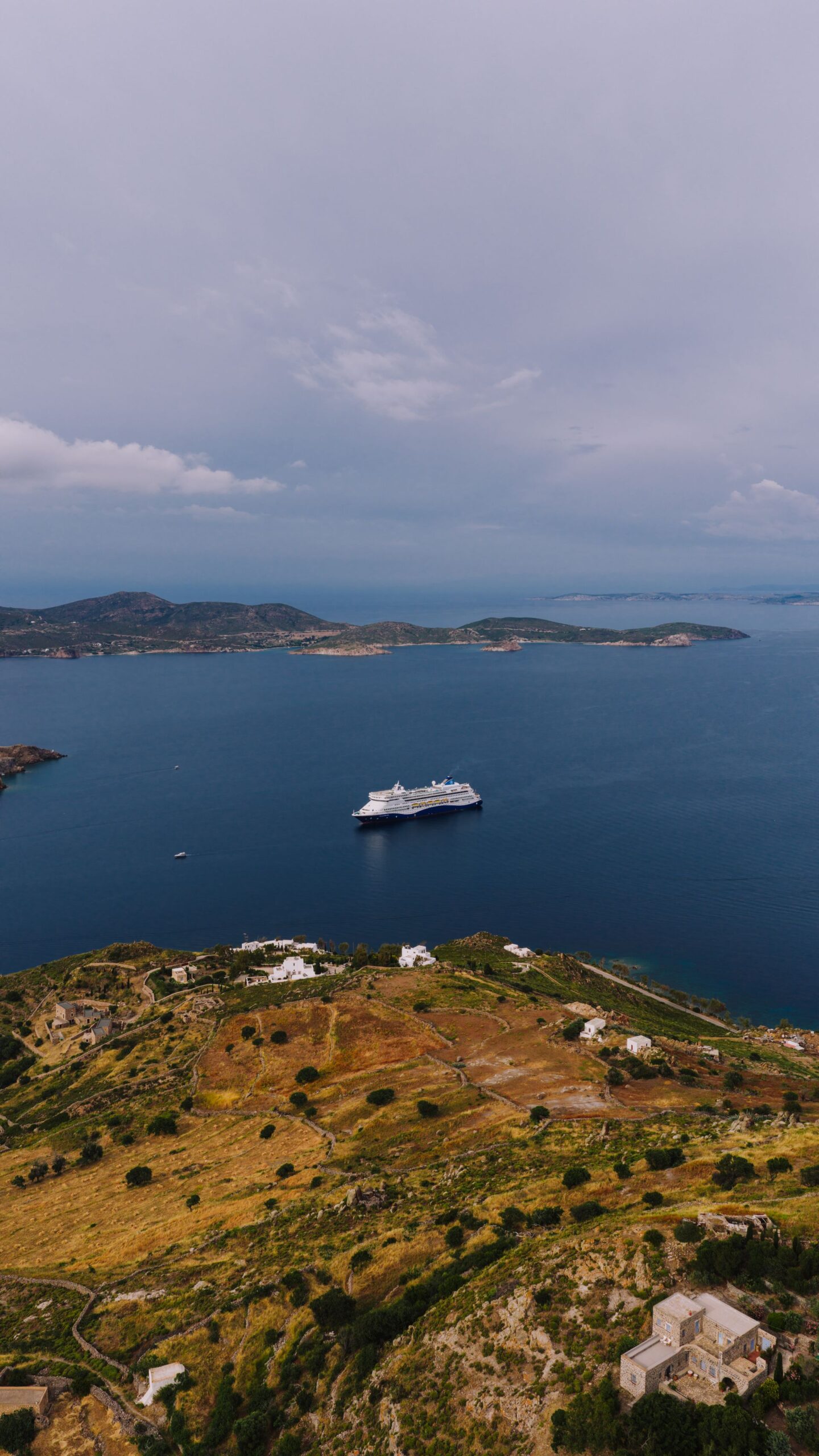
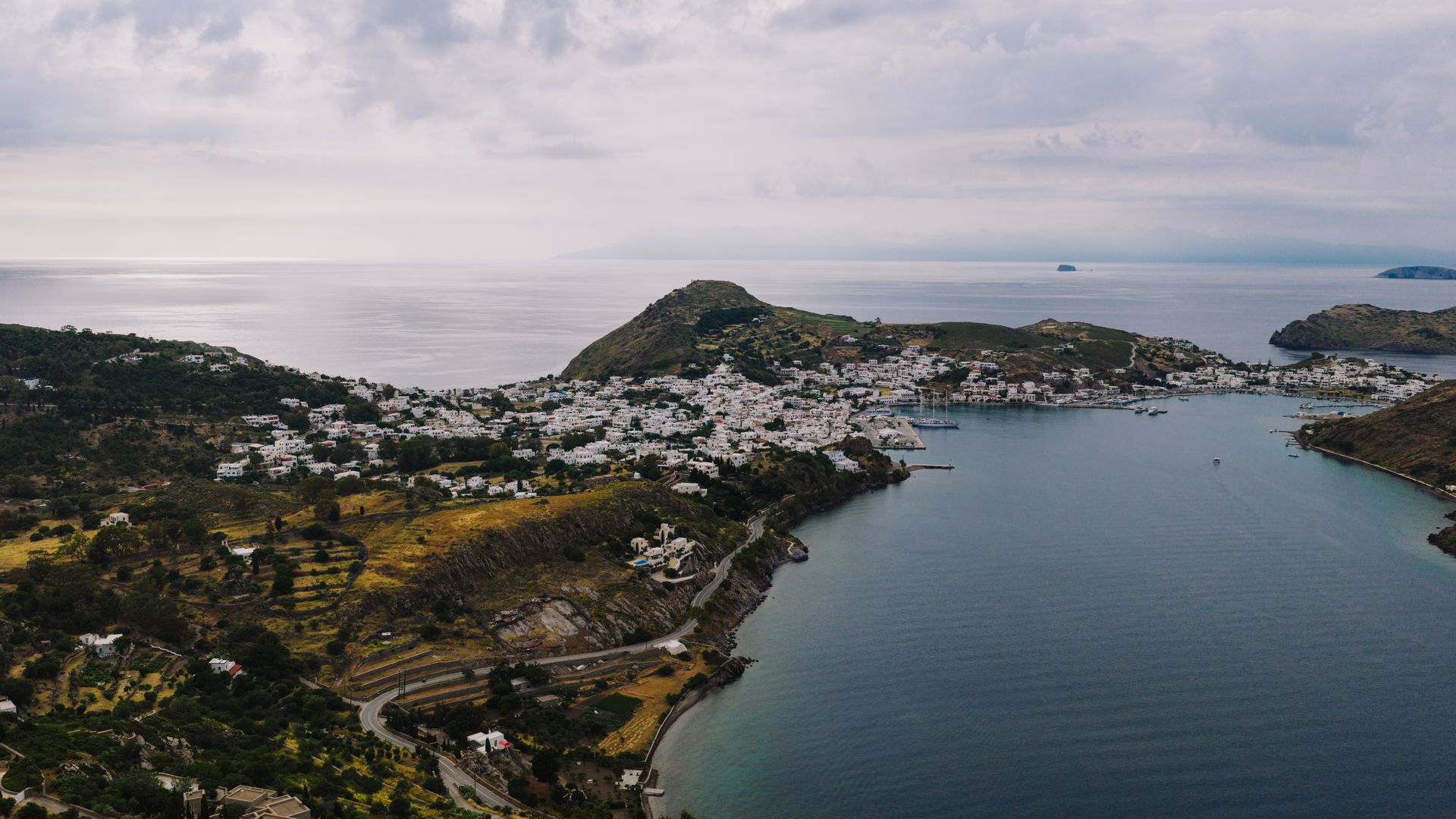
Leros sits between Patmos and Kalymnos in the Dodecanese, covering 54 square kilometres of hilly terrain that bays have carved into a shape locals compare to a butterfly. With around 8,000 permanent residents and an economy that runs on public services rather than tourism, the island has a self-sufficiency that most Greek islands lost decades ago. It has three hospitals, two high schools and a working port. Visitors are welcome, but nobody is performing for them.
“Lakki should be classified as a monument of national significance. It is a rare example of a town created from scratch, adhering to the same style and following the same plan by the same architects from beginning to end.”
— Anastasia Papaioannou, architect and Lakki restoration specialist
Why Leros Feels Different
Most Dodecanese islands trade on one thing: beaches, or ancient ruins, or nightlife. Leros trades on the fact that nothing about it quite adds up. The port is Italian modernist. The hilltop castle is Byzantine. The tunnels running through the headlands are from the Second World War. The fishing villages could be from any century at all, and the octopus drying on lines outside the tavernas is from this morning.
The island also carries a history that few Greek travel guides discuss openly. After the Second World War, Leros became a place of confinement — first for the children of political dissidents sent to re-education schools in the late 1940s, then for psychiatric patients who were deported here from overcrowded mainland asylums from 1957 onwards. The conditions in the Leros psychiatric institution became an international scandal in the 1980s, and the island carried the resulting stigma for years. The reforms that followed (known as Leros I and Leros II) were largely successful, and today the former barracks have been repurposed or left to the goats and the weather. But the history is there, visible in abandoned buildings on hillsides, and it gives the island an undertone that you do not find on Mykonos.
None of this is to say Leros is grim or difficult. It is warm, quiet and extraordinarily generous with its light. The point is that it rewards a traveller who wants more than a sunbed and a cocktail — though it offers those too, and the cocktails are not bad.
History in Layers — From Artemis to the Axis
According to myth, Leros was the private hunting ground of Artemis, goddess of the chase. The ancient poet Demodocus, who lived on the island in the 6th century BC, was sharp-tongued enough to provoke Aristotle into quoting him centuries later. The historian Pherecydes of Leros, a generation after Demodocus, wrote some of the earliest prose narratives in Greek — a fact that would surprise most visitors, who arrive expecting beaches and leave having accidentally learned something.
The island’s strategic value — a deeply indented coastline offering natural harbours with narrow, defensible entrances — has attracted every empire that passed through the Aegean. The Byzantines built the first castle on the hill above Panteli before the end of the 11th century. In 1087, Emperor Alexios I Komnenos granted Leros to the monk Christodoulos, founder of the great monastery on nearby Patmos. The Knights of St John reinforced the fortifications in the 15th century, adding the outer walls and a massive pentagonal bastion that survives today. After the fall of Rhodes in 1522, the Ottomans took the island and held it for nearly four centuries.
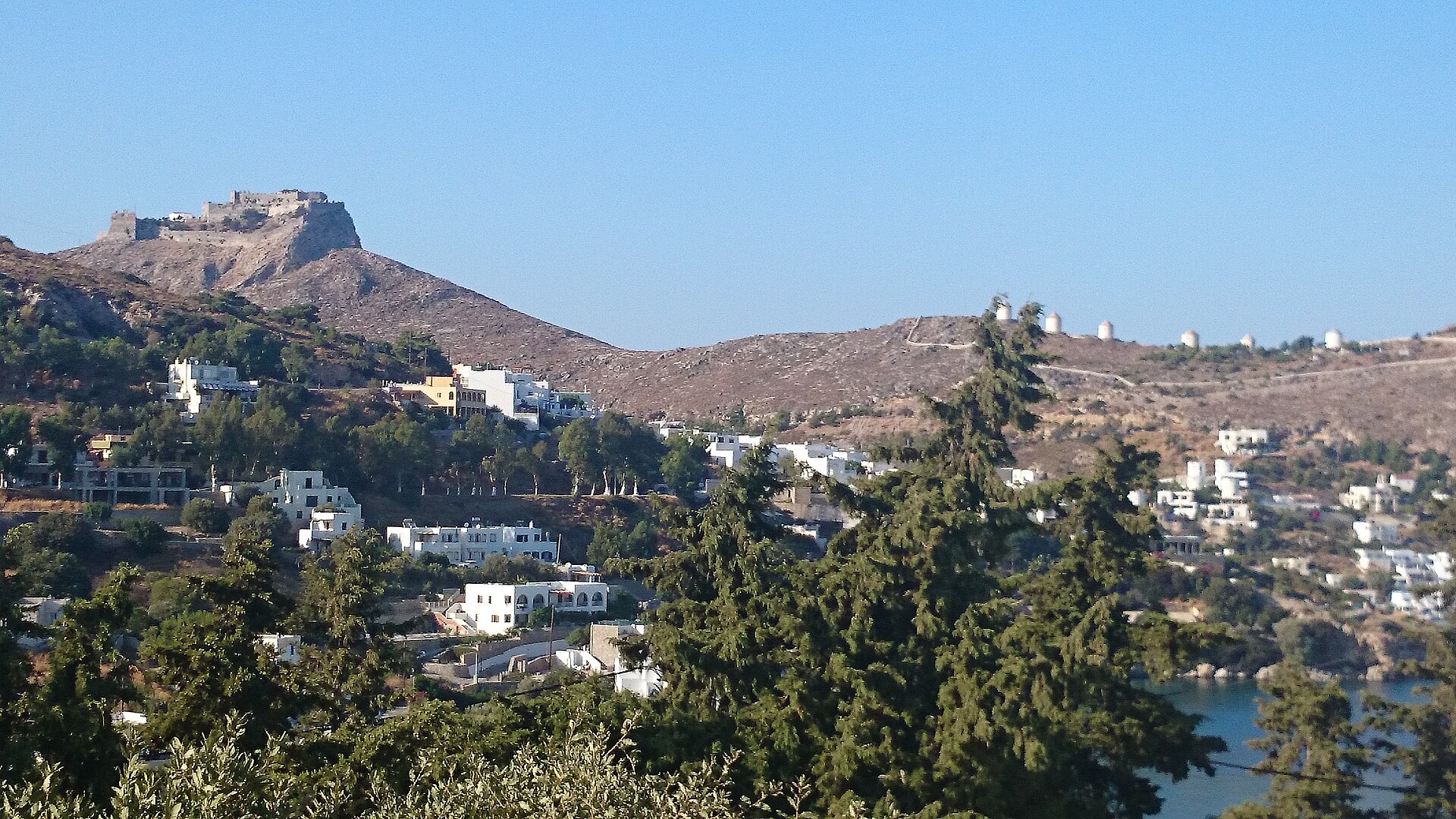
Then came the Italians. In 1912, during the Italo-Turkish War, Italy seized the Dodecanese. What began as a liberation from Ottoman rule became, under Mussolini, a full colonial occupation. The Italians recognised Leros’s enormous natural harbour — Lakki Bay, the largest in the Aegean — and transformed the island into a fortified naval and seaplane base. Mussolini reportedly called it “the Corregidor of the Mediterranean,” and the Italian military planners who built the town of Lakki (then called Portolago) turned their assignment into one of the most ambitious urban experiments of the 20th century.
The Battle of Leros, 1943
The island’s most dramatic chapter came in the autumn of 1943. After Italy signed the armistice with the Allies on 8 September, the Italian garrison on Leros was reinforced by British troops — elements of the 234th Infantry Brigade, including the Royal Irish Fusiliers, the Buffs and the King’s Own Royal Regiment, alongside Special Boat Squadron and Long Range Desert Group detachments. The Germans, determined to hold the Dodecanese, launched Operation Taifun on 12 November. Paratroopers dropped onto the island while landing craft hit the beaches. Four days of close-quarters fighting across Leros’s hills and bays ended with the capitulation of the Allied garrison on 16 November. Over 3,000 British and more than 5,000 Italian troops were captured. The Greek destroyer Vasilissa Olga, one of the most decorated ships in the Hellenic Navy, had already been sunk by German bombers in Lakki harbour on 26 September, with the loss of 72 crew.
The Battle of Leros was one of the last significant German victories of the war. Today, the island holds the second-highest concentration of Second World War shipwrecks in Europe after Normandy — a fact that draws serious divers from around the world. The Deposito Di Guerra museum and the Tunnel Museum at Merikia, housed in an authentic wartime tunnel, preserve the physical memory of those weeks in remarkable detail. If you have even a passing interest in 20th-century history, this alone justifies the ferry ticket. For more on the wider Dodecanese, our Karpathos guide covers another island where the past has a tangible presence.
Lakki — A 1930s Italian Town Dropped into the Aegean
If you arrive by conventional ferry, Lakki is where you land, and the first impression is genuinely disorienting. The buildings that line the harbour and the streets behind it belong to a style known as razionalismo — Italian rationalist architecture, a movement that blended modernist geometry with the curves of Art Deco and the severity of Fascist monumentalism. The architects Rodolfo Petracco and Armando Bernabiti, working in the 1930s, drew inspiration from the metaphysical paintings of Giorgio de Chirico, the geometry of ancient temples and the optimistic sweep of Art Deco. The result is a planned town where the lines of every building are clean and curved, the boulevards are wide enough for a military parade, and the overall effect is somewhere between a film set and a dream.
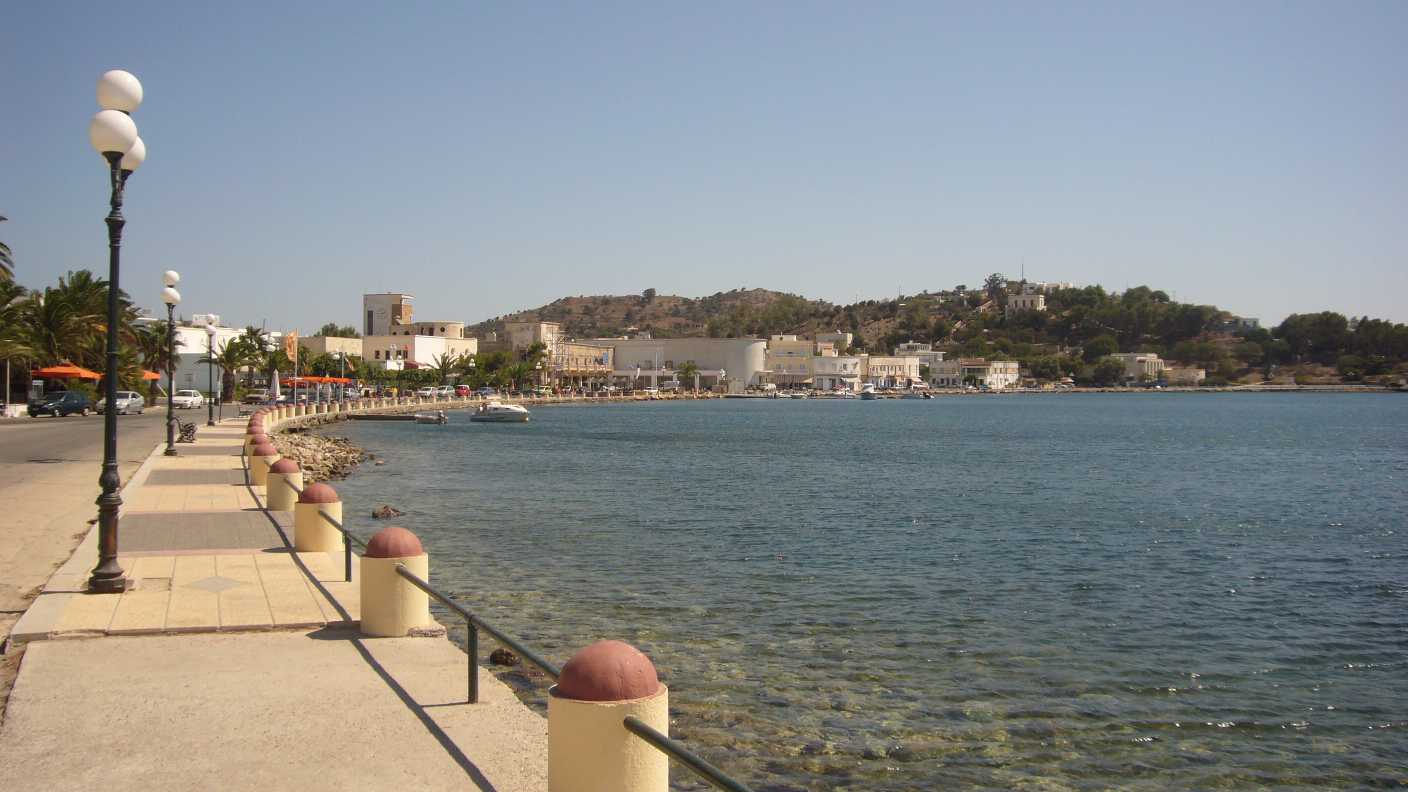
Lakki is the only intact example of Italian rationalist urban planning outside Italy itself — a distinction it shares, in a roundabout way, with Asmara in Eritrea, which is now a UNESCO World Heritage Site. The theatre and cinema building has been restored and hosts an annual Italian film festival. The public market with its clock tower, the naval barracks with their Moorish-rationalist flourishes, and the scattered residential blocks all survive in various states of repair. Some buildings have been lovingly maintained; others are crumbling photogenically behind their eucalyptus screens. An architect named Anastasia Papaioannou has argued for years that the entire town deserves monument-of-national-significance status. Walking through it on a quiet afternoon, when the only sound is the wind through the pines and a motorbike somewhere on the next boulevard, it is difficult to disagree.
Beyond Lakki itself, the Italian military left buildings scattered across every hillside on the island — radio stations, ammunition stores, officer quarters — most of them abandoned and slowly surrendering to vegetation and goats. Some contain remnants of painted interiors, faded murals left behind by conscripts who never expected anyone to see their work again. These are not on any tourist map, but ask a local with a four-wheel drive and a free afternoon, and you may find yourself standing in a roofless room on a ridgetop, looking at artwork that has been ageing in solitude for ninety years.
The Castle, the Capital and the Fishing Villages
The real centre of Leros is not Lakki but Platanos, the island’s capital, which spills down the hillside below the castle in a cascade of pastel-painted houses, narrow lanes and churches. Platanos is the kind of Greek village where the bakery opens at dawn and the kafeneio never seems to close, where a woman might lower a basket on a rope from her balcony to collect the bread she ordered by shouting from the window. It is also home to George Trampoulis, the island’s archivist and local historian, whose office in the town holds the original masterplan of Lakki signed by Petracco himself.
Below Platanos, on the eastern side, the fishing village of Panteli sits along a small bay with such casual perfection that it looks staged. Fishing boats bob in the shallows, a handful of tavernas line the waterfront with their tables practically in the sea, and the view up to the castle is the kind of thing that makes people buy one-way tickets. The beach at Panteli is modest — pebbles, clear water, tamarisk shade — but the morning swim followed by a Greek coffee at one of the shoreline cafes is a ritual that takes roughly forty minutes and improves your entire day. Vromolithos, a short walk south along the coast, offers a more organised beach with natural shade from tamarisk groves.
On the northern side of the hill, Agia Marina serves as the island’s secondary port, handling the faster catamarans from Dodekanisos Seaways. The harbour here is smaller and more conventionally picturesque, framed by a row of 18th-century stone windmills and the hilltop castle above. The Mylos restaurant sits beside one of these windmills — but more on that later.
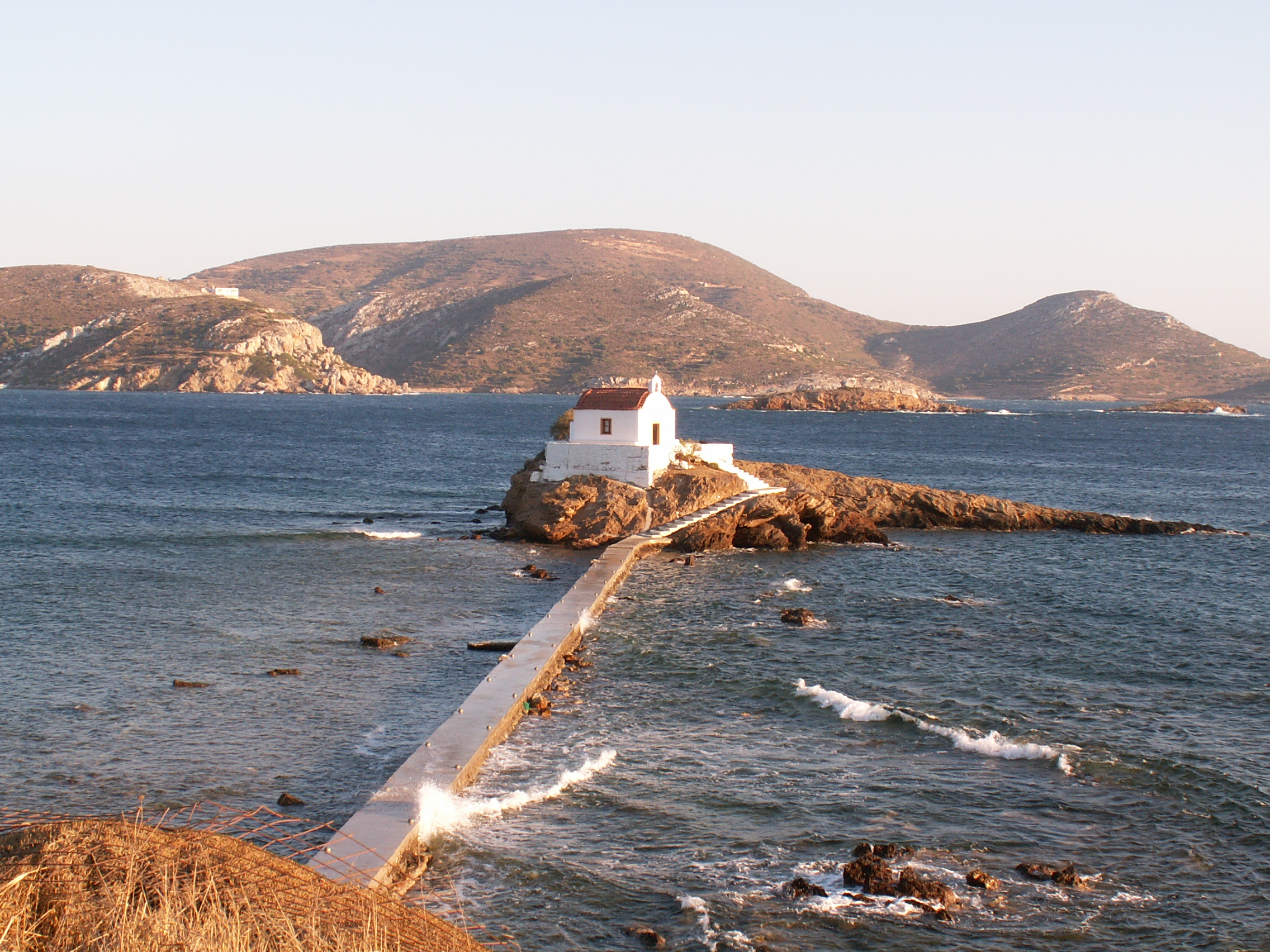
No visit to Leros is complete without climbing to the Castle of Panteli. The fortifications are a palimpsest: Byzantine core walls from before 1087, Knights’ reinforcements from the 15th century, and the Church of Panagia (the Virgin Mary) built after 1669 on the foundations of an earlier Byzantine chapel. Inside, a carved wooden iconostasis from 1745 and 16th-century icons lend the space a gravity that the views outside — sweeping across multiple bays and out to the coast of Turkey — only amplify. Allow ninety minutes for the climb, the exploration and the slow descent, preferably in the late afternoon when the light turns the stone walls gold. On the way back, detour to the chapel of Agios Isidoros, built on a reef in the sea and connected to the shore by a narrow causeway — one of the most photographed spots in the Dodecanese, and one that earns every photograph taken of it.
Beaches Worth Seeking Out on Leros
Leros will never compete with Milos or the big Cycladic names for headline beaches. What it offers instead is variety at a small scale: because the island is so deeply indented with bays, you can drive or walk for fifteen minutes in any direction and find a different coast with a different character. The water is consistently excellent — deep, clean and that particular shade of Aegean blue that verges on implausible.
Dio Liskaria is the beach that ends up on postcards. A sheltered cove on the north-eastern coast with fine pebbles, deep water and a beach bar that manages to be both lively and relaxed, it draws a younger crowd who treat it as the island’s unofficial social headquarters. Get there before ten in the morning and you may have it to yourself; after noon, the tourist boats arrive and the vibe shifts.
Gourna, on the western side, is the opposite: a wide sandy bay sheltered from the prevailing winds, shallow enough for children, with a single taverna under the trees that serves lunch at a pace that suggests the kitchen does not entirely believe in the concept of time. This is where island families come on Sundays.
Xirokambos, in the south, offers the best combination of sand, shallow water and infrastructure. A diving centre operates from here, and the tiny church of Panagia Kavouradaina — with its icon of the Virgin Mary framed, for reasons nobody can quite explain, by the claws of a crab — sits on the rocks nearby. It is exactly the kind of thing that makes you realise Greek islands are stranger than any guidebook admits.
Blefouti and Kryfos are for those willing to earn their swim. Both require either a walk or a boat, both reward the effort with water so clear it dissolves the boundary between air and sea, and both are virtually deserted outside the absolute peak of August. If solitude is what you came for, these deliver.
“The island has the second-most World War II shipwrecks in Europe after Normandy. The 8,000 locals don’t depend on tourism — Leros runs on hospitals, schools and a working port.”
Eating Your Way Through Leros
Leros is a fishing island first, and the kitchen follows the sea. Grilled octopus — hung to dry in the sun outside every harbourfront taverna, then charred over coals — is the default accompaniment to an afternoon ouzo, and here it is done with an absence of fuss that more tourist-heavy islands have forgotten. Marinated fish with rosemary, saganaki mussels, and sea urchins spooned straight from the shell are standard fare in the waterfront tavernas of Panteli and Agia Marina.
The island’s own specialities are less obvious but worth hunting for. Leros cheese pie resembles a quiche, filled with local myzithra cheese, eggs and a sesame glaze — substantial enough for breakfast, light enough for a mid-afternoon snack. Lemony goat and cabbage dumplings appear on menus in the inland villages, particularly in the cooler months. For sweets, look for pougia (parcels filled with bitter almonds), svingoi (fried dough soaked in local thyme honey, similar to loukoumades but somehow better), and patsavouropita, a layered pie of crust leaves and yoghurt that is specific to Leros and impossible to replicate elsewhere because nobody can agree on the exact recipe.
Then there is gavafa, a citrus fruit unique to Leros — somewhere between an orange and a grapefruit, with a sweetness undercut by a hint of bitterness that locals turn into preserves, drinks and a general source of pride. And sumada, a refreshing drink made from bitter almonds that appears at every wedding and feast on the island. If someone offers you a glass, do not refuse.
Mylos by the Sea
Any discussion of food on Leros eventually arrives at Mylos by the Sea, the restaurant run by brothers George and Marios Koutsounaris beside a traditional windmill on Agia Marina’s waterfront. What started as the family’s modest taverna in 2000 has become one of the most respected seafood restaurants in Greece, with a wine list of over 200 labels that would be impressive in Athens and is frankly astonishing on a Dodecanese island of 8,000 people. The kitchen puts a contemporary edge on local catch — octopus carpaccio, parrot fish ceviche, dry-aged fish — without losing the fundamental honesty that comes from cooking whatever the boats brought in that morning. Booking ahead in July and August is non-negotiable. For more on island dining as a reason to travel, our Serifos guide explores a similarly food-driven Cycladic island.
Diving the Wrecks of Leros
The seabed around Leros is an underwater museum. The island’s wartime history left it ringed with shipwrecks — the Vasilissa Olga, the British destroyer HMS Intrepid, German landing craft, Italian supply ships and assorted smaller vessels. Combined with natural reefs, underwater caves and the small islets that dot the surrounding waters, this makes Leros one of the most significant dive destinations in the eastern Mediterranean.
The Hydrovius diving school in Xirokambos runs courses and guided dives for all experience levels, including wreck-specific dives for certified divers. Visibility is typically excellent from June through October, and the water temperature sits comfortably between 22 and 26 degrees Celsius through the summer months. Even non-divers can appreciate the underwater life with a mask and snorkel — the rocky coves on the south and west coasts harbour enough marine life to justify getting your face wet.
Summer Festivals and Events
If you visit Leros in mid-July, you will arrive in time for the Feast of Agia Marina on 17 July, a two-day celebration honouring the patron saint of the capital, Platanos. A week later, on 25 July, the Alonaris festival takes place on Gourna beach — a re-enactment of traditional threshing, with free local food, live music and dancing that lasts well into the night. It is one of those events that sounds slightly contrived in description and turns out, in practice, to be entirely genuine.
August brings the Wine Festival in Xirokambos during the first fortnight — local wines, traditional dances and the kind of convivial atmosphere that makes strangers into friends by the third glass. The Alindia festival, also in August, includes swimming, diving and sailing races in the bay of Alinda. And on 15 August, the Feast of the Assumption of the Virgin at the Church of Panagia tou Kastrou in Platanos draws pilgrims from across the Dodecanese. If you are considering visiting Greece in September, you will catch the tail end of the summer energy while avoiding the August crowds.
How to Get to Leros
Leros has a small airport (code: LRS) near the village of Partheni in the north, served by domestic flights from Athens. The flight takes roughly 50 minutes and operates on small aircraft — the landing strip is short and the planes are compact, which lends the arrival a certain character. From the airport, a taxi to Platanos or Panteli takes 15 to 25 minutes.
The more common approach is by ferry from Piraeus. Blue Star Ferries runs the route approximately four times a week, with the crossing taking 8 to 10 hours — most departures are overnight, which means you board in the evening, sleep in a cabin or on a reclining seat, and wake up in the Dodecanese. Quicker connections are available via Kos or Kalymnos using the Dodekanisos Seaways catamaran, which covers the Kos–Leros run in as little as 55 minutes. SeaJets also operates high-speed services during the summer. There is even a daily ferry to Turgutreis in Turkey, departing Leros in the late afternoon.
Leros is naturally paired with its Dodecanese neighbours for island-hopping. Patmos lies to the north (the catamaran covers the distance in under an hour), Kalymnos to the south, and Lipsi — a tiny, dreamy island — is a short boat trip away. For anyone planning a wider Greek island itinerary, Leros fits elegantly into a Dodecanese route that might include Karpathos further south or a detour to Kos for its international airport.
Getting Around and Practical Tips
Leros is small enough that no point on the island is more than about twenty minutes by car from any other. A rental car or scooter is the most practical way to explore, particularly for reaching the quieter beaches on the south and west coasts. Two local bus lines connect Platanos with Lakki, Xirokambos, Alinda, Kamara and Partheni, but service is infrequent enough that relying on buses alone will test your patience.
Taxis exist but are limited in number. Most hotels offer a minibus transfer from the port or airport — call ahead to arrange it. The island is also increasingly popular with cyclists, and several marked routes cover the main sights and beaches. Hiking paths connect the villages, with the trail from Merikia to the lighthouse via Katsouni ranking as one of the most scenic walks in the Dodecanese.
For something different, take a boat trip to the islet of Archangelos, just off the northern coast at Partheni. Home to wild goats and a single taverna called Stigma Archangelos, it is the kind of place where you swim, eat lunch, and then phone the taverna to arrange your pickup. The absence of any other plan is the whole point.
The Caserma of Herbs, a converted Italian building, offers tours of its herb garden and honey-making operation. The Chatzidaki vineyard pours local wines over lunch. And The Monk, a guesthouse on the hillside above Agia Marina, has become a minor landmark in its own right — its cobalt-blue facade a deliberate nod to the fact that Greek island houses were not always painted white. “That’s only something that became common midway through the 20th century,” the owner explains. “Houses used to be very colourful.” On Leros, even the paint has a story.
Leros at a Glance
| Detail | Information |
|---|---|
| Location | Dodecanese, south-eastern Aegean Sea (between Patmos and Kalymnos) |
| Area | 54 km² (coastline: 71 km) |
| Population | Approximately 8,000 |
| Capital | Platanos |
| Main port | Lakki (conventional ferries); Agia Marina (catamarans) |
| Airport | Leros Municipal Airport (LRS) — domestic flights from Athens (~50 min) |
| Ferry from Piraeus | ~8–10 hours, approximately 4 sailings per week (Blue Star Ferries) |
| Ferry from Kos | 55 min to 2h 45min depending on operator |
| Best for | History and architecture, diving, quiet beaches, food, off-the-beaten-path travel |
| Best months | June to September (July and August warmest; September quieter) |
Is Leros Right for You?
Leros is not the island for a first-time visitor to Greece who wants the Santorini caldera or the Mykonos club scene. It is the island for a second or third trip, when you have done the greatest hits and want something that surprises you — somewhere that does not appear on the first page of every “best Greek islands” list but probably should. It is the island for people who enjoy Hydra‘s refusal to play by the rules but want more beaches and fewer day-trippers, or who loved the Dodecanese character of Karpathos but want easier ferry connections and a more varied landscape.
If you are drawn to places where history has left visible marks — not ruins behind velvet ropes, but crumbling Art Deco cinemas and wartime tunnels and abandoned radio stations full of goats — Leros will hold your attention for longer than you planned. Pack a mask and snorkel, bring a book for the ferry, and allow at least four nights. The island takes a day to understand and a week to appreciate.
The information in this article was researched and verified as of March 2026. Prices, transport options, schedules, and conditions may have changed since publication — we recommend double-checking key details before your trip.