Meteora 2026: Guide to Greece’s Sky Monasteries
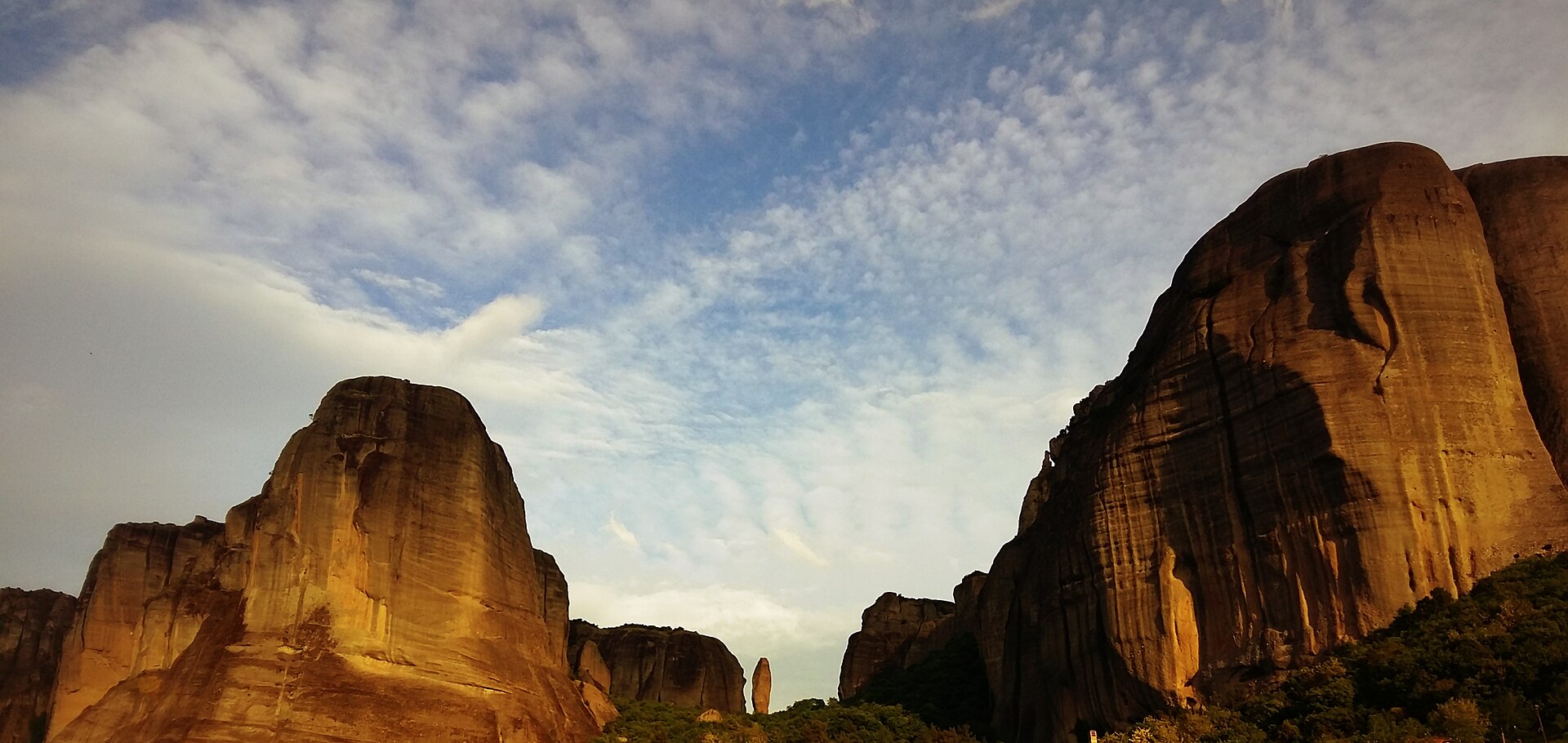
There is a stretch of land in western Thessaly where the earth seems to have lost its mind. Enormous columns of grey-brown sandstone — some wider than city blocks, others as narrow as church steeples — rise straight out of the plain without any geological courtesy, no foothills, no gradual slope. They just appear. And on top of six of them, Orthodox monks built monasteries by hand starting in the 14th century, hauling themselves, their tools, and their faith up sheer cliff faces in rope nets. The nets were how everything went up for centuries: timber, food, new monks, visiting bishops. When a visitor once asked a monk how often the ropes were replaced, the answer was supposedly “when the Lord lets them break.”
Today Meteora is a UNESCO World Heritage Site, one of the most photographed landscapes in Greece, and a place that draws over two million visitors a year. But none of that has managed to make it feel ordinary. You stand at the base of these pillars at dawn, before the tour buses roll in, and the scale of it still doesn’t compute. Your brain keeps trying to file it as something familiar — Arizona? A film set? — and keeps failing. There is nothing else quite like this in Europe.
“Meteora” comes from the Greek for “suspended in the air.” Stand at the foot of these pillars at sunrise, watching a monastery catch the first light while the valley below is still a sea of mist, and you stop wondering why the monks never wanted to come back down.
How These Rocks Got Here
The story starts roughly 60 million years ago, when the area that is now the Thessalian plain was the floor of a prehistoric sea — or more precisely, a long, narrow marine basin called the Meso-Hellenic Trench, which stretched from what is now Thessaly up into present-day Albania, flanked by the Pindos mountains to the west. Rivers flowing off those mountains dumped sand, gravel, and sediment into this basin for millions of years, building up layers of conglomerate rock — a dense mix of pebbles, sand, and natural cement — sometimes hundreds of metres thick.
When tectonic forces eventually pushed the seabed up and drained the water, what was left was a massive slab of this conglomerate sitting on softer bedrock. Then erosion went to work. Earthquakes cracked the slab. Rain, wind, and the Pineios river carved into those cracks over millennia, slowly isolating the harder rock into separate pillars while everything softer around them washed away. The result is what you see today: more than 1,500 individual rock formations spread across about seven square kilometres, some reaching over 400 metres above the valley floor. It looks like a forest made of stone — which is exactly what locals call it.
The geology alone would be worth the trip. The fact that monks then decided these pillars were the ideal place to build monasteries only adds to the strangeness.
A Short History of an Extraordinary Place
People have been drawn to these rocks for a very long time. The earliest hermits were probably settling into caves and crevices around the 9th century, though the documentation only gets solid from about the 11th century onward. These were hesychasts — monks practising a specific form of deep contemplation that involved controlled breathing, silence, and asceticism so severe that some would push away their ladders after climbing into a cave, preferring to die of starvation rather than break their solitude. They ate beans and drank water. Locals from the plain below would leave food at the base of the rocks as offerings.
In the 12th century, a monk named Nilos gathered some of these scattered hermits into a more organised community and established what might be called the first proto-monastery — the chapel of Doupiani, which still stands today at the base of one of the pillars. But the real transformation came in the second half of the 14th century, when a monk named Athanasios Koinovitis left Mount Athos and climbed the tallest accessible pillar — the platys lithos, “the broad rock” — and built a church on top. Local legend credits an eagle with carrying him up. Historians give the credit to ropes and extraordinary determination. Either way, the Great Meteoron was born.
The timing wasn’t an accident. Northern Greece was under increasing pressure from Ottoman Turkish raiders throughout the 14th century, and the fertile Thessalian plain was a prime target. The inaccessible rock pillars offered something rare: natural fortification that no army could easily storm. The Serbian ruler Simeon Uroš, who controlled Thessaly at the time, granted the monastery religious privileges and funding. His son, John Uroš, later retired as a monk to the Meteoron and died there in the early 1420s.
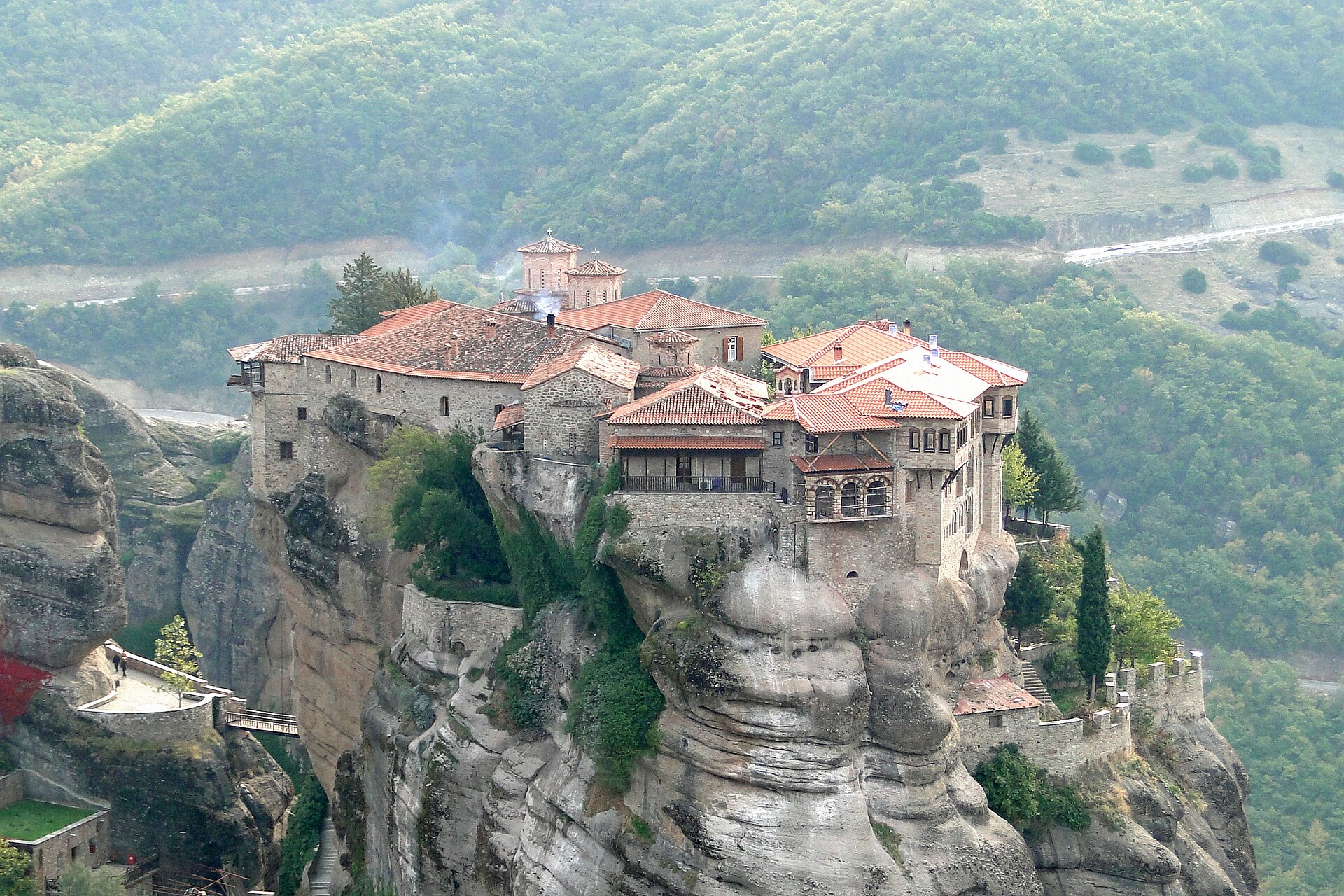
Between the 14th and 16th centuries, the community expanded rapidly. At its peak, Meteora counted 24 active monasteries. Monks accessed them by climbing removable ladders or being hauled up in rope-and-net baskets — a system that remained in use well into the 20th century. The winch mechanism at Varlaam monastery, with its original rope drum, is still on display and worth spending time with: it’s a visceral reminder of how much faith (and upper body strength) daily life here required.
Wars, neglect, and the sheer difficulty of maintaining buildings on top of rock pillars reduced the number over the centuries. By the time Greece gained independence in the 1820s, many were already ruins. Today six remain open and active, still home to roughly 50 nuns and 17 monks. The carved staircases that replaced the nets and baskets were only built in the 1920s.
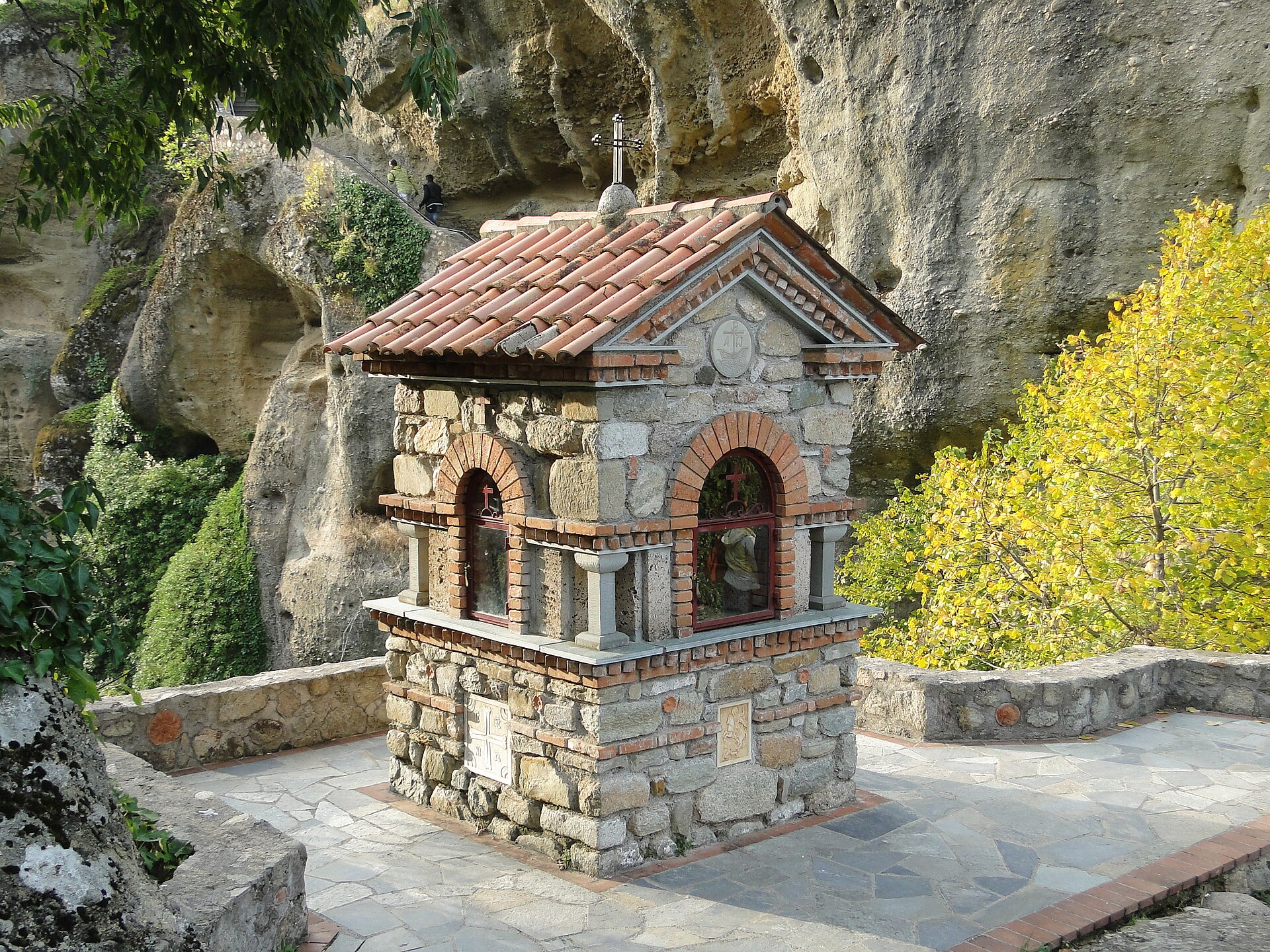
The Six Monasteries: What Makes Each One Worth Your Time
You will not visit all six in one day. You could, technically, if you started at first light and didn’t stop to look at anything properly, but that would miss the entire point. Three in a day is comfortable. Four is ambitious. The trick is knowing what sets each one apart so you can choose based on what matters to you — the frescoes, the views, the solitude, or the physical challenge of getting there.
Great Meteoron (Megalo Meteoro)
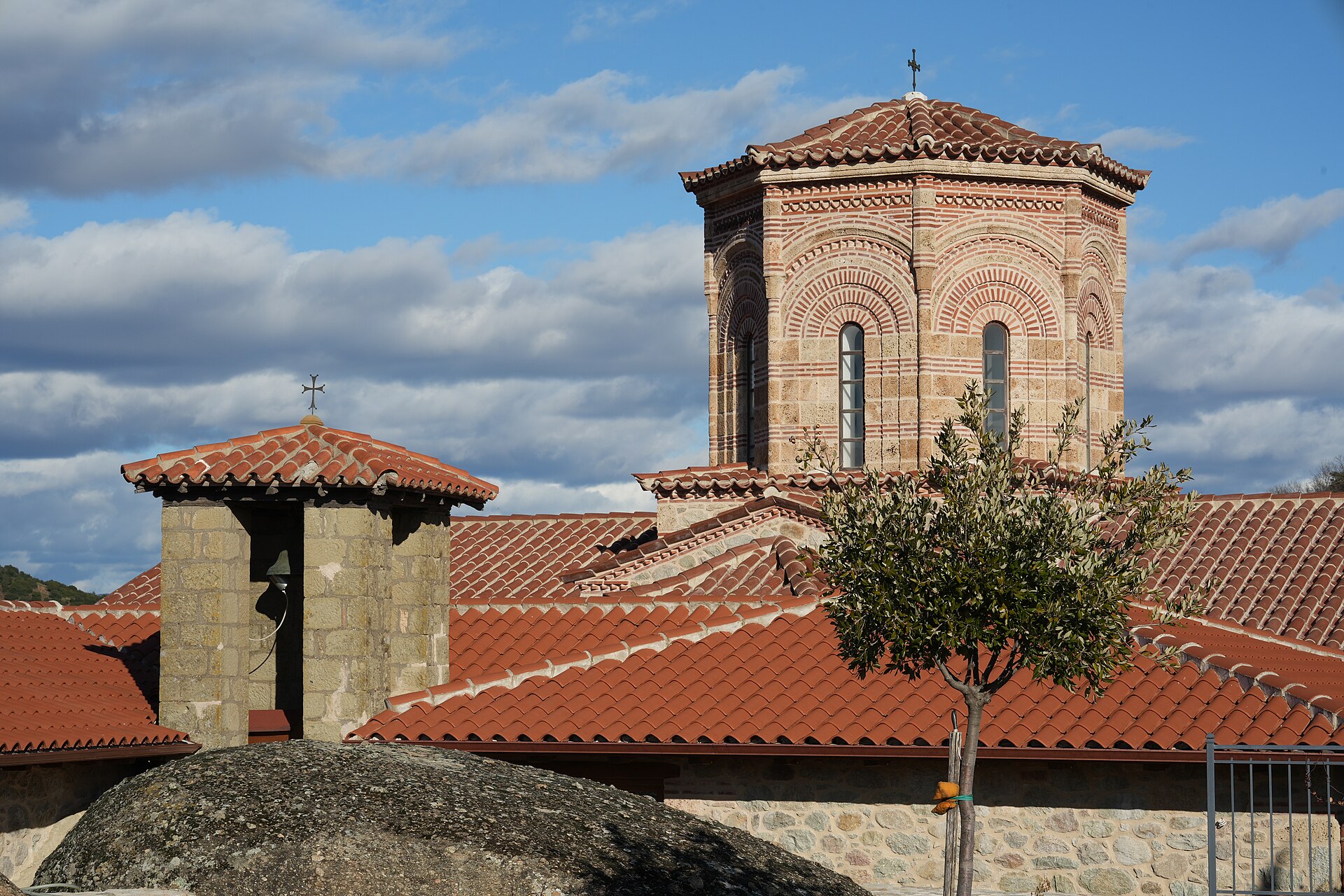
The oldest, largest, and highest of the six, sitting at about 613 metres above sea level. Founded by Athanasios in the mid-14th century and expanded by his successor Ioasaf (the retired Serbian prince John Uroš). The main church — the Katholikon of the Transfiguration — has 16th-century frescoes painted by the Cretan School master Theophanes Strelitzas. There’s also a museum with manuscripts and religious artefacts, and a bone crypt that tends to make visitors go very quiet. The climb is about 300 steps carved into rock, steep but well-maintained. This is the monastery most first-timers start with, which means the crowds concentrate here mid-morning.
Varlaam
Second in size, built in 1517, and famous for the original winch mechanism that was used to haul monks and supplies up the cliff face. The tower where the winch sits is preserved, rope drum and all, and seeing it up close communicates more about daily life in these monasteries than any exhibit. Varlaam also has excellent frescoes and a garden with views over the entire rock forest. The approach is moderate — easier than the Great Meteoron but still involves a decent set of stairs.
Holy Trinity (Agia Triada)
The most dramatic approach of any of the six: 140 steps cut into the sheer rock face, with the monastery appearing above you the whole time like something that should not architecturally exist. This is the one that appeared in the 1981 James Bond film For Your Eyes Only, and seeing it in person, you understand why they picked it. It has fewer visitors than the two big monasteries, which means you can sometimes stand in its courtyard in near-silence. A small but beautiful 17th-century chapel inside, and the views from the terrace across the valley are among the best in Meteora.
Saint Stephen (Agios Stefanos)
A convent of nuns and by far the most accessible of the six — almost no climbing required, with a short paved walkway to the entrance. This makes it the practical choice if mobility is a concern, if you’re travelling with small children, or if it’s simply 38°C and you can’t face another 300 stone steps. The original 14th-century structure was destroyed and rebuilt in the late 18th century. It has a large courtyard with gardens and a surprisingly good gift shop run by the nuns.
Rousanou (also called Saint Barbara’s)
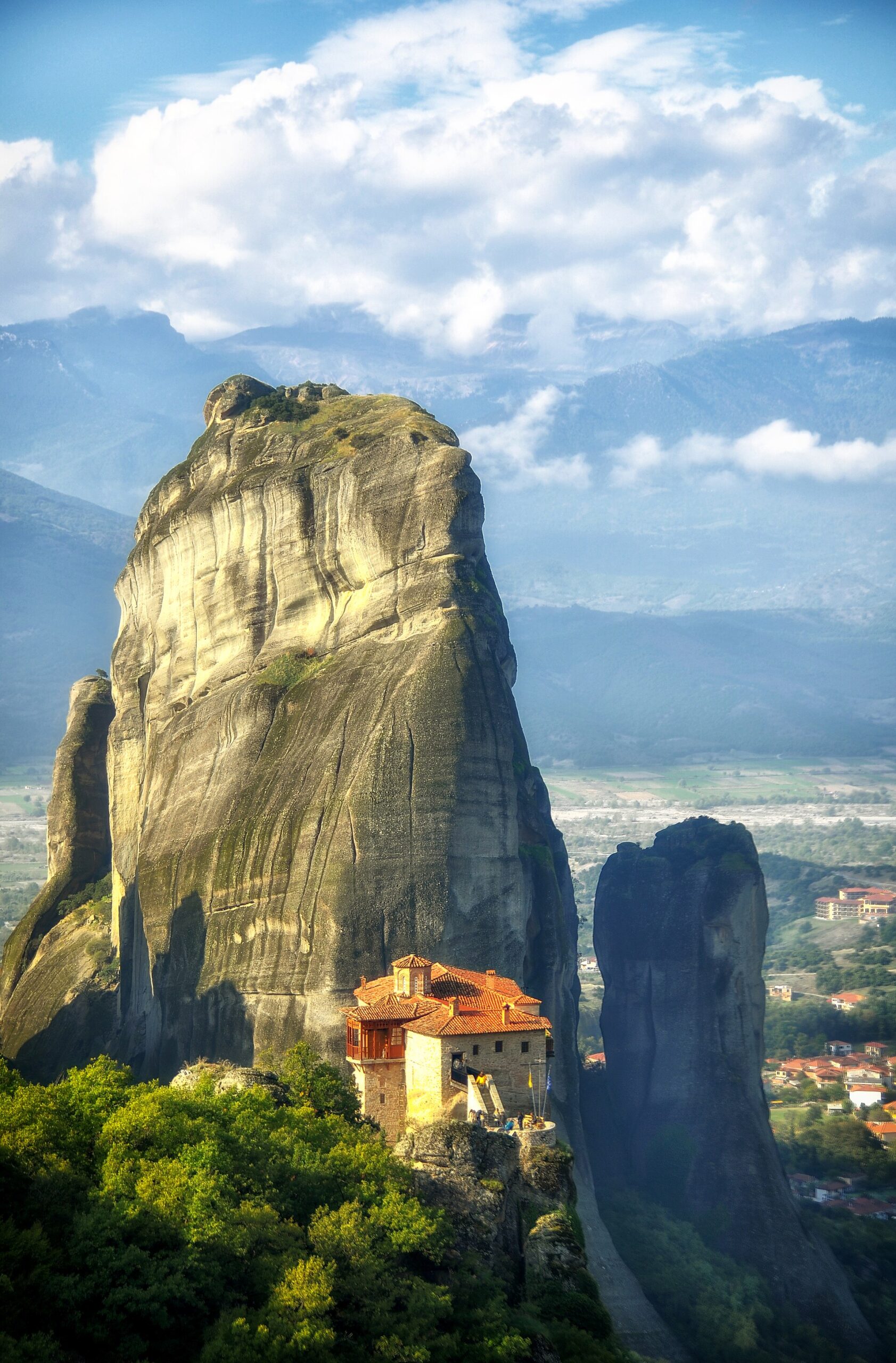
Perched on a slender, lower pillar, this is probably the most photographed silhouette in Meteora — the one you see on the postcards, the one that makes you stop the car. It’s a convent run by a small community of nuns. The monastery itself is compact but immaculately kept, with some fine 16th-century frescoes. What most people come for, though, is the viewpoint just above and behind it: widely considered the best sunset vantage point in the entire area. Get there early in the evening, bring water, and wait.
Saint Nicholas Anapafsas
The smallest of the six, compact and almost vertical — built across several narrow floors stacked up a narrow pillar. It holds frescoes by the Cretan painter Theophanis Strelitzas (the same artist who painted the Great Meteoron). This was traditionally the first monastery pilgrims reached on the old footpath from Kastraki, and it feels like an introduction: smaller, quieter, less crowded, with a charm that the bigger monasteries sometimes trade for grandeur.
What You Need to Know Before You Go
A few practicalities that will save you from the mistakes almost every first-time visitor makes.
Dress code: Strictly enforced at every monastery, without exception. Shoulders covered for everyone. Long trousers for men — shorts above the knee will get you turned away. For women, a long skirt below the knee is required; trousers are not accepted, even long ones. Most monasteries lend wraps or skirts for free at the entrance, but you’ll save yourself the queue and the slightly shapeless communal sarong by bringing your own scarf. Comfortable, closed shoes are not technically required but strongly recommended: the stone steps are worn smooth after centuries and get slippery in wet weather.
Entrance fee: Each monastery charges a small fee per adult, paid in cash at the gate. Cards are not reliably accepted — some of the larger monasteries occasionally have card readers, but don’t count on it. Bring small bills. Children under 12 are typically free.
Opening days: Each monastery closes on a different day of the week for rest and worship, and these days shift between summer and winter schedules. It is genuinely possible to drive up to your first choice, find the gate locked, and discover that your backup also happens to be closed that day. The lesson: check the current schedule before you commit to a route. The best source is the official Visit Meteora website, which maintains updated timetables. Or ask your hotel — they deal with this question daily and usually have a printed chart.
Crowds: Tour buses from Athens and Thessaloniki arrive mid-morning and leave by mid-afternoon. If you’re staying in Kalambaka or Kastraki (which you should), the early hours before 10am and the late afternoon after the buses leave are yours. The light is better then too.
Getting to Meteora in 2026
This is the one logistical detail that trips up more travellers than any other. The direct Athens–Kalambaka railway line has been out of service since the devastating floods caused by Storm Daniel in September 2023. As of mid-2026, restoration work on the damaged section is still ongoing, with the Athens–Thessaloniki main line itself facing a 20-day summer suspension for accelerated repairs. The bottom line: do not plan your trip around the train unless you have checked hellenictrain.gr within a few days of departure and confirmed the service is actually running.
What works reliably right now:
- Driving: About 350 km from Athens, roughly 3.5–4 hours on good motorway most of the way. From Thessaloniki it’s shorter — around 230 km, about 2.5–3 hours via the Egnatia Odos. This is the most flexible option and the one we’d recommend if you’re comfortable driving in Greece. Parking is available at each monastery, though it fills up by late morning in peak season.
- KTEL bus: Public buses from Athens to Kalambaka via Trikala, roughly 5–6 hours with one transfer. Affordable (around €30 one-way as a rough guide) and reliable, though not fast. From Thessaloniki it’s about 3 hours by bus.
- Organised tours: Day trips from Athens leave early morning and handle all logistics. Overnight options exist too. This removes every transfer headache but constrains your schedule — you’ll visit whatever the tour includes, on their timeline, which usually means arriving at monasteries alongside every other tour group.
Whichever way you get there, plan to stay at least two nights. A day trip from Athens is technically possible but leaves you exhausted, rushed, and without a sunset or a sunrise — which are two of the three best things about Meteora (the third being the quiet after the day-trippers leave).
Come for the monasteries. Stay for the moment just after the last tour bus pulls out of the parking lot and the rock forest goes quiet again — just you, the swifts circling the pillars, and six hundred years of candlelight.
Where to Stay: Kalambaka or Kastraki?
Both towns sit right beneath the rocks, five to ten minutes from the monastery road by car, and either one works perfectly as a base. The choice comes down to temperament.
Kalambaka is the bigger town — more hotels across a wider price range, more restaurants, better transport connections, an ATM that’s easy to find at midnight. It’s where you’ll end up if you arrive by bus, and it has a pleasant if unremarkable centre with a few good tavernas. The old quarter near the Byzantine church of the Dormition of the Virgin is worth a walk.
Kastraki is smaller, quieter, and tucked directly against the base of the pillars in a way that makes you feel like you’re already inside Meteora before you’ve visited a single monastery. Several of the best short hiking trails start from its square. Hotels here tend to be smaller, more family-run, and often have balconies with views that would cost you three times the price anywhere on Santorini. If you want to wake up, open your shutters, and see a monastery on a rock pillar with your morning coffee, Kastraki is the answer.
Two nights is the sweet spot. It lets you catch both a sunrise and a sunset, visit monasteries at a human pace, and maybe fit in a hike. One night is possible but tight. Three nights is for people who like to draw, photograph, or simply sit.
Hiking Meteora: Beyond the Monasteries
You don’t need a car — or even a monastery ticket — to experience the best of Meteora. A network of old footpaths connects Kastraki, Kalambaka, and the rock pillars, ranging from easy 30-minute strolls to half-day routes that take you deep into the “rock forest” where the only company is lizards and the occasional hawk.
A popular loop starts from the square in Kastraki, passes beneath the ruins of the abandoned Pantokrator monastery, cuts through mixed forest to the hidden Ypapanti chapel (built directly into a rock crevice and still guarded by a lone caretaker), and finishes at the Great Meteoron — about 7 km at an easy-to-moderate pace. It’s the hike that most closely follows the route the monks themselves used for centuries, and there’s something quietly powerful about walking it.
For something more ambitious, the trail to the Agio Pnevma pillar leads to a 9th-century hermit cave with views that most visitors never see because they never leave the road. The back trail up the Rock of the Great Saint offers one of the least crowded sunset viewpoints in the area — you’ll likely share it with nobody.
Meteora is also a serious rock climbing destination, which comes as a surprise to most visitors. The sandstone pillars outside the monastery-occupied rocks have hundreds of bolted sport climbing routes, ranging from easy single-pitch climbs to multi-pitch lines that take most of a day. The contrast is striking: monks praying inside a monastery on one pillar while a climber works up an overhang on the pillar next door, both of them 300 metres above the same plain. Several outfitters in Kalambaka and Kastraki offer guided climbing sessions for beginners.
When to Go
Spring (March through May) and autumn (September through November) are the sweet spots. Temperatures are comfortable for all the climbing you’ll do on monastery stairs, the light is warm and low for photographs, and the crowds thin out noticeably compared to the July–August peak. If you’re building a wider mainland itinerary around shoulder-season travel, our guide to visiting Greece in September covers this kind of timing in detail.
Summer works but comes with caveats: temperatures on the shadeless monastery steps can hit 38–40°C, the parking lots fill by 10am, and every viewing platform is a negotiation with selfie sticks. Start early, carry more water than you think you’ll need, and save the afternoon for a swim in one of the natural pools along the Pineios river — the locals will point you to the good ones if you ask.
Winter is a genuine surprise. Visitor numbers drop to almost nothing, mist settles below the pillars in the mornings (giving the monasteries the floating-in-the-sky effect the place was named for), and occasionally it snows, turning the entire landscape into something from a Byzantine manuscript illumination. Some hiking trails get muddy and a few monastery schedules tighten, but the core experience — standing in a courtyard 400 metres above a silent, frost-covered plain — is arguably Meteora at its most powerful.
Connecting Meteora to a Bigger Trip
Meteora works best as part of a mainland Greece road trip rather than a rushed day trip bolted onto an Athens-and-islands itinerary. The kind of traveller who’s drawn to monasteries on rock pillars is usually the same kind who’ll love what else the mainland has to offer — and there’s a lot that most visitors to Greece never see.
Heading northwest from Meteora, a few hours’ drive through the Pindos mountains brings you to Zagori and the Vikos Gorge — stone-built villages connected by Ottoman-era arched bridges, and a gorge that gives the Grand Canyon a run for its money in terms of depth-to-width ratio. The landscapes are entirely different from Meteora but the feeling is the same: ancient, unhurried, spectacularly vertical.
Going south, eventually you reach the Peloponnese. Our Peloponnese road trip guide strings together Nafplio, Monemvasia, Mystras, and the wild Mani peninsula into a route that pairs naturally with a mainland trip — two weeks, no ferries, and a Greece that most tourists have no idea exists.
The key insight is that mainland Greece isn’t the “boring part you drive through to get to the islands.” It’s where the history is thickest, the landscapes most dramatic, and the tavernas cheapest. Meteora is usually the place that makes people realise this.
Practical Checklist
- Cash: Bring small bills. Entrance fees, many tavernas in Kastraki, and the occasional parking lot are cash-only.
- Clothing: A scarf or sarong solves the dress code at every monastery. Pack one even if you think your outfit is modest enough — the guards have opinions.
- Timing: Start early. Before 10am you’ll have the monasteries largely to yourself, the light will be better, and you’ll find parking without circling.
- Footwear: Proper walking shoes. The stone steps are centuries old, worn smooth, and treacherous when wet.
- Water: Carry more than you think you need, especially in summer. There are no reliably stocked kiosks between monasteries.
- Schedule check: Confirm opening days before you set out — each monastery closes on a different day and the pattern shifts seasonally. Ask your hotel or check the Visit Meteora website.
- Two nights minimum: One night means you miss either the sunrise or the sunset. Don’t do that to yourself.
The information in this article was researched and verified as of July 2026. Prices, transport options, schedules, and conditions may have changed since publication — we recommend double-checking key details before your trip.