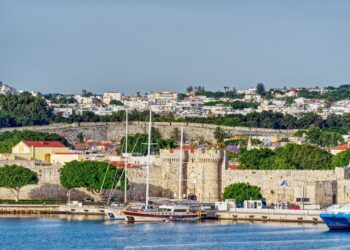
Why Rhodes Deserves More Than a Day Trip
Rhodes is one of the few Greek islands where you can walk through a UNESCO World Heritage medieval city in the morning, climb an ancient acropolis before lunch, and swim in a sheltered bay by afternoon. The largest of the Dodecanese islands, it sits closer to the Turkish coast than to Athens, and its layered history — Greek, Roman, Byzantine, Crusader, Ottoman, Italian — has left a physical record that is almost impossibly dense. This is not an island you absorb in a weekend.
Rhodes tends to attract two kinds of visitor: those who come for its beaches and resort infrastructure, and those drawn by its medieval and ancient heritage. The island rewards both, but its real strength is that it does not force you to choose. A rental car and five or six days open up a destination that moves fluidly between deep history and uncomplicated summer pleasure.
The Old Town alone — Europe’s largest inhabited medieval town — could occupy a serious visitor for two full days. Beyond the walls, the Acropolis of Lindos rivals Delphi for sheer dramatic impact. And then there are the beaches: Tsambika’s long golden sand, the pine-fringed cove of Anthony Quinn Bay, and Prasonisi at the island’s southern tip, where the Aegean meets the Mediterranean and windsurfers queue for the best launch spots.
This guide covers the places that genuinely matter, the ones you should skip, and the practical information that will save you from the most common planning mistakes visitors make on Rhodes.
Rhodes at a Glance
| Location | Dodecanese, southeastern Aegean — approximately 18 km from Turkey |
| Area | Approximately 1,400 km² — the largest Dodecanese island and fourth-largest in Greece |
| Population | Around 120,000 (Rhodes municipality) |
| Best for | History, beaches, families, couples, first-time Greece visitors |
| Best time to visit | May–June and September–October; July–August are hot and crowded |
| Getting there | International airport (RHO) with direct European flights; ferries from Piraeus (13–23 hours) and nearby Dodecanese islands |
| Minimum stay | 5 days; 7–10 days for serious exploration |
| Car needed? | Strongly recommended for anything beyond Rhodes Town and Lindos |
The Medieval Old Town: What to See and What to Skip
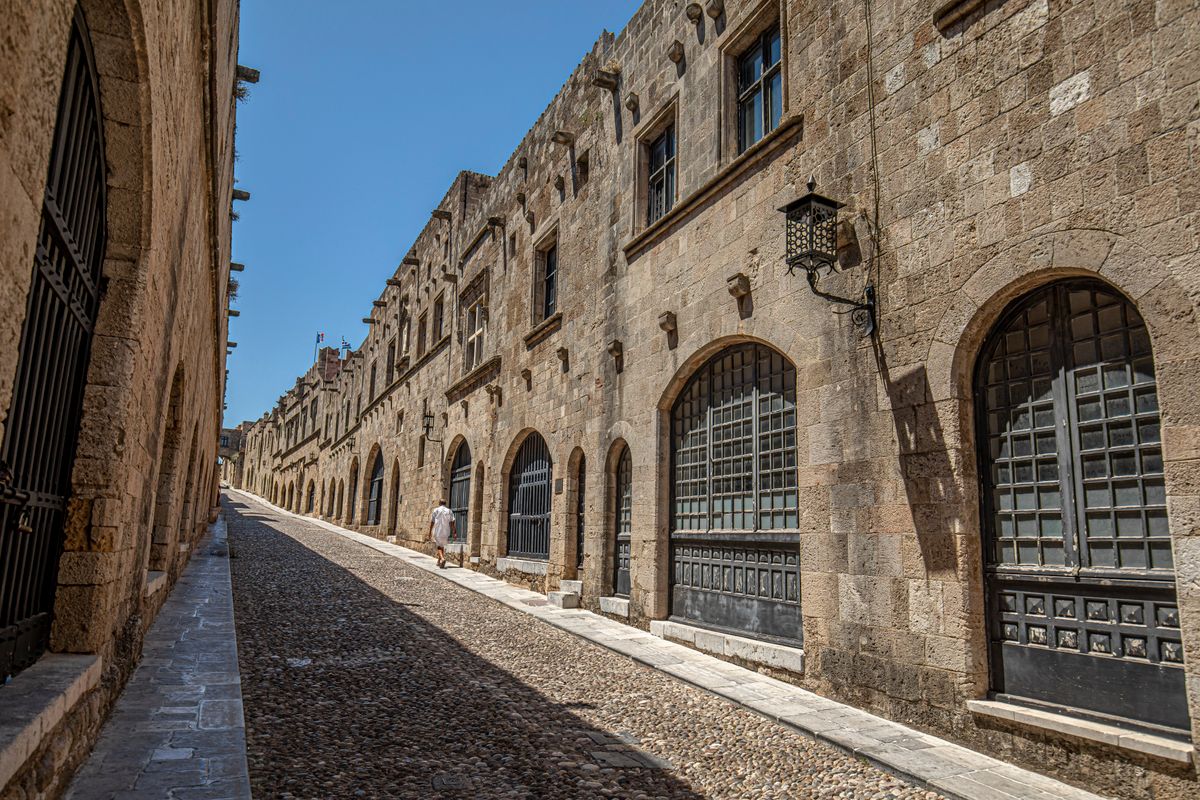
Photo: Erik Karits, Pexels
The medieval walled city of Rhodes was inscribed as a UNESCO World Heritage Site in 1988, and it earns the designation. The Knights of St John — the Hospitaller order that ruled Rhodes from 1309 to 1522 — built one of the most formidable fortress cities in the Mediterranean, and much of their work survives. Ottoman mosques, hammams, and fountains were layered on top during four centuries of Turkish rule, and Italian-era restoration in the 1930s added a further chapter to an already dense built environment.
The Street of the Knights (Odos Ippoton) is the spine of the Upper Town — a 200-metre cobblestone lane flanked by the inns of the various “tongues” (national divisions) of the Hospitaller order. It is one of the best-preserved medieval streets in Europe and genuinely atmospheric, though it fills with tour groups from mid-morning onward. Walking it at dawn or after the last coaches leave is a markedly different experience.
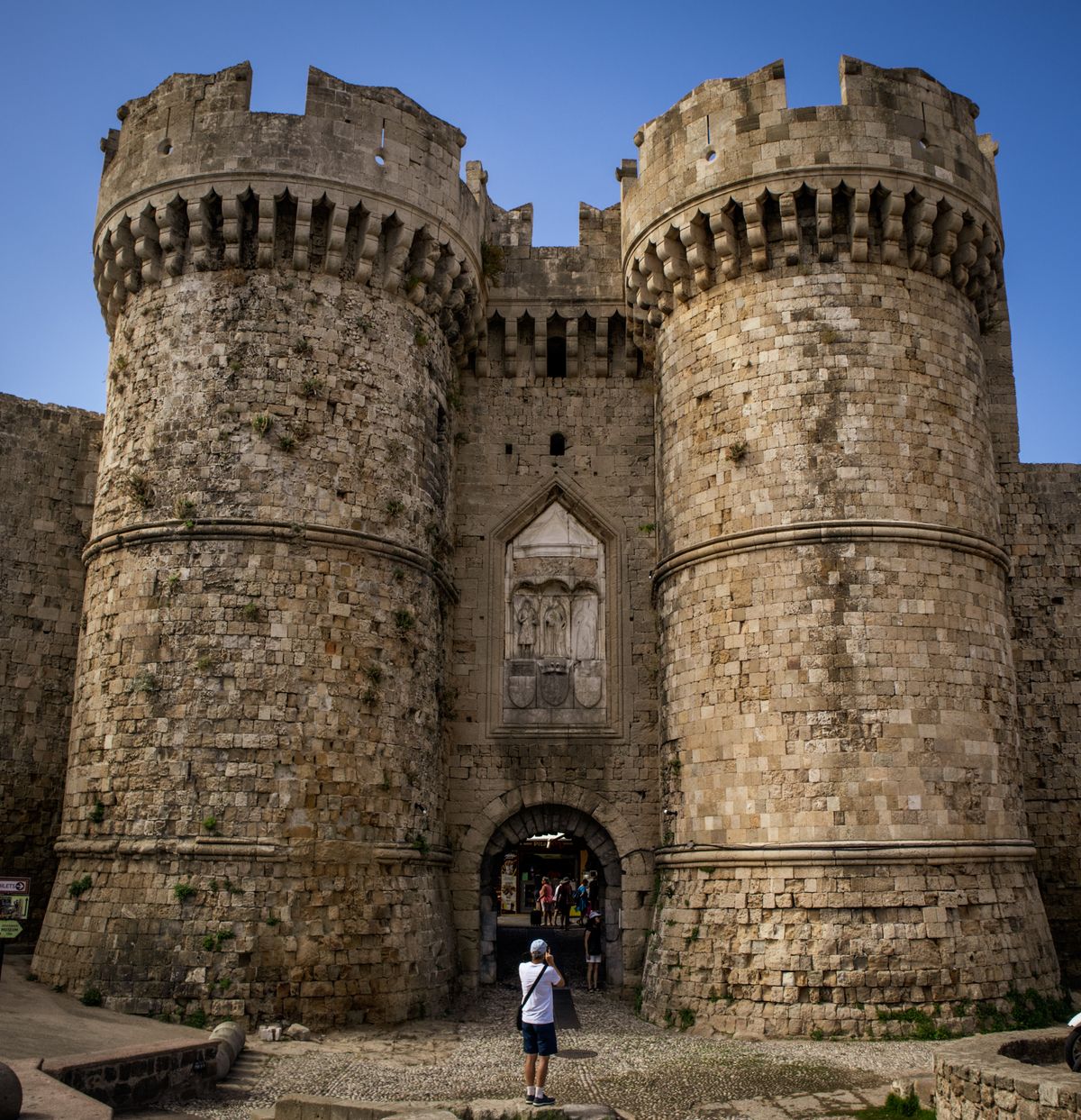
Photo: George Alex, Pexels
The Palace of the Grand Master crowns the top of the Street of the Knights. The original 14th-century structure was largely destroyed in an ammunition explosion in 1856, and what stands today is a 1930s Italian reconstruction — imposing and worth visiting, but not a genuine medieval interior. The ground floor houses two useful permanent exhibitions on the ancient and medieval history of Rhodes, and the first-floor halls display Hellenistic-period floor mosaics transported from Kos. Summer opening hours are typically 08:00–20:00, though these should be confirmed with the Greek Ministry of Culture before your visit.
The Archaeological Museum, housed in the 15th-century Great Hospital of the Knights, is the more rewarding cultural stop for most visitors. The building itself — a Gothic courtyard hospital with an arcaded ground floor — is arguably as interesting as many of the exhibits inside.
What you can safely skip: the commercialised sections around Sokratous Street, where aggressive souvenir vendors and tourist-menu restaurants dominate. The atmosphere improves substantially in the quieter southern and eastern sections of the Lower Town (the former Ottoman and Jewish quarters), where you will find residential lanes, cats, and far fewer tour groups. Walking the exterior of the medieval walls, a circuit of roughly four kilometres, gives a better sense of the fortification’s scale than any interior visit.
Lindos and Its Acropolis
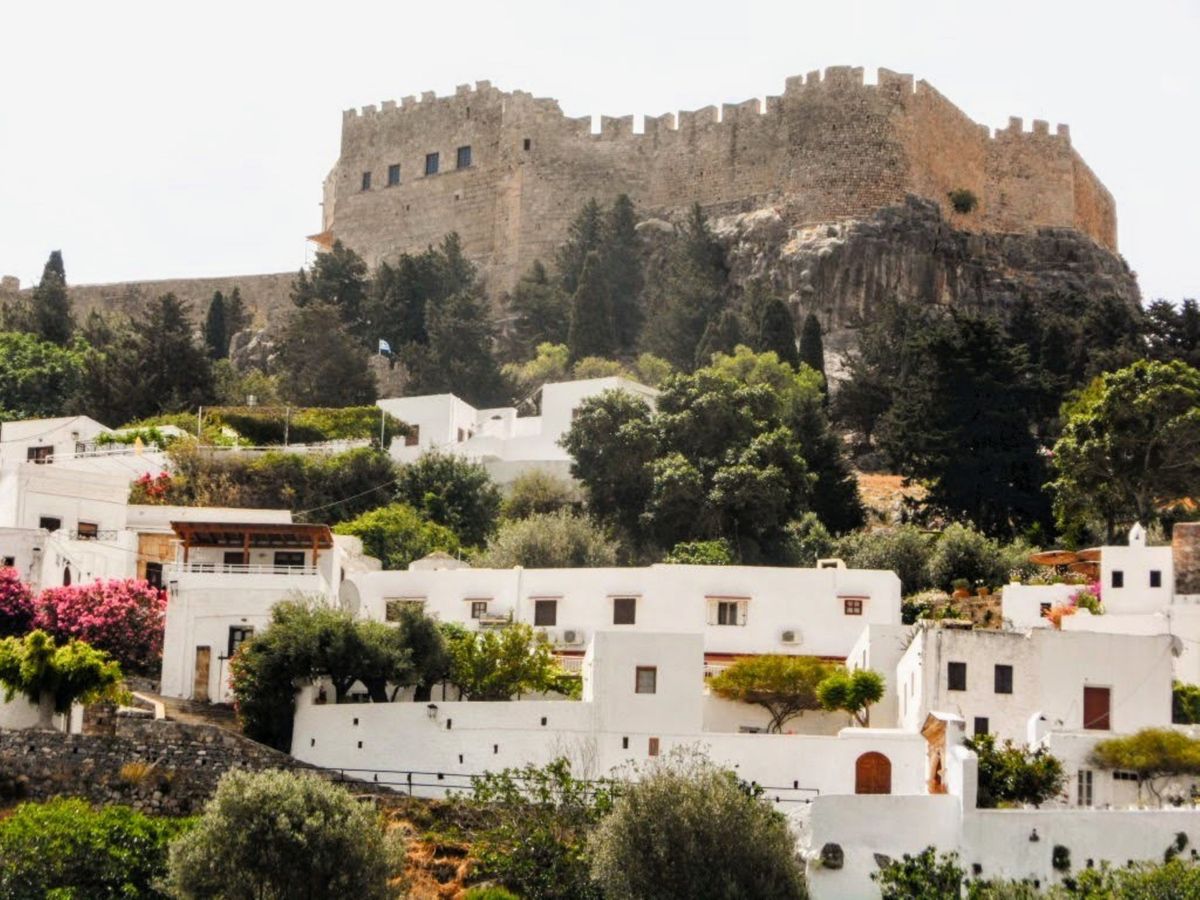
Photo: Pedro Vinicius Garrett, Pexels
Lindos sits approximately 50 kilometres south of Rhodes Town on the east coast, and it is the island’s second essential stop after the Old Town. The village itself — a cluster of whitewashed captain’s houses with ornamental stone doorways — occupies a natural amphitheatre beneath a dramatic rocky acropolis.
The Acropolis of Lindos is among the most visited archaeological sites in Greece. The citadel was fortified successively by the Greeks, Romans, Byzantines, and Knights of St John. At its summit are the remains of the Temple of Athena Lindia, a sanctuary whose origins may date to the 9th century BC and which took its final monumental form around 300 BC. The Hellenistic stoa, the monumental staircase, and the Propylaea survive in partially restored form, though much of the visible reconstruction dates to the Italian occupation period and should be understood as interpretive rather than original.
Practical considerations: the climb to the Acropolis involves a steep uphill walk of 15–20 minutes on uneven stone paths with minimal shade. In July and August, temperatures at midday can exceed 35°C on exposed rock. Arrive before 09:00 or after 16:00 to avoid both the worst heat and the largest tour-bus crowds. Comfortable shoes with good grip are essential — the polished stone can be slippery. There is no drinking water available on the Acropolis itself.
The village below is attractive but heavily commercialised during summer. Parking is limited and expensive, and the narrow access road creates significant traffic congestion in peak season. Travellers without a car can reach Lindos by public bus from Rhodes Town (approximately one hour, operated by KTEL Dodecanese) or by excursion boat.
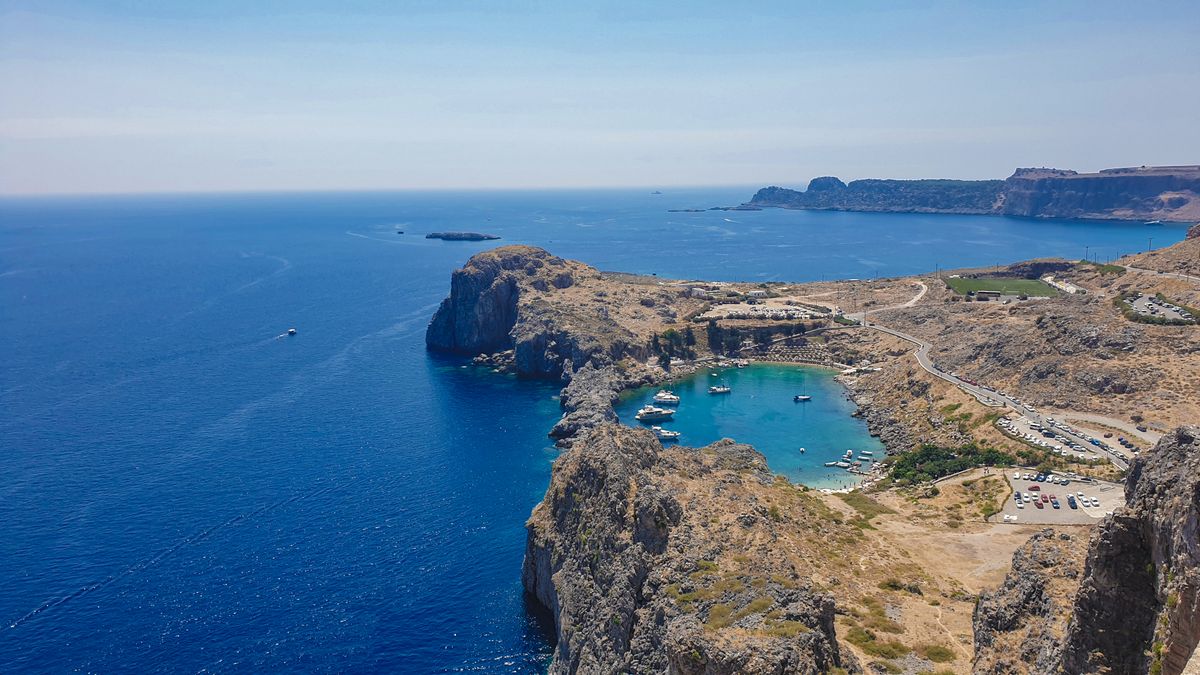
Photo: Daciana Cristina Visan, Pexels
St Paul’s Bay, a small sheltered cove directly below the southern side of the Acropolis, is one of the most photographed spots on Rhodes. According to tradition, the apostle Paul landed here during his journey through the Aegean. The bay is beautiful and swimmable, though small in area and extremely busy in high season. It works best as a brief stop combined with an Acropolis visit rather than as a full beach day.
Beaches: Where to Swim and What to Expect
Rhodes has more than 40 accessible beaches, and the quality and character vary considerably depending on the coast, the wind, and the time of year.
The fundamental distinction: the east coast is sheltered from the prevailing northwesterly winds (the meltemi) and offers calmer, warmer water — this is where most families and casual swimmers should base themselves. The west coast is windier, with rougher seas and stronger currents, making it better suited to windsurfers and kitesurfers. This is not a subtle difference; on a strong meltemi day, the west coast can be actively unpleasant for swimming while the east coast remains flat.
| Beach | Coast | Type | Best For | Notes |
|---|---|---|---|---|
| Tsambika | East | Long golden sand | Families, first-time visitors | Shallow water, sunbeds available, monastery views |
| Anthony Quinn Bay | East | Rocky cove | Snorkelling, couples | Very small, extremely crowded in summer; bring water shoes |
| Lindos (Megali Paralia) | East | Sandy | Combining beach with sightseeing | Below the Acropolis; busy but well-organised |
| Agathi | East | Sandy cove | Relaxed beach days | Quieter than Tsambika, golden sand, near Feraklos Castle |
| Elli Beach | East (town) | Pebble/sand | Quick swim from Rhodes Town | Walking distance from Old Town; decent for a town beach |
| Prasonisi | Southern tip | Double-sided sand spit | Windsurfing, kitesurfing | Aegean/Mediterranean meeting point; not ideal for swimming |
| Faliraki | East | Long sandy | Water sports, families wanting facilities | Developed resort area; lively but commercial |
| Glystra | East | Small sandy | Couples, quiet beach seekers | Pine-shaded, smaller crowds, south of Lindos |
A note on safety: even on the calmer east coast, conditions can change when wind direction shifts. Rhodes receives strong meltemi winds primarily in July and August, and west-facing beaches can develop significant surf. There are no lifeguards at most beaches outside peak season. Prasonisi, while visually dramatic, is a specialist water-sports location — the currents where the two seas meet can be unpredictable, and casual swimming is not advisable.
Mountain Villages and the Interior
Most visitors never leave the coast, which means the island’s mountainous interior is disproportionately quiet and, for those with a car, easily one of its most rewarding areas.
Embonas, the wine village of Rhodes, sits on the slopes of Mount Attavyros — the island’s highest peak at 1,215 metres. The village is the centre of Rhodian winemaking, a tradition stretching back over 2,400 years. Rhodes holds its own PDO wine designation, and the local varieties are worth knowing: Athiri, a fruity white with tropical and honey notes, and Mandilaria, a deep red with pomegranate character. Several small wineries in and around Embonas offer tastings, and the village is equally known for its grilled meats and the local spirit souma, a grape-pomace distillate similar to tsipouro but found almost exclusively here. The drive from Rhodes Town takes approximately 50 minutes through increasingly green mountain scenery.
Archangelos, one of the largest villages on the island, sits about 30 kilometres south of Rhodes Town and is known for its handcrafted pottery and a castle ruin overlooking the settlement. It retains a working, residential character that feels distinctly different from the resort coast.
Asklipio, further south, is built amphitheatrically and features a medieval castle and an 11th-century Byzantine church with remarkable frescoes — the Church of the Dormition of the Virgin, whose interior paintings rank among the finest on any Greek island.
The Valley of the Butterflies (Petaloudes), near the village of Theologos, is a wooded valley where Jersey tiger moths gather in large numbers during summer. The site is popular but ecologically fragile — the moths are sensitive to noise and disturbance. It works best as a morning visit during June to September, combined with a drive along the west coast.
Mandraki Harbour and the New Town
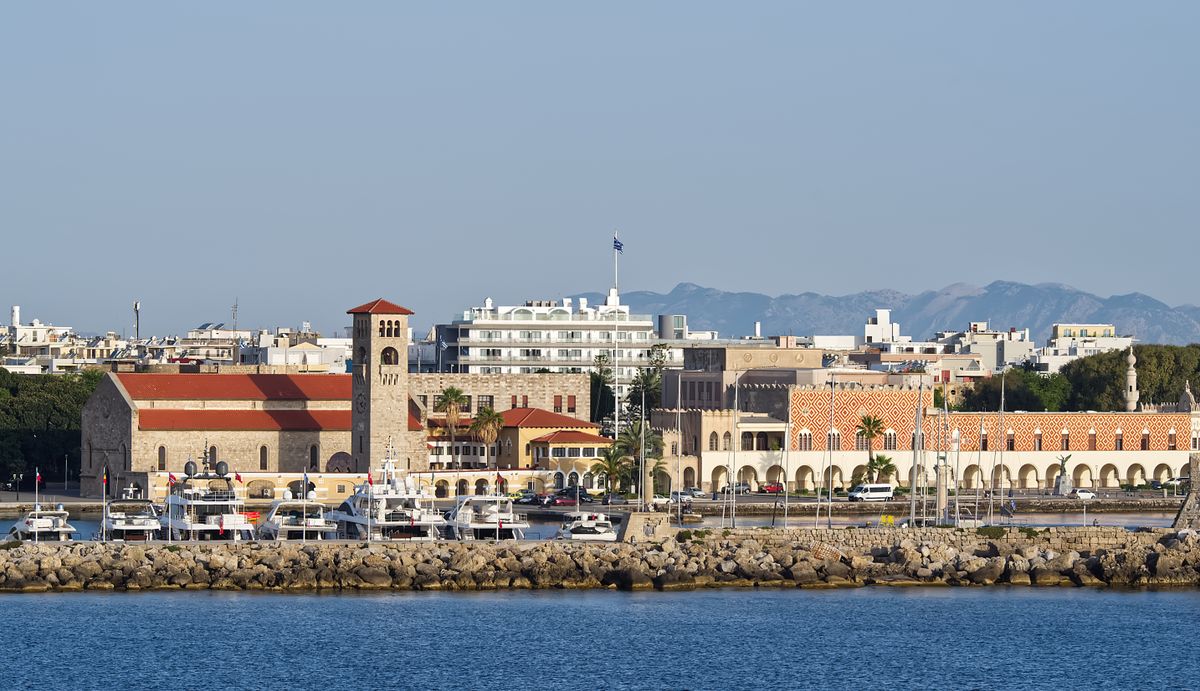
Photo: Mark Thomas, Pexels
Mandraki is the smaller of the two harbours flanking Rhodes Town, and it has been in continuous use since antiquity. The entrance is marked by two columns topped with bronze deer — the symbols of Rhodes — on the site where the Colossus of Rhodes, one of the Seven Wonders of the Ancient World, is traditionally believed to have stood. The 30-metre-high bronze statue of the sun god Helios was erected around 280 BC and toppled by an earthquake in approximately 226 BC; no trace of it survives, and its exact location remains uncertain.
The three medieval windmills along the harbour breakwater and the Fort of St Nicholas at its tip form one of the most recognisable views in the Dodecanese. The New Town, which developed outside the walls during the Italian period, is a functioning modern Greek city with markets, bakeries, and everyday commercial life that provides a useful counterpoint to the tourist infrastructure of the Old Town.
Day Trips from Rhodes
Rhodes functions well as a base for day trips to smaller Dodecanese islands, particularly Symi — a neoclassical harbour town roughly one hour by fast boat. Symi is one of the most photogenic ports in Greece, with pastel-coloured mansions rising steeply from the waterfront. Day-trip boats are frequent in summer, though many travellers find the island deserves at least an overnight stay.
Halki, a smaller and quieter island, is reachable by ferry from both Rhodes Town and Kamiros Skala on the west coast (approximately 45 minutes from the latter). It offers a more subdued pace and good swimming.
For those interested in crossing international borders, ferries and fast boats connect Rhodes to Marmaris (approximately one hour) and Fethiye in Turkey, with multiple weekly departures year-round. Check current entry requirements and schedules before planning a day crossing.
Rhodian Food: What to Eat
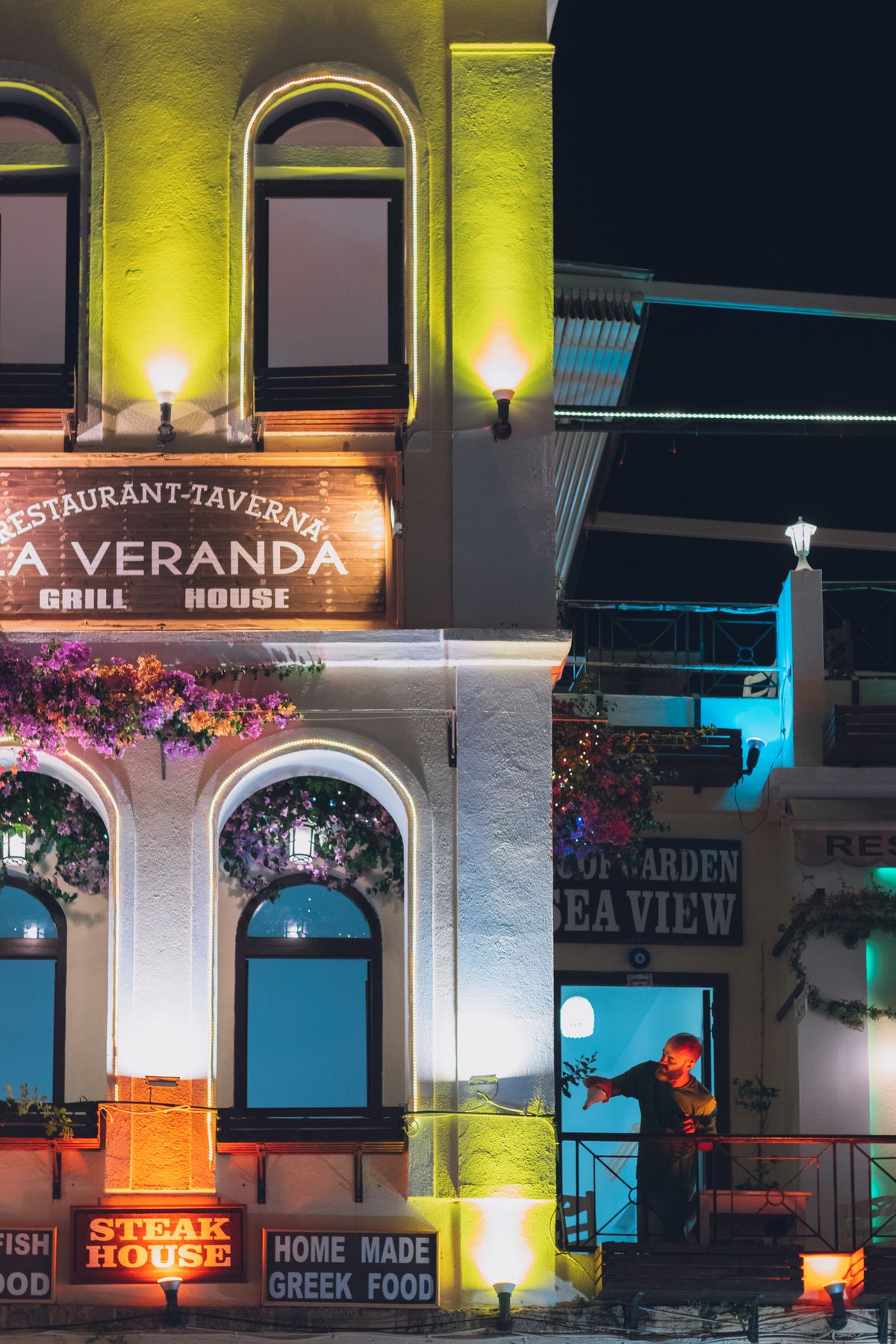
Photo: Márton Novák, Pexels
Rhodes has a culinary identity that goes beyond the standard Greek taverna menu, though you will have to look past the first row of tourist restaurants to find it.
Pitaroudia are the island’s signature appetiser: deep-fried chickpea fritters mixed with tomatoes, onions, parsley, and mint. They are crunchier and more herbal than falafel, and when made well — with fresh chickpeas rather than canned — they are one of the best bar snacks in the Aegean. You will find them on menus across the island, but quality varies considerably.
Melekouni is a traditional sesame-and-honey sweet that has roots in ancient Greek cookery. The Rhodian version uses roasted sesame seeds bound with local thyme honey and flavoured with cinnamon, clove, nutmeg, and orange peel. It is traditionally served at weddings and celebrations but is now available year-round at bakeries and traditional product shops. Each area of Rhodes has its own variant.
Lopada is a slow-cooked bean dish, often enriched with tomatoes and local herbs, that functions as Rhodes’s answer to the mainland bean soups. The island also has a strong tradition of trachanas — a fermented grain-and-milk preparation that is cooked into thick soups, sometimes with fish.
For wine, head inland. The Embonas area produces the best-known Rhodian wines (see the mountain villages section above), and several producers — including CAIR, Emery Winery, and smaller family operations like Kounaki and the Alexandris family — offer tastings that range from casual roadside stands to more structured cellar-door experiences.
Where to eat: the general rule on Rhodes, as on most large Greek islands, is to walk past the first line of waterfront restaurants and look for the places where tables are set up on quieter side streets or in village squares. The Old Town has better food in its southern and eastern sections. Outside Rhodes Town, the mountain villages — particularly Embonas and the villages along the road to Attavyros — tend to offer more honest cooking at lower prices.
Where to Base Yourself
Rhodes is large enough that your base matters. Each area suits a different kind of trip.
Rhodes Town (Old Town) is the best base for history, culture, and walkability. Staying inside the medieval walls puts you within walking distance of most major sites, the harbour, and Elli Beach. The trade-off is parking difficulty and tourist-area pricing for dining.
Rhodes Town (New Town) offers a more local feel, better supermarket access, and easier parking. It is within walking distance of both the Old Town and Mandraki Harbour.
Faliraki is the island’s main resort strip — long sandy beach, water sports, nightlife, and family-friendly facilities. It is well-connected by bus but lacks the character of other areas. It suits travellers who want a straightforward beach holiday with easy access to activities.
Lindos area (Pefkos, Lardos, Kiotari) offers calmer, smaller-scale accommodation on the southeast coast. This area works well for couples and families who want a quieter base with Lindos and several good beaches within short driving distance. Bear in mind that Lindos village itself becomes very congested in summer.
Kolymbia, between Faliraki and Lindos, is a newer resort area that strikes a middle ground — quieter than Faliraki but with enough facilities to avoid feeling isolated. It is well-positioned for reaching both Tsambika and Anthony Quinn Bay.
Getting to Rhodes
By air: Rhodes International Airport (RHO), also known as Diagoras Airport, receives direct flights from Athens year-round (approximately one hour, operated by Aegean Airlines, Sky Express, and others) and from dozens of European cities seasonally. As of 2026, approximately 48 airlines serve the airport with connections to over 100 destinations during the summer schedule. The airport is located on the island’s northwest coast, approximately 16 kilometres from Rhodes Town.
By ferry: Blue Star Ferries operates the main route from Piraeus to Rhodes, with one to two departures daily during high season. Journey time varies from approximately 13 hours (direct) to over 20 hours on routes that call at multiple islands. Rhodes is also connected by ferry to Kos (approximately two to four hours depending on the vessel), Patmos, Leros, Symi, Halki, Tilos, Kalymnos, Karpathos, and Heraklion (Crete). Dodekanisos Seaways operates faster catamaran services between the Dodecanese islands.
From Turkey: Regular ferry services connect Rhodes to Marmaris (approximately one hour) and Fethiye (approximately 25 minutes to two hours depending on the operator), running three to seven days per week year-round.
Getting Around the Island
Rental car: strongly recommended. Rhodes is roughly 80 kilometres from north to south, and many of the best villages, beaches, and viewpoints are inaccessible without your own transport. Roads are generally in good condition, though mountain roads to places like Embonas are narrow and winding. Parking in Rhodes Town and Lindos is the main challenge — arrive early or be prepared to walk.
Public buses: KTEL Dodecanese operates a reasonable bus network along the east coast, connecting Rhodes Town with Faliraki, Kolymbia, Archangelos, and Lindos. West-coast and inland services are more limited and less frequent. Bus timetables should be confirmed locally, as schedules vary between seasons.
Taxis: available in Rhodes Town and at most major destinations but not always easy to find in remote areas. Agree on the fare before departing, or ensure the meter is running.
Scooters and ATVs: widely available for rent but worth serious caution on the island’s busier roads. Rhodes has heavier traffic than most Greek islands, particularly on the coast road between Rhodes Town and Lindos.
Best Time to Visit
Rhodes enjoys more than 300 days of sunshine per year, one of the highest figures in Europe, and its season runs longer than most Greek islands.
May to June: the best overall period. The weather is warm (22–29°C), the sea is swimmable from late May, wildflowers are still present in the interior, and crowds have not yet peaked. Accommodation is significantly cheaper than in July–August.
July to August: peak season. Temperatures regularly exceed 30°C and can reach the mid-to-high 30s during heatwaves. Beaches and major sites are crowded, and accommodation prices are at their highest. The meltemi wind provides some relief, particularly on the west coast, but it also makes western beaches unsuitable for swimming on strong-wind days. Plan sightseeing for early morning or late afternoon.
September to October: an excellent shoulder season. The sea is at its warmest (often above 25°C in September), crowds thin noticeably after mid-September, and the light turns golden. October remains pleasant but some seasonal services begin to wind down.
November to April: Rhodes remains more active than most Greek islands in winter, with its Old Town functioning year-round and a resident population large enough to sustain everyday commercial life. However, many resort-area businesses, tour services, and smaller beaches close for the season. Winter is good for city exploration and hiking but not for beach holidays.
How Many Days Do You Need?
Three days is enough to see the Old Town properly and make a day trip to Lindos, but you will miss the beaches and the interior.
Five days is the realistic minimum for a satisfying visit. This allows two days for Rhodes Town (including the Old Town, the Archaeological Museum, and Mandraki), a day for Lindos and the southeast coast, a beach day, and a day for either the mountain villages or a boat trip.
Seven to ten days opens up the full island: the west coast, Prasonisi, the Valley of the Butterflies, a day trip to Symi, and time to return to favourite places without feeling rushed.
Common Mistakes to Avoid on Rhodes
- Underestimating the island’s size. Rhodes is not a small Cycladic island you can cross in thirty minutes. Give yourself enough time and ideally a car.
- Visiting Lindos Acropolis at midday in summer. The exposed rock becomes punishingly hot, shade is nonexistent, and tour-bus crowds peak between 10:00 and 14:00.
- Choosing a west-coast beach for a calm swim. If the meltemi is blowing, the west coast will be rough. Check wind conditions and default to the east coast for swimming.
- Eating on Sokratous Street. The Old Town’s most touristy commercial strip offers the worst value-for-money dining. Walk two streets in any direction for better food at lower prices.
- Expecting the Colossus of Rhodes. It no longer exists. What remains is a pair of deer statues and a good story.
- Skipping the interior. The mountain villages, particularly Embonas, offer a completely different side of Rhodes that most visitors never see.
Suggested Five-Day Itinerary
Day 1 — Rhodes Old Town. Arrive, settle into your accommodation. Spend the afternoon and evening exploring the Old Town: the Street of the Knights, the Palace of the Grand Master, and the Archaeological Museum. Walk the southern residential lanes and find a taverna away from the main tourist streets.
Day 2 — Lindos and the southeast coast. Drive or take the bus to Lindos early (arrive by 08:30 to beat the heat and crowds). Visit the Acropolis, walk through the village, and swim at St Paul’s Bay or Lindos Beach. On the return, stop at Tsambika Beach for the afternoon.
Day 3 — Beach day. Explore Anthony Quinn Bay in the morning (arrive early for parking), then move to Agathi or Glystra for a more relaxed afternoon. Alternatively, drive to Prasonisi if you are interested in windsurfing.
Day 4 — Mountain villages and wine. Drive to Embonas via the inland route. Stop for wine tastings and a grilled-meat lunch. Continue to the summit area of Mount Attavyros if conditions allow, or visit the Valley of the Butterflies on the return journey. Stop at Asklipio for the Byzantine frescoes if time permits.
Day 5 — Day trip to Symi or exploration. Take a morning boat to Symi, spend the day walking the harbour and upper town, and return in the late afternoon. Alternatively, use the day to revisit favourite spots or explore the west coast by car.
Links to Related Guides
For more Dodecanese coverage, see our guide to Leros and our Karpathos guide. If you are considering island-hopping from Rhodes, our family-friendly Greek islands guide covers the best options for different traveller types. For mainland alternatives with a similar depth of history, see our Monemvasia guide.
This article was researched and verified as of July 2026. Ferry schedules, opening hours, and admission fees may change seasonally — we recommend confirming time-sensitive details with official operators before travelling. Vivid Greece maintains editorial independence; no payment or sponsorship influenced this guide.